Part 1: The Cake
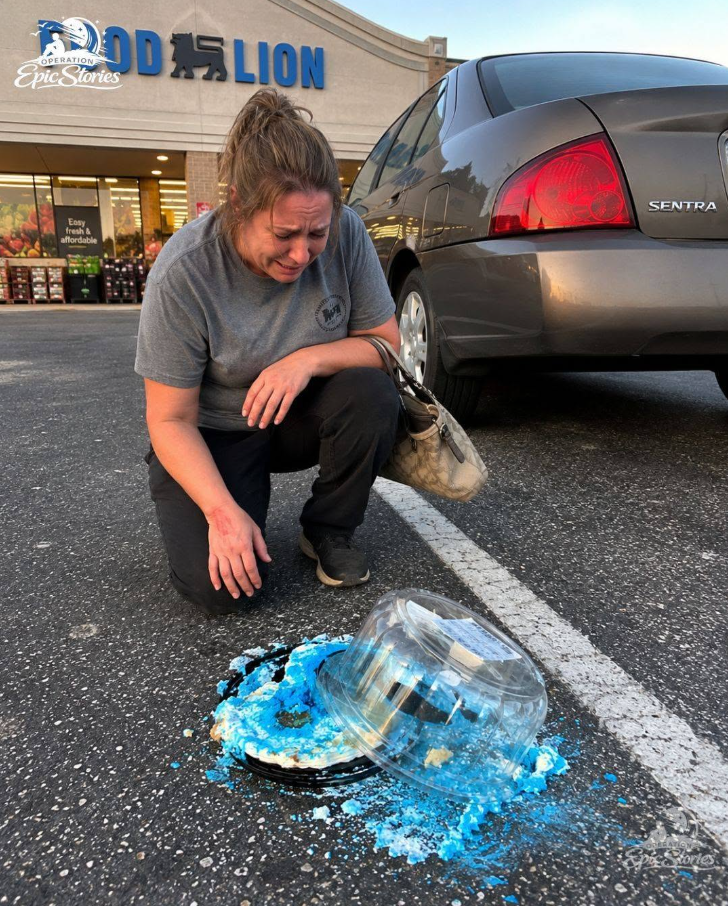
The cake hit the pavement upside down. For a few seconds, Shannon Avery just stood there staring at the clear plastic lid cracked against the asphalt, blue frosting smeared across the parking space like spilled paint. Then she covered her mouth with one hand. “Oh, no.” It was her son’s eighth birthday. And that cake had cost almost everything she had left.
Shannon was 38 then, raising her boy, Caleb, alone in a small South Carolina town where people still waved from pickup trucks and neighbors knew when somebody’s porch light had burned out. Six months earlier, the textile mill where Shannon had worked for nearly eleven years had closed. One Friday, she had a job. By Monday, she had a cardboard box filled with family photographs, a coffee mug, and a final paycheck that suddenly seemed much too small.
There was no time to fall apart. Caleb still needed breakfast. The electric bill still arrived. Shoes still wore out. So Shannon took whatever work she could find. Mornings, she cleaned rooms at a roadside motel. Evenings, she washed dishes at a family restaurant. On weekends, she sometimes helped an elderly neighbor with laundry for a little extra cash. She became very good at saying, “I’m just tired,” when Caleb noticed her red eyes. And Caleb became very good at pretending he believed her.
For weeks before his birthday, he talked about one thing. Not toys. Not a party. A cake. “Can it have blue frosting?” he asked one night while Shannon packed his lunch. “Blue?” “Really blue.” She smiled. “I think we can manage really blue.”
What Caleb didn’t know was that Shannon had been saving quarters and dollar bills in an old coffee tin above the refrigerator. She skipped lunch more than once. She put only ten dollars of gas in the car at a time. She repaired the sole of her work shoe with glue instead of buying another pair. By Caleb’s birthday, she had enough for a small cake, candles, and a frozen pizza. It wasn’t much. But to Shannon, it felt like victory.
That afternoon, she finished cleaning motel rooms, drove across town, bought the cake, and carried it carefully through the grocery store parking lot. She had been awake since 4:45 that morning. Halfway to her car, her foot caught on the uneven edge of a parking curb. Her knees buckled. The cake slipped. And everything she had worked so hard to protect landed upside down.
Shannon crouched beside it. She wasn’t crying because of frosting. She was crying because sometimes one ruined little thing is where all the bigger things finally come out. The lost job. The overdue bill. The ache in her back. The nights she lay awake wondering whether Caleb knew how scared she was. The humiliation of telling him, “Maybe next month.” The exhaustion of trying to make poverty invisible to a child.
Shannon wiped her face quickly. Then she did what mothers have done forever. She picked up the broken pieces and figured out what came next.
Part 2: The Woman
She walked back into the grocery store. At the bakery counter, she found another small blue cake. Same size. Same price. She carried it to the register and opened her purse. There were two crumpled dollar bills. Some quarters. Dimes. Nickels. A few pennies buried beneath old receipts.
The clerk, a woman around Shannon’s age named Denise, watched her count. “Give me one second,” Shannon whispered. She counted again. Still short. She started removing the candles. Then the frozen pizza. “I can put this back,” Shannon said.
Denise looked at the cake. Then at Shannon’s scraped palm. Then through the front windows toward the parking lot, where the ruined cake was still visible beside Shannon’s old sedan. “Birthday?” Denise asked softly. “My son.” “How old?” “Eight.”
Denise reached under the counter and pulled out her own wallet. Shannon immediately shook her head. “No. Please. You don’t have to do that.” “I know.” Denise handed a few bills to the cashier. “That’s why I want to.”
Shannon’s eyes filled again. “I can pay you Friday.” Denise smiled. “I didn’t ask for a loan.”
For years afterward, Shannon remembered that sentence. Not because of the money. Because of the dignity in it. Denise didn’t announce what she was doing. She didn’t make Shannon explain her life. She didn’t ask whether Shannon had made bad choices. She didn’t make her feel like a charity case. She simply slid the cake toward her and said, “Go make eight years old a good one.”
That night, Caleb never knew there had been another cake. He blew out eight candles while blue frosting stained the corners of his mouth. Shannon laughed when he gave himself a frosting mustache. They ate frozen pizza in the living room. He opened two small presents. Then he wrapped his arms around Shannon and said, “This was my best birthday.” She turned her face so he wouldn’t see her cry.
Part 3: The Return
Life slowly improved. Not quickly. Not magically. But slowly. Shannon found steadier work. She took night classes. Years passed. Caleb grew taller than she was, graduated high school, and eventually moved away for college. Shannon built the kind of life that once seemed impossible when she was counting nickels beside a birthday cake.
But she never forgot Denise. Or the parking lot. Or what it felt like to have another human being see her at one of the lowest moments of her life and refuse to let her feel small.
Nearly thirteen years later, Shannon walked into that same grocery store on a rainy Saturday afternoon. The place had been remodeled. Different floors. Different checkout lanes. Denise had retired years earlier. Shannon was buying groceries when she noticed a young woman at the register ahead of her. The woman had a little girl beside her, maybe six years old. In their cart sat a small birthday cake decorated with pink flowers.
The cashier ran the woman’s card. Declined. She tried again. Declined. The young mother’s face changed. Anyone who has ever been short on money knows that expression. The quick embarrassment. The nervous glance behind you. The silent calculation. “What can I put back?” She removed a carton of milk. Still not enough. Then cereal. Still not enough. Finally, her hand reached toward the birthday cake.
The little girl looked up. “Mom?” The woman forced a smile. “We’ll get one another day, baby.”
Shannon felt thirteen years disappear. She saw blue frosting on asphalt. She felt coins in her palm. She heard Denise saying, “I didn’t ask for a loan.” “Leave the cake,” Shannon said. The young mother turned around. “I’m sorry?” Shannon stepped forward and handed her card to the cashier. “I’ve got it.”
The woman’s face flushed. “No, ma’am. I couldn’t—” “Yes, you can.” Shannon smiled. “Someone once did this for me.” The woman stared at her. Then her eyes filled with tears. “I’ll pay you back.” Shannon almost laughed. Because now she finally understood. She shook her head. “I didn’t ask for a loan.”
The words came out exactly as Denise had spoken them all those years earlier. And for a moment, Shannon felt as though a kindness given in one grocery store parking lot had been traveling quietly through time, waiting for somewhere else to land.
The little girl hugged the cake against her chest. “Thank you,” she whispered. Shannon watched them leave beneath one umbrella. Then she stood there with tears running down her cheeks, smiling like someone had just handed something back to her.
That evening, Shannon called Caleb. She told him the whole story for the first time. The ruined cake. The coins. Denise. Everything. There was silence on the phone. Then Caleb said, “Mom… I never knew.” “I know.” “You made everything feel normal.” Shannon looked around her quiet kitchen. “That was the job.” Caleb’s voice cracked. “No, Mom. That was love.”
Sometimes we think kindness disappears the moment it is given. It doesn’t. A meal becomes a memory. A few dollars become dignity. A stranger’s compassion becomes something we carry until another tired person needs it. And maybe that is how ordinary people change the world—not with grand gestures, but by refusing to let somebody else feel alone in the exact place where they once stood.
Kindness never really ends. It simply waits for the next pair of hands willing to pass it on.
Shannon still thinks about Denise. She still thinks about that parking lot. And every time she sees someone struggling at a register, she steps forward. Not because she has extra money. Because she has extra memory. Because she knows exactly what it feels like to need help and receive it without shame.
That’s what Denise gave her. Not just a cake. But a way to see herself differently. Not as someone who failed. But as someone who was worthy of kindness.
She passes it on every chance she gets. Because that’s what kindness does. It keeps going.
And one day, when Shannon is gone, someone else will remember her. Someone else will stand in a checkout line and pay for a stranger’s birthday cake. Someone else will say, “I didn’t ask for a loan.” And the chain will keep going, one quiet act at a time.
That’s the legacy of a single moment of grace.
And it never, ever ends. ❤️