Part 1: The Party
“It smells like gasoline and dead fish.”
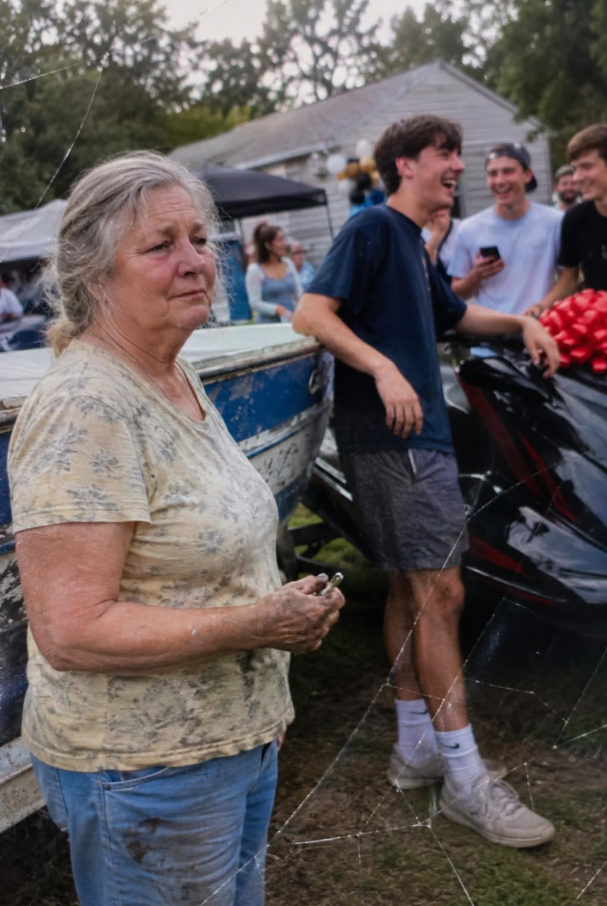
My seventeen-year-old grandson, Easton, said it loudly enough for everyone at his graduation party to hear. A few relatives laughed. I stood beside the little blue-and-white fishing boat I had spent five months restoring, holding the keys in my palm.
The boat had belonged to my husband, Roy. For thirty-two years, Roy and I took it onto the lakes of southern Ohio before sunrise. We drank coffee from the same dented thermos, argued over who forgot the bait, and came home smelling like lake water and sunscreen. Roy died six years ago. After that, the boat sat beneath a tarp behind my garage. I could not bring myself to touch it.
Then Easton mentioned that he wished he remembered more about his grandfather. He had been only eleven when Roy passed. That sentence stayed with me. So every weekend after finishing my morning route as a school bus driver, I worked on that boat. I replaced cracked wiring, scrubbed mildew from the seats, repaired the trailer lights, and painted the faded hull the same soft blue Roy had chosen in 1989. My hands cramped from arthritis. My back complained every night. But every time the old motor finally coughed and turned, I imagined Easton sitting beside me on the lake, asking questions about the grandfather who would have adored the young man he had become.
That was the gift. Not the boat. The memories waiting inside it.
But Easton barely looked at it. His attention was fixed on the shiny new jet ski parked near the mailbox. It had been bought by Hollis, my daughter’s wealthy father-in-law, who arrived at family gatherings twice a year wearing expensive sunglasses and handing out gifts that came with oversized bows. Easton ran his hands across the jet ski like it was a treasure. “Now this is awesome,” he said. Hollis grinned and tossed him the keys. Everyone applauded.
I looked down at the small brass key in my own hand.
My daughter, Corinne, stepped beside me. “Don’t take it personally, Mom,” she whispered. “He’s young. He wants something exciting.” “I thought the boat might mean something to him.” Corinne glanced toward the house. “Well, you’ve always been the practical one. You give rides. You fix things. Hollis is better at the big surprises.” She squeezed my shoulder. “You’re dependable, Mom. That’s your thing.”
Dependable. It sounded like a compliment. But standing there with grease still embedded beneath my fingernails, it felt like another word for useful.
Part 2: The Tools
I had been useful for years. After Roy died, I threw myself into helping Corinne’s family. I drove Easton to school when he missed the bus—even though I drove a school bus for a living. I picked him up from football practice. I repaired their porch steps, watched their dog, carried groceries, made casseroles when everyone was busy, and spent two weeks repainting their kitchen because Corinne said contractors charged too much. I never asked for money. I rarely even asked for thanks. I told myself that family helped family. But somewhere along the way, helping had become expected. I was no longer invited because they missed me. I was called because something needed doing.
Before I could say another word, Corinne pointed toward the house. “Actually, Mom, the bathroom faucet is dripping again. Could you look at it before you leave?” Behind her, Easton started the jet ski on the trailer, making the engine roar while his friends cheered.
Something inside me became very quiet. I closed my fingers around the boat key. “No,” I said. Corinne blinked. “No?” “Call a plumber.” She stared at me as though I had spoken another language.
I walked through the side gate and entered their garage. My red toolbox sat beside the workbench, exactly where it had been for four years. I lifted it with both hands and carried it toward my truck. Corinne followed me. “Mom, what are you doing?” “Taking my tools home.” “But we keep them here because you’re always fixing something.” “That’s exactly why I’m taking them home.”
Easton finally noticed us. “Grandma, are you leaving?” He had no idea what I was about to take with me—or why, three weeks later, he would come looking for me.
I drove home with my toolbox in the passenger seat. I didn’t cry. I didn’t feel angry. I just felt tired. Tired of being the one who showed up. Tired of being the one who fixed things while everyone else celebrated. Tired of being dependable in a family that only noticed me when something broke.
That night, I sat on my porch and looked at the boat sitting in my driveway. The blue paint gleamed in the moonlight. I thought about Roy. I thought about the mornings we spent on the lake. I thought about Easton, the boy who used to sit on my lap and listen to stories about his grandfather, who grew up into a young man who laughed at a boat that held everything I had left.
I decided, right there, that I would take the boat out by myself. I would go to the lake at sunrise, just like Roy and I used to. I would drink coffee from the dented thermos. I would remember. And I would stop waiting for anyone to appreciate what I had given.
Part 3: The Return
Three weeks passed. I didn’t call Corinne. I didn’t answer her texts. I took the boat to the lake every Saturday morning, just as I had promised myself. The old motor coughed and sputtered, then found its rhythm. I drank coffee from Roy’s thermos. I watched the sun rise over the water. I remembered.
One morning, I heard footsteps on the dock. I turned and saw Easton standing there, looking uncertain. He wore old jeans and a faded T-shirt, not the expensive clothes from his graduation party. In his hand was a small tackle box. “Grandma,” he said, “can I come with you?”
I looked at him for a long moment. Then I nodded. “Get in.”
He stepped into the boat carefully, almost reverently. He sat across from me, his eyes scanning the boat, the tackle, the old rod I had kept in the compartment. “I’ve been thinking about it,” he said quietly. “About what I said at the party. I was an idiot.”
“I didn’t say anything.”
“You didn’t have to.” He looked down at the tackle box. “I found this in Grandpa’s old stuff in the garage. Mom was going to throw it away. I saved it.”
My throat tightened. He opened the box. Inside were old lures, some rusted, some worn smooth by years of use. I recognized them. Roy had tied every one of those lures himself.
“I know about the boat now,” Easton said. “I know you spent months working on it. I know you did it for me.” He looked up, his eyes shining. “I didn’t understand what it meant. I didn’t understand what you were trying to give me.”
I reached across and took his hand. “You understand now?”
“Yeah.” He squeezed my fingers. “I do.”
We spent the next three hours on the lake. He asked about Roy. I told him everything—the early mornings, the fights over bait, the way Roy would whistle off-key and smile when he hooked a fish. I told him about the dented thermos and the faded blue paint. I told him about the day Roy died, and how I couldn’t touch the boat for six years.
Easton listened. He didn’t interrupt. When I finished, he said, “I wish I had known him better.”
“Me too,” I said. “But you’re here now. That counts.”
He nodded slowly. Then he picked up one of the lures and turned it over in his hands. “Can I keep one?”
I smiled. “You can keep them all.”
We came back to the dock that afternoon with two small fish and a new understanding. Corinne was waiting, her face apologetic. “Mom, I’m sorry. I should have—”
“It’s okay,” I said. “I’m not angry. But I’m done being useful for things that don’t matter.”
She looked at Easton, then at me. “I think I understand.”
I nodded. “That’s a start.”
Easton started coming to the lake with me every weekend. He learned to bait a hook. He learned to cast. He learned to wait. And I learned that sometimes, the most important thing you can do is stop giving and start letting people come to you.
The boat still smells like gasoline and fish. But now it smells like something else too: mornings on the water, stories shared, and a grandson who finally understood what he had been given.
I still have Roy’s tackle box. I still have the thermos. And I still have the key. But now, when I hold it, I don’t feel like I’m giving something away.
I feel like I’m passing something on. ❤️