Part 1: The Confession
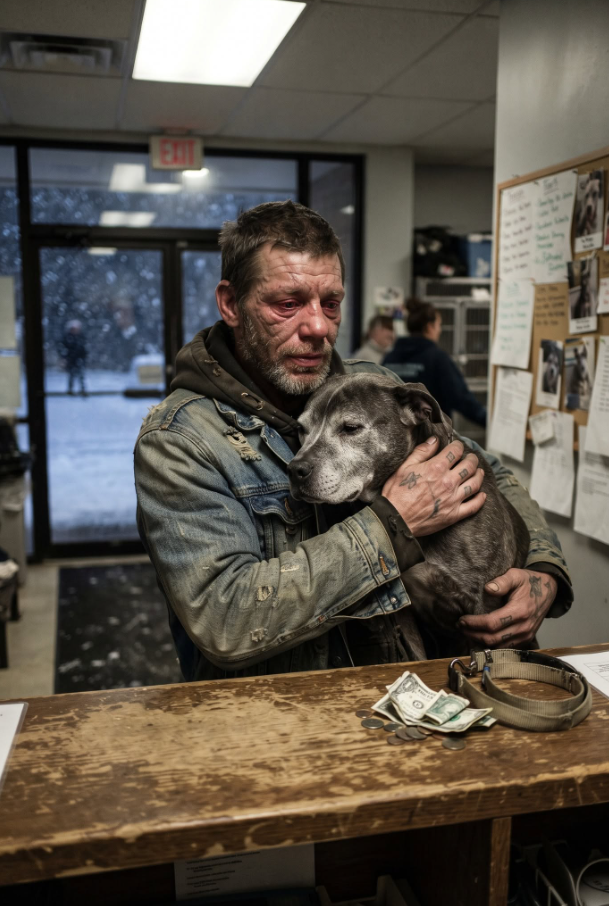
My hand hovered over the silent alarm beneath the front desk. It was ten minutes to closing, the snow was blinding outside, and I was entirely alone in the lobby. The glass doors rattled so violently I thought they would shatter. The man who walked in blocked out the streetlights completely. He had to be six-foot-three, wearing a torn denim jacket over heavily tattooed arms. His face was weathered, scarred, and hard. In my line of work, a guy like this walking in at closing time usually meant a nasty argument. Sometimes, it meant someone was dumping an abused fighting dog they didn’t want anymore. I braced myself for a confrontation.
Then I saw how he was holding his arms. He wasn’t reaching for a weapon. He was cradling a dog like it was a newborn baby. It was a pitbull mix, but it was just skin and bones. The dog’s muzzle was completely white with age, and its breathing was incredibly shallow.
The giant man walked up to my counter, his heavy boots tracking mud and snow across the clean floor. He didn’t look angry at all. He looked completely shattered. With impossible care, he lowered the dog onto the counter, right on top of a stack of adoption flyers. The dog whined softly and licked the man’s rough hand.
The man reached into his jacket pocket. He pulled out a crumpled handful of one-dollar bills and a faded, frayed nylon collar. He pushed the collar toward me. It was practically falling apart, but I could still see our shelter’s old logo stitched into the fabric.
“I need to pay my debt,” he whispered. His gravelly voice was shaking uncontrollably. “Fourteen years ago, I broke into this building. And I stole him.”
My hand slowly moved away from the alarm. I just stared at him in absolute shock. He was standing there shivering, tears welling up in his dark eyes, confessing to a break-in from over a decade ago.
“Why?” I asked. It was the only word I could manage to force out.
He didn’t look at me. He just kept his eyes on the dog, gently stroking its head.
“I had just gotten out of prison,” the man said, his voice cracking. “I lost everything. I had no family, no friends, no place to go. I was sleeping under a freezing overpass on the edge of town, and I was so tired of fighting. I was just done.”
He took a shaky breath, clearly fighting the urge to break down. “I broke in here looking for the medicine room. I wanted to find whatever you used to put the animals to sleep. I was going to take it myself.”
Part 2: The Bond
“But then, from somewhere deep in the back kennels, I heard a sound. A whimper. Not a bark or a growl, but this soft, scared little whimper. I followed it, and I found him. He was just a puppy, maybe six months old, with these big brown eyes. He was in the last cage, all alone. And when he saw me, he wagged his tail. Just once. But it was enough.”
He paused, wiping his eyes with his sleeve. “I couldn’t do it. I couldn’t take that medicine. I couldn’t leave him there. So I took him. I broke the lock on his cage, carried him out through the back door, and ran. I didn’t know what I was going to do. I had nothing. But I had him.”
For fourteen years, that dog had been his only family. They had lived on the streets together, slept in shelters, and survived winters that should have killed them. The man had worked odd jobs, done whatever he could, always making sure the dog ate first. He named him Bear because he said the dog had the heart of one.
“I know I stole him,” the man said. “And I know I should have brought him back. But I couldn’t. He saved my life. Every time I thought about giving up, he would look at me with those eyes, and I would keep going.”
Now Bear was dying. Old age, cancer, his body simply giving out. The man had walked miles through the snow to bring him back to the place where they had first met. He wanted to pay his debt, to apologize, to make things right before it was too late.
“I have forty-two dollars,” he said, pushing the crumpled bills toward me. “It’s not enough. I know it’s not enough. But I wanted to try.”
Part 3: The Reckoning
I didn’t take the money. I couldn’t. Instead, I looked at the dog, at Bear, at this old, tired creature who had spent fourteen years keeping a broken man alive. And I made a decision.
“There’s no debt,” I said softly. “No debt at all.”
The man stared at me, confused. “But I—”
“You gave him a life,” I said. “You gave him love. He wasn’t stolen. He was rescued.”
I walked around the counter and knelt beside him. “Can I examine him?”
The man nodded, unable to speak. I gently checked Bear’s vitals. His heart was weak, his breathing labored. He was in pain, but he was still fighting. He was still looking at his human with those big brown eyes.
“He’s ready,” I said quietly. “He’s been holding on for you.”
The man broke down then. He fell to his knees beside the counter, burying his face in Bear’s fur, sobbing. “I can’t do it. I can’t let him go.”
I sat with them for a long time. I told the man that he wasn’t alone anymore. I told him that Bear had given him the greatest gift—a reason to keep going. And now, the greatest gift he could give Bear was peace.
In the end, he nodded. He held Bear in his arms while I administered the injection. Bear licked his hand one last time, then closed his eyes and went to sleep.
The man stayed with him for hours. I brought him coffee. I sat beside him. I told him about other people who had walked through our doors, broken and lost, and found their way back.
“This isn’t the end,” I said. “It’s a beginning. Bear would want you to keep going.”
He looked at me, his eyes red and swollen. “I don’t know how.”
“One day at a time,” I said. “That’s how we all do it.”
We buried Bear in the small pet cemetery behind the shelter, under a big oak tree. The man—his name was Ray—stayed to help. He fixed a broken fence. He cleaned kennels. He stayed for a month, then two. He became part of the shelter, part of the family.
Six months later, a new dog arrived. A young pitbull mix, scared and skinny, hiding in the back of his cage. Ray was the only one who could get near him. He sat on the floor outside the kennel, talking softly, waiting.
“You remind me of someone,” I told him.
He smiled. “Yeah. Me too.”
Ray adopted that dog. He named him Bear Jr. He got a job, an apartment, a life. He came back every weekend to volunteer. And every time he walked through those doors, I remembered the snowy night when a scarred, broken man cradled a dying dog and confessed to a crime that had actually saved them both.
Sometimes the people who have the least to give are the ones who give the most. Sometimes the broken ones know best how to heal. And sometimes the greatest act of love is letting go so someone else can start again.
Ray still visits Bear’s grave. He still talks to him. He still carries the faded nylon collar in his pocket. But he doesn’t carry the weight anymore.
He carries hope. And that’s exactly what Bear would have wanted.
The money? I never took it. I framed it instead—forty-two crumpled dollars, hung on the wall of the shelter’s front office. A reminder that redemption doesn’t require perfection. It just requires showing up.
And Ray showed up. He kept showing up. And in doing so, he proved that even the most broken lives can become something beautiful.
Bear saved him. And he saved himself. ❤️