Part One — The Cottage Nobody Was Supposed to Remember
My landlord gave me one week to move out.
That same afternoon, my fiancé drained our joint savings account.
Then my mother told me I was old enough to stop expecting relatives to save me.
By Friday night, I was twenty-eight, unemployed, newly single, and sleeping inside my Honda Civic with exactly $186 left.
Then a lawyer I had never spoken to called and told me my late uncle had left me a cottage on a lake.
Apparently, almost nobody in my family knew it existed.
My name is Emily Carter.
Before that phone call, I used to imagine hitting rock bottom would feel dramatic.
It doesn’t.
Rock bottom is quiet.
It’s your debit card being declined when you try to buy a twelve-dollar dinner. It’s choosing a parking space beneath a grocery-store security light because sleeping somewhere dark suddenly feels dangerous. It’s receiving a text from the person you expected to marry saying, I’m sorry, but this hasn’t been working for a long time, after he has already moved $14,300 out of an account you shared.
Most of that money belonged to me.
For four years, I had worked as a junior architectural designer in Charlotte, North Carolina. Then my firm lost two major projects, and forty-one employees were laid off in a single afternoon.
Brandon Hayes, my fiancé, stayed with me for nine more days.
Apparently unemployment made our relationship less appealing.
Or maybe he had been planning his exit long before I lost my job.
Either way, he took the savings and moved into another apartment.
With Madison.
A woman from his marketing office.
I discovered that part through Instagram.
When I called my mother, she tried to sound practical.
“You can stay here for a couple weeks.”
Then her husband complained.
Two weeks became three nights.
Three nights became one.
I told her not to worry.
That was how I ended up sleeping in my car.
And that was where Rachel Bennett found me.
Not in person.
By phone.
“Emily Carter?”
“Yes?”
“My name is Rachel Bennett. I was the attorney for your uncle, Thomas Carter.”
I immediately sat upright.
“Uncle Tom?”
“Yes.”
“He died almost a year ago.”
“Eleven months ago.”
I knew.
Thomas Carter had been my father’s older brother.
He lived by himself in northern Michigan and rarely appeared at family gatherings.
When I was a child, his birthday gifts were always strange.
A compass.
A pocketknife.
A book about shipwrecks on the Great Lakes.
When I turned fourteen, he mailed me a set of drafting pencils.
After I graduated from college, a card arrived with fifty dollars inside and one sentence written across the bottom:
BUILD SOMETHING THAT OUTLASTS YOU.
My father died when I was sixteen.
After that, Uncle Tom called every Christmas.
The conversations were never emotional.
“You doing okay, kid?”
“Yes.”
“Good.”
That was usually the whole thing.
Then, at seventy-four, he died of heart failure.
I attended the funeral.
Maybe twenty people came.
My mother didn’t.
My cousin Derek supposedly handled the estate.
At least, that’s what everyone told me.
Then Rachel said:
“Thomas left you some property.”
I laughed.
Not because anything was funny.
My life had simply become absurd enough that a mysterious inheritance sounded like a scam.
“What property?”
“A cottage.”
“Where?”
“On Lake Charlevoix.”
I stopped laughing.
Waterfront property there wasn’t exactly where people kept worthless cabins nobody cared about.
“What kind of cottage?”
“An old one.”
“How old?”
“Roughly ninety years.”
“Is it falling apart?”
“No. It’s habitable.”
“What is it worth?”
There was a pause.
“Probably less than most neighboring waterfront homes.”
That answer bothered me.
“How much less?”
“Your uncle placed restrictions on selling it, which makes a normal valuation difficult.”
I gripped the phone.
“Why am I only hearing about this now?”
“The property should have transferred to you shortly after Thomas died.”
“But it didn’t.”
“No.”
“Why?”
“Because the trust was challenged.”
I already knew the next answer involved family.
It was always family.
“Who challenged it?”
“Your cousin Derek.”
Of course he did.
I stared through the windshield at the empty parking lot.
“What does Derek want?”
“The cottage.”
“Why?”
Rachel went silent.
And that was when I realized there was something about Uncle Tom’s property she still hadn’t told me.
“Rachel?”
“Derek believes something is inside it.”
“What?”
“He doesn’t know.”
“That makes two of us.”
She almost laughed.
Then her voice became serious again.
“Emily, your uncle anticipated the challenge. He left extremely specific instructions. Derek’s petition was dismissed yesterday.”
I sat completely still.
“What does that mean?”
“It means the cottage is yours.”
I looked around my Honda.
My entire life was inside three grocery bags and a suitcase in the back seat.
“When can I go there?”
“Whenever you want.”
I left North Carolina the next morning.
The drive took two days.
By the time I reached northern Michigan, the sky had turned the pale gray of early autumn.
Rachel met me at a gravel road lined with pine trees.
She was in her sixties, silver-haired, practical, and nothing like the dramatic estate lawyer I had imagined.
She handed me a ring with three old keys.
“Your uncle refused electronic locks.”
“That sounds like him.”
We walked down the drive.
Then I saw the cottage.
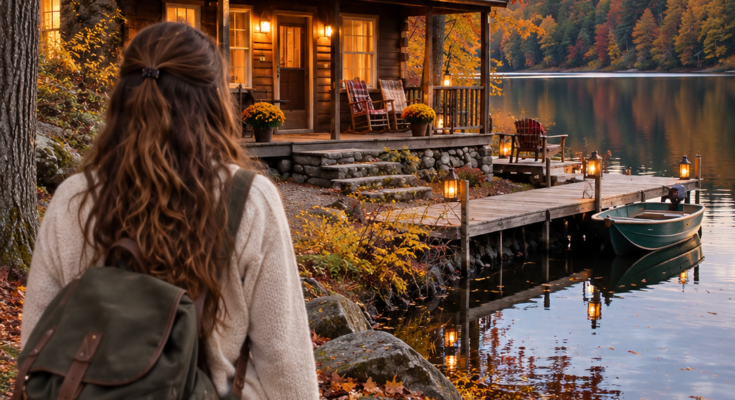
It wasn’t large.
Cedar siding weathered almost silver.
A stone chimney.
Deep porch.
Green shutters.
Beyond it, Lake Charlevoix stretched toward the horizon under a cold blue sky.
I stopped.
“This is mine?”
Rachel smiled.
“Yes.”
For the first time in weeks, I cried.
Not because I suddenly felt rich.
Because I had somewhere to sleep.
Inside, the cottage smelled of cedar, dust, and old books.
Nothing had been modernized.
There were wool blankets folded over the sofa.
A cast-iron stove.
Shelves full of maritime history.
And on an old drafting table near the window sat the exact same brand of mechanical pencil Uncle Tom had mailed me when I was fourteen.
Beside it was an envelope.
EMILY.
I opened it.
Inside was one page.
Kid,
If you are standing here, then people probably made this harder than it needed to be. I’m sorry for that.
I laughed through tears.
Then:
The cottage is yours because you were the only person who ever asked me what I was building instead of what it was worth.
I had forgotten.
I was twelve when Uncle Tom added the porch.
Everyone else teased him for spending money on an old cottage.
I had asked to see the plans.
He let me hold the ruler.
I continued reading.
Do not sell it for one year. Live in it first. Draw something here. Fix something here. Decide what the place means before somebody tells you what it’s worth.
At the bottom:
And before you call Rachel asking about Derek, check beneath the drafting table. The loose floorboard is not subtle. I was old, not creative.
I stared down.
There was, in fact, one board that looked different.
Under it was a small steel box.
Inside were no stacks of cash.
No diamonds.
Just documents.
Old stock certificates.
Tax records.
A bank statement.
And a faded photograph of Uncle Tom and my father standing in front of a shipyard.
On top was another note.
Three words.
ASK RACHEL NOW.
So I did.
━━━━━━━━━━━━━━━━━━━━
Part Two — The Money Everyone Thought He Lost
Rachel returned the next morning with coffee and a file thick enough to qualify as furniture.
“What did my uncle do?”
She sat across from me at the kitchen table.
“Do you remember Carter Marine?”
Of course I did.
My grandfather and his brother had built a regional marine-equipment company decades earlier.
By the time I was a teenager, it was mostly a family legend.
According to my mother, Uncle Tom had inherited a fortune when my grandfather died and then lost nearly everything making “stubborn old-man investments.”
That story was repeated so often it had become fact.
Rachel slid a document toward me.
“He didn’t lose it.”
I stared at her.
“What?”
“Thomas sold part of his interest years ago. But he retained shares through a holding company and invested the proceeds very conservatively.”
“How much?”
“He never wanted family discussions reduced to that number.”
“Rachel.”
She smiled faintly.
“Approximately $4.2 million in liquid investments today. Plus the remaining private-company interest.”
I actually looked behind me.
As though another Emily Carter might be standing there.
“Four million?”
“Roughly.”
“My family thought he was broke.”
“Thomas encouraged that assumption.”
“Why?”
Rachel’s expression softened.
“Because when people believed he had money, they treated him differently.”
That sounded painfully familiar.
She showed me letters.
Over the years, relatives had asked Uncle Tom to finance businesses, cover debts, co-sign loans, fund vacations disguised as “family opportunities.”
Derek had been the most persistent.
Three failed ventures.
A boat dealership.
A cryptocurrency investment.
Then a proposed luxury development.
Uncle Tom had said no every time.
Eventually, he stopped correcting anyone who said his fortune was gone.
“What does the cottage have to do with it?”
Rachel tapped the papers I’d found.
“Those documents prove the holding company’s ownership history. Copies exist elsewhere, so destroying them wouldn’t change anything. But Derek apparently believed Thomas kept something here that could give him control.”
“Did Derek know about the money?”
“He knew enough to suspect.”
“And now?”
“He knows the cottage went to you. He does not automatically receive information about the rest of the trust.”
I felt dizzy.
“So Uncle Tom left me four million dollars?”
Rachel shook her head.
“No.”
That answer strangely relieved me.
“What did he leave me?”
“A trust benefit.”
She explained carefully.
Uncle Tom had created a trust years earlier.
The investments remained professionally managed.
I wasn’t being handed a checking account containing millions of dollars.
The trust could support specific purposes—housing, education, career development, healthcare, and eventually broader distributions at ages Uncle Tom had selected.
There were also charitable commitments.
And one unusual provision.
“He created an architectural preservation fund.”
I stared at her.
“For what?”
“Old residential structures in northern Michigan.”
I started laughing.
“Of course he did.”
“You may apply to direct projects through it if you want. You don’t have to.”
“Why me?”
Rachel reached into the file and handed me another letter.
This one had been written seven years earlier.
Emily understands that old doesn’t mean worthless.
My eyes filled.
She once spent an hour drawing the broken boathouse instead of swimming with everybody else because she wanted to understand why the roof hadn’t fallen in. That is either a sign of professional promise or a deeply boring child.
I laughed.
Then I cried.
Again.
The trust wasn’t Uncle Tom declaring me better than everyone else.
It wasn’t revenge against Derek.
It was a man paying attention.
He had noticed me.
That realization mattered more than the number.
I asked Rachel one question.
“Why didn’t he tell me?”
She thought about it.
“Probably because he wanted to know who you became without it.”
I looked down at my hands.
Unemployed.
Broke.
Sleeping in a car three nights earlier.
“I’m not sure he’d be impressed.”
Rachel smiled.
“Emily, you drove fourteen hours to live in a ninety-year-old cottage before asking me how soon you could sell it.”
Fair point.
My phone rang that afternoon.
Derek.
I almost didn’t answer.
Then I did.
“What did Uncle Tom leave you?”
No hello.
No condolence.
No how are you.
I looked out at the lake.
“A cottage.”
“Don’t play stupid.”
“I’m not.”
“There were papers in that house.”
“Were you searching for them?”
Silence.
Then:
“Tom wasn’t in his right mind at the end.”
“His doctors disagreed.”
“He hated me.”
“I don’t think this is about whether he liked you.”
“You don’t deserve what he had.”
There it was.
I surprised myself by not getting angry.
“Maybe not.”
Derek went quiet.
I continued.
“But that’s the thing about somebody else’s property. They don’t have to prove the recipient deserves it to your satisfaction.”
“You think you’re rich now?”
“No.”
“Then you don’t understand what you’ve got.”
I looked around the cottage.
The battered drafting table.
The old stove.
My father’s photograph.
“I think I understand enough.”
I ended the call.
Then I turned my phone off.
For the first time in months, silence didn’t feel like abandonment.
It felt peaceful.
━━━━━━━━━━━━━━━━━━━━
Part Three — Build Something That Outlasts You
I stayed for the year Uncle Tom requested.
At first because the trust required me not to sell.
Later because I stopped wanting to.
The cottage needed work.
Not glamorous work.
Roof flashing.
Rot near one porch column.
Old wiring.
Windows that leaked cold air like they had a personal disagreement with winter.
I could have hired everyone.
Instead, I did what I could myself and hired local tradespeople for what I couldn’t.
For the first time since losing my job, I opened drafting software because I wanted to.
Not because a project manager needed revisions by Monday.
I measured the cottage.
Documented the original framing.
Drew the porch.
Then the boathouse.
Rachel introduced me to a small nonprofit that preserved historic homes around northern Michigan.
They needed help documenting a 1912 lakeside lodge before restoration.
I volunteered.
That became freelance work.
Freelance work became a contract.
A year later, I opened a tiny architecture and preservation studio in the converted rear room of Uncle Tom’s cottage.
I named it Carter Preservation Works.
My first employee was a recent graduate who had been laid off from a large firm.
When I offered her the job, she asked:
“What if there isn’t enough work?”
I thought about myself sleeping under a grocery-store security light.
“Then I’ll tell you before your paycheck disappears.”
She looked confused.
“That’s a weirdly specific promise.”
“It is.”
Brandon eventually returned $8,600 of the savings after an attorney helped me document what belonged to whom.
There was no dramatic arrest.
No public downfall.
The account had been jointly titled, which made the situation far messier than my anger wanted it to be.
We negotiated.
I recovered part of what I could prove.
Then I stopped letting the money keep him in my life.
My mother called when she learned about Uncle Tom’s trust.
Her first sentence was:
“I always knew Thomas had something hidden.”
Not:
I’m sorry you slept in your car.
That told me where we still stood.
Then she said:
“You know, your stepfather and I have been talking about renovating the house.”
I actually laughed.
“Mom.”
“What?”
“Don’t.”
She became offended.
“I was only mentioning it.”
“I know.”
We didn’t speak for three weeks.
Eventually, she called again.
This time she said:
“I handled things badly when you lost your job.”
“Yes.”
“I thought making you figure it out would make you stronger.”
“I wasn’t asking you to fix my life. I needed somewhere safe to sleep.”
Silence.
“I know.”
That apology didn’t erase anything.
But it was a beginning.
Derek took longer.
His challenge to the trust failed.
He had no secret claim waiting to appear.
No dramatic disinheritance clause destroyed his life.
Uncle Tom had simply exercised the same right all of us hope to have.
He decided where his own property went.
Almost three years after I moved into the cottage, Derek showed up.
He knocked.
That surprised me.
I opened the door but didn’t invite him in.
He looked older.
“I’m not here about the money.”
“Okay.”
“I didn’t know Tom kept Dad’s photograph.”
Derek’s father was Uncle Tom’s younger brother.
He had died years before mine.
I understood then that Derek’s obsession with the cottage wasn’t entirely financial.
Mostly financial.
But not entirely.
I brought him the photograph.
He sat on the porch steps holding it for a long time.
Finally he said:
“You know what I hated about Tom?”
“What?”
“He could say no.”
I leaned against the railing.
Derek laughed bitterly.
“Everybody else in this family could be pushed eventually. Guilt them, yell, keep calling. Tom would just say no and go fishing.”
“That does sound like him.”
“I thought that meant he didn’t care.”
“And now?”
Derek looked at the photograph.
“Now I think maybe he cared without thinking caring meant giving me everything I asked for.”
That was probably the closest Uncle Tom and Derek would ever come to reconciliation.
I gave him a copy of the photograph.
Not money.
Not a piece of the cottage.
A photograph.
He thanked me.
That was enough.
Years passed.
The trust grew and distributed money according to the structure Uncle Tom created.
I used some to expand my firm.
Some to restore the cottage.
Some I never touched.
The preservation fund helped save twelve historic houses in its first eight years.
Not mansions.
A fisherman’s cottage.
A farmhouse.
A tiny library threatened with demolition.
An old boarding house.
Buildings most developers called obsolete.
Every project began with the same question Uncle Tom had somehow taught me to ask:
What remains worth saving?
On the tenth anniversary of his death, I finally renovated his drafting room.
I found the original set of pencils he had bought when he was in college.
Beside them was a wooden ruler with his name burned into the edge.
I mounted it over my desk.
Then I framed the card he’d sent me after college.
BUILD SOMETHING THAT OUTLASTS YOU.
For years, I thought Uncle Tom meant buildings.
Eventually, I understood he didn’t.
Money doesn’t necessarily outlast you.
Houses don’t either.
Even trusts eventually end.
What lasts is what your choices make possible in someone else’s life.
Uncle Tom did not rescue me from every consequence.
He couldn’t.
He was dead before my life fell apart.
What he gave me was more useful than a bag of money appearing at the perfect moment.
He gave me somewhere to stand.
A roof.
Time.
A structure designed so desperation couldn’t force me to sell everything in the first terrible month.
And the knowledge that somebody had been paying attention long before I knew I needed them to.
I still live at the cottage.
It no longer leaks.
The green shutters have been repaired, not replaced.
The old drafting table remains beside the lake-facing window.
Sometimes young designers from my firm work there.
One asked me recently why I never sold the property when waterfront prices became ridiculous.
I looked through the window.
At the lake.
At the porch Uncle Tom built.
At the place that had taken me in when I owned almost nothing.
“Because once,” I said, “I thought its value was the answer to the most important question.”
“What was the question?”
“How much is it worth?”
She smiled.
“And now?”
I looked at Uncle Tom’s ruler above my desk.
“Now I think the better question is what it’s worth keeping.”
The fortune everyone believed had disappeared never really disappeared.
Uncle Tom had simply stopped displaying it for people who confused knowing his net worth with knowing him.
And when he finally left it behind, the greatest part wasn’t the millions.
It was the little cedar cottage almost everyone had forgotten.
Because that was where a broke twenty-eight-year-old woman arrived with $186, three bags, and nowhere else to go—
and slowly built something that outlasted the life she thought she had lost.