
Part One — “Then I’ll Disappear.”
My name is Thomas Mercer.
I was sixty-eight, widowed, and living in the guest suite of the house I had helped buy for my son, Daniel, and his wife, Vanessa.
It was only supposed to be temporary.
After my wife, Margaret, died, Daniel told me I shouldn’t spend my first year alone.
“Come stay with us, Dad. The kids would love having you around.”
I believed him.
Maybe I wanted to believe him.
Grief makes even obvious kindness feel like rescue.
I had already helped them financially for years.
I paid the down payment on their four-bedroom house and guaranteed the mortgage because Daniel’s business income was uneven. I paid their children’s private-school tuition, covered Vanessa’s luxury SUV lease, paid several premiums associated with Daniel’s small construction company, and transferred $3,000 every month into the household account.
When groceries were expensive, I paid.
When the water heater failed, I paid.
When their oldest daughter needed braces, I paid.
Nobody called it dependency.
They called it:
“Family helping family.”
Over time, the word helping disappeared.
Christmas was when I finally noticed.
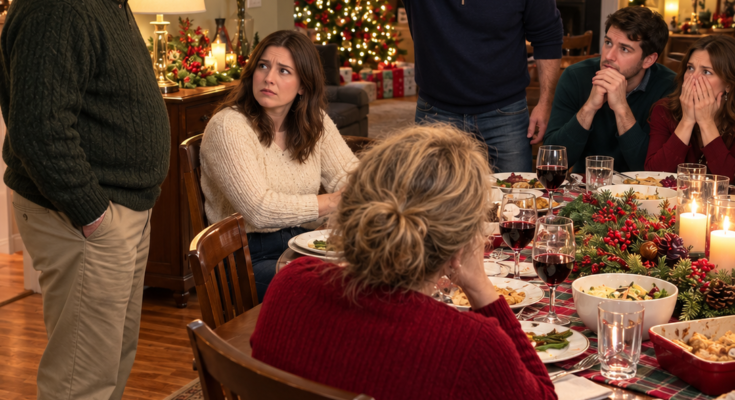
There were twenty-two people at dinner.
Vanessa seated me at the far end of the table beside the kitchen door.
That should have told me something.
I had paid for most of the food.
Bought presents for the grandchildren.
Covered half the holiday catering because Vanessa said preparing dinner for that many people was “emotionally overwhelming.”
After dessert, Daniel stood.
He had been drinking.
“We need to settle something.”
The room went quiet.
Vanessa lifted her wineglass.
Daniel pointed at me.
“Starting January first, you pay two thousand dollars a month in rent or you disappear.”
For a second, I waited for someone to laugh.
Nobody did.
Vanessa did smile, though.
“Let’s see how long you survive without us.”
A few relatives looked down at their plates.
My sister Helen stared at Daniel as though she couldn’t believe what she’d heard.
I asked:
“Rent?”
Daniel crossed his arms.
“Yes.”
“For the guest suite?”
“You live here.”
“In the house whose down payment I paid and whose mortgage I guaranteed?”
His face hardened.
“It’s our house, Dad.”
“I know.”
“You’re taking advantage of us.”
That sentence changed everything.
Not because it was cruel.
Because he believed it.
Somewhere along the way, every dollar I contributed had become invisible.
My presence was the only thing he could still see.
Vanessa leaned back in her chair.
“You’ve been here long enough. Either contribute properly or get your own place.”
I looked around the room.
At the chandelier I had paid to replace.
At the dining table Margaret and I had given them.
At the grandchildren wearing school sweaters whose tuition statements arrived in my email.
Then I looked at Daniel.
“All right.”
He frowned.
“All right what?”
“I’ll disappear.”
His expression changed immediately.
“Dad, don’t be childish.”
“You gave me two options.”
“You know what I meant.”
“I do now.”
I went upstairs.
I didn’t make a speech.
I didn’t drag boxes down the stairs to prove anything.
I packed one suitcase.
Margaret’s photograph.
My medication.
Enough clothing for a week.
Important documents.
At 10:40 that night, from the guest suite I was apparently exploiting, I called my attorney, Evelyn Shaw.
She had handled my estate planning for almost twenty years.
I told her what happened.
She listened.
Then she said:
“Thomas, before you start canceling things out of anger, let’s separate what you can legally stop from what you’re still obligated on.”
That was why I called Evelyn.
Not because she encouraged revenge.
Because she prevented me from turning anger into an expensive mistake.
The mortgage guarantee couldn’t simply be canceled because my feelings were hurt.
The vehicle lease had contractual terms.
The children’s current school semester was already paid.
But there were plenty of things I was voluntarily funding.
Automatic household transfers.
Authorized-user credit cards.
Future tuition.
Insurance premiums I had agreed to cover but was not legally required to continue indefinitely.
Business expenses charged to my accounts.
Utilities paid from my card.
Those could be addressed properly.
At 5:30 the next morning, I left.
Nobody came downstairs.
By seven, I had moved into a furnished apartment.
It wasn’t glamorous.
One bedroom.
Small balcony.
Cheap artwork.
A coffee maker that sounded like farm machinery.
I loved it immediately.
At eight o’clock, I sent one message to Daniel and Vanessa.
You asked me to live independently. I agree. Effective today, I will no longer provide voluntary financial support for your household. Evelyn will contact you regarding any obligations involving my name.
Then I started making calls.
I stopped the $3,000 monthly transfer.
Removed Daniel and Vanessa as authorized users from my personal cards.
Changed access to accounts that belonged solely to me.
Canceled recurring payments that had no contractual obligation beyond me choosing to pay them.
Instructed the school that future tuition decisions would be made directly by the children’s parents.
Told Daniel’s insurance broker I would no longer personally fund future premiums and that they should contact the actual policyholders about maintaining coverage.
I did not cancel their mortgage.
I couldn’t.
I did not make their children suffer in the middle of a semester.
I did not seize their car from the driveway.
I simply stopped pretending their expenses were automatically mine.
By 8:37, my phone started ringing.
Vanessa.
Daniel.
Vanessa again.
Then messages.
WHAT DID YOU DO TO THE AMEX?
Dad, call me immediately.
The insurance agent says they need another payment method.
This is insane.
Then:
The school emailed us. Are you seriously involving the children?
I almost answered.
Then Evelyn called.
Her voice was different.
“Thomas, don’t respond to them yet.”
I sat down.
“Why?”
“The bank’s fraud department contacted me after reviewing one of the loan files connected to Daniel’s business.”
My stomach tightened.
“What loan?”
There was a pause.
“Exactly.”
━━━━━━━━━━━━━━━━━━━━
Part Two — The Signature That Wasn’t Mine
Evelyn emailed me a document.
It was a commercial line of credit opened eighteen months earlier.
Borrower:
Mercer Residential Group LLC.
Daniel’s company.
Guarantor:
Thomas Mercer.
I stared at my own name.
Then I scrolled lower.
There was a signature.
It looked like mine.
Close enough that a stranger might believe it.
I knew immediately it wasn’t.
“Evelyn.”
“I know.”
“I never signed this.”
“Then don’t call Daniel.”
The line had originally been $150,000.
The current balance was almost $132,000.
My chest tightened.
“How did I not know?”
“The statements went electronically to an address associated with the company. The bank apparently relied on documents submitted during underwriting. They’re reviewing exactly what verification occurred.”
I stared at the screen.
This was not about Christmas anymore.
“Was my Social Security number used?”
“Yes.”
That was the moment the anger disappeared.
Fear replaced it.
Someone had used my identity to support a business debt without my permission.
Evelyn told me what came next.
A written fraud dispute.
Credit freezes.
Copies of my identification.
A signature comparison.
Review of electronic records.
Possibly a police report depending on what the bank uncovered.
No dramatic raid.
No handcuffs at breakfast.
Just procedures.
But procedures have a way of becoming terrifying when the paperwork is real.
I spent the next several hours checking all three credit bureaus and every account I could identify.
There were inquiries I didn’t recognize.
One was connected to Daniel’s company.
Another involved an attempted increase to the line of credit six weeks earlier.
Then we found something that hurt more than the balance.
The application included a scanned copy of my driver’s license.
The scan came from a file I kept in a locked cabinet in the guest suite.
Or what I thought was locked.
Evelyn asked:
“Who knew where you kept personal documents?”
“Daniel.”
Silence.
“And Vanessa?”
“She probably did.”
That afternoon Daniel finally left a voicemail long enough for me to listen.
“Dad, I don’t know what you’re doing, but you’re blowing up everything because of one argument. Vanessa is furious. The kids are asking questions. Call me before this gets worse.”
One argument.
Twenty-two witnesses.
Pay rent or disappear.
Apparently humiliation only counted as an argument when the humiliated person stopped paying.
I didn’t call him.
The bank did.
That changed the tone.
At 4:12, Daniel texted:
WHY IS THE BUSINESS LINE FROZEN?
Then:
DAD WHAT DID YOU TELL THEM?
Then:
CALL ME NOW. PEOPLE’S PAYCHECKS DEPEND ON THIS.
I handed the phone to Evelyn when she came by my apartment.
She read the messages.
“Do not debate the facts by text.”
“I’m not planning to.”
The bank temporarily restricted further draws while reviewing the disputed guarantee.
That did not erase the company’s debt.
It did not automatically make Daniel guilty of fraud.
It did mean the bank wanted answers.
So did I.
The next evening Daniel appeared at my apartment.
I had not given him the address.
My sister Helen had.
I was angry at her until she explained he told her he wanted to apologize.
He knocked for almost five minutes.
Eventually, I opened the door but left the chain on.
Daniel looked terrible.
“Dad.”
“What do you want?”
“We need to talk.”
“About Christmas?”
His eyes shifted.
“About everything.”
“Did you sign my name on a loan?”
His face changed.
Barely.
But enough.
I had spent thirty-eight years being his father.
I knew when he was afraid.
“It’s complicated.”
“No.”
I stared through the gap in the door.
“That question is extremely simple.”
He rubbed both hands over his face.
“The company was going through a cash-flow problem.”
“Did you sign my name?”
“You already guaranteed the mortgage. You’d guaranteed equipment before. I thought—”
“Did you sign my name?”
Finally:
“Yes.”
I closed my eyes.
He rushed on.
“I was going to tell you.”
“When?”
“As soon as the contracts closed.”
“What contracts?”
“We had two big developments pending. They fell through.”
“So you used my identity for a six-figure loan.”
“I wasn’t stealing from you.”
“You made me responsible for a debt without asking me.”
“I knew you’d say no.”
That sentence almost made me laugh.
“You knew I’d say no.”
“Yes.”
“So you decided my answer didn’t matter.”
He started crying.
Actually crying.
“Dad, I was trying to save the business.”
“And if it failed?”
He said nothing.
I understood.
If the business failed, the bank would come looking for the guarantor.
Me.
Maybe by then he planned to confess.
Maybe he planned to call it another emergency.
Maybe he assumed I would fix it because I always had.
I asked:
“Did Vanessa know?”
His silence answered.
Then he whispered:
“She knew about the line.”
“Did she know I hadn’t signed it?”
Another pause.
“Yes.”
I shut the door.
Not because I hated him.
Because I suddenly understood Christmas.
They weren’t afraid I couldn’t survive without them.
They were afraid of what would happen when they had to survive without me.
━━━━━━━━━━━━━━━━━━━━
Part Three — Independence Worked Both Ways
The investigation lasted months.
That part of the story is less dramatic than people expect.
The bank reviewed the application history, document submissions, IP records, and signatures.
My attorney coordinated with the bank and law enforcement.
The disputed guarantee was treated separately from the company’s legitimate borrowing obligations.
Daniel retained his own lawyer.
So did Vanessa.
I did not threaten to send my son to prison if he refused to apologize.
I did not use the grandchildren as leverage.
I gave the evidence to the people whose job it was to determine what had happened.
Daniel eventually admitted his role.
So did Vanessa, although her involvement was smaller than I first feared.
She had known the guarantee wasn’t authorized.
She had not personally created the signature.
That distinction mattered.
Consequences followed.
Daniel’s business lost access to the line and ultimately closed after a restructuring attempt failed.
Assets were sold.
Creditors were negotiated with.
Daniel faced legal consequences associated with the false loan documents.
The exact outcome was less important to me than something he said months later in a mediation room.
He looked exhausted.
No expensive jacket.
No Christmas whiskey confidence.
Just my son.
“I thought you would always cover whatever went wrong.”
I stared at him.
“Why?”
“Because you always did.”
That hurt.
Because he wasn’t entirely wrong.
When his first business struggled, I paid a supplier.
When the second needed a truck, I guaranteed financing.
When he and Vanessa couldn’t afford private school, I wrote the check.
When they bought too much house, I supplied the down payment.
Every rescue had felt like love.
I hadn’t noticed that I was teaching him something alongside it.
That Dad’s money lived at the bottom of every hole.
I asked:
“Did you think that gave you the right to sign my name?”
“No.”
“Then why do it?”
His eyes filled.
“Because I was afraid if I asked, you’d finally say no.”
There it was.
Not desperation.
Entitlement mixed with fear.
The belief that access to me mattered more than consent from me.
I thought about Christmas.
Pay rent or disappear.
I almost smiled at the irony.
Instead I said:
“I should have said no more often.”
Daniel looked down.
“That doesn’t make what I did your fault.”
“No.”
It didn’t.
Both things could be true.
I had enabled him.
He had betrayed me.
One did not erase the other.
Vanessa and Daniel eventually sold the house.
Not because I swooped in and took it.
Because without my $3,000 monthly contribution, without my tax payments, without me covering school and vehicles and business expenses, their numbers no longer worked.
The mortgage lender still had rights.
So did Daniel and Vanessa.
My guarantee had to be dealt with through the sale and refinancing process.
There was paperwork.
Negotiation.
Time.
Not a dramatic eviction.
They moved into a smaller three-bedroom rental.
The children transferred schools after the academic year ended.
I worried about them most.
My granddaughter, Sophie, asked me:
“Grandpa, did we have to leave our house because you got mad at Dad?”
I knelt beside her.
“No.”
She looked skeptical.
“Then why?”
“Because your mom and dad are changing how they pay for things.”
“Because you’re not paying?”
I smiled sadly.
“That’s part of it.”
“Are you mad at us?”
“Never.”
That was important.
I stopped paying the parents’ expenses.
I did not stop being a grandfather.
Birthday gifts remained birthday gifts.
I opened education accounts for the grandchildren that their parents could not withdraw from.
I took them fishing.
Went to school plays.
Bought ice cream.
Love remained.
Access to my checking account did not.
Daniel and Vanessa separated two years later.
I won’t pretend Christmas caused it.
Their marriage had problems long before that night.
Money merely exposed them.
Vanessa eventually apologized to me.
A real apology.
Not:
I’m sorry you misunderstood the joke.
Not:
I’m sorry things got out of hand.
She said:
“I laughed because Daniel humiliating you made me feel powerful.”
I appreciated the honesty.
Then she added:
“And I knew about the loan. I told myself it wasn’t my problem because Daniel handled the business. That was cowardly.”
I accepted the apology.
We did not become close.
Forgiveness doesn’t require pretending trust has returned.
Daniel took longer.
For almost three years, our conversations stayed mostly about the children.
Then one December, he asked me to lunch.
He arrived early.
That alone was new.
We sat in a diner.
He looked at me.
“Do you remember what I said at Christmas?”
“Yes.”
“I think about it constantly.”
“So do I.”
He stared into his coffee.
“I thought letting you live with us was something we were giving you.”
I waited.
“I never added up what you were giving us.”
“Money wasn’t the part that hurt most.”
“I know.”
He nodded.
“The part that hurt was making you feel like you were unwanted.”
That surprised me.
“Yes.”
He swallowed.
“And then finding out I’d already taken something bigger than money.”
“My name.”
He looked at me.
“Your right to say no.”
For the first time since Christmas, I felt something loosen inside me.
Not everything.
Enough.
Years have passed.
I still live in the furnished apartment.
Eventually I bought it.
Not because it was luxurious.
Because it was mine.
No guest suite.
No child telling me whether I belonged.
No $2,000 rent demand delivered after dessert.
On the small bookshelf in my living room sits the one suitcase I packed that Christmas night.
I could put it away.
I haven’t.
It reminds me how little I actually needed to leave.
Daniel once asked:
“Were you scared?”
“Of course.”
“You didn’t look scared.”
“Parents get good at that.”
He smiled.
Then he said:
“I really thought you couldn’t survive without us.”
I looked around my apartment.
At Margaret’s photograph.
My books.
My coffee.
The quiet life I had built after sixty-eight.
“I thought that too for a while.”
That was the saddest part.
Grief had convinced me dependence was connection.
My son had mistaken financial dependence for authority.
Vanessa had mistaken generosity for weakness.
And I had mistaken rescuing everyone for being needed.
Christmas finally broke all four illusions.
They told me:
Pay rent or disappear.
So I disappeared from one role.
The guarantor.
The automatic transfer.
The emergency credit card.
The man expected to make every bad decision affordable.
But I didn’t disappear from my family.
I became something healthier.
A father who could love his son without financing him.
A grandfather whose affection wasn’t attached to tuition payments.
And a man who learned, much later than he should have, that independence works both ways.
The morning after Christmas, Daniel thought he had thrown an old man out of his home.
What he actually did was hand me back something I had been giving away for years.
The right to decide where my help ended.
And where my life began.