
Part 1: The Secret
“Boy, if I cut that hair any shorter, your mother’s gonna think you joined the Army.”
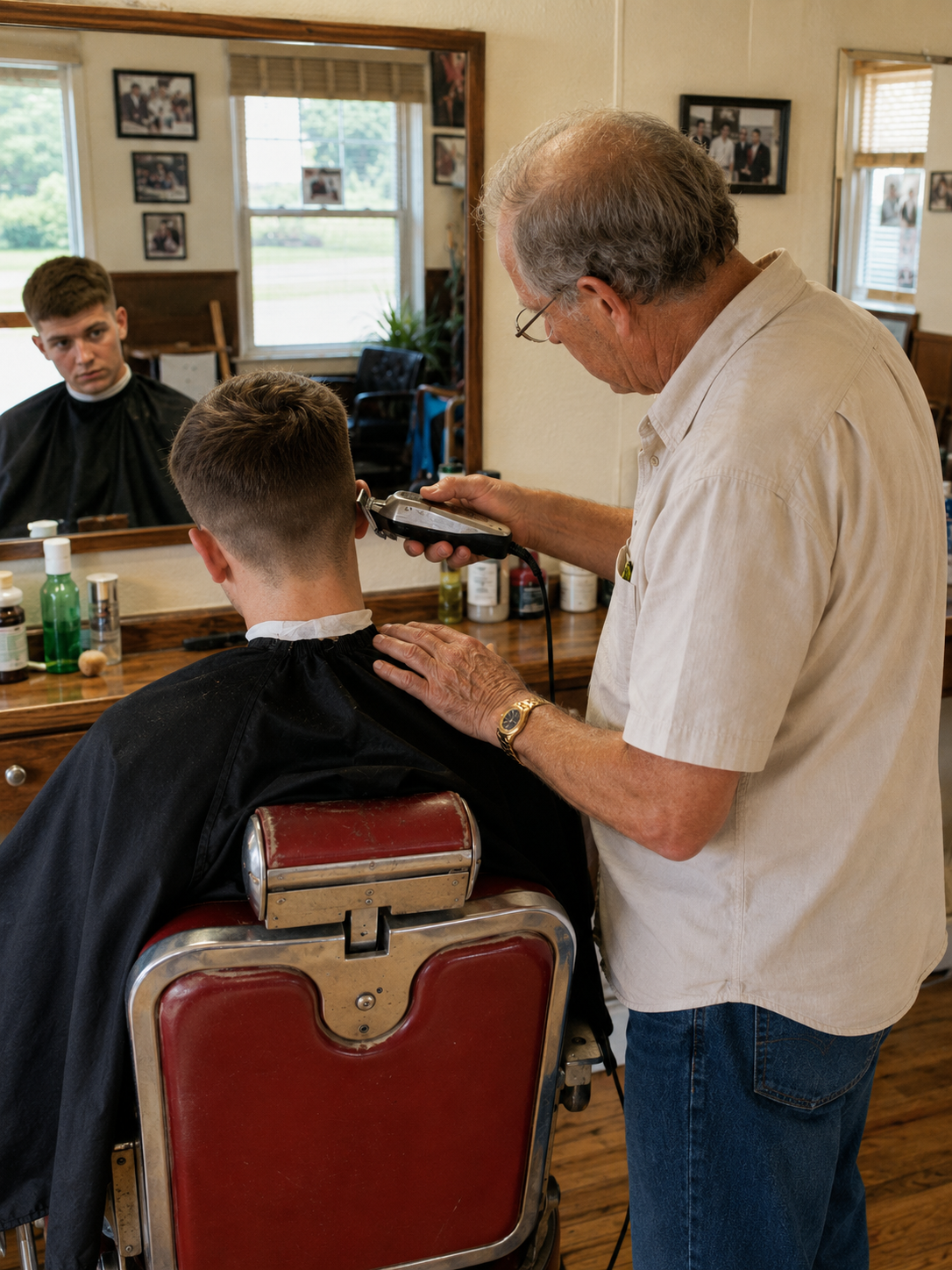
Luther Finch said it with a grin, but his right hand was trembling again. Seventeen-year-old Evan Mercer sat quietly in the old red barber chair and smiled at him through the mirror. “That’s okay,” the boy said. “Just clean it up a little.”
Luther looked at Evan’s hair. There was almost nothing left to clean up. It was the fourth Saturday in a row the kid had come into Luther’s little barbershop in rural Georgia asking for a trim he didn’t need. Luther had been cutting hair in that same shop for forty years. He knew when a boy needed a haircut. And he knew when something else was going on. But Luther had learned long ago that people usually told you what they needed when they were ready.
So he draped the striped cape around Evan’s shoulders and picked up his clippers. That was when his hand betrayed him again. His fingers tightened awkwardly around the machine. The weakness had been there since the stroke five months earlier. Luther could still walk. He could still talk. He could still make his terrible coffee and complain about baseball and remember every customer’s usual haircut. But his right hand—the hand that had made his living—was no longer the same.
Some mornings, it worked almost normally. Other mornings, holding the clippers felt like gripping a brick with a glove on. Luther hated when customers noticed. He hated it even more when they pretended not to.
Forty years earlier, his father had helped him buy that first barber chair secondhand. Luther had cut farmers before harvest, boys before prom, fathers before weddings, and old friends before their funerals. He gave toddlers their first haircuts and, years later, cut those same boys’ hair before they left for college. The shop had become more than a business. It was where people came when they needed to talk without admitting they needed to talk.
After the stroke, Luther began wondering whether his own chair was about to sit empty. His doctor had told him recovery could take time. But patience had never been Luther’s strongest virtue. Every time the clippers slipped slightly in his hand, he heard the same thought: Maybe you’re done.
He hadn’t told anyone. Especially not his daughter, who kept suggesting retirement. “You’ve earned some rest, Dad.” Luther always answered the same way. “A man can rest when he’s tired.” The truth was, Luther wasn’t tired. He was scared.
Then Evan started showing up. Every Saturday at 10:30. Always alone. Always with twelve dollars folded neatly in his pocket. Always asking for barely half an inch off hair that had barely grown. Evan wasn’t much of a talker. He was a skinny high school junior with scuffed sneakers and grease sometimes trapped beneath his fingernails from shop class. He answered most questions with “yes, sir” or “no, sir.”
But Luther noticed something strange. The boy watched his hands. Not the mirror. Not his haircut. His hands. Whenever Luther switched the clippers to his left hand, Evan leaned slightly forward. Whenever Luther stretched his fingers or adjusted his grip, the boy’s eyes followed.
I know you’re curious to see what happens next, so please be patient and continue reading in the comments below. Thank you for understanding the inconvenience. Please leave a “YES” below and give us a Like to get the full story. 👇to part 2.
—
Part 2: The Device
One Saturday, Luther finally stopped halfway through the haircut. He switched the clippers off. The shop went quiet. “Evan.” “Yes, sir?” “You planning on becoming a barber?” The boy’s face turned red. “No, sir.” “Then why have you been studying my hand for a month?”
Evan looked down at the cape. For a moment, Luther thought he might bolt out the door. Instead, the teenager reached into his backpack. “I didn’t want to tell you until I knew it might work.”
He pulled out something strange. It looked like a curved plastic handle wrapped with rubber, with a wide strap on one side. Luther stared at it. “What in the world is that?” Evan swallowed. “It’s for your clippers.” Luther didn’t speak.
Evan explained that in shop class they had been learning basic design and fabrication. He had noticed Luther struggling months earlier when his grandfather came in for a haircut. Evan’s grandfather had been coming to Luther for nearly twenty years. “My grandpa said you’d probably quit before you ever asked somebody for help,” Evan said. Luther raised an eyebrow. “Your grandpa talks too much.” Evan smiled.
Then he attached the device to the clippers. The wider grip meant Luther didn’t have to squeeze nearly as hard. A strap crossed the back of his hand so the clippers stayed steady even when his fingers weakened. Evan had shaped one side slightly differently because he’d noticed the angle Luther naturally used while cutting around someone’s ears.
“I made three versions,” the boy said. Luther looked up. “Three?” “The first one was too heavy. The second one rubbed your thumb.” “How would you know it rubbed my thumb?” Evan pointed. “Because you always move your thumb after about five minutes.”
For once in his life, Luther Finch had no smart answer. He slipped his hand into the grip. Then he turned the clippers on. The familiar hum filled the shop. He moved them slowly across Evan’s hair. Once. Twice. No strain. No slipping. No desperate squeezing. Luther stopped. His vision blurred.
Evan stared straight ahead, pretending not to notice. Luther cleared his throat. “How much do I owe you?” Evan looked shocked. “Nothing.” “Nobody works for nothing.” “You cut my grandpa’s hair when he couldn’t afford it after he lost his job.” Luther frowned. “That was years ago.” “He remembers.”
Luther looked down at the little device in his hand. So did I, he thought.
I know you’re curious to see what happens next, so please be patient and continue reading in the comments below. Thank you for understanding the inconvenience. Please leave a “YES” below and give us a Like to get the full story. 👇to part 3.
—
Part 3: The Legacy
Luther finished Evan’s haircut. When the boy stood up, he placed his usual twelve dollars on the counter. Luther pushed it back. “No.” Evan shook his head. “Mr. Finch—” “You’ve paid ahead.” “For how long?” Luther glanced at the homemade grip attached to his clippers. “Probably till you’re forty.” The boy laughed.
That afternoon, Luther called Evan’s grandfather. He intended to thank him. Instead, the old man said something Luther never forgot. “You spent forty years making boys feel like men when they climbed out of that chair, Luther. Maybe you ought to let one of them return the favor.”
After that, Evan stopped pretending he needed haircuts. He simply came to the shop. At first he swept the floor. Then he cleaned combs. Then Luther taught him how to hold scissors properly. “How come you never went to barber school?” Luther asked one afternoon. Evan shrugged. “I never thought I was good with people.” Luther laughed. “Neither are most people. That’s why they need barbers.”
Little by little, the quiet teenager came out of his shell. Luther taught him that a haircut was only half the job. The other half was remembering that Mr. Dawson’s wife was sick. That Earl wanted the weather radio turned up on storm days. That little kids sat still if you gave them an old comb to hold. That sometimes a man said, “Just a trim,” when what he really needed was twenty quiet minutes with somebody who knew his name.
Evan taught Luther things too. How to use the new card reader his daughter had bought him. How to enlarge the letters on his phone. How to stop pretending needing help was the same thing as being helpless.
Years passed. Evan graduated. Then he trained professionally and earned his barbering license. He could have moved to Atlanta. He could have worked in some shiny new shop with polished floors and modern chairs. He stayed.
When Luther finally retired at seventy-six, half the town packed into that little barbershop. Someone brought a sheet cake. Someone else brought an old photograph of Luther giving a nervous five-year-old his first haircut in 1989. His daughter cried. Luther insisted he had “something in his eye.”
The next Monday morning, a new name appeared on the front window. MERCER BARBER SHOP. Underneath, in smaller letters: EST. IN THE TRADITION OF LUTHER FINCH.
Evan renovated almost everything over the next year. New lights. New flooring. Fresh paint. Better equipment. But one thing never moved. Luther’s old red barber chair stayed beside the second window, exactly where it had stood for decades. The leather was cracked. The chrome was scratched. And on a small wooden shelf beside it sat a funny-looking plastic clipper grip made by a seventeen-year-old boy who once paid for haircuts he didn’t need because he was too shy to say, “I think I can help you.”
Luther still stops by on Saturday mornings. He drinks terrible coffee. He complains that young barbers play the music too loud. And sometimes, when the shop gets busy, Evan points toward that old chair. “Mr. Finch, you want to take one?” Luther pretends to think about it. Then he smiles. “Only if you’ve got my clippers.”
Because sometimes one generation doesn’t replace another. Sometimes it reaches back, steadies its hand, and carries the good things forward. The finest legacy isn’t leaving your name on the door—it’s leaving something worth teaching to the person who opens it next.
Luther still has the clipper grip. It sits on his mantel, next to a photograph of Evan graduating from barber school. He doesn’t need it anymore. His hand is stronger now. But he keeps it as a reminder that help can come from the most unexpected places—from a quiet teenager who saw a need and decided to do something about it.
Evan still cuts hair in that shop. He still has Luther’s old chair in the corner. And sometimes, when a young person comes in looking lost, he remembers the barber who taught him that a haircut is never just a haircut. It’s a moment. A connection. A chance to make someone feel seen.
That’s the legacy Luther left behind. Not just a shop. Not just a chair. But a way of treating people that will outlast any tool or building.
And that, Luther would say, is worth more than any haircut. ❤️