Part 1: The Judgment
At 5:40 one morning, I saw him standing outside Room 12 with an iron in one hand and his little girl’s school blouse spread across a motel towel. That was the moment I realized I had gotten him completely wrong.
My name is Sherry Vale. I was 57 then, managing an old roadside motel in southern New Mexico that had seen better decades. The sign out front buzzed when the wind blew. The ice machine worked when it felt like it. Half the bathroom faucets dripped no matter how many times I replaced the washers.
And my hands hurt every single morning. I have rheumatoid arthritis, and some days turning a room key felt like twisting a bolt with frozen fingers. But the motel was mine. Not fancy. Not profitable enough. But mine.
So when a young man named Caleb showed up with a girl who looked about eight, I noticed everything. He paid cash. Wrinkled bills. One night at a time. He drove an old work truck with a dented tailgate and primer on one door. He wore dusty boots and shirts that looked like they had been washed in a sink. His daughter, Rosie, was quiet and polite. “Thank you, ma’am,” she said when I handed them the key to Room 12.
The next morning, Caleb came back to the office. “One more night, if you’ve got it.” He counted out the money carefully. The next day, same thing. Then again. By the fifth night, I started worrying.
Running a cheap roadside motel teaches you to be cautious. I had dealt with people who skipped out without paying. People who broke furniture. People who brought trouble through the door at 2 a.m. And Caleb was becoming a question mark I couldn’t afford.
One afternoon, my housekeeper told me she had seen him sleeping in his truck in the parking lot. That made me even more suspicious. Why pay for a room and sleep outside? I decided the next morning would be their last. I rehearsed what I was going to say. “Sorry, but we can’t keep extending the room.” It sounded professional. Necessary. I even wrote it on a sticky note because I hated confrontation.
Then arthritis woke me before dawn. My hands were throbbing, so I made coffee and stepped outside to loosen my fingers in the cool desert air. That’s when I saw the light under Room 12.
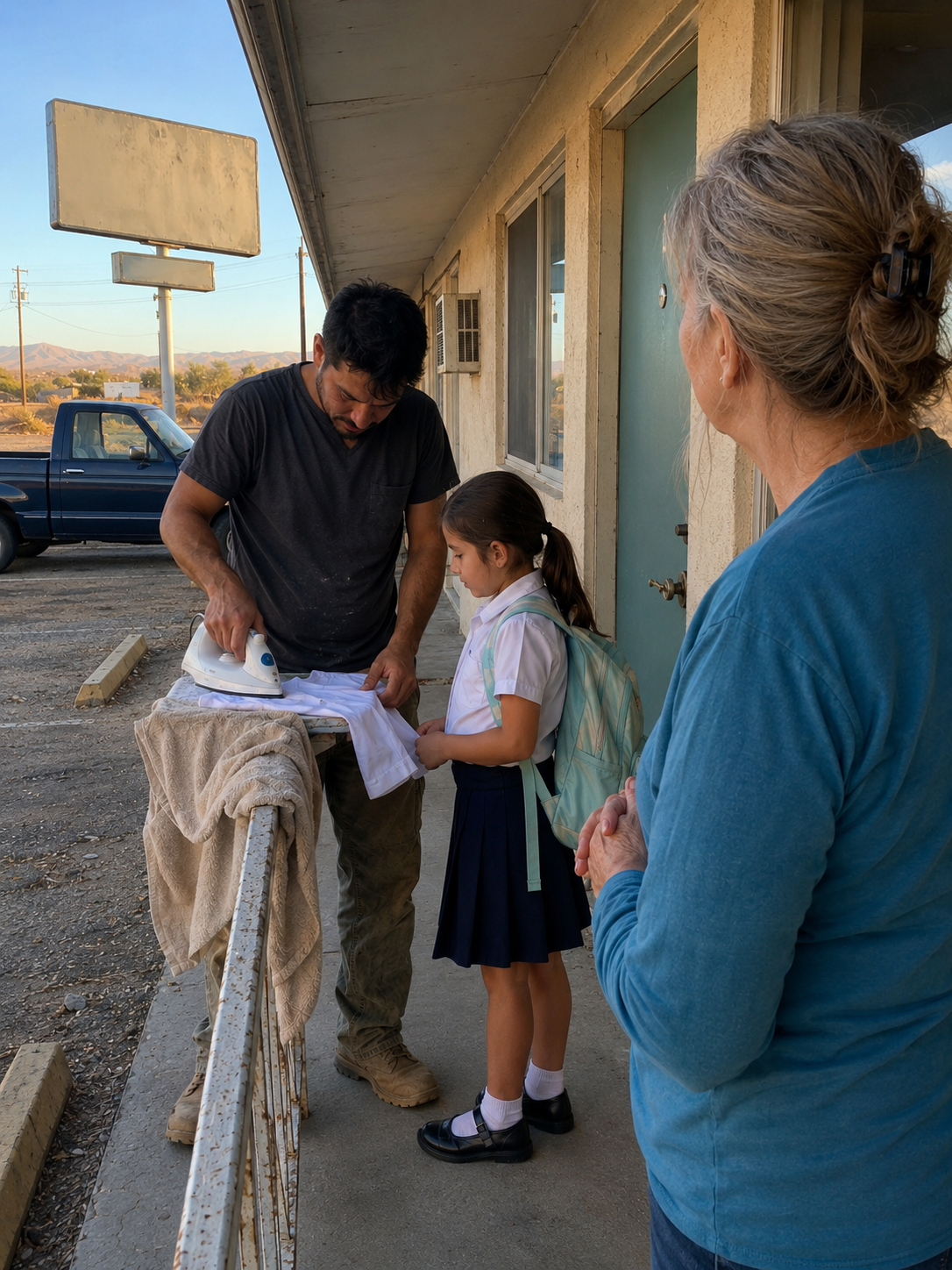
Caleb was standing on the walkway. He had borrowed the little iron we kept behind the front desk. Rosie’s white school blouse was laid across a towel on the railing. He pressed every wrinkle slowly. Not well, exactly. The man clearly had no idea how to iron. He burned his finger once, shook his hand, then tried again.
I know you’re curious to see what happens next, so please be patient and continue reading in the comments below. Thank you for understanding the inconvenience. Please leave a “YES” below and give us a Like to get the full story. 👇to part 2.
—
Part 2: The Truth
A few minutes later, Rosie came outside carrying a backpack. Her hair was brushed neatly. Her shoes were scuffed, but clean. Caleb knelt and fixed her collar. “You look sharp, kiddo.” She smiled. “You missed a wrinkle.” He leaned back like he had been deeply insulted. “Impossible. I am a professional.” She laughed. Then he handed her a granola bar and watched her walk toward the bus stop.
After she left, Caleb sat on the curb. He looked exhausted. I stepped closer. “You sleeping in your truck?” He froze. For a second, I saw embarrassment cross his face. Then he nodded. “Sometimes.” “Why?” He looked toward Room 12. “She sleeps better alone in the bed.”
I didn’t understand. Then he told me. Their rental house had caught fire three weeks earlier. Nobody was hurt, thank God. But nearly everything they owned was gone. His landlord’s insurance covered the building, not their belongings. Caleb had been taking every carpentry job he could find while trying to save enough for another deposit. Rosie’s school had given her two used uniforms. He washed them in the motel sink at night. Some nights he slept beside her. Some nights, when his back was aching and Rosie was restless, he went outside and slept in the truck so she could stretch out.
“I just don’t want her feeling homeless,” he said quietly.
That sentence stayed with me. I had been ready to throw them out because of wrinkled cash and an old truck. Meanwhile, that man was doing everything he could to make sure his daughter still woke up feeling like a regular little girl going to school.
I walked back into the office and threw away my sticky note. When Caleb came to pay that afternoon, I slid half the money back across the counter. He stared at it. “Ms. Vale, this isn’t enough.” “It is now.” “I can’t take charity.” “Good,” I said. “Because I’m not giving you any.” I pointed toward the busted wooden gate beside the laundry room. “You’re a carpenter, aren’t you?” His eyebrows went up. “Licensed.” “Fix that gate when you’ve got time. We’ll call it even.”
That gate was worth maybe thirty dollars. I knocked nearly half off his room rate for six weeks. Neither of us mentioned the math.
I know you’re curious to see what happens next, so please be patient and continue reading in the comments below. Thank you for understanding the inconvenience. Please leave a “YES” below and give us a Like to get the full story. 👇to part 3.
—
Part 3: The Return
Rosie started doing her homework at the little breakfast table in the office. Sometimes I helped her with spelling. Sometimes she helped me open jars on bad arthritis days. Caleb repaired the gate. Then a shelf. Then three loose stair rails. Then the sagging frame around Room 7. He never let me pay him much. “Call it rent,” he’d say.
Eventually, he found a small apartment. On their last morning, Rosie hugged me around the waist. Caleb shook my hand gently because he knew my fingers hurt. “Someday,” he said, “I’ll pay you back properly.” I told him he already had.
I thought that was the end of it. It wasn’t.
About nine months later, a developer came through town buying old roadside properties. By then, my motel was in bad shape. The roof needed work. Three rooms were unusable. The plumbing kept eating money. The developer made an offer. It wasn’t generous. But it was enough for me to walk away.
I sat in the office that night staring at the papers. I cried harder than I expected. That motel had belonged to my parents before me. My father poured the concrete around the pool himself. My mother planted the desert willow near the office. Selling it felt like admitting the place—and maybe I—had reached the end.
I had almost decided to sign when someone knocked. Caleb stood outside. Behind him were six pickup trucks. Then another pulled in. Then another. A former truck driver who had stayed with us during a breakdown climbed out carrying tools. A retired couple who used to stop every winter brought paint. A traveling nurse who had spent three months in Room 6 showed up with sandwiches. Two construction workers arrived with ladders. One family brought their teenage sons.
I stood there speechless. Caleb smiled. “Rosie heard you might sell.”
Apparently, Rosie had told her father that Room 12 was the place where “we stopped being scared.” So Caleb started making calls. He called people he remembered meeting at the motel. They called others. For three weekends, that parking lot looked like a neighborhood barn raising from fifty years ago.
Caleb rebuilt the damaged stairs. Someone repaired the roof. Someone else repainted the doors. A plumber replaced bad fixtures for the cost of materials. Rosie, now nine, painted little clay pots and lined them outside the office with desert flowers.
I kept trying to protest. Nobody listened. One afternoon, Caleb was replacing warped trim outside Room 12 when I asked him why he was doing all this. He stopped hammering. “You gave my daughter dignity when I couldn’t afford much else.” I looked away because I was crying. He continued. “You didn’t make us feel like a problem.”
That part hurt. Because the truth was, at first, I had. I had looked at his truck. His cash. His clothes. His uncertainty. And I had decided I knew his story. I didn’t.
A year later, the motel was profitable again. Not wildly profitable. But enough. The neon sign still buzzed. The ice machine was still temperamental. My hands still hurt. But Room 12 had fresh paint, new curtains, and a framed crayon picture Rosie gave me hanging beside the mirror. It showed a little brown motel with yellow windows. Underneath, in a child’s handwriting, she had written: “THE PLACE THAT KEPT US SAFE.”
I still think about how close I came to telling them to leave. Sometimes the people who look like trouble are simply people carrying more trouble than we can see. And sometimes the kindness you offer when nobody is watching comes back years later carrying ladders, paintbrushes, and a whole parking lot full of people.
Never judge someone by the chapter you walked in on. You may be standing inside the hardest page of their life.
Caleb and Rosie still visit. They stay in Room 12 every summer. Rosie is in high school now, still polite, still bright. And every time she walks past the office, she waves at me like I’m family. Because I am. That’s what happens when you stop seeing someone as a problem and start seeing them as a person.
The motel is still mine. It’s still old. It’s still not fancy. But it’s full. Full of stories. Full of kindness. Full of people who remember what it felt like to be welcomed when they had nowhere else to go.
And that, I’ve learned, is worth more than any offer a developer could make. ❤️