Part 1: The Stop
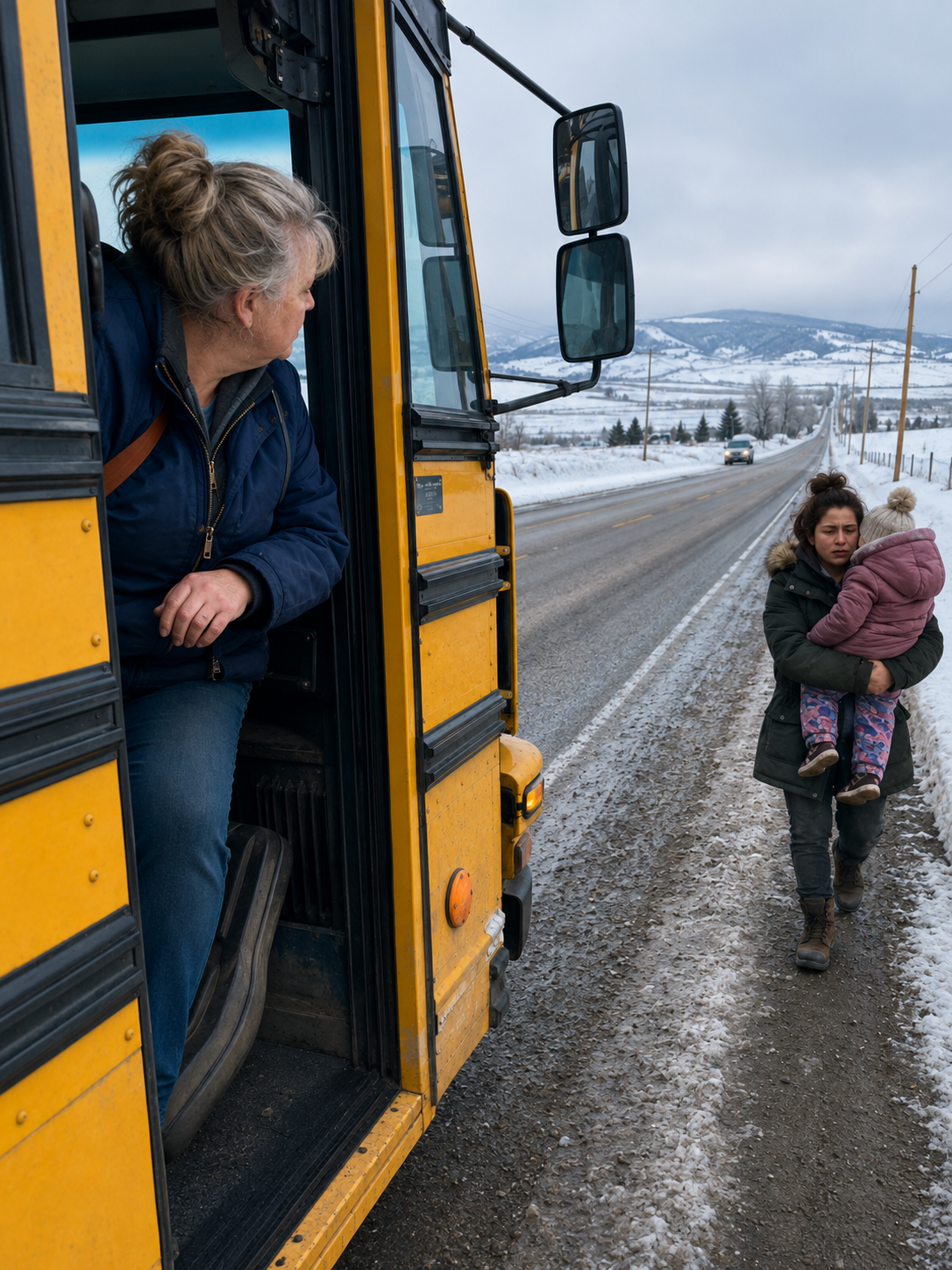
I saw the little girl’s bare hand first. It was sticking out from under a pink blanket as her mother walked along the shoulder of a two-lane Montana highway, fighting a wind so sharp it made my bus shake.
I had six students left on board. The temperature outside was 14 degrees. And I knew exactly what the rule said. Do not allow unauthorized passengers onto the school bus. I also knew something else. I had already been warned once that year for making an unscheduled stop. One more violation could cost me my job.
At 58 years old, I couldn’t afford that. My husband, Dean, had Parkinson’s. Some mornings, I buttoned his shirt before I buttoned my own. Some nights, I helped him from the kitchen table to his recliner one careful step at a time. My paycheck wasn’t extra money. It was groceries, heating oil, prescriptions, and the mortgage on the little house where we had raised our children.
So I kept driving. For maybe three seconds. Then I looked at that toddler again. “Mrs. Dray,” a boy behind me said quietly, “is that lady carrying a baby?” I pulled the bus over. Even now, I remember the sound of the air brakes better than almost anything else.
The young woman stopped walking. She looked terrified. Not relieved. Terrified. I opened the door. “You need a ride?” She shook her head quickly. “I’m okay.” Nobody walking seven miles in Montana winter carrying a toddler is okay. I told her that. She looked down at the little girl wrapped against her chest, then back at me. “My sister lives outside town,” she said. “I’m trying to get there.” “What happened to your car?” “I don’t have one.” There was something in the way she said it that stopped me from asking anything else in front of the children.
I looked at the clock. I looked at the empty front seat. Then I looked at the rule sheet clipped above my windshield. “Get in.”
Her name was Kayla. I recognized her after she pulled down her hood. She had ridden my bus years earlier. Quiet girl. Always sat three rows back. Always thanked me when she got off, even when the other kids were already halfway down the road. “Colleen?” she said. That almost broke me. Because suddenly I didn’t see a 24-year-old woman standing there. I saw the skinny eighth grader who used to carry library books in a backpack held together with silver tape.
She climbed aboard with her daughter. The little girl’s cheeks were bright red from the cold. I turned the heater up. One of my students offered her a pack of crackers without being asked. Another moved his backpack so Kayla could sit near the front. Nobody laughed. Nobody complained about the delay. Maybe kids understand more than we give them credit for.
Once we dropped off the last student, I asked Kayla where her sister lived. She gave me an address seven miles away. Then she started crying. Quietly. Like she was embarrassed to be doing it. She told me she had left a home where she no longer felt safe. She had packed one diaper bag, two changes of clothes, her daughter’s stuffed rabbit, and less than forty dollars. She had called her sister, but her sister was working and couldn’t leave until evening. Kayla thought she could walk the distance. “I just needed to get my baby somewhere warm,” she whispered.
That was the moment I stopped worrying about my job. Not because I suddenly became brave. I wasn’t. I was scared to death. I simply knew that if I made her get out of that bus because a handbook told me to, I would remember it every time I looked in the mirror. So I drove her to her sister’s house. When we pulled into the gravel driveway, a woman came running from the porch without a coat. Kayla stepped off the bus, and her sister wrapped both arms around her. Then she reached for the toddler. Before Kayla walked away, she turned back. “Thank you, Mrs. Dray.” I said the same thing I had told hundreds of kids over the years. “Get inside where it’s warm.”
I thought that was the end of it. It wasn’t.
I know you’re curious to see what happens next, so please be patient and continue reading in the comments below. Thank you for understanding the inconvenience. Please leave a “YES” below and give us a Like to get the full story. 👇to part 2.
—
Part 2: The Report
Someone driving past had photographed my bus stopped along the highway. By the next morning, the transportation office had the picture. Two days later, I was called in. Unauthorized passenger. Unapproved route deviation. Failure to follow transportation policy.
I understood why the rules existed. School districts can’t have drivers picking up strangers. Parents trust us with their children. I knew that. But knowing the reason didn’t make the knot in my stomach any smaller.
Dean sat at the kitchen table the night before my disciplinary hearing, trying to steady a spoon in his trembling hand. “What happens if they fire you?” he asked. I stared at my coffee. “We figure it out.” He gave me a tired smile. “You’d stop again.” It wasn’t a question. I looked at him. “Yes.” He nodded. “Then don’t be ashamed tomorrow.”
I barely slept. The hearing was held in a plain meeting room with beige walls and folding chairs. My supervisor was there. Two district officials were there. A representative from transportation was there. And on the table sat the photograph of my bus on the shoulder of the highway.
I explained everything. No excuses. No dramatic speech. I told them I knew the rule and broke it anyway. One official asked, “Mrs. Dray, if faced with the same situation tomorrow, what would you do?” I swallowed. “Probably lose my job twice.” Nobody laughed.
Then the door opened. A man I didn’t recognize stepped inside. He was maybe in his early sixties, wearing work boots and a heavy brown jacket. He looked uncomfortable. He asked if he could speak. My supervisor frowned.
Then the man said something I never expected. “I’m the one who reported her.”
The room went silent. My stomach dropped.
His name was Glenn. He explained that he had been driving behind my bus that afternoon. He saw me stop for an adult woman. He saw her climb aboard. He took the photograph because he thought I was ignoring safety rules. “I have grandkids on these buses,” he said. “I figured rules mattered.”
Then he looked at me. “But I didn’t know the story.” Apparently, after making the report, Glenn mentioned what he had seen to a neighbor. That neighbor knew Kayla’s sister. Within a day, he learned why Kayla had been walking. Glenn said he had spent the next night thinking about the photograph. “I saw a rule being broken,” he said. “I didn’t see a mother carrying a child down a freezing highway.”
Then he turned toward the officials. “If you need someone to blame, blame me for assuming the worst before I knew anything.”
I know you’re curious to see what happens next, so please be patient and continue reading in the comments below. Thank you for understanding the inconvenience. Please leave a “YES” below and give us a Like to get the full story. 👇to part 3.
—
Part 3: The Lesson
Nobody spoke for several seconds. Glenn continued. “I still believe rules matter. But I also hope the person driving my grandkids home knows when being human matters too.”
I stared at the table because I could feel tears coming. In the end, I wasn’t fired. I received a formal warning and a long reminder about procedure. I signed it gladly. The district later reviewed what drivers should do when they encounter stranded people during dangerous weather, so nobody would have to make that kind of decision alone again.
But the part I remember most happened in the parking lot. Glenn was waiting beside my old pickup. “I’m sorry,” he said. I told him he had been trying to protect children too. He shook his head. “Maybe. But I learned something.” “What’s that?” He looked toward the school buses lined up behind us. “A picture can show what somebody did. It can’t always show why.”
A few months later, Kayla came by our house. She brought her little girl, a pan of cinnamon rolls, and a card made from folded construction paper. Inside was a crayon drawing of a yellow bus. Underneath, in Kayla’s handwriting, were six words: “You stopped when I needed someone.”
That card still sits on our refrigerator. Dean’s hands shake more now. My hair is grayer. And I eventually retired from driving children down those snowy country roads. But sometimes I think about that afternoon. About rules. About fear. About Glenn walking into that hearing when he could have stayed home. About a bus full of children who watched an adult make a difficult choice. And about a young mother who simply needed one person to open a door.
We spend a lot of our lives deciding who deserves our patience, who deserves another chance, and whether helping someone is worth the inconvenience. Sometimes we get it wrong. Sometimes we judge before we understand. And sometimes the most important thing we can do is admit it and become better than we were yesterday.
Because rules may tell us where we are supposed to stop. But kindness is knowing when you shouldn’t keep driving.
I still think about Kayla sometimes. I wonder how she’s doing. I hope she found the peace she was looking for. And I hope her little girl knows that there are people in this world who will stop, even when it costs them something.
That’s what I learned from that freezing afternoon on the highway. Rules are important. Safety is important. But so is compassion. So is seeing the person behind the situation. So is being willing to risk something for someone else.
Glenn taught me that. Kayla taught me that. And those six kids on the bus that day taught me that too. They watched me make a choice. And they learned that sometimes, the right thing isn’t the easy thing.
I don’t regret stopping. I never will. And I hope, wherever she is, Kayla knows that I would do it again. Every single time.
Because when you’re holding a child in the cold, and someone opens a door, that’s not a rule. That’s a miracle.
And miracles are worth breaking rules for. ❤️

The story is so moving. Doing the right thing, at the moment, is so important…definitely a moral judgment.
What really bothers me in these stories is the graphic and immoral ADS posted throughout the story parts. I, angrily, pass through them because of the simple, yet prophetic moral of the story. Can you imagine how many readers you could have if you remove the obscene ADS??