Part 1: The Invasion
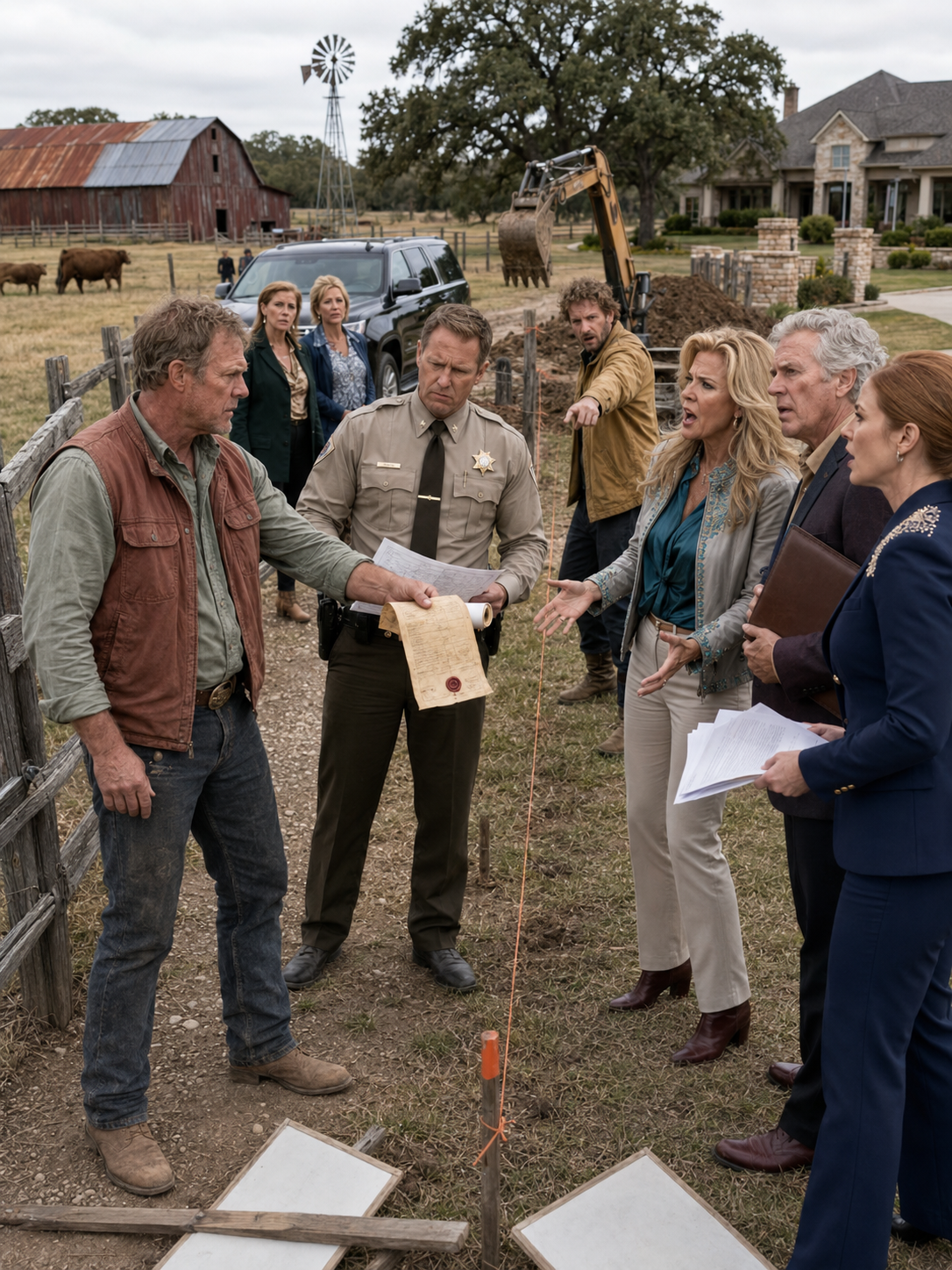
The first man through my gate cut the chain with a county-owned bolt cutter. The second handed me a court order that had never been signed by a judge. The third looked across the pasture my family had owned for four generations and said, “You have forty-eight hours to remove your cattle from HOA property.”
I didn’t raise my voice. I didn’t threaten anyone. I folded the unsigned order along its existing crease, handed it back to the attorney, and asked one question. “What time did Judge Whitmore supposedly sign this?”
The attorney blinked. Behind him, fifty black Angus cattle grazed beneath the September sun. Their shadows stretched across the yellow grass. A windmill squeaked near the stock pond. Dust clung to the boots of the deputy standing beside the gate.
The HOA president stepped forward before he could answer. Her name was Vivian Cross. She was fifty-six, polished, wealthy, and accustomed to people moving when she pointed. Her white SUV waited behind the sheriff’s cruiser with its engine running. Two private security trucks idled farther down the road.
Vivian wore cream trousers, a dark green blazer, and sunglasses large enough to hide half her face. “Mr. Mercer, this situation has already been decided. Your family has occupied community land for years without authorization. We’re giving you the courtesy of leaving peacefully.”
I looked past her. Beyond the cattle guard stood three men in matching gray uniforms. One held a roll of orange construction fencing. Another carried metal signs marked PROPERTY OF SILVER CREEK HOA. The third was unloading survey stakes. They had brought a locksmith to my ranch. They had brought armed guards. They had brought paperwork they hoped I wouldn’t read. They had brought everything except the one thing they needed. Ownership.
My name is Caleb Mercer. At the time, I was forty-nine years old, and I owned Red Hollow Ranch, 2,860 acres of limestone ridges, oak groves, cattle pasture, and spring-fed creek bottom in Grayford County, Texas. The ranch had been in my family since 1919. My great-grandfather bought the first 640 acres after returning from France. My grandfather expanded it during the cattle slump of the 1970s. My father kept it alive through drought and debt.
I grew up repairing fence after thunderstorms and checking water troughs before school. Then I left. I studied civil engineering at Texas A&M, spent twelve years working on transportation and land-development projects, and returned when my father’s heart began failing. By the time he died, I understood two things he had always known: land remembers every promise made over it, and men who want it cheaply will always tell you the paperwork is too complicated to understand.
Silver Creek Estates bordered the eastern side of Red Hollow. It had started as twenty-eight expensive homes around a manufactured lake. Over eighteen years, it became 176 houses, a clubhouse, tennis courts, and a private entrance. Most residents were decent people—doctors, teachers, retired military families. The problem was the board. More specifically, the problem was Vivian Cross. She had become HOA president six years earlier. Since then, dues had doubled and fines had tripled. Control had become her business.
Three months before she arrived with deputies, Silver Creek announced a new expansion called The Preserve—eighty-four luxury homes, an equestrian center, a spa, and a private vineyard. The proposed land was my east pasture. No one had asked me to sell it. That assumption lasted until Vivian walked into my kitchen on a Tuesday afternoon carrying a bottle of bourbon and an offer for $3.2 million—less than half of what the land was worth.
I know you’re curious to see what happens next, so please be patient and continue reading in the comments below. Thank you for understanding the inconvenience. Please leave a “YES” below and give us a Like to get the full story. 👇to part 2.
—
Part 2: The Deed
I poured Vivian coffee instead of bourbon. She sat at my father’s oak table and explained that Red Hollow had become “economically incompatible” with Silver Creek. Cattle created odors. Tractors created noise. My fences disrupted the “visual continuity” of the community. After fifteen minutes, she slid a purchase contract toward me. The buyer wasn’t the HOA. It was a limited-liability company called Halcyon Residential Partners.
I didn’t sign. I said I’d think about it. She left, and I spent the night in my father’s study, going through old documents. At the bottom of a trunk, beneath tax records and faded photographs, I found a leather-bound envelope. Inside was a deed from 1919—the original transfer from the state of Texas to my great-grandfather.
But there was something else. A folded map, brittle with age, showing the original boundaries of the property. I spread it across the desk and traced the lines with my finger. The eastern boundary extended farther than I had ever known. Much farther. It didn’t stop at my fence line. It continued past Silver Creek Estates, past the manufactured lake, past the clubhouse, and all the way to the county road.
My grandfather had never sold that land. He had never even mentioned it. But the deed was clear. The HOA’s neighborhood—all 176 houses—had been built on land that legally belonged to my family. The map had been filed with the county in 1919 and never updated. Silver Creek had been built on a mistake. Or a lie.
I called my attorney, Marta Reyes. She spent the next week verifying the records. When she called me back, her voice was shaking. “Caleb, it’s true. The HOA has no legal claim to the land. The original survey was never corrected. They built an entire neighborhood on your property.”
I know you’re curious to see what happens next, so please be patient and continue reading in the comments below. Thank you for understanding the inconvenience. Please leave a “YES” below and give us a Like to get the full story. 👇to part 3.
—
Part 3: The Reckoning
The morning Vivian arrived with deputies, I didn’t threaten anyone. I didn’t even argue. I simply smiled, walked back into my house, and brought out the leather-bound envelope. I handed the map to the attorney. “You might want to look at this,” I said.
He unfolded it, his eyes scanning the lines. His face went pale. “This can’t be right.”
Vivian snatched the map from him. She stared at it, her jaw tightening. “This is a forgery.”
“It’s been on file with the county since 1919,” I said. “Your neighborhood was built on my family’s land. Every house. Every tennis court. Every walking trail. You’ve been paying HOA dues on property you don’t own.”
The attorney stammered. The deputies exchanged uncertain glances. Vivian’s perfect composure cracked. “We’ll fight this,” she said. “We’ll take you to court.”
“Take me to court,” I said calmly. “But while you’re doing that, I’ll be filing trespassing notices for every house in Silver Creek. I’ll be sending eviction notices to every homeowner. I’ll be charging the HOA for eighteen years of unauthorized land use. And I’ll be suing Halcyon Residential Partners for fraud.”
Vivian’s face went white. She backed away, got into her SUV, and drove off without another word. The deputies followed, their tails between their legs. The surveyors packed up their stakes and left. The attorneys disappeared.
I stood alone in my pasture, watching the dust settle. My cattle grazed peacefully. The windmill squeaked. The sun continued its slow arc across the sky.
The next day, I called a town meeting. I invited every resident of Silver Creek Estates—all 176 families. They filled the high school gymnasium. Some were angry. Some were scared. Most were confused.
I stood at the podium and told them the truth. “Your neighborhood was built on land that belongs to my family,” I said. “But I’m not here to evict you. I’m not here to sue you. I’m here to tell you that you have a choice.”
I explained that the HOA had been charging them for land they didn’t own. I explained that Vivian Cross had been using their dues to enrich herself. I explained that the board had been operating without any legal authority for years. And I offered them a solution. I would sell them the land their homes were built on—for a fair price. Not the inflated value the HOA had been charging. A fair price. And the HOA would be dissolved.
The room erupted in applause. People stood and cheered. They thanked me. They hugged me. And they immediately began organizing to remove Vivian from power.
Within a month, Silver Creek Estates had a new board. The residents voted to dissolve the old HOA and establish a new one—with transparent finances, fair dues, and a board that actually represented them. Vivian Cross resigned in disgrace. The development company behind The Preserve quietly withdrew their plans.
And I became the unlikely hero of the neighborhood I had never wanted to join. I kept my ranch. I kept my cattle. I kept my land. And I made a choice that surprised everyone. I donated the land for a community park—a green space that would belong to everyone, free of charge. The park was named after my grandfather. A small bronze plaque read: “Dedicated to those who believe land is meant to hold people together, not keep them apart.”
I still run cattle on Red Hollow. I still hear the windmill squeak. But now, when I look toward the eastern boundary, I don’t see an enemy. I see neighbors. Friends. Families who chose to stay because I chose to be generous.
Sometimes, the right thing isn’t about winning. It’s about showing people that they can trust you. It’s about turning an enemy into an ally. It’s about remembering that land is not just ownership—it’s connection.
The HOA came to take my ranch. Instead, they gave me a community. And I gave them a home. ❤️