Part 1: The Tap
The first tap came at 5:38 a.m. It was so faint that I continued measuring flour. Freezing rain clicked against the windows, the mixer vibrated across the stainless-steel counter, and warm air from the ovens fogged the front glass from inside. Then came a second tap. This one was slower.
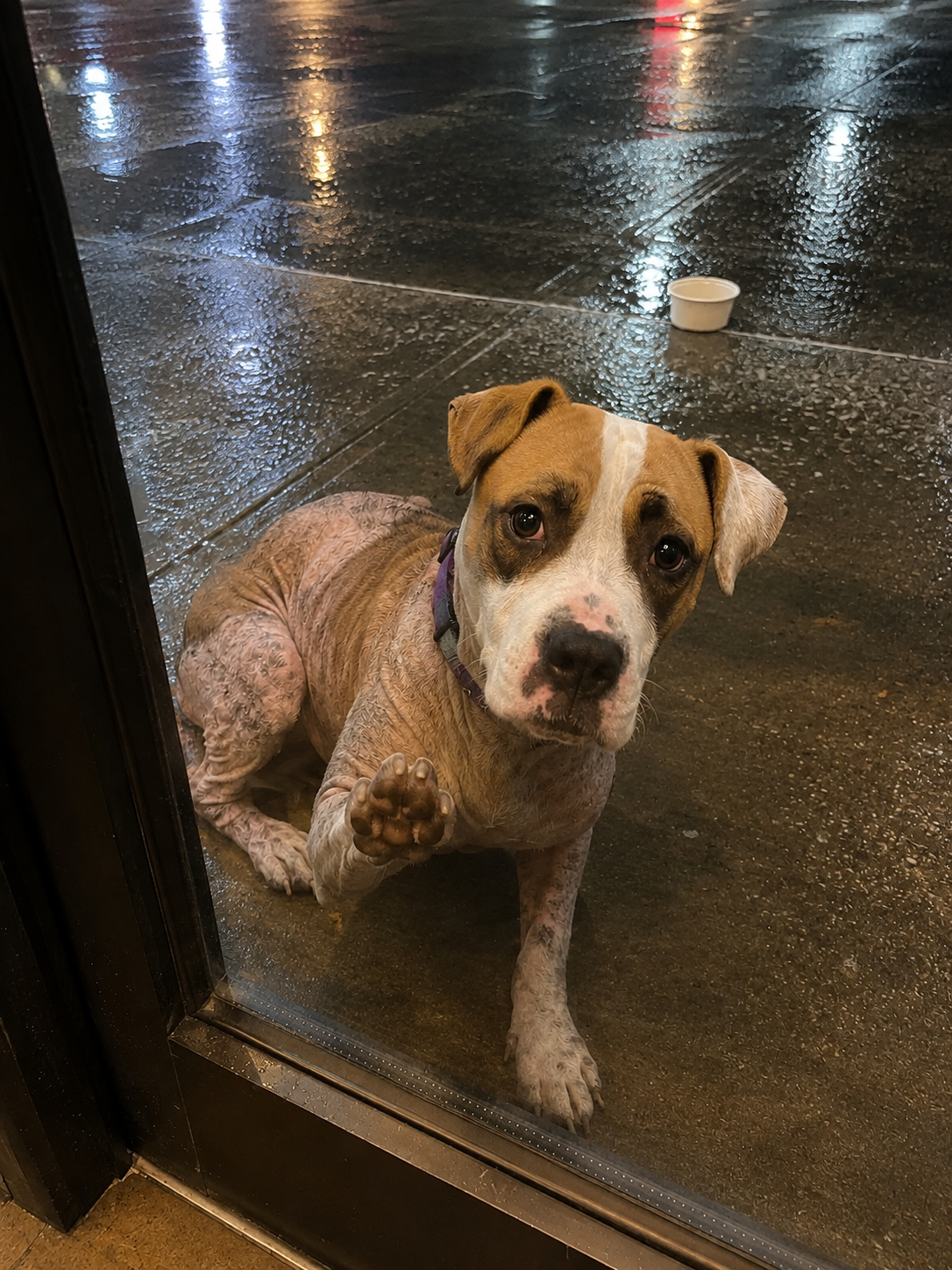
I stepped out of the kitchen and saw a paw resting against the bottom of the locked entrance. Beneath it lay a dog so motionless that, for one second, I thought someone had abandoned an old blanket against the door. When I switched on the dining-room lights, she raised her head.
She was a small, underweight Pit Bull mix with tan fur, a white stripe down her muzzle, and a dark patch around her left eye. Her right ear folded forward while the left remained pinned against her head. A faded lavender collar hung loosely around her neck. Most of the fur across her shoulders, ribs, flanks, and tail base was gone. The exposed skin was dry and gray-pink, with roughened areas where she had likely rubbed or scratched herself. Nothing was bleeding, but in eighteen-degree weather, the missing coat created a danger visible even to someone without veterinary training.
The dog opened her mouth as if she were barking. No sound came. She raised her right paw and touched the glass again. Tap.
My name is Elena Ramirez, and I opened Linden Street Bakery before sunrise. People sometimes left bags of clothing beneath our awning or pushed shopping carts into the alley, but no animal had ever waited against the entrance like that.
I knelt on the warm side of the glass. The dog’s eyes tracked me. She did not wag her tail or press her face to the door. She merely kept her paw against the pane until the muscles in her leg began to tremble.
I called the county animal-response line and reported a dog showing signs of cold exposure. The dispatcher asked whether she was conscious, whether her breathing was regular, and whether I could move her into the vestibule. I looked at the door. It swung outward directly against her body. “We can’t open it,” I said.
The dispatcher told me to use another exit, approach slowly, and avoid sudden warming. Hot water, vigorous rubbing, or direct heat could cause additional problems in a severely chilled animal. I was to protect her from wind, provide a dry barrier beneath her if possible, and wait for the rescue officer.
I know you’re curious to see what happens next, so please be patient and continue reading in the comments below. Thank you for understanding the inconvenience. Please leave a “YES” below and give us a Like to get the full story. 👇to part 2.
—
Part 2: The Silence
I collected a rubber mat, fleece blanket, and a shallow bowl of warmed canned food. The side delivery door opened into an alley covered with hard pellets of ice. When I rounded the building, the dog heard my shoes scraping behind her. Her head lifted, and her front legs pushed against the concrete. For an instant, she appeared ready to flee. Then her hindquarters failed to rise.
I stopped and turned sideways. The dog watched me with her ears flattened. Her mouth remained slightly open, but she still could not bark. I laid the mat on the ground and slid it toward her without entering the distance that made her recoil. She smelled the food but did not move. Her breathing was slow enough that I began counting each rise of her ribs.
The store manager arrived and parked his car between the sidewalk and the nearest lane, creating a barrier in case she tried to reach the street. He remained inside the vehicle so we would not surround her. At 5:49, the dog attempted to tap the door again. Her paw rose only two inches.
The rescue truck turned onto Linden Street at that exact moment, its lights reflecting across the wet storefront. The dog saw the unfamiliar vehicle, pressed herself closer to the glass, and began shaking harder. The officer stepped out carrying a low stretcher and warming blankets. He did not walk directly toward her. He crouched beside me and watched the same shallow breaths. Then he pointed to the concrete beneath her chest. A thin layer of ice had formed where her body heat had melted the sleet and the temperature had frozen it again. Moving her carelessly could pull at the dry, exposed skin along her underside.
We needed to separate her from the ground without frightening her into struggling. The officer placed the stretcher several feet away, opened a thermal blanket, and asked me to remain where she could see me. I extended my hand along the pavement. The dog’s paw moved from the glass. Slowly, she reached toward my fingers.
What happened next revealed just how cold she had become—and why the silence behind that attempted bark was more serious than any of us expected.
I know you’re curious to see what happens next, so please be patient and continue reading in the comments below. Thank you for understanding the inconvenience. Please leave a “YES” below and give us a Like to get the full story. 👇to part 3.
—
Part 3: The Paw
Her paw touched my fingers. It was cold. Not just cool from the ice, but dangerously cold—the kind of cold that steals heat from living tissue. The officer moved quickly but calmly, sliding the stretcher beneath her body as she focused on my hand. She didn’t struggle. She didn’t growl. She just kept her paw against my fingers, as if she understood that I was the only warmth she could trust.
We wrapped her in the thermal blanket and carried her inside the bakery. The officer placed her on the mat near the oven, where the warmest air pooled. She lay still, her eyes half-closed, her breathing still shallow. I knelt beside her and gently rubbed her shoulders through the blanket, careful not to create friction on her exposed skin.
The officer examined her collar. “No tags,” he said. “But she’s been wearing this for a while.” He checked her microchip with a handheld scanner. A number appeared on the screen. He called it in. “She’s registered. Her name is Peaches. And she belongs to someone.”
My heart lifted. “Can we call them?” The officer’s face tightened. “The number on file has been disconnected.” He paused. “But there’s another record. A veterinary clinic on the other side of town. They might know something.”
We wrapped Peaches in blankets and drove her to the clinic. The vet examined her, listened to her chest, and checked her temperature. Her hypothermia was severe, but she was stable. “She’s been like this for a while,” the vet said. “The fur loss, the weight—this isn’t just from one night. She’s been neglected for weeks, maybe months.”
My stomach turned. I looked at Peaches, who was now lying on a heated table, watching me with those soft, tired eyes. “Why would someone do that to her?” The vet shook her head. “I don’t know. But I do know she found you for a reason.”
The vet gave Peaches fluids, warmed her slowly, and let her rest. I stayed by her side. I missed my shift. I called the store manager and told him I wouldn’t be in. He understood.
Hours later, Peaches opened her eyes. She looked at me. Then she lifted her paw and placed it on my hand. Tap. That one was different. It wasn’t desperate. It was grateful.
I looked at the vet. “I want to adopt her.”
The vet smiled. “I was hoping you’d say that.”
Peaches came home with me that night. She was weak, but she was alive. I made her a soft bed in the corner of my kitchen, near the warmest spot. She slept for twelve hours straight. When she woke, she looked at me, and her tail wagged—just once. But it was enough.
We never found her original owners. The number was disconnected, and the address on file led to an empty house. Someone had left her behind. But I never left her behind again.
Peaches recovered slowly. Her fur grew back. Her weight returned. She learned to trust again. She followed me everywhere—to the bakery, to the store, to the park. She never tried to run. She never barked. She just stayed close, like she was making sure I wouldn’t disappear too.
A year later, I brought Peaches to the animal shelter where she had been found. I wanted to thank the officer who had helped us. He recognized her immediately. “She looks like a different dog,” he said. “She looks happy.” I smiled. “She is.”
Peaches stood beside me, her tail wagging, her eyes bright. She was no longer the cold, silent creature on the doorstep. She was warm. She was safe. She was home.
I thought about that first morning often. The freezing rain. The silent bark. The paw against the glass. I thought about how easy it would have been to ignore her, to assume someone else would help. But I didn’t. I opened the door. I let her in. And she changed everything.
Sometimes, the most broken things need the most love. And sometimes, the smallest act of kindness can turn into the greatest gift.
Peaches is still with me. She still taps her paw against things when she wants attention. She still doesn’t bark. But she doesn’t need to. Her silence says everything—that she survived, that she trusted, and that she chose me.
I chose her too. And I’ll always be grateful for the tap that led her to my door. ❤️