Part One — The Route My Father Never Told Me About
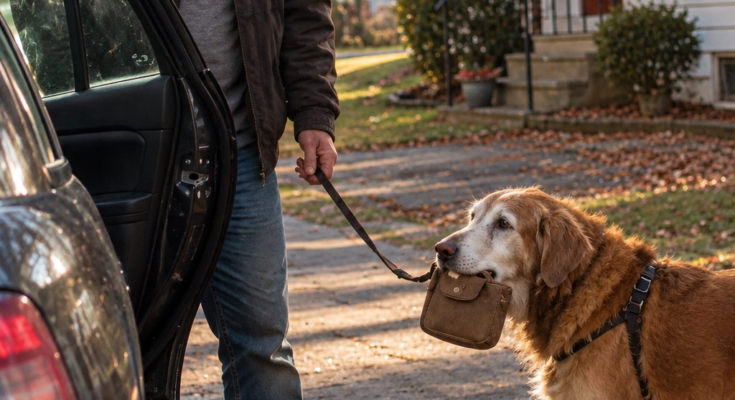
The morning after my father’s funeral, I was taking his old dog to a shelter when Ruby refused to get into my car.
She just stood there.
Eleven years old, gray around the muzzle, one bad hip, staring at me like I was the one who didn’t understand what was happening.
“Come on, girl,” I said. “We have to go.”
Ruby backed away.
Then she disappeared into my father’s house and came back carrying a faded canvas pouch in her mouth.
That stopped me.
I’d seen that pouch before. My father, Clifford Brennan, clipped it to Ruby’s harness almost every time he walked her.
I’d never asked why.
There were a lot of things I never asked my father.
Clifford was seventy-one when he died. He had spent most of his life repairing appliances and most of my life speaking in sentences shorter than grocery lists.
When I graduated college, he said, “Good. Keep going.”
When I got promoted, he said, “Don’t get comfortable.”
When my marriage fell apart, he asked, “You eating?”
That was my father.
No hugs. No long talks. No “I’m proud of you.”
So after the funeral, I planned to sell his small Pennsylvania house, clear out the garage, find Ruby a good place, and get back to my life in Colorado.
Simple.
Ruby had other plans.
I clipped on her leash and said, “One last walk.”
She pulled me three blocks farther than I expected.
Then six.
Then almost a mile.
She stopped beside an old garage behind a small house. Under the awning sat a beat-up refrigerator with a handwritten sign taped to the door:
TAKE WHAT YOU NEED. LEAVE WHAT YOU CAN.
Inside were canned vegetables, peanut butter, pasta, cereal, baby food, and a few bags of dog food.
I almost smiled.
Then I noticed the toolbox beside it.
My father’s toolbox.
I knew the scratches on the handle.
Inside were copies of repair slips.
Broken heater.
Washer not draining.
Refrigerator not cooling.
Every bill had the same word written across the bottom in Clifford’s blocky handwriting.
PAID.
No customer names.
No amounts owed.
Nothing.
I stood there longer than I’d like to admit.
My father once made me buy my own replacement toaster when I was nineteen because, according to him, “You broke it.”
Apparently strangers got a better deal.
That thought made me angry.
I didn’t want to turn him into some saint just because he was dead.
If he had all this kindness in him, where had it been when I was growing up?
Ruby tugged the leash.
We kept walking.
Her next stop was a bus shelter near the edge of a high school.
Nobody was there.
Ruby climbed onto the bench and sat like she had done it a thousand times.
Under the seat, taped out of the rain, was a plastic container.
Inside were granola bars, hand warmers, and several prepaid bus passes.
There was also a note.
FOR THE KID WHO WAITS LATE. NO QUESTIONS.
I knew that handwriting too.
Suddenly I remembered something.
For years, my father never answered my calls on Tuesday afternoons.
“Busy,” he’d say later.
I always imagined him watching television or fixing something nobody had asked him to fix.
Now I wondered if he had been sitting right here with Ruby, making sure some kid didn’t wait alone.
I hated that thought.
Not because it was bad.
Because it was good.
And I didn’t know what to do with a good version of my father I had never met.
Ruby pulled again.
Her third stop was a wooden food cabinet built along a fence at the end of another street.
I recognized the wood immediately.
It came from Dad’s garage.
One hinge sat slightly crooked. My father always mounted hinges that way after an old wrist injury made his left hand stiff.
The cabinet was nearly empty.
Ruby sat down in front of it.
She wouldn’t move.
I opened the canvas pouch.
There was an envelope inside.
Fifty dollars.
And a little handwritten list.
Thursday — porch.
Tuesday — bus stop.
Sunday — pantry.
Those were the same days my father always seemed too busy to talk.
Then I found a hidden fold inside the pouch.
There was one more note.
My name was written across the top.
I sat down on the curb.
Ruby lowered herself beside me.
The note began:
Claire—
If you found this, Ruby got stubborn. She does that when she thinks somebody needs telling twice.
I laughed once.
Then I kept reading.
The money is for the pantry. Thursday porch belongs to Mrs. Alvarez. Her freezer works when it feels like it. Tuesday bus stop is mostly for whichever kid misses the late bus. Don’t go asking names. That’s not the point.
Then the handwriting became shakier.
You don’t have to keep doing any of this. Sell the house. Give the tools away. Go home. Don’t turn my habits into your burden because I died.
I stopped.
The next lines were harder.
And don’t mistake any of this for me being better than I was with you.
My throat tightened.
I know I was easier with broken washers than people. Machines tell you what hurts if you listen long enough. Kids don’t. Wives don’t. Daughters definitely don’t.
I wiped my face.
Ruby rested her chin on my knee.
I thought paying for school meant I was proud of you. I thought fixing your car before you asked meant I loved you. I thought not bothering you with my problems meant I was being a good father.
Turns out people need words too.
I could barely see the page.
So here’s one I should’ve said when you were standing in that cap and gown.
Proud.
Then underneath it:
And here’s another.
Sorry.
I pressed the note against my mouth.
There was one final paragraph.
Ruby knows the route better than I do now. She’ll show you the rest if you let her.
Then, at the very bottom:
You were never the person I helped least, Claire. You were the person I was most afraid of disappointing. I just managed to make those look exactly the same.
I sat there crying beside a nearly empty food cabinet while my father’s old dog leaned against me.
For the first time since he died, I wasn’t angry that Clifford Brennan was gone.
I was furious that he had finally learned how to talk when there was nobody left to answer him.
━━━━━━━━━━━━━━━━━━━━
Part Two — The People Who Knew a Different Clifford
I did not take Ruby to the shelter that day.
I told myself I was postponing it.
Ruby knew better.
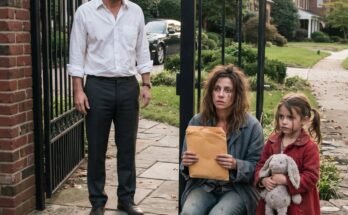
On Thursday, she led me to the porch from Dad’s note.
Mrs. Alvarez was eighty-two, lived alone, and opened the door wearing slippers and holding a screwdriver.
The moment she saw Ruby without my father, her face changed.
“Oh.”
That was all she said.
I introduced myself.
“I’m Clifford’s daughter.”
She stared at me.
“Colorado.”
I blinked.
“You know where I live?”
“Your father talked about you constantly.”
I almost laughed.
“My father barely talked.”
“To you, maybe.”
That hurt.
Mrs. Alvarez seemed to realize it.
“He showed me every photograph you sent. Your new apartment. The mountain trip. That award from your company.”
“My award?”
“He said you ran some big project.”
I looked away.
Dad had replied to that photograph with:
Nice.
One word.
Apparently “nice” had become a twenty-minute conversation on Mrs. Alvarez’s porch.
She pointed toward an old freezer.
“He fixed that thing four times because I couldn’t afford another one. Last time I tried paying him, he said, ‘Buy groceries instead.’”
Then she looked at Ruby.
“He wasn’t good at receiving thanks.”
“No.”
“Or giving compliments.”
“No.”
She smiled sadly.
“But he loved you.”
I wanted to argue.
Instead I said, “I know.”
It was not completely true yet.
But I was beginning to understand.
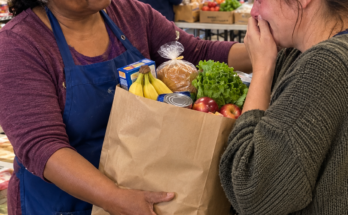
That Sunday, I filled the pantry.
Not because Dad asked me to.
Because it was nearly empty.
There is a difference.
━━━━━━━━━━━━━━━━━━━━
Part Three — Ruby’s Last Route
My flight back to Colorado came and went.
I canceled it the night before.
My boss gave me another week.
Then another.
I told people I needed time to handle the estate.
That was partly true.
Mostly I needed time to understand my father.
Ruby and I walked his route every day.
Not every stop was about charity.
Some were simply people.
At the hardware store, the owner kept a bowl of water for Ruby.
At a little brick house near the elementary school, a man named Curtis opened the door and immediately hugged me.
I stiffened.
Then he apologized.
“Sorry. Your dad hated hugs too.”
That made me laugh.
Curtis had been seventeen when my father met him.
His mother had died.
His father was drinking.
Curtis was skipping school and sleeping in a friend’s garage.
Dad found him sitting behind a laundromat one winter afternoon.
“What did Dad do?”
Curtis shrugged.
“Asked if I knew anything about dryers.”
“That sounds like him.”
“I said no.”
“What happened?”
“He said, ‘Then learn.’”
Dad paid Curtis ten dollars to carry tools.
Then twenty.
Then taught him appliance repair.
Curtis eventually opened his own business.
On the wall behind him hung an old photograph.
Dad.
Ruby.
Curtis.
All three standing beside a washing machine.
“I tried paying him back once,” Curtis said.
“What happened?”
“He told me if I had extra money, find somebody who needed ten dollars more than he did.”
I smiled.
“He could be annoying like that.”
“He was extremely annoying.”
That helped.
Saints are difficult to grieve honestly.
Fathers are easier.
My father could help a stranger fix a furnace and still fail to call his daughter on her birthday until nine at night.
He could sit beside a lonely teenager at a bus stop and still tell me to “shake it off” when I cried after my first breakup.
One truth did not erase the other.
That became important.
For several days, I worried that discovering Dad’s secret generosity meant I was supposed to rewrite my childhood.
I didn’t.
There were things I needed from him that I did not receive.
Words.
Affection.
Curiosity about who I was rather than whether I was “doing okay.”
Death did not magically make those absences disappear.
But neither did those absences mean he had never loved me.
Both could be true.
I wish I had understood that while he was alive.
I wish he had understood it too.
While sorting through the garage, I found an old metal filing cabinet.
Inside were tax records, instruction manuals, warranties for appliances he had not owned in twenty years, and a folder labeled simply:
CLAIRE
My hands started shaking before I opened it.
Inside was my life.
A copy of my first-grade school picture.
A program from my middle-school orchestra concert.
My college acceptance letter.
The newspaper clipping announcing my promotion.
A printed photograph of me standing in Colorado with snow-covered mountains behind me.
Dad had written dates on everything.
On the back of my graduation picture were three words:
She did it.
On the promotion clipping:
Knew she would.
I sat on the concrete garage floor for a long time.
My father had collected evidence of loving me.
He just never learned how to hand it over.
That might be the saddest thing I discovered.
The house sold three months later.
I did not keep it.
Dad specifically told me not to turn his habits into my burden.
I listened.
Curtis took the tools.
Mrs. Alvarez got the good freezer from Dad’s basement.
The pantry became a neighborhood project instead of something one old man quietly restocked alone.
The school eventually agreed to keep emergency snacks and transit cards inside the office instead of under a bus-stop bench, which was more practical and much less likely to be eaten by raccoons.
Dad probably would have complained about bureaucracy.
Then secretly approved.
And Ruby?
Ruby came to Colorado.
There was never another serious discussion about the shelter.
She hated the flight.
She hated elevators.
She hated my apartment’s polished floors because her bad hip slipped on them.
So I bought rugs.
A ridiculous number of rugs.
Within two months, my apartment looked like a carpet store had exploded.
Ruby approved.
She slept beside my desk while I worked.
At exactly four every afternoon, she brought me her leash.
Apparently Clifford’s schedule had survived him.
At first, our walks were ordinary.
Then Ruby started choosing stops.
An elderly man in my building who sat alone near the mailboxes.
A woman who worked late at the convenience store and always saved Ruby a biscuit.
A young mother in the next block whose toddler would squeal whenever Ruby appeared.
I started carrying treats.
Then extra hand warmers in winter.
Then a grocery gift card after I learned the young mother had lost hours at work.
I caught myself one afternoon.
“Oh no.”
Ruby looked at me.
“I’m becoming him.”
Her tail wagged.
“That was not a compliment.”
She kept wagging.
I didn’t recreate Dad’s route in Colorado.
I didn’t need to.
What I kept was the part beneath it.
Notice people.
Help when you can.
Do not make them perform gratitude.
And, unlike my father, say the words while you still have time.
That last rule became mine.
I started calling people.
Actually calling.
Not liking photographs.
Not sending birthday texts.
Calling.
When my niece graduated nursing school, I said, “I’m proud of you.”
Out loud.
She laughed and said, “Why are you crying?”
“Old age.”
“You’re forty-four.”
“Cruel child.”
When my friend Denise lost her mother, I did not tell her to call if she needed anything.
I brought dinner.
Then I sat with her.
Dad taught me some things by example.
Others by omission.
Both lessons counted.
Ruby lived another two years.
Near the end, her bad hip became two bad hips.
Her hearing faded.
She slept most afternoons.
But she still carried the canvas pouch.
I had washed it once.
That was apparently a violation of sacred law.
She spent an hour searching the laundry room for it.
After that, I clipped it to her harness for walks even though it usually carried nothing but waste bags and one emergency dog biscuit.
Then, one October morning, she didn’t bring me the leash.
She stayed on her bed.
I knew.
The veterinarian came to my apartment the following afternoon.
Ruby was thirteen.
I spread Dad’s old work jacket beneath her because she always slept on it when we visited Pennsylvania.
Before the medication, I clipped the canvas pouch onto her harness one last time.
Then I opened the hidden fold.
Dad’s note was still there.
Soft from being unfolded too many times.
I read the final line again.
You were the person I was most afraid of disappointing. I just managed to make those look exactly the same.
Ruby rested her head across my ankle.
“You were a terrible messenger,” I whispered.
Her tail moved once.
I cried.
Then I thanked her.
For refusing the car.
For knowing the route.
For making me stay long enough to discover a man I had known my whole life and somehow never completely met.
Ruby died with one paw on my shoe.
For months afterward, I kept expecting her at four o’clock.
Sometimes I still stood up automatically.
Leash.
Walk.
Then remembered.
The canvas pouch hangs beside my front door now.
Not in a frame.
Dad would have hated that.
Inside it, I keep twenty dollars, a grocery-store gift card, and a folded copy of his note.
Sometimes I use the money.
Then replace it.
Not every week.
Not by schedule.
Not because Clifford Brennan created some sacred obligation I have to continue forever.
I do it when I notice somebody.
That is the important part.
Last winter, I saw a teenage boy standing outside my building in the snow waiting for a bus that was running forty minutes late.
He was wearing a sweatshirt.
No coat.
I almost kept walking.
Then I heard my father’s voice as clearly as if he were standing beside me.
Not something profound.
Not help that child.
My father would never waste four words when two would do.
I heard:
Cold out.
I went upstairs.
Brought down gloves and a hand warmer.
The boy looked suspicious.
“You want money?”
“No.”
“Why are you giving me this?”
I almost said my father taught me.
But that wasn’t completely true.
My father taught me eventually.
That is different.
So I said, “Because you’re cold.”
He took them.
“Thanks.”
I nodded.
Then I did something Clifford probably wouldn’t have.
I stayed until the bus came.
My father spent years quietly making sure strangers did not have to face every hard thing alone.
I only wish he had understood that his daughter needed some of that quiet kindness too.
I think, before he died, he finally understood.
He just ran out of time to say it in person.
So he left fifty dollars in an old dog’s pouch.
A crooked pantry.
A bus stop.
A stack of repair slips marked PAID.
And one piece of paper containing the words he should have given me decades earlier.
I had planned to take Ruby to a shelter that morning.
Instead, she took me on my father’s final route.
And somewhere between the pantry and the bus stop, an old dog delivered the longest conversation my father and I ever had.