Part One — The Night Ethan Got Everything Wrong
“What the hell are you doing in my bed?”
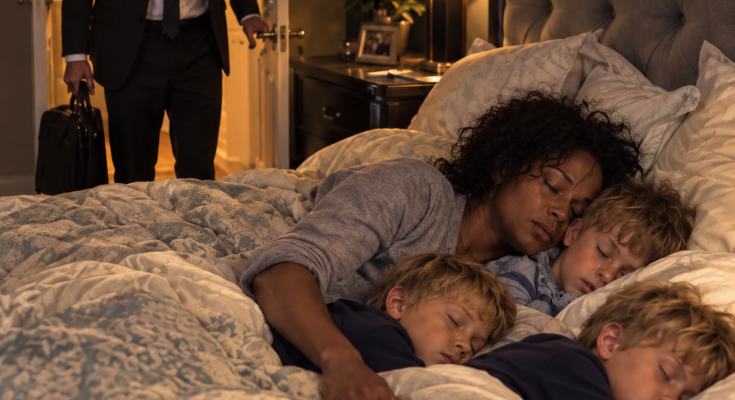
Ethan Carter’s voice cracked through the dark like glass. He stood in the doorway of his master bedroom, still wearing his wrinkled suit from the flight home, one hand clamped around his briefcase so hard his knuckles had gone white.
On the center of his bed lay Mariah Bennett.
And curled against her, finally asleep, were his three seven-year-old sons.
For a second, Ethan couldn’t breathe.
Noah had one fist twisted in the blanket near her shoulder. Ben was pressed against her side. Little Caleb, who had not slept through a full night in months, had his cheek resting on her arm like he was afraid she might disappear.
Mariah opened her eyes slowly.
She looked exhausted.
But calm.
“Mr. Carter,” she whispered, careful not to wake the boys. “I can explain.”
He didn’t let her.
His face hardened in one brutal second, the worst part of him rushing to the surface before his mind had even caught up.
“You’re done,” he snapped. “Get out. Right now.”
Mariah went still.
Not angry.
Not defensive.
Just still.
Then she carefully eased herself out from beneath the boys, moving like someone defusing a bomb. She tucked the blanket back around Caleb. Smoothed Noah’s hair away from his forehead. Whispered something into Ben’s ear.
None of them woke.
That alone should have told Ethan something was different.
It didn’t.
Mariah slipped on her shoes, lifted her chin, and walked past him without another word.
Downstairs, Rosa Alvarez, the family’s longtime cook, looked up from the kitchen when Mariah appeared.
“Mariah?”
Mariah swallowed.
“It’s okay, Miss Rosa.”
It clearly wasn’t.
She opened the front door and stepped into the cold Indianapolis night with nothing but her coat and her pride.
The house became quiet again.
Too quiet.
Ethan returned upstairs, still furious, still breathing hard, still full of the kind of certainty that can ruin lives.
Then he looked at his sons.
They were sleeping.
Really sleeping.
Not collapsing from exhaustion after hours of panic.
Not sedated.
Not curled separately in three different bedrooms with night-lights blazing and doors open.
Sleeping.
Together.
Peacefully.
After nearly eight months of chaos.
After twenty-two nannies, six behavioral specialists, two sleep consultants, and one expensive therapist who described his sons as “emotionally barricaded.”
After all that, the impossible had happened.
On his nightstand sat a folded sheet of paper.
Ethan picked it up.
The handwriting was Mariah’s.
Mr. Carter,
The boys came into your room at 11:40 because the storm frightened Caleb. Noah brought Ben. None of them would let me take them back downstairs. They kept pointing at your side of the bed.
Ethan sat down.
He continued reading.
I know I am the housekeeper. I know this is not my room and not my place. But they were shaking, and tonight Noah spoke to me.
Ethan stopped.
Read that sentence again.
Noah spoke to me.
Noah had not spoken a full sentence to anyone in 241 days.
Ethan knew the number.
He had counted.
The last time Noah spoke normally had been the morning of his mother’s funeral.
Ethan read faster.
He said, “Daddy sleeps here alone because Mommy never came back.”
His throat tightened.
The note continued.
Then Ben said, “People leave when we make noise.”
Ethan’s hands began shaking.
Caleb cried, but no sound came out. He just opened his mouth and shook.
I asked them who told them that speaking made people leave. Noah said, “Nobody. We know.”
Ethan covered his mouth.
Mariah’s final paragraph was shorter.
I think the boys believe silence protects them from losing people. I did not want to move them after they finally fell asleep. I stayed because Caleb would not let go of my sleeve. I am sorry I crossed a boundary. But please don’t punish them for tonight. Something opened. They need someone to listen before it closes again.
Beneath that, one final sentence:
And please stop calling them difficult where they can hear you. They understand more than they say.
Ethan sat motionless.
For eight months, he had paid people to fix his sons.
That was how he thought about it, though he would never have admitted it aloud.
Fix the sleep.
Fix the silence.
Fix the tantrums.
Fix the refusal to eat at the table.
Fix the three boys who used to fill the house with so much noise their mother occasionally hid in the pantry and ate chocolate in secret.
Then Caroline died.
A drunk driver crossed the center line while she was driving home from the grocery store.
She was thirty-six.
Ethan was at work when the police came.
The triplets were home.
They saw the strangers at the door.
They heard Ethan scream when he learned.
And in the weeks after the funeral, the house filled with adults discussing them as if they were not standing nearby.
They’re not coping.
They’re regressing.
Something is wrong with them.
You need professionals.
Ethan listened.
Because he was grieving too.
And because action was easier than pain.
He hired help.
Then more help.
Every new nanny arrived enthusiastic.
Every new nanny tried harder.
Sticker charts.
Reward systems.
Speech games.
Bedtime routines.
Consequences.
Praise.
Schedules.
Some lasted three days.
Some lasted three weeks.
One lasted four months.
Then Caleb bit her when she tried to force him into his room during a panic attack.
She quit that afternoon.
By the time Mariah arrived, she wasn’t even there for the boys.
She had been hired to clean the house.
That was all.
She vacuumed.
Changed sheets.
Polished the enormous dining table nobody used anymore.
And unlike everyone else, she asked nothing from the triplets.
If Noah sat beneath the staircase while she dusted, she let him sit.
If Ben followed her from room to room, she did not ask why.
If Caleb lined up spoons on the kitchen floor, she stepped around them.
She sang quietly while she worked.
Not children’s songs.
Old Motown songs her mother had played while cleaning.
The boys began appearing wherever she was.
Ethan noticed.
He assumed they liked her because she didn’t make them do anything.
He never considered that perhaps that was exactly why they trusted her.
A small movement brought him back to the bedroom.
Noah had opened his eyes.
He stared at the empty place beside him.
Then at Ethan.
His face changed.
He sat up quickly.
His eyes moved around the room.
Searching.
Ethan whispered, “She’s gone.”
Noah froze.
Then his mouth opened.
Nothing came out.
Ben woke next.
Then Caleb.
Within seconds, all three boys were sitting upright.
Caleb pointed toward the doorway.
Ethan knew what he wanted.
“Mariah went home.”
Noah stared at him.
Ethan tried to explain.
“She shouldn’t have been—”
Noah made a sound.
Not a word.
A strangled little breath.
Then he climbed off the bed.
All three boys ran into the hallway.
“Boys.”
They didn’t stop.
Downstairs, they searched the kitchen.
Laundry room.
Living room.
Ben opened the pantry.
Caleb looked behind the sofa.
Then Noah reached the front door.
Locked.
He turned toward Ethan.
And for the first time in eight months, Ethan heard his oldest son shout.
“You made her leave!”
The words echoed through the foyer.
Rosa covered her mouth.
Ethan stopped breathing.
Noah was crying now.
Actual sobs.
“You make everybody leave!”
Ethan stepped toward him.
Noah backed away.
“Noah—”
“Mommy left!”
“Noah.”
“Nannies leave!”
His voice cracked.
“Mariah left!”
Ben began crying beside him.
Caleb pressed both hands over his ears.
And suddenly Ethan understood something none of the specialists had been able to make him understand.
His sons had not been refusing to speak.
They had been trying not to need anyone loudly enough for that person to disappear.
And Ethan had just proven their fear correct.
━━━━━━━━━━━━━━━━━━━━
Part Two — The Woman Who Never Tried to Fix Them
Ethan called Mariah twelve times.
She answered on the thirteenth.
“What?”
Her voice was flat.
“I read the note.”
Silence.
“I was wrong.”
“Yes.”
He deserved that.
“The boys are asking for you.”
Another silence.
Then Mariah said, “No, Mr. Carter. They’re panicking because you threw away the person they trusted.”
Ethan closed his eyes.
“Please come back.”
“As what?”
That stopped him.
“The housekeeper you can fire because you see something you don’t understand? The unpaid therapist? The woman who’s useful until she makes you uncomfortable?”
“I’m sorry.”
“I believe you’re sorry.”
She took a breath.
“But those boys don’t need you to hire another solution. They need their father.”
That hurt because it was true.
Ethan had been physically present and emotionally absent for months. He traveled because work was easier than Caroline’s empty side of the bed. He answered emails during dinner because the boys’ silence frightened him.
Mariah had noticed.
“You want me back?” she said. “Then call their therapist. Tell her what happened tonight. Tell her Noah spoke. And tomorrow, sit with your sons without trying to make them do anything.”
“Will you come?”
“Not tonight.”
“Mariah—”
“They need to learn you can stay too.”
Then she hung up.
Ethan sat on the staircase until sunrise with all three boys.
No questions.
No demands.
No promises he couldn’t guarantee.
He simply stayed.
When Caleb fell asleep against his shoulder, Ethan finally understood why Mariah had been in his bed.
Sometimes the thing a frightened child needs most is not correction.
It is proof that when they wake up, somebody will still be there.
━━━━━━━━━━━━━━━━━━━━
Part Three — The House That Learned to Make Noise Again
Mariah returned four days later.
Not because Ethan offered more money.
He did.
She refused it.
She returned because Rosa called and told her Noah had asked for her by name.
That was different.
When Mariah entered the house, all three boys stood at the far end of the hallway.
Nobody ran to her.
For a moment, nobody moved.
Then Caleb walked forward.
Stopped.
Looked at Ethan.
That broke him.
His seven-year-old son was checking whether loving Mariah was permitted.
Ethan crouched.
“You can go to her.”
Caleb ran.
Mariah caught him.
Then Ben.
Noah came last.
He did not hug her immediately.
He stood in front of her.
“You left.”
Mariah knelt.
“Your dad told me to leave.”
Noah looked at Ethan.
Ethan forced himself not to defend himself.
“I did.”
“Why?”
“Because I saw something I didn’t understand, and I got scared and angry before I asked what happened.”
Noah’s face tightened.
“Were you mad at us?”
“No.”
“At her?”
“I was. But I was wrong.”
Noah considered this.
Children notice when adults avoid the word wrong.
Ethan had learned that.
Then Noah asked, “Can she stay?”
Mariah looked at Ethan.
He looked back at his son.
“If Mariah wants to.”
That answer mattered.
Not yes.
Not I’ll make her stay.
If she wanted to.
Mariah returned to work on different terms.
She remained the housekeeper because that was the job she had accepted, but Ethan hired additional professional childcare and stopped expecting household employees to quietly absorb responsibilities because they cared.
The boys continued therapy.
So did Ethan.
That last part surprised nearly everyone.
Especially Ethan.
His first sessions were mostly him explaining why therapy was unnecessary.
His therapist finally asked, “If you’re doing so well, why haven’t you slept in your bedroom since the night your wife died?”
Ethan stared at him.
He had no answer.
The truth was he slept there only when exhaustion forced him.
Most nights he fell asleep in his office.
The room Mariah had been found in with the boys was technically Ethan’s bedroom.
Emotionally, it had become Caroline’s grave.
The boys knew that too.
That was why they went there during the storm.
They did not want Mariah in Ethan’s bed.
They wanted to be where their mother had once been.
Mariah had understood because she listened.
Ethan hadn’t because he had stopped listening months earlier.
Slowly, the boys began speaking more.
Not evenly.
Not magically.
Noah returned first.
Full sentences appeared in bursts.
Then Ben.
Caleb took longer.
For several weeks, he communicated mostly through gestures and whispers.
One morning at breakfast, Rosa dropped a metal pan.
It crashed against the kitchen floor.
Everybody froze.
Caleb looked at it.
Then shouted:
“That was loud!”
Rosa burst into tears.
Caleb stared at her in horror.
“Why are you crying?”
Rosa laughed while wiping her face.
“Because you scared me.”
“I’m sorry.”
“Do it again.”
Everyone laughed.
That was the first morning the Carter house sounded normal.
Not peaceful.
Normal.
There is a difference.
Normal has spoons hitting bowls.
Children arguing.
Cabinet doors slamming.
Someone asking where their shoes are while standing beside their shoes.
For months, Ethan had believed silence meant his house was under control.
Now silence frightened him.
One Saturday, the triplets were fighting over a game controller.
Noah shouted.
Ben shouted louder.
Caleb began yelling something incomprehensible simply because his brothers were doing it.
Ethan entered the room.
All three stopped immediately.
Old fear.
Waiting for correction.
Ethan looked at them.
Then at the controller.
“Who had it first?”
All three began talking at once.
Ethan held up his hands.
“Okay. Apparently I have created a different problem.”
Mariah laughed from the hallway.
He looked over.
She had been working in the adjacent room.
For a second, both of them remembered the night he fired her.
Ethan’s expression changed.
Mariah noticed.
“You can stop apologizing every time you look at me.”
“I only apologized twice.”
“Verbally.”
“Fair.”
She smiled.
Their relationship never became romantic.
People later assumed it would.
Perhaps because stories make people uncomfortable when a man and woman matter profoundly to each other without falling in love.
Mariah became family in another way.
The boys trusted her.
Ethan respected her.
And Mariah maintained something Ethan had initially hated.
Boundaries.
If her shift ended at five, she left at five.
If the boys asked her to stay for dinner, sometimes she did.
Sometimes she said no.
That was good for them too.
They needed to learn that someone could leave without abandoning them.
Mariah began announcing departures.
“I’m going home now.”
Caleb would ask, “Tomorrow?”
“Tomorrow.”
“You promise?”
“If I’m sick, I’ll call. Otherwise, yes.”
Then she left.
The next morning, she returned.
Again.
Again.
Again.
Predictability rebuilt things reassurance could not.
Ethan began doing the same.
Before work trips, he told the boys exactly when he was leaving and when he expected to return.
He showed them the flight on a calendar.
He called from hotels.
Then came home when he said he would.
Once, a flight was canceled.
Ethan panicked more than the boys.
He called immediately.
Noah answered.
“I’m stuck in Chicago.”
“Okay.”
“I won’t be home tonight.”
Silence.
Ethan’s chest tightened.
Then Noah asked, “Tomorrow?”
“Yes.”
“Okay.”
That was it.
No panic.
No collapse.
When Ethan returned the following afternoon, all three boys ran to him.
He understood then that trust was not built by never leaving.
It was built by telling the truth about leaving and returning often enough that people stopped expecting disappearance.
A year passed.
The twenty-three nannies became a running joke, though Ethan hated it.
Mariah once found the old spreadsheet his assistant had created while hiring them.
Nanny 1 — three weeks.
Nanny 7 — twelve days.
Nanny 14 — resigned without notice.
Nanny 22 — four months.
Mariah stared.
“You made a spreadsheet?”
“I was desperate.”
“You color-coded it.”
“I like organization.”
“You have a red column labeled ‘reason for failure.’”
Ethan looked embarrassed.
Mariah pointed to herself.
“What would’ve gone in my row?”
He thought about it.
Then said, “Employer stupidity.”
She laughed so hard she had to sit down.
The following spring, Ethan did something Caroline had begged him to do for years.
He reduced his workload.
He had spent his marriage believing financial security was his primary responsibility.
Caroline used to say, “The boys already know you’re good at providing. I’d like them to know you’re good at Tuesday.”
He never understood what she meant until she died.
Tuesday was homework.
Dinner.
Baths.
Missing socks.
Nothing important.
Everything important.
So Ethan learned Tuesday.
Badly.
He burned grilled cheese.
Forgot library day.
Sent Ben to school wearing Noah’s sweatshirt.
Once he washed a red sock with the boys’ white uniform shirts and turned everything pink.
The triplets loved that.
“Dad broke laundry!”
Mariah refused to rescue him.
“This is training.”
“Whose?”
“Yours.”
Two years after the night in the bedroom, Noah found the folded note Mariah had written.
Ethan had kept it in a desk drawer.
Noah was nine now.
He read well enough to understand most of it.
“Did I really say people leave when we make noise?”
Ethan sat beside him.
“Yes.”
“That’s weird.”
“You were scared.”
Noah looked at the paper.
“Why did you fire Mariah?”
Ethan could have softened the answer.
He didn’t.
“Because I saw her in my bed with you and your brothers, and I made a bad assumption before asking what happened.”
“What assumption?”
Ethan hesitated.
“That she had crossed a boundary she shouldn’t have crossed.”
Noah thought.
“But she was helping us.”
“Yes.”
“So you didn’t know.”
“No.”
“Then why didn’t you ask?”
That was the question.
Ethan looked at his son.
“Because sometimes adults mistake being certain for being right.”
Noah nodded as though storing that somewhere.
Then he asked, “Did Mariah forgive you?”
“I think so.”
From the hallway, Mariah shouted, “Mostly.”
Noah laughed.
Ethan did too.
Years passed.
The triplets became teenagers.
Noah grew quiet again, but this time because fifteen-year-olds apparently believe conversation with fathers is medically dangerous.
Ben joined the school orchestra.
Caleb, once the boy who opened his mouth and cried without sound, became the loudest person in the family.
He joined debate.
Mariah said this proved the universe had a sense of humor.
She eventually stopped cleaning the Carter house.
Not because anything went wrong.
Because she opened a small residential cleaning company of her own.
Ethan invested nothing.
That was her demand.
“I don’t want your money.”
“You’ll need startup capital.”
“I have startup capital.”
“I could help.”
“You can recommend me.”
So he did.
Within four years, Mariah employed nineteen people.
She provided benefits as soon as she could afford them, guaranteed predictable schedules, and had one rule she refused to compromise on:
Nobody’s job description expands because an employer thinks kindness is free labor.
Ethan suspected he had contributed to that rule.
He wisely never asked.
Mariah still came to Sunday dinner.
The boys never called her Mom.
She never asked them to.
Caroline remained their mother.
There was room to love Mariah without replacing anyone.
That lesson mattered too.
On the tenth anniversary of Caroline’s death, Ethan and his sons visited the cemetery together.
By then, they could speak about her without the entire day collapsing.
Noah placed flowers.
Ben told a story.
Caleb complained that he barely remembered her voice.
Ethan took out his phone.
He had dozens of recordings.
For years, he had been afraid to play them.
That afternoon, they listened.
Caroline laughing.
Caroline singing badly in the kitchen.
Caroline telling three four-year-old boys to put on pants.
Caleb laughed so hard he cried.
Then Ethan cried too.
Nobody tried to stop.
That night, they went home.
Mariah was already there with Rosa, arguing about whether lasagna needed more garlic.
Ethan stood in the entryway listening.
People talking.
Pans moving.
Teenagers shouting from upstairs.
A dog barking somewhere outside.
Noise.
Life.
He thought about the night years earlier when he returned from a business trip and found Mariah asleep in his bed with all three boys.
He had believed he was seeing something inappropriate.
A violation.
A stranger taking liberties inside his home.
What he was actually seeing was the first moment his sons had felt safe enough to sleep deeply beside another human being since their mother died.
And because Ethan did not understand it, his first instinct was to destroy it.
That knowledge humbled him more than any business failure ever had.
He kept Mariah’s note.
Not because he enjoyed remembering his mistake.
Because one sentence had become a rule for the rest of his life:
Something opened. They need someone to listen before it closes again.
Ethan once thought listening was passive.
It wasn’t.
Listening required patience when he wanted answers.
Humility when he wanted certainty.
And sometimes the courage to admit that the person with less money, less authority, and no impressive title understood something he had completely missed.
Twenty-two professional caregivers had come through his house trying to make three silent boys speak.
Mariah never tried.
She cleaned around them.
Sat near them.
Let them follow.
Let them be silent.
And when one frightened night finally broke something open, she stayed beside them until they fell asleep.
That was all.
Years later, when Ethan tried to thank her again, Mariah shook her head.
“I didn’t save them.”
“You reached them.”
“No.”
She looked toward the kitchen, where the three boys were arguing loudly over dessert.
“They reached back.”
Then Caleb shouted, “Mariah! Noah took my pie!”
Mariah smiled.
“See?”
Ethan listened to the noise filling the house.
Once, silence had terrified him because he did not know what it meant.
Now he understood.
The boys had never needed somebody powerful enough to break through their walls.
They needed someone patient enough to sit outside them until they opened the door themselves.