
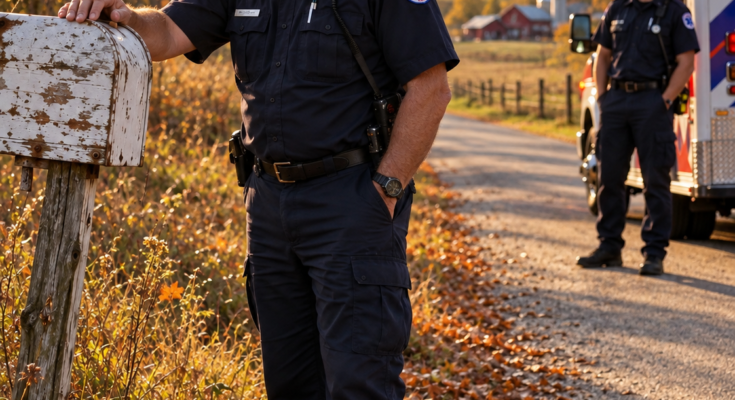
Part One — The Mailbox
Dean Holloway pulled the ambulance onto the gravel shoulder without saying a word.
No emergency lights.
No radio call.
No patient waiting.
Just a faded white mailbox leaning toward a narrow Tennessee road, surrounded by October weeds turning brown at the edges.
His new partner, twenty-seven-year-old Tyler Boone, looked over from the passenger seat.
“You okay?”
Dean kept staring through the windshield.
“Give me a minute.”
He stepped outside.
For nearly thirty years, Dean had worked as a paramedic in rural Tennessee, where almost everyone seemed connected by two handshakes and one last name.
He had delivered babies in farmhouses.
Held pressure on wounds inside overturned trucks.
Sat with old men having heart attacks on kitchen floors while their wives stood barefoot in the hallway.
People called him calm.
Dependable.
The man you wanted walking through your door on the worst day of your life.
What most people didn’t know was that Dean sometimes woke at three in the morning remembering details from calls everyone else had forgotten.
A red shoe beside a ditch.
A kitchen curtain covered in sunflowers.
A little boy asking whether his father could still hear him.
Some memories faded.
Others seemed to learn his address.
Tyler watched Dean walk toward the mailbox, rest one hand on the weathered wooden post, and stand there for almost a minute.
When he returned to the ambulance, Tyler waited until they were moving again.
“You stop there often?”
“Once a year.”
“Why?”
Dean drove another mile before answering.
“Twenty years ago today, we got a call right there.”
It had been raining that night.
Not hard.
Just enough to turn the road black and shiny beneath the headlights.
Dean had been thirty-six and still young enough to believe experience would eventually teach him not to carry every patient home.
A seventeen-year-old girl named Emily had been driving back from decorating her high school gym for a fall dance.
Her car left the road on a curve.
By the time Dean and his partner arrived, firefighters were already cutting away metal.
Emily was conscious.
Barely.
Rain had plastered her brown hair against her forehead.
She kept asking one question.
“Is my mom coming?”
Dean told her they were trying to reach her.
He checked what he could check.
Called out numbers.
Passed equipment.
Kept his voice steady while everyone around him worked.
But there are moments emergency workers understand before they say them aloud.
Dean knew they were losing her.
Emily must have understood something too.
Eventually she stopped asking whether her mother was coming.
Instead, she looked directly at Dean.
“Can you stay?”
He did.
He removed one glove and took her hand.
He told her she wasn’t alone.
He told her help was there.
He asked her to squeeze if she could hear him.
For a little while, she squeezed back.
Then she didn’t.
Dean stayed beside her after there was nothing left for him to fix.
For months afterward, he replayed the call.
What if they’d left the station thirty seconds earlier?
What if he’d recognized something sooner?
What if he’d chosen different equipment?
What if he had pushed harder, moved faster, noticed more?
“You can torture yourself negotiating with a day that’s already over,” Dean told Tyler.
Tyler didn’t interrupt.
Three months after Emily died, Dean came home from a night shift and found an envelope in his mailbox.
The handwriting was unfamiliar.
Inside was a letter from Emily’s mother.
The first sentence made him sit down.
I don’t know if you remember my daughter, but I want you to know I remember you.
Dean had expected anger.
Questions.
Maybe blame.
Instead, Emily’s mother wrote that for weeks she had been tormented by one thought.
Was Emily afraid?
Had she called for her mother?
Had her daughter died alone on a dark road while strangers worked around her?
Then a firefighter told her about Dean.
The paramedic who had stayed beside Emily.
The hand she had been holding.
Near the bottom, she wrote:
You couldn’t bring my daughter home. But you stayed when I couldn’t be there. A mother never forgets something like that.
Dean stopped reading.
Put his head down on his kitchen table.
And cried harder than he had cried since childhood.
The letter did not make losing Emily acceptable.
Nothing could.
It simply showed him something his training had never explained.
Sometimes helping someone and saving someone were not the same thing.
━━━━━━━━━━━━━━━━━━━━
Part Two — The Calls You Bring Home
Dean kept the original letter in a wooden box at home.
A photocopy stayed in his work bag.
Tyler stared through the passenger window after Dean finished the story.
“Nobody teaches us that part,” he said.
“What part?”
“That you can do everything right and still lose somebody.”
Dean nodded.
“No.”
Tyler looked down at his hands.
He had been a paramedic less than two years.
Dean recognized the look immediately.
New medics sometimes carried every death as though it were a performance review.
“There’ll be calls you take home,” Dean said. “Don’t lie to yourself about that.”
Tyler nodded.
“And there’ll be people you help who won’t remember your name.”
Dean glanced toward him.
“That doesn’t mean you weren’t important.”
“So that’s why you stop at the mailbox?”
Dean shook his head.
“Not exactly.”
He tapped the steering wheel.
“I stop because some years I remember the people I couldn’t save more clearly than all the people who went home.”
He swallowed.
“That mailbox reminds me not to judge every call by whether I got the ending I wanted.”
Before Tyler could answer, the radio crackled.
An elderly man had fallen at a farmhouse twelve miles away.
Dean picked up the microphone.
The ambulance turned east.
Work continued.
━━━━━━━━━━━━━━━━━━━━
Part Three — The Next October
One year later, October came again.
Dean and Tyler were still partners.
They had worked hundreds of calls together by then.
Some ordinary.
Some terrible.
One in particular had stayed with Tyler.
A man in his forties had gone into cardiac arrest while mowing his yard.
Tyler had worked beside Dean until his uniform was soaked through with sweat.
They did everything they were trained to do.
The man died anyway.
For weeks afterward, Tyler kept mentioning tiny details.
Maybe compressions should have started sooner.
Maybe they should have changed something faster.
Maybe he had missed a rhythm.
One night Dean finally told him:
“You’re doing it.”
“Doing what?”
“Negotiating with a day that’s already over.”
Tyler looked away.
He understood.
So when the ambulance reached that narrow country road the following October, Dean began slowing down.
Before he could say anything, Tyler pointed toward the shoulder.
“We stopping?”
Dean smiled.
“Yeah.”
Both men climbed out.
The mailbox looked even older.
Paint peeling.
Post leaning.
Nothing about it suggested that anyone’s life had changed there.
Most drivers passed without seeing it.
Dean stood beside the post with his hands tucked into his jacket.
Tyler reached into the ambulance and returned carrying a few small roadside daisies he’d picked near the station earlier.
He placed them beside the mailbox.
Dean looked at him.
“For Emily,” Tyler said.
Neither man spoke for a while.
Then Tyler asked:
“Do you think her mother ever knew you kept coming back here?”
“No.”
“You ever think about telling her?”
Dean considered it.
Then shook his head.
“She already gave me what I needed.”
“What was that?”
“Permission to stop thinking failure was the only thing that happened that night.”
Years passed.
Dean eventually retired.
On his last shift, Tyler—no longer the nervous young medic who questioned every movement of his hands—drove.
They made one final stop beside the mailbox.
Dean was sixty-three by then.
His knees hurt in cold weather.
His beard had gone almost completely white.
He stood beside the post for less than a minute.
Then Tyler handed him a small envelope.
“What is this?”
“Open it later.”
Dean frowned.
“You hate surprises.”
“I learned from you.”
At home that evening, Dean opened the envelope.
Inside was a photocopy of Emily’s mother’s old letter.
He had shown it to Tyler once years earlier.
Tyler had typed one additional line beneath it:
You taught me that staying counts too.
Dean sat at his kitchen table.
The same table where he had first read Emily’s mother’s letter decades earlier.
And for a moment he was thirty-six again, rainwater dripping from his sleeves, holding the hand of a frightened seventeen-year-old girl he could not save.
Except this time, another memory arrived with it.
A young paramedic beside a faded mailbox.
A bunch of daisies.
Hundreds of patients who had gone home.
Hundreds of families who had not.
And all the moments between those endings when someone had needed another person to remain present.
Dean finally understood why the mailbox had mattered for so long.
It wasn’t a monument to the worst call of his career.
It was a reminder that emergency work cannot always produce the outcome you want.
Neither can parenting.
Nursing.
Teaching.
Caregiving.
Friendship.
Sometimes you can do everything within your power and still lose the person, the marriage, the job, the chance, the ending you were desperately trying to protect.
That does not automatically make what you did meaningless.
Emily’s mother had never thanked Dean for saving her daughter.
He hadn’t.
She thanked him for something smaller.
He stayed.
And sometimes “smaller” is only how an act looks from the outside.
To a frightened teenager waiting for her mother on a rainy Tennessee road, one hand might have been the entire world.
That became the lesson Dean carried into retirement.
Not every act of care changes the ending.
Some simply change what the ending feels like.
A chair pulled beside a hospital bed.
A meal left at someone’s door.
A phone answered after midnight.
A hand held when every solution has already run out.
We tend to remember heroes for the people they save.
But there are moments when saving is no longer possible.
And then another kind of courage begins.
The courage to stay.