
Part One — The Page Claire Didn’t Expect Him to Read
“Sign it, Margaret.”
Evan Mercer heard his wife’s voice before he reached the living room.
It wasn’t loud.
That made it worse.
Claire sounded calm, almost patient, as if she were asking someone to approve a grocery list instead of staring down the woman who had raised Evan from childhood.
Evan stopped in the hallway.
His suitcase was still in his hand. He had landed in Austin almost six hours earlier than planned after canceling the final meeting of a three-day business trip. Nobody at home knew he was coming back.
That had been intentional.
He couldn’t explain why.
All morning, something had bothered him.
Not fear.
Not exactly.
Just the feeling that he had been away from his own life for too long.
Now he understood why.
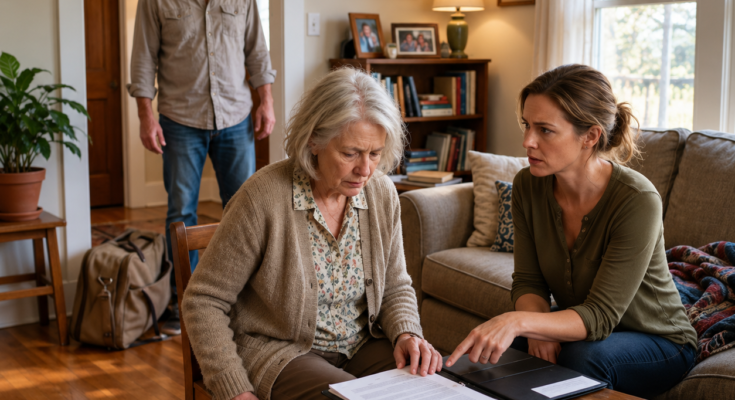
“I already told you,” Margaret said quietly. “I’m not signing anything until Evan reads it.”
Claire let out a slow breath.
“You keep saying that as if Evan has time to read every piece of paper that crosses this house.”
“He has time for this one.”
Evan set his suitcase down without making a sound.
Through the doorway, he could see the back of Claire’s cream-colored chair. She sat with perfect posture beside the long coffee table.
A folder rested in front of her.
Across from her sat Margaret Mercer, the seventy-one-year-old woman who had adopted Evan when he was a scared nine-year-old boy carrying one backpack and no idea where he would sleep the following month.
Margaret’s cardigan was buttoned wrong.
Evan noticed that immediately.
She always dressed carefully, even if she was only spending the afternoon reading on the back porch.
Now her silver hair looked hurriedly combed, and one hand gripped the arm of her chair.
The other rested beside a pen.
Claire pushed it toward her.
“You’re making this more dramatic than it needs to be.”
Margaret didn’t touch it.
“The guesthouse is beautiful,” Claire continued. “You’ll have privacy. Your own kitchen. Your own entrance. Nobody is putting you out.”
Margaret looked at her.
“You told the staff my things were being moved Monday.”
Claire’s mouth tightened.
“I said we were preparing.”
“You told them before you asked me.”
“It’s my home too.”
Margaret lowered her eyes.
“No one said it wasn’t.”
There was something in her voice Evan had never heard before.
Defeat.
He stepped into the room.
“Preparing for what?”
Claire turned so quickly the folder slipped from her fingers.
Margaret looked up.
Her face changed instantly.
Not relief.
Something deeper.
The look of a person who had been holding a heavy box alone and had finally seen someone reach for the other side.
“Evan,” she whispered.
Claire stood.
“You’re home.”
“I can see that.”
“You weren’t supposed to be back until tonight.”
“I changed my schedule.”
His eyes moved to the folder.
“What are you asking her to sign?”
Claire glanced at Margaret, then back at him.
“Nothing important.”
Margaret said nothing.
Evan walked to the coffee table.
The first page carried a simple heading.
RESIDENTIAL TRANSITION AGREEMENT.
Below it were several paragraphs describing Margaret’s “voluntary” decision to relocate from the main house to a smaller detached property at the far edge of Evan’s estate.
There were sections about household privacy.
Guest restrictions.
Property access.
Staff communication.
Even rules about when Margaret could use the main kitchen.
Evan looked at Claire.
“What is this?”
“A practical arrangement.”
“You wrote rules for my mother to enter my kitchen?”
Claire’s expression hardened.
“Our kitchen, Evan.”
Margaret looked down.
Evan turned another page.
That was when his stomach tightened.
Section nine had nothing to do with bedrooms or kitchens.
It stated that Margaret acknowledged she held no continuing expectation of authority, occupancy, financial interest, or decision-making status within the Mercer family household or related family entities, except as specifically permitted by Evan and Claire.
Below that was another clause.
Margaret would voluntarily resign from the advisory committee of the Mercer Family Trust.
Evan read it twice.
Then a third time.
He looked at his wife.
“Why is the trust in this?”
Claire crossed her arms.
“Because your mother has no reason to be involved in business matters anymore.”
“She has been on that committee for twenty-six years.”
“She doesn’t understand half of what comes through it now.”
Margaret flinched.
Evan saw it.
“Did you tell her that?”
Claire sighed.
“Evan, don’t turn this into something ugly. Margaret is seventy-one. She should be enjoying retirement, not interfering in decisions she doesn’t understand.”
“Interfering?”
“She questions everything. Renovations. Staffing. The family foundation. Property purchases.”
Margaret finally spoke.
“I asked why you wanted to refinance the Hill Country property.”
Claire looked at her sharply.
“There. That’s exactly what I’m talking about.”
Evan stared at Claire.
“What refinance?”
Claire’s face changed.
Barely.
But enough.
“What refinance?”
“It was preliminary.”
“Why don’t I know about it?”
“Because it wasn’t finalized.”
Evan set the agreement down.
“Then why does my mother have to resign from the trust committee before it happens?”
Nobody answered.
Evan’s pulse began pounding.
He turned another page.
There it was.
A consent provision authorizing future restructuring of certain trust-held real estate if Margaret resigned and waived her advisory rights.
He looked at Claire.
“You buried this inside a relocation agreement.”
“I did not bury anything.”
“You put it on page seven after rules about her using the laundry room.”
Claire’s voice rose.
“Because every conversation with your mother becomes impossible! She acts like this family still belongs to her.”
Margaret stood.
“No.”
Her voice was quiet.
“I have never said that.”
Claire laughed.
“You don’t have to say it. You sit at the head of the table when Evan is gone. Staff still ask you questions. You correct the gardener. You tell the chef how Evan likes his birthday cake. You still behave like you’re the woman of this house.”
Margaret’s face went pale.
Evan stared at his wife.
“She’s my mother.”
“She’s not your biological mother.”
Silence.
Absolute silence.
Claire seemed to realize what she’d said only after it existed in the room.
Margaret looked as though someone had struck her.
Evan spoke very slowly.
“Say that again.”
Claire shook her head.
“I didn’t mean—”
“You knew exactly what you meant.”
“Evan—”
“Margaret adopted me when I was nine years old.”
“I know.”
“She sat beside me through nightmares for two years because I thought every adult who loved me eventually disappeared.”
“I know.”
“She worked double shifts to pay for the school that gave me a chance.”
“I know.”
“She mortgaged her own house to help me start Mercer Systems.”
“I know!”
Claire’s voice cracked.
“That’s the problem! Everything always comes back to what Margaret did for you twenty-five years ago.”
Margaret stood slowly.
“I think I should go.”
“No.”
Evan turned toward her.
“Please stay.”
Then Margaret did something neither of them expected.
She walked to the old writing desk near the window.
Opened the bottom drawer.
And removed a dark green folder.
She placed it on the coffee table.
“I was hoping never to use this.”
Claire stared at it.
“What is that?”
Margaret looked at Evan.
“Your father’s original trust documents.”
Evan frowned.
“My father didn’t create the trust.”
“Yes, he did.”
“My biological father?”
Margaret nodded.
Evan stopped breathing.
He knew almost nothing about the man.
His biological father, Daniel Mercer, had died when Evan was seven. His mother died two years later. Margaret had been Daniel’s older sister.
His aunt.
Then his legal mother.
Margaret opened the folder.
“When Daniel knew he was sick, he put what little property he had into a trust for you. After your mother died, I became trustee.”
Evan stared at the papers.
“But there was almost nothing.”
“There wasn’t.”
Margaret turned another page.
“Then you started your company.”
Claire looked confused.
Margaret continued.
“When you needed your first seventy-five thousand dollars, I lent it to you.”
“I know.”
“No.”
Margaret looked at him.
“You think I mortgaged only my house.”
Evan felt something cold move through him.
“What else did you do?”
Margaret slid a document across the table.
The original investment agreement.
Her name was there.
So was a percentage.
Evan read it.
Then sat down.
Margaret had been one of Mercer Systems’ earliest investors.
Not symbolically.
Legally.
She had exchanged the money she raised for an ownership interest.
Years later, when Evan bought her shares back as the company expanded, the proceeds had not gone into Margaret’s personal bank account.
She had placed them into the family trust.
The trust that later purchased the Hill Country property.
The trust that helped fund the estate they were all sitting in.
Claire whispered, “How much?”
Margaret looked at her.
“The house you’re trying to move me out of is owned by the trust.”
Claire’s face drained.
Margaret continued.
“And under Daniel’s original terms, I have a lifetime right of residence.”
Evan looked down at the agreement Claire had tried to make her sign.
A document asking a seventy-one-year-old woman to voluntarily surrender rights his wife had apparently assumed she never possessed.
Suddenly, the guesthouse wasn’t the issue anymore.
Neither was the kitchen.
Claire had not merely been trying to reorganize a household.
She had been trying to remove the one person whose signature could complicate what she wanted to do next.
Evan looked at his wife.
“Why did you need the refinance?”
Claire sat down.
For the first time since he walked through the door, she had no answer ready.
━━━━━━━━━━━━━━━━━━━━
Part Two — The Debt Behind the Agreement
The truth came out over the next two days.
Claire had not been secretly planning to steal the estate.
Reality was less theatrical and, in some ways, worse.
For eighteen months, she had been covering losses connected to a luxury home-design business she had started with a friend. Evan knew about the company.
He did not know he had personally guaranteed several expenses through accounts Claire managed.
He did not know the business was almost $430,000 in debt.
And he did not know Claire had been exploring a loan against trust-held property because she was terrified of admitting the business was failing.
Margaret discovered the paperwork when a trust administrator copied her on an inquiry.
“She asked me questions,” Claire said. “Every single time I tried to fix something, she asked another question.”
Evan stared at her.
“That is what an advisory committee is supposed to do.”
“I panicked.”
“So you decided to move her out and get her signature.”
“I thought if she wasn’t involved anymore, we could simplify everything.”
Margaret shook her head.
“You thought if I was embarrassed enough, I would sign.”
Claire began crying.
Margaret did not comfort her.
Neither did Evan.
But Margaret also did not call her a thief.
That mattered.
“You got scared,” she said. “Then you started treating everybody standing between you and the solution you wanted as the problem.”
Claire covered her face.
The refinancing proposal stopped immediately.
Attorneys reviewed the trust, the business debt, and the financial agreements properly.
There would be consequences.
There would also be options.
But Margaret would not be signing away her home.
And Evan had another problem to face.
He had spent so much time working that his wife had hidden a financial crisis in his name while his mother had been slowly pushed toward the edge of his family.
He had been living inside his own house without knowing what was happening in it.
That frightened him more than the money.
━━━━━━━━━━━━━━━━━━━━
Part Three — The Place at the Table
Claire moved out two weeks later.
Not because Evan threw her onto the street.
Not because Margaret demanded it.
Claire chose to stay with her sister while she and Evan decided whether their marriage could survive what had happened.
The distinction mattered.
Evan was angry.
Furious, some days.
But he had watched enough damage come from people making irreversible decisions while humiliated or afraid.
He wasn’t going to repeat the same pattern.
He and Claire began counseling.
Separately first.
Then together.
The financial part was almost easier.
Numbers could be listed.
Debts could be verified.
Contracts could be read.
The emotional part was uglier.
Evan had to admit that Claire had been telling him for years that she felt like an outsider in the Mercer family.
He had dismissed it.
“Mom loves you.”
That was his answer every time.
But Claire’s complaint had not really been that Margaret disliked her.
It was that Evan still turned to Margaret for decisions he should have been making with his wife.
Which vacation house needed repairs.
Which charity received money.
Who hosted Thanksgiving.
Which staff member should be hired.
Margaret rarely demanded control.
Evan simply trusted her.
Automatically.
Claire had entered a family whose routines were already twenty years old and often felt as though she had married both a man and the structure that had raised him.
That did not excuse what she did.
But it explained part of the resentment that made it possible.
One evening during counseling, Claire said, “I felt like there was never going to be a place in that house that was mine.”
Evan answered, “So you tried to erase hers.”
Claire began crying.
“Yes.”
That was the first time she said it without qualification.
No discussion of privacy.
No talk about practical arrangements.
No blaming Margaret for asking too many questions.
Just yes.
Meanwhile, Evan finally asked Margaret a question he should have asked years earlier.
“Did I make you feel responsible for everything?”
They were sitting in the kitchen late one evening.
Margaret smiled faintly.
“Since you were nine.”
“I’m serious.”
“So am I.”
She stirred tea.
“When your father died, I thought I had to save whatever was left of his family. Then your mother died, and suddenly you were sleeping down the hallway.”
She looked at him.
“I loved you immediately. But I was terrified.”
Evan had never heard her admit that.
“You didn’t seem terrified.”
“I was forty-one. I had no children. Then somebody handed me a nine-year-old boy who had lost both parents and said, essentially, ‘Good luck.’”
He smiled sadly.
“You did okay.”
“I made mistakes.”
“I don’t remember many.”
“Children rarely know which mistakes adults remember.”
That sentence stayed with him.
Then Evan asked about the trust.
“Why didn’t you ever tell me the house was partly built from your investment?”
Margaret looked genuinely puzzled.
“Why would I?”
“Because it matters.”
“It mattered when you needed the money.”
“No. It matters now too.”
She shook her head.
“You bought my shares properly. The proceeds went into the trust because I didn’t need them. I had a house. A pension. More than enough.”
“Mom.”
She looked up.
He almost never called her Margaret.
Claire did.
Attorneys did.
Staff sometimes did.
To Evan she had been Mom since he was eleven.
“You could have lived anywhere.”
“I wanted to live near you.”
“You could have told me.”
“You would have tried paying me back.”
“Probably.”
“That sounds exhausting.”
He laughed.
Then became serious.
“When Claire said you weren’t my real mother…”
Margaret looked down.
“It hurt.”
“I’m sorry.”
“You didn’t say it.”
“I brought someone into your home who did.”
She looked at him.
“This is your home too, Evan.”
He shook his head.
“You know what I mean.”
Margaret did.
For a long moment, neither spoke.
Then Evan said the words he had been trying to find since coming home early.
“You never needed a document to prove your place in this family.”
Margaret’s eyes filled.
“I know.”
“Do you?”
She smiled.
“Most days.”
That answer sounded like her.
Claire eventually returned to the house.
But not quickly.
Five months passed.
The design business was shut down carefully. Assets were sold. Claire took responsibility for debts that were legally hers, and she and Evan worked with attorneys and financial advisers on the obligations involving both of them.
There was no secret bailout from Margaret.
That was deliberate.
Claire needed to deal with the consequences without being destroyed by them and without someone else quietly making them disappear.
Her first conversation with Margaret happened in a therapist’s office.
Claire had requested it.
Margaret almost refused.
Then went.
“I’m sorry,” Claire said.
Margaret waited.
“I’m sorry for treating you like a problem I needed to move out of the way.”
Margaret nodded once.
Claire continued.
“I’m sorry I used the fact that Evan adopted you as his mother against you.”
Margaret’s eyes watered.
Claire’s did too.
Then she said, “And I’m sorry I tried to make you sign something I knew he hadn’t seen.”
That was the most important part.
Margaret finally spoke.
“I understand why you wanted more of a voice in your own home.”
Claire looked surprised.
“That doesn’t mean you had the right to take mine.”
“I know.”
“I don’t need you to like me.”
“I do like you.”
Margaret raised one eyebrow.
Claire laughed despite herself.
“Most of the time.”
“Better.”
They did not hug.
I think people expect forgiveness to be physical.
Sometimes it is simply two people telling the truth and leaving without making things worse.
Claire moved back three months later.
The house changed after that.
Not because Margaret was pushed aside.
Because Evan finally noticed that the family had been operating according to habits nobody had examined.
Margaret stopped handling staff questions unless they directly concerned her.
Claire stopped treating household decisions as territory to win.
Evan stopped responding to every disagreement with, “Ask Mom.”
They created boundaries that did not require anyone to disappear.
Margaret voluntarily moved rooms too.
Not to the guesthouse.
To the downstairs suite overlooking the garden.
Her hip had begun making the staircase difficult, something she had apparently hidden because, according to her, “There are enough people in this family discussing where I live.”
Claire helped her choose curtains.
Margaret hated Claire’s first choice.
“Those look like a hotel lobby.”
“They’re linen.”
“They’re beige sadness.”
Claire laughed.
They bought blue ones.
The guesthouse became something else entirely.
An office and studio for Claire after she began working independently again, on a much smaller scale.
The first time Margaret walked in, she looked around.
“So this was where you planned to exile me?”
Claire closed her eyes.
“I was hoping we’d eventually stop using that word.”
Margaret smiled.
“Not yet.”
That was as close to teasing as they had gotten.
A year after the afternoon with the agreement, Evan came home early again.
This time deliberately.
He walked into the kitchen and found Claire at the table with Margaret.
A folder sat between them.
His stomach dropped.
Claire saw his face and burst out laughing.
“You should see yourself.”
“What is that?”
Margaret pushed the folder toward him.
“Read it.”
He did.
It was a proposal for the family foundation.
Margaret wanted to fund transitional housing and educational support for older foster children aging toward adulthood.
Evan looked at her.
“Why this?”
Margaret stared at him as though he had asked something obvious.
“Because not every nine-year-old gets me.”
Claire nearly choked on her coffee.
Evan laughed.
Margaret’s expression softened.
Then she added, “And not every eighteen-year-old has somewhere to go.”
That became the foundation’s largest new program.
Margaret insisted her name not be attached.
Evan insisted on one thing.
The first building had a simple plaque inside the entrance.
Not her name.
A sentence.
YOU DO NOT HAVE TO EARN YOUR PLACE HERE.
Margaret cried when she saw it.
Then complained that the font was too large.
She was still herself.
That was the best part.
Five years later, Margaret was seventy-six.
Her hair was completely white.
She used a cane on bad days.
She still attended family dinners at the same table Claire once accused her of controlling.
But she no longer sat automatically at the head.
Neither did Claire.
They had abandoned assigned places altogether because Margaret claimed assigned seating made holidays “look like a board meeting.”
One Thanksgiving, Evan’s twelve-year-old daughter asked a question.
“Grandma Margaret, are you Dad’s real mom?”
The entire table became quiet.
Evan looked at Claire.
Claire looked at Margaret.
Margaret did not flinch.
She smiled.
“Your father had two mothers.”
The girl frowned.
“How?”
“One gave birth to him. I got lucky enough to raise him.”
“Which one is his real mom?”
Margaret thought for a second.
“Both.”
The child accepted this immediately.
Adults make some things much harder than children do.
Later, while everyone cleared dishes, Claire approached Margaret.
“I’m sorry.”
Margaret looked confused.
“For what?”
“For making that word a weapon.”
Margaret understood.
She touched Claire’s hand.
“You stopped.”
That was all.
Their relationship never became perfect.
Neither did Evan and Claire’s marriage.
But perfect was no longer the standard.
Honest became more useful.
The dark green folder remains in the family safe.
So does the unsigned residential transition agreement.
Evan kept both.
For years, Claire hated that he kept hers.
Then eventually she understood.
The trust documents reminded them what Margaret had quietly given.
The unsigned agreement reminded them what fear and resentment had almost taken.
Together, they told the whole story.
Evan used to think that afternoon was about property.
A house.
A trust.
A refinance.
It wasn’t.
It was about belonging.
Claire had believed there was only so much room inside a family, and the only way to secure hers was to reduce Margaret’s.
Margaret had spent years making herself smaller because she feared being accused of exactly what Claire accused her of—holding too tightly to a son she had not given birth to.
And Evan had assumed that because he loved both women, they automatically knew where they stood.
They didn’t.
People need to hear those things.
Years later, when Margaret’s health began declining, Evan sat beside her one evening in the downstairs room with the blue curtains.
She looked toward the garden.
“You know, I never wanted the estate.”
“I know.”
“I never cared about the trust.”
“I know.”
“I would have signed almost anything if I thought it would keep peace between you and Claire.”
Evan turned toward her.
“Why didn’t you?”
Margaret smiled.
“Because you were nine once.”
He waited.
“You came to my house with one backpack and spent the first six months asking whether you had to leave if you broke something.”
His throat tightened.
“I promised you then that nobody in my house had to sign papers to earn their place in the family.”
She looked at him.
“I figured I should hold us to the same rule.”
Evan took her hand.
Margaret squeezed once.
That was the woman who raised him.
Not the name on the trust.
Not the early investor.
Not the seventy-one-year-old woman Claire once tried to move into a guesthouse.
His mother.
The folder changed the argument because it proved Margaret had legal rights Claire did not understand.
But that was never the most important thing inside it.
A contract could prove Margaret had the right to live in that house.
No document had ever been needed to prove she belonged in the family.