Part One — The Extra Biscuit
“Ma’am, you can put that bag down. You don’t have to pay for a thing.”
Vanessa Carter froze in the doorway of a little food pantry in rural Alabama.
She knew that voice.
Standing behind a folding table, wearing a faded blue apron and holding a bag of potatoes, was Loretta Simmons.
The same cafeteria worker Vanessa had spent three months trying to get fired.
For a moment, neither woman moved.
Then Vanessa lowered her eyes, tightened her grip on her purse, and whispered, “I think I made a mistake coming here.”
Loretta set down the potatoes.
“No, honey,” she said softly. “I think you came to the right place.”
But to understand why those words mattered, you have to go back to the elementary school cafeteria where it all started.
Loretta Simmons was 59 years old, with tired knees, flour-dusted shoes, and hands that had spent nearly three decades serving school lunches.
Every morning, she arrived before sunrise.
She turned on the ovens, checked the milk coolers, and tied the same faded apron around her waist.
By 10:30, the cafeteria smelled like warm rolls, green beans, and whatever the kitchen could stretch into a decent meal that day.
Loretta wasn’t a fancy cook.
But she believed every child deserved to leave her lunch line with a full stomach.
Especially the quiet ones.
She knew which little boy never brought lunch money. She knew which girl saved half her biscuit for her younger brother.
And she knew which children asked for seconds because they were growing.
And which ones asked because there wasn’t much waiting at home.
Loretta understood that difference better than most.
Three years earlier, her daughter, Rachel, had died unexpectedly, leaving behind a seven-year-old boy named Caleb.
Loretta had been raising him ever since.
At 59, when most of her friends were talking about retirement, Loretta was checking homework, washing soccer uniforms, and trying to remember where she’d put her reading glasses.
Her paycheck wasn’t much.
But Caleb had clean clothes, a warm bed, and a grandmother who never let him wonder whether he was loved.
Then there was Vanessa Carter.
Vanessa was 38, the mother of a third grader named Ethan.
She was sharp, organized, and the sort of woman who believed rules existed for a reason.
And she had a problem with Loretta.
It started when Ethan came home talking about getting an extra biscuit at lunch.
“Mrs. Simmons gave me another one,” he said happily.
Vanessa frowned.
“Why?”
“Because I was still hungry.”
Vanessa didn’t like that answer.
She emailed the principal the next morning.
She complained that cafeteria portions weren’t being monitored properly.
A week later, she complained that the meals contained too much starch.
Then she complained that certain children appeared to receive extra food while others didn’t.
Eventually, she requested a meeting with the principal.
“I don’t think this woman should be working around children if she can’t follow basic guidelines,” Vanessa said.
Loretta sat quietly across from her.
Her hands rested in her lap.
She didn’t argue.
She didn’t tell Vanessa that Ethan sometimes came through the lunch line with trembling fingers, asking whether there were any leftovers.
She didn’t mention that he’d once whispered, “Sometimes Mom gets home too late to make supper.”
Loretta figured there were things children said in confidence that didn’t belong in a room full of adults.
So she simply said, “I’ll be more careful, ma’am.”
Vanessa wasn’t satisfied.
Over the next several weeks, she sent more complaints.
One afternoon, Loretta’s supervisor pulled her aside.
“Loretta, I know your heart’s in the right place. But you need to be careful. That parent is asking for you to be dismissed.”
Loretta nodded.
Then she went back to wiping down the lunch tables.
That night, Caleb found her sitting at the kitchen table with an unopened electric bill.
“Grandma, you okay?”
She smiled.
“Just tired, baby.”
He climbed into the chair beside her.
“You always tell me tired people need a hug.”
So he gave her one.
Loretta held him a little longer than usual.
Because losing that job would mean more than losing a paycheck.
It would mean losing the place where she’d spent almost half her life making sure children had someone who noticed them.
Still, the next morning, she returned to the cafeteria.
And when Ethan came through her line looking worried, she smiled.
“Morning, sweetheart. How’s that spelling test coming?”
He shrugged.
“Not good.”
“Well, eat your lunch. An empty stomach never helped anybody spell better.”
She placed his tray in front of him.
And when there was an extra biscuit left after every child had been served, she offered it to him.
Because some things mattered more to Loretta than being liked. Pasted markdown Pasted markdown Pasted markdown
━━━━━━━━━━━━━━━━━━━━
Part Two — The Day Vanessa Needed the Lunch Line
Then, in November, Vanessa lost her job.
The small medical office where she worked closed with almost no warning.
At first, she wasn’t frightened.
She had experience.
References.
A clean work history.
She told Ethan she was simply “taking a little break” while she looked for something better.
Two weeks passed.
Then four.
Then six.
Every morning Vanessa sent applications from the kitchen table.
Every afternoon she checked her email.
Every evening the same bills waited in the mailbox.
The refrigerator slowly emptied.
She started buying cheaper groceries.
Then fewer groceries.
Then she began skipping meals herself.
One night, Ethan opened the refrigerator and stood staring inside.
“Mom?”
“Yeah?”
“Are we having dinner?”
Vanessa looked over his shoulder.
Three eggs.
Half a carton of milk.
Some rice from the night before.
“Of course.”
She scrambled the eggs, made toast, and placed everything in front of him.
“Aren’t you eating?”
“I already did.”
That was a lie.
Vanessa drank coffee while Ethan ate.
Then he broke a piece of toast in half and pushed it toward her.
“You can have this.”
Something inside her almost broke.
“No, sweetheart. You eat it.”
“But I’m full.”
He wasn’t.
She knew because she had spent months complaining that Loretta Simmons kept giving him extra food.
Three days later, Vanessa found a food-pantry flyer tucked into her mailbox.
She threw it away.
That evening, she took it out of the trash.
Saturday morning, her checking account showed eleven dollars until payday from a small temporary job she had picked up.
So Vanessa drove to the church pantry.
She parked as far from the entrance as possible.
She waited until nobody she recognized was outside.
Then she walked in.
And heard:
“Ma’am, you can put that bag down. You don’t have to pay for a thing.”
Loretta.
Of all the people in town.
Vanessa wanted to disappear.
“I should go.”
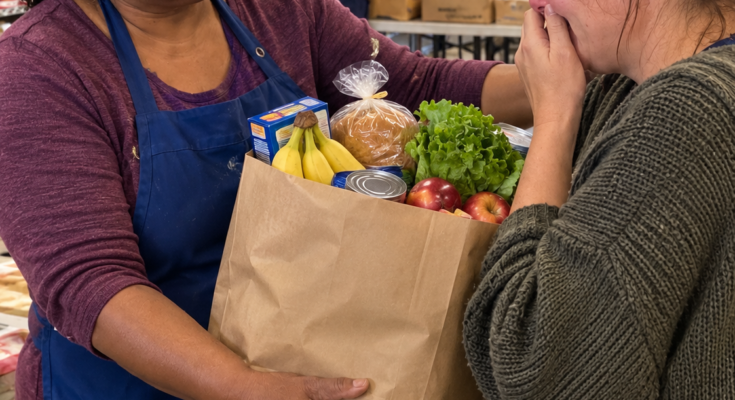
Loretta picked up a paper grocery bag.
“How’s Ethan?”
Vanessa couldn’t answer.
Loretta began filling the bag.
Potatoes.
Rice.
Canned vegetables.
Peanut butter.
Apples.
Eggs.
Chicken.
“Mrs. Simmons, please.”
Loretta looked up.
“What is it, honey?”
Vanessa’s face burned.
“You know what I did to you.”
Loretta stopped.
“I complained about you. Over and over. I told the principal you shouldn’t be working around children. I tried to get you fired.”
Her voice cracked.
“And now I’m standing here taking food from you.”
Loretta folded the top of the bag.
Then quietly said:
“Your little boy shouldn’t go hungry because two grown women had a disagreement.”
Vanessa covered her mouth.
The tears came hard.
“I didn’t know.”
“Know what?”
“That he was hungry.”
Loretta’s expression softened.
Vanessa shook her head.
“I thought you were spoiling him. I thought you were ignoring the rules.”
“He was embarrassed,” Loretta said. “Sometimes he’d come through my line asking whether anything was left over. I didn’t think he needed me announcing his business to everybody.”
Vanessa stared at her.
“Why didn’t you tell me?”
“Because Ethan deserved dignity too.”
That sentence hurt.
Vanessa had spent weeks trying to protect rules.
Loretta had been protecting her son.
“I judged you.”
“Yes,” Loretta said.
Vanessa looked surprised by the answer.
Loretta continued gently:
“And I probably bend more rules than my supervisor likes. Both things can be true.”
Then she reached into the basket and added two apples.
“One for Ethan.”
She added another.
“And one for his mama.”
Vanessa cried harder.
Loretta came around the folding table and put a hand on her shoulder.
“Listen to me. Needing food this month doesn’t erase every month you took care of that boy.”
“I feel like I’ve failed him.”
“No.”
Loretta shook her head.
“Hard times aren’t a character flaw.”
That afternoon, Vanessa set the groceries on her kitchen counter.
Ethan immediately saw the apples.
“Mrs. Simmons gives me those sometimes.”
Vanessa turned.
“She does?”
“Yeah.”
He picked one up.
“She says everybody needs something good in their day.”
Vanessa sat down.
And cried until Ethan came over and wrapped his little arms around her neck.
On Monday morning, she went directly to the school.
The principal invited her into his office.
Vanessa did not blame unemployment.
She did not say she had been stressed.
She did not call anything a misunderstanding.
“I was wrong about Mrs. Simmons,” she said. “I judged what she was doing without understanding it. I want my complaints withdrawn.”
The principal nodded.
Vanessa wasn’t finished.
“She treated my child with more kindness than I treated her.”
That was the first consequence Vanessa could repair.
Not the embarrassment she had caused Loretta.
Not the nights Loretta worried she might lose her job.
But the story Vanessa herself had helped create about who that woman was.
She could at least stop adding to it. Pasted markdown Pasted markdown Pasted markdown
━━━━━━━━━━━━━━━━━━━━
Part Three — The Second Apron
The next Saturday, Vanessa returned to the food pantry.
Loretta looked toward the door.
For a moment, she assumed Vanessa needed groceries again.
There was no judgment in her face.
That alone told Vanessa how much she still had to learn.
But this time Vanessa wasn’t holding an empty grocery bag.
She carried an apron.
“I was wondering if you needed help.”
Loretta raised an eyebrow.
“You any good at stacking canned beans?”
“Probably not.”
“Perfect. You’ll fit right in.”
She handed Vanessa a box.
No dramatic forgiveness.
No speech about friendship.
They worked.
That was how their relationship began again.
Side by side.
Some Saturdays, Vanessa still left with groceries.
Loretta never turned volunteering into payment for them.
“You don’t have to earn food,” she told her once.
When Vanessa finally found another full-time job, she kept returning anyway.
Sometimes Ethan came.
Caleb came with Loretta.
The boys became friends.
And gradually Vanessa learned pieces of Loretta’s life she had never bothered to imagine before judging her.
She learned Loretta had buried a daughter.
That she was raising a grandson on cafeteria wages.
That the electric bill sometimes sat unopened until payday.
That the woman Vanessa had once described as careless with school food counted every dollar at home.
One afternoon Vanessa asked:
“Why didn’t you hate me?”
Loretta laughed.
“Who says I didn’t get irritated?”
“I’m serious.”
Loretta stopped sorting cans.
“So am I.”
Then she looked at Vanessa.
“Being kind doesn’t mean nobody ever hurts your feelings.”
That stayed with her.
Loretta had not fed Vanessa because Vanessa deserved a reward for changing.
She fed her because Ethan needed dinner.
That difference became the entire lesson.
Months later, a young father entered the pantry holding his daughter’s hand.
He apologized before anyone had even asked his name.
“I’m sorry. I’ve never done this before.”
Vanessa recognized the look immediately.
Eyes lowered.
Voice too quiet.
The terrible belief that needing help was something everybody in the room could see.
She stepped toward him.
“You don’t need to apologize.”
He looked at her.
Vanessa handed him a grocery bag.
“You came to the right place.”
Across the room, Loretta heard her.
She didn’t say anything.
She just smiled and went back to stacking cans.
Years later, Ethan barely remembered the extra biscuit that started everything.
Vanessa did.
She remembered every time she saw someone being judged by a small piece of a much larger life.
When Ethan was old enough to understand, she finally told him the whole story.
“I almost got Mrs. Simmons fired because she gave you extra food.”
Ethan stared at her.
“You did what?”
“I thought she was breaking rules.”
“She was feeding me.”
“I know that now.”
He laughed.
“That’s pretty bad, Mom.”
Vanessa smiled.
“It was.”
Then she became serious.
“But I want you to remember something.”
“What?”
“Sometimes you’ll know enough about someone to form an opinion, but not enough to understand them.”
She thought of Loretta sitting at her kitchen table with the unpaid electric bill.
Of Ethan quietly asking for leftovers.
Of herself hiding in a church parking lot because eleven dollars stood between her pride and an empty refrigerator.
“Before you decide who someone is,” she said, “leave room for the part of the story you haven’t seen yet.”
Loretta eventually retired from the elementary school.
The cafeteria staff gave her a little plaque.
She pretended not to care about it and then displayed it in her living room.
Vanessa and Ethan attended her retirement dinner.
So did Caleb, now grown.
When people stood to give speeches, Vanessa stayed seated.
She had already spent years telling Loretta what she meant to her.
She did not need to turn the woman’s kindness into a performance.
Instead, Vanessa brought her something small.
A framed photograph from the food pantry.
Four people stood behind a folding table.
Vanessa.
Ethan.
Caleb.
Loretta.
On the table sat grocery bags, canned vegetables, potatoes—
and a basket of apples.
Loretta looked at the picture and smiled.
“Everybody needs something good in their day.”
Vanessa laughed.
“You remember saying that?”
“I’ve been saying it forever.”
Then Vanessa hugged her.
The real lesson was never simply that Vanessa had been wrong.
People are wrong every day.
The part she carried with her was what Loretta did after being wronged.
She could have watched Vanessa walk into that pantry and thought:
Now she knows what it feels like.
She could have made her wait.
Could have embarrassed her.
Could have reminded her of every complaint.
Instead, she picked up a grocery bag.
Because kindness is easiest when the person receiving it has been kind to you first.
Loretta’s kindness mattered because Vanessa hadn’t.
And she never confused feeding a hungry family with pretending the hurt never happened.
She simply refused to make a child pay for an adult’s pride. Pasted markdown Pasted markdown
Facebook caption:
She tried for months to get the school cafeteria worker fired for giving her son extra food. Then she lost her job, walked into a food pantry with only $11 left—and saw the same woman standing behind the table. What happened next changed the way she judged people forever.