
Part One — The Woman in the Hospital Gown
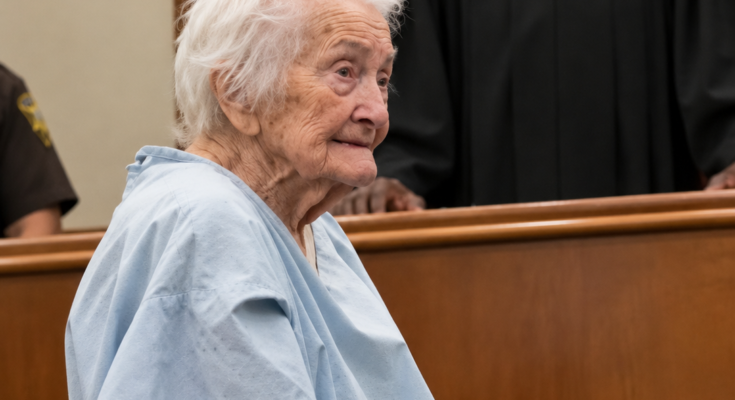
Helen Carter was ninety-one years old when she entered the courtroom wearing a hospital gown beneath a borrowed gray sweater.
Her wrists were cuffed in front of her.
Judge Marcus Bennett looked down from the bench, then looked again.
For twenty-three years, he had presided over cases involving theft, assault, drugs, fraud, and almost every variety of bad decision a person could make.
He had never seen anything quite like Helen.
She was barely five feet tall. Her white hair had not been combed. Hospital identification bands still circled one wrist beneath the handcuff.
Judge Bennett glanced toward the prosecutor.
“Why is this defendant dressed like that?”
The prosecutor stood.
“Your Honor, Mrs. Carter experienced a severe blood-pressure spike while in custody yesterday. She was transported to the hospital for evaluation and discharged this morning.”
Judge Bennett looked at the paperwork again.
Helen had been arrested after attempting to leave a pharmacy with medication she had not paid for.
The original police report described a theft. There had been a confrontation near the exit, but no firearm had been found and nobody alleged that Helen had threatened anyone with a weapon. By the time the case reached court, the charge before the judge was theft—not the dramatic “armed robbery” description that had already begun circulating outside the courthouse.
Judge Bennett looked toward Helen.
“Mrs. Carter, do you understand why you’re here?”
Helen nodded.
“Yes, sir.”
Her voice was almost too quiet to hear.
“And you have counsel?”
A public defender beside her stood.
“Yes, Your Honor. I met with Mrs. Carter at the hospital this morning.”
Judge Bennett noticed Helen swaying slightly.
“Officer, remove the handcuffs and let her sit.”
The bailiff hesitated only a moment before unlocking them.
Helen rubbed her wrists.
Then she lowered herself into the chair.
The judge turned to the attorney.
“Tell me what happened.”
Helen had been married to her husband, George, for sixty-five years.
They met at a church picnic when she was twenty-four and he was twenty-one.
She used to tease him that he had proposed because she made better peach cobbler than his mother.
George insisted it was her smile.
They raised three children.
Buried one.
Worked.
Retired.
Grew old together in the same little brick house outside St. Louis.
By the time Helen was ninety-one and George eighty-eight, their world had become much smaller.
Doctor appointments.
The grocery store.
Church when George felt strong enough.
Television after dinner.
A pair of recliners positioned close enough that they could hold hands without getting up.
George also had advanced heart disease.
His medication regimen had changed several times, and some of the prescriptions were expensive. For months, a supplemental insurance plan and assistance program had kept their out-of-pocket costs manageable.
Then something changed.
Helen did not fully understand what.
There had been letters.
Forms.
A renewal deadline.
A premium they couldn’t afford.
By the time she arrived at the pharmacy that Monday, expecting roughly the same amount she had paid previously, the pharmacist told her the prescription would cost hundreds of dollars.
Helen thought she had misheard him.
“How much?”
The pharmacist repeated the price.
Helen gripped the counter.
“That can’t be right.”
He checked again.
It was.
Without the previous coverage, the medication was far more expensive than Helen had expected.
She opened her purse.
Inside were seventy-three dollars.
She went home without the medicine.
For the next three days, she tried to solve the problem herself.
She called the insurance number and spent nearly an hour listening to hold music.
She called George’s doctor’s office but became confused when someone explained prior authorization, coverage, and alternative medication.
She wrote down three phone numbers on the back of an electric bill.
Called all three.
At some point she began crying.
Then she stopped calling.
That was how Helen had handled difficult things all her life.
She kept going until she couldn’t.
George noticed.
“What’s wrong?”
“Nothing.”
“You’ve said nothing sixty-five years. I know what it sounds like.”
She finally admitted that she had not picked up one of his prescriptions.
George became upset.
Not with her.
With himself.
“We’ll figure it out.”
But over the following days, his breathing became more difficult.
That frightened Helen.
On Thursday afternoon, she returned to the pharmacy.
The medication was still unaffordable.
The pharmacist tried to explain that he could contact the doctor’s office and look into available options, but Helen heard only fragments.
Tomorrow.
Insurance.
Call the doctor.
George was home struggling to breathe.
Tomorrow felt too far away.
Helen stood near the pharmacy counter for several minutes.
Then she saw the bag containing the prescription.
She later told her lawyer she did not remember making a decision.
She remembered only thinking:
George needs that.
When the pharmacy employee turned away, Helen took the medication and slipped it into her purse.
She made it less than twenty feet.
A store employee stopped her near the doors.
Helen panicked.
There was an argument.
Security was called.
Then police.
The medication was recovered unopened.
At the station, Helen’s blood pressure rose dangerously high. She became dizzy and disoriented, and officers called for medical help.
That was how a ninety-one-year-old woman ended up entering Judge Bennett’s courtroom from a hospital.
When the public defender finished explaining, the courtroom was completely silent.
Judge Bennett looked toward Helen.
“Mrs. Carter, did you know taking the prescription without paying was illegal?”
Helen nodded.
“Yes, sir.”
“Why did you do it?”
Her mouth trembled.
She looked down at her hands.
“I’ve never stolen anything.”
The judge waited.
Helen continued.
“George worked forty-seven years. I worked too. We paid our bills. We raised our children. We never asked anybody for much.”
Her voice broke.
“I watched him sitting in his chair trying to breathe, and I had seventy-three dollars.”
She wiped her cheek.
“I didn’t know what else to do.”
Judge Bennett leaned back.
For several seconds he said nothing.
Then he looked toward the prosecutor.
“Has this woman ever been arrested before?”
“No, Your Honor.”
“Any criminal history?”
“None.”
“The medication was recovered?”
“Yes.”
“Unopened?”
“Yes.”
He turned toward the defense attorney.
“Is her husband receiving medical care now?”
The attorney hesitated.
“We don’t know, Your Honor. He’s currently at home.”
The judge’s expression changed.
“Currently?”
“Yes.”
Judge Bennett looked toward his clerk.
Then toward the courtroom officer.
“Before we discuss anything else, somebody needs to make sure Mr. Carter is safe.”
Helen immediately looked up.
“Please don’t take him away.”
The fear in her voice changed the room.
The judge softened.
“Nobody is taking your husband away from you, Mrs. Carter.”
He paused.
“We’re making sure he gets help.”
That was when Helen began to cry.
Not because she had been caught.
Because for the first time in four days, somebody else had taken part of the problem out of her hands.
━━━━━━━━━━━━━━━━━━━━
Part Two — What the Court Could Actually Do
Judge Bennett could not simply erase the case because the story was heartbreaking.
But the prosecutor could exercise discretion, the defense could present Helen’s circumstances, and the court could address immediate safety concerns.
After a recess, the prosecutor agreed not to pursue the case if Helen completed a diversion arrangement and remained out of trouble.
The judge released her without requiring money she clearly did not have.
More importantly, a court social worker helped contact George’s medical team.
By that afternoon, George was being evaluated.
The pharmacy, doctor’s office, and a benefits counselor worked through his prescriptions and coverage options. An assistance program was located for one of the medications, and his doctor reviewed whether lower-cost alternatives were medically appropriate for others.
None of it was magic.
There were forms.
Phone calls.
Eligibility rules.
Appointments.
But there were now people helping Helen navigate them.
Before she left, Judge Bennett looked at her.
“Mrs. Carter, I need you to promise me something.”
Helen straightened.
“What?”
“If you cannot afford his medicine again, you ask for help before you steal it.”
A few people smiled.
Helen didn’t.
“I did ask.”
That answer silenced the room.
Judge Bennett nodded slowly.
“Then next time, keep asking until somebody listens.”
━━━━━━━━━━━━━━━━━━━━
Part Three — The Number Beside the Telephone
George was in the hospital when Helen returned from court.
His condition had worsened enough that his doctor wanted him monitored while his medications were adjusted.
Helen sat beside his bed holding his hand.
He looked at her hospital bracelet.
Then at the fading marks around her wrists.
“What happened to you?”
She tried lying.
After sixty-five years, George was still better at recognizing it than she was at doing it.
Helen told him.
Everything.
The pharmacy.
The police.
The hospital.
The courtroom.
When she finished, George stared at the ceiling.
Then he started crying.
Helen had seen her husband cry only a handful of times.
When their youngest son died.
When his mother died.
When their first great-grandchild was born.
Now.
“I did that to you.”
Helen squeezed his hand.
“No.”
“You stole medicine because of me.”
“I stole medicine because I panicked.”
“I should’ve known.”
“You were busy trying to breathe.”
That shut him up.
After a while, George said, “Sixty-five years and this is the first crime you’ve committed for me?”
Helen stared at him.
Then, against all logic, she laughed.
George smiled.
“There she is.”
The story might have ended there if the courtroom had simply processed one unusual case and moved on.
But Judge Bennett could not forget Helen’s answer.
I did ask.
He had heard people say for years that struggling families needed to “ask for help.”
Helen had.
What she lacked was not willingness.
She lacked the ability to navigate a system requiring long phone calls, internet access, passwords, application forms, insurance terminology, and repeated explanations to different offices.
At ninety-one, she had been expected to coordinate all of that while caring for an eighty-eight-year-old husband with serious illness.
A month later, Judge Bennett asked representatives from several local organizations to meet.
Not because judges ran healthcare programs.
They did not.
But judges could bring people into the same room.
The county aging agency came.
A hospital social worker.
A pharmacist.
Two legal-aid attorneys.
A representative from a senior transportation program.
Someone from a nonprofit that helped older adults apply for benefits.
They discovered what people who worked directly with seniors already knew.
Helen was not unique.
Some older adults stretched medications.
Some skipped doses.
Some chose between prescriptions and electricity.
Some qualified for assistance but never completed the paperwork.
Others were simply overwhelmed.
So the organizations created something very ordinary.
A phone line.
No grand foundation.
No television campaign.
Just one local number older residents could call when they were stuck between a prescription, an insurance problem, and a system they did not understand.
A real person answered.
That person did not always have the solution.
But they knew where to start.
Helen knew nothing about it until a social worker visited her house several months later.
There was a bright card in her hand.
MEDICATION & SENIOR BENEFITS HELP
A phone number was printed underneath.
Helen studied it.
“This is because of me?”
“Partly.”
“Oh, Lord.”
The social worker smiled.
“What?”
“Now everybody will know I stole pills.”
“Your name isn’t on it.”
“Good.”
She put the card beside the kitchen telephone.
George tapped it with one finger.
“You should frame that.”
“Absolutely not.”
George recovered enough to come home.
Not cured.
Nobody pretended that.
His heart was still weak.
Their lives still revolved around pill organizers, appointments, and carefully planned trips to the grocery store.
But his medication became manageable.
Their daughter, Susan, also became more involved.
That led to an argument.
A large one.
“Why didn’t you tell me?”
Helen stood at the kitchen counter.
“You have your own family.”
“I’m fifty-nine years old, Mom. I can handle a phone call about Dad’s prescriptions.”
“I didn’t want to bother you.”
Susan started crying.
“You called me twice last month to tell me about a squirrel eating your birdseed.”
“That squirrel is a menace.”
“Mom.”
Helen looked away.
Susan lowered her voice.
“You let me help with squirrels, but not when Dad couldn’t breathe?”
That landed.
Helen had spent her entire adulthood believing independence meant solving your own problems.
Her generation had praised that.
Work hard.
Don’t complain.
Don’t become a burden.
But at ninety-one, the word burden had become dangerous.
It had convinced her that asking her own children for help was somehow more shameful than sitting alone with a problem she could not solve.
So they made changes.
Susan received copies of important insurance information.
Their son David joined medical calls when needed.
A granddaughter organized their documents into a binder with labels so large Helen complained they could be read “from Missouri to Kansas.”
They laughed more after that.
Not because life became easy.
Because secrets became fewer.
About six months after the arrest, Helen received a letter.
No return address she recognized.
Inside was a handwritten note from the pharmacist who had been working that afternoon.
Mrs. Carter,
I’ve thought about that day many times. I wish I had recognized sooner that you weren’t simply asking about a price. You were frightened.
I couldn’t legally let you walk away with medication without proper payment or authorization, but I could have slowed down, brought someone else in, called the physician while you were there, and made sure you understood the options.
I’m sorry I didn’t.
Helen read it twice.
Then she wrote back.
Dear Mr. Daniels,
You were doing your job. I was frightened and did a foolish thing.
She stopped.
Crossed out foolish.
Then continued.
I did a desperate thing. That isn’t the same as a good thing.
But thank you for remembering I was scared.
She signed it.
The two later met.
There was no dramatic reconciliation because neither had really been enemies.
That was perhaps the point.
Most systems fail people without any individual waking up that morning intending to be cruel.
The insurance employee follows the rule.
The pharmacy follows the rule.
The doctor’s office has another procedure.
The patient gets another phone number.
Everyone completes their small part.
And occasionally a ninety-one-year-old woman ends up standing in a store believing the only remaining choice is to put medicine into her purse.
George lived another eighteen months.
His final months were difficult, but they were also ordinary in ways Helen treasured.
Coffee in the mornings.
Baseball on television.
Arguments about whether the thermostat should be seventy-two or seventy-four.
One afternoon, Susan found them asleep in their recliners, hands still touching between the chairs.
George died at home on a Sunday morning.
Helen was holding his hand.
At the funeral, Judge Bennett attended quietly and sat near the back.
Helen spotted him afterward.
“You didn’t have to come.”
“No.”
“Judges usually attend funerals of criminals?”
He smiled.
“Only the dangerous ones.”
Helen laughed.
Then she hugged him.
She lived three more years.
During those years, she volunteered one morning each week at the senior center.
Her primary qualification, according to Helen, was being “old enough to know which paperwork makes people cry.”
She sat beside other seniors while they made insurance calls.
She helped write questions before appointments.
When somebody became embarrassed about not understanding a form, Helen told them:
“If I can survive getting arrested at ninety-one, you can ask that woman to explain page three again.”
Everyone at the center eventually knew the story.
Helen stopped being embarrassed by it.
Not proud.
Never proud.
She was careful about that distinction.
“I did something illegal,” she once told a group of volunteers. “Being scared explained it. It didn’t turn it into the right thing.”
Then she pointed toward the phone.
“But I should never have reached the point where stealing felt like my only remaining option.”
After Helen died at ninety-four, Susan cleaned out the little brick house.
Most things were ordinary.
Clothes.
Old bills.
George’s watch.
Photographs from sixty-five years of marriage.
Then she found the bright assistance card beside the kitchen telephone.
Its edges were worn.
On the back, in Helen’s handwriting, were seven names and telephone numbers.
People she had helped.
Susan framed the card.
Not the court paperwork.
Not the hospital bracelet.
Not a newspaper clipping about the ninety-one-year-old woman who had once appeared in court after taking her husband’s medication.
The phone number.
Because that was the part of the story Helen ultimately cared about.
People often remembered the handcuffs.
Judge Bennett remembered something else.
A frightened old woman sitting in his courtroom saying:
“I did ask.”
That sentence stayed with him.
Helen had broken the law.
The court still had to deal with that honestly.
But accountability did not require pretending desperation had no context.
And compassion did not require pretending theft was right.
Both things could be true.
Helen should not have taken the medicine.
And an eighty-eight-year-old man should not have been struggling to breathe while his ninety-one-year-old wife tried to navigate a problem far beyond what she could manage alone.
Years later, Judge Bennett was asked about the case.
He didn’t call Helen a criminal.
He didn’t call her a hero either.
He simply said:
“She was an old woman who reached the end of what she knew how to do.”
Then he added:
“The most important thing we did wasn’t letting her walk out of my courtroom.”
“It was making sure that the next person in her position had someone to call before desperation became a crime.”