Part One — The Six Seconds That Changed Everything
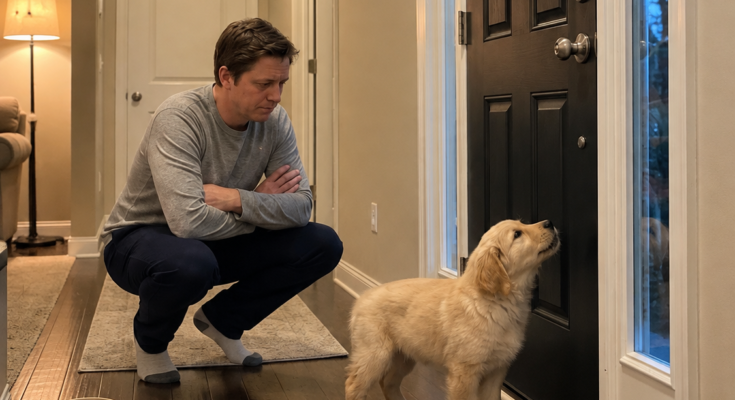
I thought I had rescued a nine-week-old Golden Retriever, but by midnight she was crying like I had taken her from the only home she understood. For six hours, Poppy refused food, water, warmth, toys, and every attempt I made to hold her, always turning toward the door as if someone was supposed to answer.
Then my phone played six seconds of sound I had recorded by accident, and the moment she heard it, my entire understanding of what I had done began to change.
I was sitting on my kitchen floor in an old gray sweatshirt when Poppy cried for what felt like the hundredth time. Three short cries. A pause. Then one long, exhausted sound. “Sweetheart,” I whispered. “There’s nobody out there.”
She didn’t even look at me. She pressed her tiny nose beneath the front door and inhaled desperately, as though the rain-darkened porch might still carry the scent of whoever she was waiting for.
I had brought her home that afternoon from Riverbend County Animal Center outside Nashville. She was nine weeks old, pale gold, with one slightly darker ear and paws that looked much too large for her body. Everybody at the shelter had wanted her. A young couple asked if they could reserve her. A father took pictures for his sons. One woman told Poppy through the kennel gate that she had already bought her a pink bed.
But Poppy kept returning to the wall beside her kennel.
On the other side was an old Saint Bernard. Ten years old. One hundred forty-three pounds. Rust-and-white fur faded with age. A silver muzzle. One cloudy eye. While Poppy bounced around carrying a rubber ring, the Saint Bernard barely moved. At least, that was what I thought.
When Poppy stumbled, the old dog’s ear turned toward her. When another dog barked, she shifted closer to the divider. When Poppy settled, the Saint Bernard exhaled slowly and closed her eye. Before I left, Poppy pressed herself against the concrete wall separating them. The old dog placed one paw near the bottom of the divider. Their faces couldn’t touch, but their breathing met beneath it.
I saw it happen.
Then I drove away with Poppy.
By evening, I knew something was wrong. She ate seven pieces of kibble and threw them up. She dragged her shelter blanket to the front door. Then she carried a yellow rubber duck to the kitchen wall, tapped it three times with her paw, and waited.
Nothing happened.
She tried again.
Three taps.
Then silence.
At 10:27, she scratched at the front door until thin white lines appeared in the wood. I picked her up. “You can’t go back tonight.” Her little body went completely still against me.
At 11:41, exhausted and desperate, I searched through the pictures I had taken at the shelter. A short video started playing accidentally. There was almost nothing in it: Poppy’s kennel, my shoe, a squeaking rubber toy, a metal gate clicking.
Then, near the end, came a sound from the kennel next door.
A deep, slow breath.
Poppy froze.
I played it again. She walked across the kitchen slowly and put one ear against my phone speaker. Her front legs folded beneath her. By the third replay, she had tucked her nose under one paw.
And for the first time since I brought her home, Poppy fell asleep.
I didn’t move for twenty-seven minutes.
At 12:18 in the morning, I called the shelter. Voicemail. They reopened at seven. So I sat in the dark, replaying those six seconds while Poppy slept beside my phone, and one question kept getting louder inside me.
Why did the breathing of a dog she had supposedly known only a few days comfort her more than food, warmth, toys, or me?
At 5:42, Poppy woke and sat beside the front door.
I put on my coat and clipped on her green leash. Then I looked at the hook beside the door, where another leash hung—a wide brown one.
I took it too.
At 7:06, we entered the shelter kennel aisle.
Poppy pulled so hard her paws slid across the concrete. The old Saint Bernard opened her cloudy eye. Poppy cried three times. Then once, long and low.
The old dog stood shakily and released that same deep breath.
Poppy collapsed against the kennel bars.
Her crying stopped instantly.
A shelter employee stared at the second leash in my hand. Her expression changed, and instead of opening the kennel, she reached toward the desk behind her.
“There’s a night log you need to see before you decide what happens next.”
Her name was Marissa. She had been the one who processed Poppy’s adoption the day before. She pulled a thick binder from beneath the counter and flipped through several pages.
“I wasn’t here when they came in,” she said. “I only saw the intake notes.”
“They came in together?”
Marissa looked at me.
“Yes.”
My stomach dropped.
She turned the binder around.
11:48 P.M. — County roadside pickup. Adult female Saint Bernard and female Golden Retriever puppy found near abandoned vehicle on Old Mill Road. Adult dog lying around puppy, sheltering her from heavy rain. No microchip detected on puppy. Adult dog microchip outdated.
I read it twice.
“Why were they separated?”
“Different kennel requirements. Size, age, vaccination status. We thought the puppy was probably unrelated.”
“Probably?”
Marissa nodded slowly. “They clearly aren’t biologically related.”
I looked through the glass toward the dogs. Poppy had pushed her entire body against the kennel bars. The Saint Bernard was lying on the other side with her nose pressed as close to Poppy as the gap allowed.
Marissa continued. “But there’s more.”
She pointed lower on the page.
12:26 A.M. — Puppy distressed during intake. Adult dog vocalized from isolation kennel. Puppy moved temporarily beside adult. Both settled.
Then:
2:10 A.M. — Adult dog refused food until puppy was fed.
And:
4:37 A.M. — Puppy asleep against divider. Adult awake, watching her.
My throat tightened.
“How long were they together before animal control found them?”
“We don’t know.”
“Days?”
“Maybe.”
“Weeks?”
“Possible.”
I looked at the old dog.
“What’s her name?”
“We’ve been calling her Mabel.”
“Is she available for adoption?”
Marissa hesitated.
That hesitation scared me.
“Mabel has some health issues.”
“What kind?”
“Arthritis. A heart murmur. She needs dental work. Her vision is poor on one side. And she’s ten, maybe eleven.”
“So?”
Marissa gave me a tired smile. “People say ‘so’ until they see the estimate.”
I understood what she meant. I was thirty-seven, single, working from home, and had carefully budgeted for one puppy. Food, vaccines, training, emergencies. I had not budgeted for a hundred-and-forty-pound senior dog with medical needs.
Marissa looked toward the kennel again.
“I’m not telling you that you have to take her. You adopted Poppy legally and responsibly. But I do think you should know that whatever happened before they got here, Mabel appears to be the reason Poppy made it through it.”
I looked at the brown leash in my hand.
Then at Poppy.
Then at Mabel.
“Open the kennel.”
━━━━━━━━━━━━━━━━━━━━
Part Two — The Dog Who Had Already Chosen Her
Marissa did not hand Mabel over that morning. There were forms, a veterinary check, and one major question: could I actually care for both dogs safely? Mabel was nearly my weight. She moved slowly, struggled with stairs, and needed medication twice a day.
So the shelter gave us a supervised meeting first.
The moment the gate opened, Poppy ran beneath Mabel’s chest. Mabel lowered her enormous head and began licking the top of Poppy’s skull with slow, tired movements.
Poppy made that same strange little sequence.
Three cries.
Pause.
One long sound.
Mabel exhaled.
Poppy sat down.
It was like watching a conversation in a language I didn’t speak.
Marissa whispered, “She does that every time.”
“What does it mean?”
“No idea.”
The shelter veterinarian, Dr. Patel, joined us a few minutes later. She examined Mabel while Poppy refused to move more than a foot away. “This dog has been through something,” she said. “There are old pressure sores along her elbows, her nails were badly overgrown when she came in, and she’s underweight for her size.”
“Was she neglected?”
“Maybe. But we can’t know from that alone.”
Then she ran the microchip number again.
This time, an old registration surfaced.
Mabel had once belonged to a man named Thomas Weller.
The listed phone number was disconnected.
The address was seven years out of date.
But the shelter found one emergency contact: Rebecca Weller — daughter.
They called.
An hour later, Marissa returned with tears in her eyes.
“You need to hear this.”
Rebecca was forty-five and lived in Kentucky. Her father had died eight months earlier.
Mabel had been his dog.
Not just his pet.
His constant companion.
Thomas had been a retired school custodian who spent the last years of his life largely housebound after a stroke. Rebecca said Mabel slept beside his recliner, followed him to the bathroom, and barked whenever he fell.
After Thomas died, Rebecca tried to take Mabel, but her apartment did not allow large dogs. A family acquaintance named Dean offered to keep her temporarily on a rural property outside Nashville.
Then Dean stopped answering calls.
Rebecca had been trying to find out what happened ever since.
When the shelter told her Mabel had been found beside an abandoned vehicle with a puppy, Rebecca started crying.
“She always takes care of something,” she said.
Nobody knew where Poppy came from.
But animal control found one clue.
Inside the abandoned vehicle were two bowls.
One enormous.
One tiny.
A torn bag of puppy food sat behind the passenger seat.
Someone had been transporting both dogs together.
We never learned exactly why.
Maybe Dean had acquired Poppy.
Maybe someone else had.
Maybe Mabel had known her for days.
Maybe weeks.
But whatever happened, when that vehicle was abandoned during a freezing rainstorm, Mabel had stayed with Poppy.
The animal-control officer who found them later told me he almost missed the puppy entirely.
Mabel was curled around her.
Her body formed a wall against the wind.
Poppy was tucked beneath her chest, dry enough to survive the night.
The officer said when he tried lifting Poppy first, Mabel growled.
Not aggressively.
Desperately.
He finally carried them to the truck together.
I went home that afternoon without either dog.
That was the hardest part.
The shelter needed to complete Mabel’s medical assessment, and Poppy had to remain there for observation after her vomiting and stress.
My house felt wrong without her.
The yellow rubber duck still sat beside the kitchen wall.
I picked it up.
Three little scuff marks marked the paint where Poppy had tapped.
That night I listened to those six seconds again.
Mabel breathing.
Nothing dramatic.
Just air entering and leaving an old dog’s tired lungs.
But to Poppy, that sound had meant:
You’re not alone.
I understood that more than I wanted to.
Three years earlier, my mother had died after a long fight with ovarian cancer. During the final months, I slept at her house more often than mine. There was a particular sound her oxygen concentrator made at night—a low mechanical hum followed by a soft click.
For months after she died, I couldn’t sleep without a fan running.
I had never told anyone why.
The silence felt wrong.
It occurred to me then that perhaps grief doesn’t always look like grief when you’re very young.
Maybe sometimes it looks like refusing food.
Scratching at a door.
Dragging your blanket toward an exit.
Trying to recreate a familiar sound because your whole world disappeared without explanation.
The next morning, Dr. Patel called.
“Mabel can be adopted.”
I stood up so quickly I knocked over my coffee.
“But.”
There it was.
“She needs care. Medication, weight management, joint support, likely dental surgery after she stabilizes. And I need you to understand that at her age, you may not get years.”
I looked at the empty dog bed in my living room.
“How long?”
“Nobody can promise that.”
“I know.”
“Months could be possible. Years could be possible. We just don’t know.”
I closed my eyes.
Then I asked the question I was afraid of.
“Would separating them hurt Poppy?”
Dr. Patel was careful.
“I can’t predict that. Puppies adapt. She might eventually adjust beautifully to a home without Mabel.”
That should have made the decision easier.
It didn’t.
Then she added, “But Mabel may not have much time left, and right now, they are clearly bonded.”
That afternoon, I drove back to Riverbend.
Two leashes hung in my hand.
Green.
Brown.
I signed both sets of paperwork.
Marissa smiled.
“You came prepared.”
“No.”
I looked toward the kennel aisle.
“I think they did.”
━━━━━━━━━━━━━━━━━━━━
Part Three — The Sound Poppy Never Forgot
Bringing both dogs home was nothing like the first night.
Poppy ran inside as if she had lived there forever.
Mabel entered slowly.
She inspected the hallway.
The kitchen.
The living room.
Then she lowered herself beside the couch.
Poppy immediately curled against her stomach.
That was it.
No crying.
No scratching.
No waiting at the door.
That night, I put two beds beside mine.
Poppy ignored hers.
She slept pressed against Mabel’s chest.
At 2:13 in the morning, I woke to that deep breath.
Poppy’s paw twitched.
Then she relaxed.
I smiled in the dark.
The next few months reorganized my entire life.
Mabel could not climb the stairs, so I moved my office downstairs.
She needed rugs across the hardwood because her back legs slipped.
I learned how to hide pills inside cheese.
Poppy learned none of the dignity expected of a Golden Retriever. She climbed over Mabel, slept on Mabel, stole Mabel’s food, tugged her ears, and once attempted to drag the old dog’s tail into the kitchen.
Mabel tolerated all of it.
Mostly.
Every once in a while, she would give Poppy one deep bark.
Poppy would freeze.
Then behave for approximately forty seconds.
But something more interesting happened as Poppy grew.
She started helping Mabel.
At six months old, Poppy began waiting at the back steps instead of charging into the yard. She would stand beside Mabel until the old dog carefully lowered herself down.
At eight months, when Mabel’s eyesight worsened, Poppy started walking slightly ahead of her through the hallway.
Once, during a thunderstorm, Mabel became disoriented and couldn’t find her bed.
Poppy carried the yellow rubber duck across the room and dropped it beside her.
Then she tapped the floor three times.
Mabel turned toward the sound.
I sat there staring.
Three taps.
That strange ritual had never been about the wall.
It was communication.
Maybe Poppy had learned it in the shelter.
Maybe before.
Maybe one day, while trapped together somewhere frightening, she discovered that making three little sounds caused Mabel to answer.
Whatever its origin, they still used it.
Tap.
Tap.
Tap.
Then Mabel breathed.
I started calling it their check-in.
One spring morning, about fourteen months after I adopted them, Mabel didn’t get up for breakfast.
Poppy knew before I did.
She stood beside Mabel’s bed and tapped the floor.
Three times.
Nothing.
Again.
Three taps.
Mabel opened her eye.
She tried to stand and couldn’t.
I called Dr. Patel.
By noon, we were in the veterinary office.
Mabel’s heart had worsened significantly.
There were options that might buy some time, but Dr. Patel was honest about what that time could look like.
I sat on the floor beside Mabel.
Poppy pressed against her.
“How do I know?” I asked.
Dr. Patel crouched beside me.
“You know her.”
It was the same impossible answer every person with an old animal eventually receives.
I looked at Mabel.
She was tired.
Not merely sleepy.
Tired in her bones.
She had stopped enjoying food.
Walking had become frightening.
Breathing required effort.
I could have asked her body for more days.
But those days would have been for me.
So I made the appointment for the following morning at home.
That night, I slept downstairs beside them.
At some point around three, I woke.
Poppy was sitting upright beside Mabel.
She tapped the floor.
Once.
Twice.
Three times.
Mabel opened her cloudy eye.
Then came the breath.
Deep.
Slow.
Familiar.
Poppy curled against her.
I picked up my phone.
For a second, I almost recorded it.
Then I stopped.
I already had six seconds.
I didn’t need to turn their final night into something I was trying to preserve perfectly.
I put the phone down and listened.
The veterinarian arrived the next morning.
Mabel lay on her favorite rug by the window.
Poppy stayed beside her.
I worried whether she should be there.
Dr. Patel said gently, “Let her decide.”
So I did.
I stroked Mabel’s silver face while Dr. Patel gave the medication.
Poppy placed one paw over Mabel’s front leg.
Mabel’s breathing slowed.
Then stopped.
Poppy waited.
She tapped the rug.
Three times.
Nothing answered.
She waited.
Then tapped again.
I broke.
I buried my face in Mabel’s fur and sobbed harder than I had since my mother died.
Poppy did something I will never forget.
She climbed into my lap.
All sixty pounds of her.
Then she leaned her chest against mine.
Exactly the way she used to press herself against Mabel.
We sat there together beside the old dog who had saved both of us in ways she could never understand.
Poppy searched for Mabel for several days.
She checked the old bed.
The kitchen.
The hallway.
Once, she tapped beside the back door.
No answer came.
But she ate.
She drank.
She slept beside me.
And gradually, she stopped waiting.
I kept Mabel’s brown leash hanging beside Poppy’s green one.
I couldn’t put it away.
Months later, Rebecca—the daughter of Mabel’s original owner—came to visit.
She brought photographs.
Mabel as a puppy.
Mabel beside Thomas’s hospital bed.
Mabel wearing a ridiculous Christmas sweater.
In one photograph, Thomas was sitting in a recliner with Mabel’s head resting on his knee.
Rebecca looked at Poppy sleeping nearby.
“My dad used to say Mabel needed someone to look after.”
I smiled.
“She found someone.”
Rebecca shook her head.
“Looks like she found two.”
Poppy is four now.
Healthy.
Ridiculous.
Obsessed with tennis balls.
She still sleeps against the side of my bed.
And every once in a while, usually when she is tired or uncertain, she taps something three times with her paw.
A door.
The floor.
My leg.
I answer now.
Usually by touching her shoulder.
Sometimes I breathe deeply on purpose.
She always settles.
The six-second recording is still on my phone.
I rarely play it.
I thought for a long time that it captured the moment I realized Poppy missed Mabel.
Now I think it captured something bigger.
We talk about rescuing animals as if the direction of saving is obvious.
Human finds dog.
Human brings dog home.
Human provides food, warmth, medicine, safety.
But Poppy had already been rescued before I ever saw her.
An old Saint Bernard had curled her aging body around a puppy in the rain and stayed there until somebody came.
Then Poppy spent the next fourteen months returning that devotion in every small way she knew.
And somewhere in between, both of them taught me something I had needed since losing my mother.
Home is not always a building.
Sometimes home is a sound.
A familiar breath in the dark.
Three taps against the floor.
Someone answering:
I’m still here.