
Part One — The Card I Refused to Use
After thirty-seven years of marriage, Richard walked out of my life like a man taking off an old coat he no longer needed. At the courthouse in Chicago, the day everything became official, he pressed a bank card into my palm and said in a voice so calm it made me hate him more, “Take it. That should be enough to keep you going for a little while.”
I did not cry in front of him. I would rather have swallowed glass. I slipped the card into my handbag and watched him disappear down the hallway without looking back, like I was something he had already buried.
I rented a tiny room with water stains on the ceiling and a window that rattled all winter. I scrubbed strangers’ kitchens, watched cars outside a pharmacy for cash, picked up bottles and cardboard when there was nothing in the cupboard but salt and tea bags. Some nights I went to bed hungry just to make what little I had last one more day.
But I never used the card.
Maybe part of it was pride. Mostly, it was rage. Those three thousand dollars felt like an insult dipped in plastic, Richard’s way of putting a price tag on nearly four decades of my life. I had raised our children, managed our home, cared for his mother during her final years, stretched his paycheck when work was slow, and worked part-time whenever we needed extra money. Then at sixty, I was supposed to accept three thousand dollars and be grateful.
My children helped when they could, but both were raising children of their own. My daughter, Michelle, once tried to give me six hundred dollars after discovering my electricity had been shut off for two days. I lied and told her it was a billing error. My son offered to let me move into his basement. I told him I loved my independence.
I lied beautifully.
The truth was that I had turned survival into a private competition with Richard. Every month I managed without touching his card felt like proof that he had not broken me. The problem was that eventually I stopped noticing how much I was breaking myself.
A few days ago, I fainted outside my apartment.
At the clinic, the doctor looked at my test results and told me I had been neglecting several problems for far too long. I needed more testing and treatment, and I needed to stop pretending that skipping meals and postponing medication counted as financial planning.
That night, I opened the small tin box where I had hidden Richard’s card. It was worn around the edges. I turned it over in my fingers and thought, Fine. You win.
Three thousand dollars was not much, but it could cover the medical expenses I was afraid of and buy me some breathing room.
The next morning, I went to the bank.
The branch smelled like floor cleaner and cold air. Everyone around me looked polished and certain. I stood there in repaired shoes with my stitched handbag and placed the card on the counter as though I were surrendering the last piece of my pride.
“I want to withdraw everything,” I told the teller.
She inserted the card information, typed for several seconds, then stopped.
She typed again.
Her expression changed.
“Is there a problem?”
“May I see your identification?”
I handed it over.
She checked the screen once more, then looked at me carefully. “Ma’am… there isn’t three thousand dollars in this account.”
For one terrible second, I thought Richard had withdrawn it years ago.
Of course he had.
Why wouldn’t he?
My chest tightened. “Then how much is there?”
Instead of answering, she picked up the telephone.
“I’m going to ask my manager to come speak with you.”
My legs weakened.
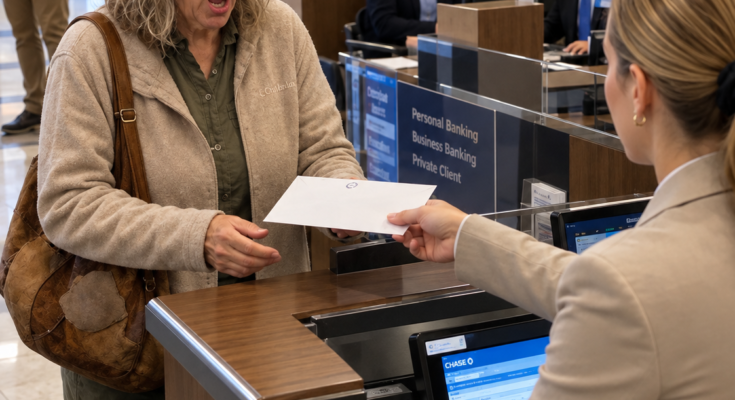
A minute later, a woman in a navy suit came from a glass office carrying a sealed cream-colored envelope. My full name—Eleanor Whitmore—was handwritten across the front.
“Mrs. Whitmore?”
“Yes.”
“My name is Angela Reed. Before I discuss the balance, I need to verify a few details.”
She asked my address, date of birth, and several security questions. Then she guided me into her office and closed the door.
I could barely stand the suspense.
“Please,” I said. “I just need to know whether the money is gone.”
Angela looked at me strangely.
“It isn’t gone.”
She turned the computer monitor slightly toward me.
I saw the number.
Then I looked again because my mind refused to understand it.
$47,286.19
My whole body went numb.
“There has to be a mistake.”
“There isn’t.”
“I haven’t deposited anything into this account.”
“I know.”
She clicked through several years of transactions.
Every month, on the third business day, money had entered the account.
Five hundred dollars.
Sometimes six hundred.
Occasionally more.
Again.
And again.
And again.
For five years.
My hand went to my mouth.
“Where did this come from?”
Angela placed the envelope between us.
“Mr. Whitmore arranged the recurring deposits when the account was opened. He also left instructions that this envelope be given to you if you ever personally came into the branch and requested access.”
I stared at Richard’s handwriting.
Five years after our divorce, I recognized it instantly.
My hands shook as I opened the envelope.
Inside was one sheet of paper.
Eleanor,
If you are reading this, then stubbornness finally lost to necessity. I am sorry it took necessity to make you accept something that was yours all along.
I stopped reading.
“What was mine?”
Angela quietly pushed a box of tissues toward me.
I continued.
The three thousand dollars was a lie. I knew if I told you what I had actually arranged, you would tear up the card, throw it at me, or make me undo it. Probably all three.
Despite myself, I almost laughed.
That sounded like me.
Then I reached the sentence that made my knees feel weak all over again.
This money was never a goodbye gift. It is repayment for thirty-seven years in which your work made my life possible while only my name appeared on most of the paychecks.
I put the letter down.
For five years, I had been refusing Richard’s charity.
Only it had never been charity at all.
━━━━━━━━━━━━━━━━━━━━
Part Two — The Marriage I Had Remembered Wrong
I stayed in that bank office for almost an hour.
Angela explained that Richard had opened the account as part of the financial arrangements made around our divorce. The original three thousand dollars had been deposited immediately, but he had also instructed his bank to send a fixed amount from his retirement income every month. The card was mine. The account was mine. He had no ability to withdraw the money once it entered.
“Why wasn’t this in the divorce paperwork?” I asked.
“There were retirement provisions in your settlement, but this particular account appears to have been funded separately by Mr. Whitmore from money he retained after the division.”
That confused me even more.
Richard had voluntarily kept depositing money after the divorce.
I returned to the letter.
I handled the end of our marriage badly. There is no polite way to rewrite that. I was distant because distance was easier than admitting what I had done to us. By the time I finally said I wanted out, I had spent years treating your work as background noise because it was always there. Meals appeared. Bills were remembered. Children got to appointments. My mother was cared for. I worked overtime and told myself that made me the provider.
I swallowed hard.
Those words reopened memories I thought I had already settled.
Richard coming home and asking what I had done all day.
Richard complaining if dinner was late.
Richard telling friends he had “supported a family of four” while forgetting the years I cleaned offices at night after putting the children to bed.
But I remembered good things too.
Thirty-seven years cannot honestly be reduced to the final ugly chapter.
He had slept in a hospital chair for four nights when I had pneumonia at forty-two. He taught our daughter to drive because I was too nervous. He held my father’s hand during his final hours because I could not.
That was what made divorce so difficult.
Richard had not been a monster.
He had been a man I loved who had also hurt me deeply.
The letter continued.
By the end, I had convinced myself that because I had earned more money, I had contributed more to the marriage. My attorney asked me a question I could not answer: “If Eleanor had billed you for everything she did while you built your career, what would you owe her?”
I sat back.
I still don’t know the number. I know it isn’t three thousand dollars.
There were tears on the page now.
Mine.
You may believe I left because thirty-seven years meant nothing. That isn’t true. I left because I had become unhappy and cowardly enough to believe leaving was easier than repairing what I had helped damage. I will not insult you by pretending the divorce was noble. It wasn’t. But I also refuse to let the last thing I ever contribute to your life be the sentence, “That should keep you going for a while.”
I closed my eyes.
For five years, those words had lived inside me.
That should be enough to keep you going for a little while.
I had used them as fuel.
Every hungry night.
Every humiliating job.
Every time I refused to ask my children for help.
I imagined Richard somewhere living comfortably, proud of himself for tossing three thousand dollars toward the woman who had given him thirty-seven years.
Now I realized something worse and better at the same time.
He had known exactly how those words sounded.
He had said them deliberately because he knew anger would make me keep the card instead of returning it.
That irritated me enough that I almost admired him.
Almost.
The final paragraph said:
I am not asking forgiveness. I am not asking you to call. Use the money. Burn the letter. Curse me if that helps. But please stop treating every kindness offered to you as if accepting it means you lost. You spent most of your life helping other people survive. You are allowed to survive too.
Underneath, Richard had written a phone number.
Not his old number.
A new one.
I left the bank with two thousand dollars transferred into my checking account for immediate medical costs and the rest untouched until I could think clearly.
Then I went home.
I placed Richard’s letter on my kitchen table and stared at the phone number for three hours.
At seven that evening, I called.
A man answered on the fourth ring.
“Hello?”
His voice had changed.
Older.
Rougher.
But it was Richard.
Neither of us spoke.
Then he said quietly, “Eleanor?”
Five years collapsed into one second.
“You knew I would call.”
“No.”
“You left your number.”
“I hoped.”
I looked at the account statement.
“Forty-seven thousand dollars.”
He exhaled.
“So you finally went to the bank.”
“I almost fainted.”
“That seems excessive.”
“Don’t make jokes.”
“Sorry.”
There was an awkward silence.
Then I asked the question that mattered.
“Why?”
Richard did not pretend not to understand.
“Because it was yours.”
“No. The settlement was done. You didn’t legally owe me monthly deposits.”
“I know.”
“Then why?”
His answer was simple.
“Because after I left, I finally learned how much you had been doing.”
I almost laughed bitterly.
“How?”
“I had to do it myself.”
He told me something I never expected.
The woman I assumed he had left me for did not exist.
There had been no affair.
He had simply wanted a different life and had been too emotionally immature to say that honestly until the marriage was already beyond repair.
After our divorce, Richard moved into a condominium alone.
For the first time in nearly four decades, he had to remember everything.
Groceries.
Insurance.
Laundry.
Medication.
Birthdays.
Taxes.
Meals.
Appointments with his aging mother.
“Three months after you left,” he said, “I missed Mom’s cardiology appointment because I wrote the wrong date down.”
I said nothing.
“You never missed one.”
“No.”
“I thought things like that just happened.”
“They happened because I did them.”
“I know that now.”
For the first time since our divorce, I heard something from Richard I had wanted for decades.
Not money.
Recognition.
“I was selfish, Eleanor.”
My eyes filled.
“Yes.”
“I treated what you did like it had no value because nobody sent you a paycheck for it.”
“Yes.”
“I’m sorry.”
I sat at the kitchen table and cried.
Not because his apology repaired our marriage.
It didn’t.
Some truths arrive too late to save what they should have saved.
But late truth is still truth.
Before we hung up, Richard asked, “Are you sick?”
“How did you know?”
“You would have left that card untouched until the day you died unless something forced you.”
I hated how well he still knew me.
“I need treatment.”
“Then use the account.”
“I will.”
“Good.”
Then he said something that surprised me.
“Eleanor?”
“Yes?”
“Don’t make suffering your proof that you never needed me.”
I nearly snapped back.
Then I realized he was right.
And I hated him for that too.
━━━━━━━━━━━━━━━━━━━━
Part Three — The Money I Finally Understood
My medical treatment began the following week.
Nothing miraculous happened. The money did not buy youth. It did not erase five years of struggling or undo decades of mistakes inside my marriage. What it did was far less dramatic and far more valuable.
It gave me room to breathe.
I paid the medical deposit without deciding which utility bill could wait. I filled every prescription the doctor gave me instead of asking which one mattered most. I bought groceries containing things other than noodles, tea, and whatever happened to be discounted near closing time.
For the first time in years, I bought fresh strawberries.
That sounds ridiculous until you have spent years deciding fruit is a luxury.
I stood in my kitchen eating them over the sink and started crying.
My daughter Michelle came over two days later and found me making soup.
“You look different.”
“I bought vegetables.”
She stared at me. “Mom, are you having some kind of breakdown?”
I laughed.
Then I told her about the account.
Michelle cried before I finished.
Not because of the money.
Because she finally understood how badly I had been struggling.
“You told me you were okay.”
“I didn’t want you worrying.”
“I am your daughter. That’s part of the job.”
“No. That’s exactly what I used to say about you.”
She sat beside me.
“Mom, letting us help you doesn’t make you a burden.”
I had heard variations of that sentence before.
I had never believed them.
Richard’s letter made me reconsider something uncomfortable.
For most of my life, I had confused usefulness with worth.
When I was useful, I felt safe.
Wife.
Mother.
Caregiver.
Cook.
Cleaner.
Organizer.
The person who remembered everything.
Then the divorce took those roles away, and instead of building something new, I became determined to prove I needed no one.
That was not independence.
It was another form of fear.
Richard and I began speaking occasionally.
Not romantically.
That part of our life was over.
We did not reunite.
I think that’s important.
An apology does not require a remarriage.
Understanding why someone hurt you does not obligate you to invite them back into the position from which they hurt you.
Sometimes reconciliation means simply being able to remember a person without needing them to remain the villain.
Richard had his life.
I had mine.
Several months after my treatment began, we met for coffee.
The last time I had seen him, we were standing in a courthouse hallway.
This time, he was seventy.
His hair was almost completely white.
He walked with a slight limp.
For several seconds, we just looked at each other.
Then he said, “You look good.”
“I look medicated.”
He laughed.
And suddenly I remembered why I once loved him.
That was painful in a softer way.
We talked for two hours.
About our children.
Our grandchildren.
His mother, who had died two years earlier.
The apartment where I had lived after the divorce.
Then I asked him the question I had carried for months.
“Why didn’t you simply tell me about the deposits?”
He smiled sadly.
“Because you would have refused them.”
“I might have.”
“You definitely would have.”
I couldn’t argue.
Then he said, “Also because I was ashamed.”
“Of what?”
“That it took leaving you before I understood what your life with me had been worth.”
I looked down at my coffee.
He continued. “The money doesn’t settle that debt.”
“No.”
“I know.”
That answer mattered.
Before we left, Richard reached for his wallet.
I stopped him.
“I’m paying for my own coffee.”
He smiled.
“Of course you are.”
Then I added, “But you can buy the cake.”
His eyes filled.
“Deal.”
The account still exists.
I no longer treat it like contaminated money.
I use it carefully.
Some went toward my health.
Some went into a proper emergency fund.
I moved from the tiny room with the rattling window into a modest one-bedroom apartment where sunlight reaches the kitchen in the morning.
I even bought a new pair of shoes.
Not expensive ones.
But I did not repair the old pair first.
That felt extravagant enough.
The strangest thing happened last Christmas.
My granddaughter, Sophie, was accepted into a summer science program. My daughter was worried about the cost.
My old instinct immediately appeared.
I wanted to pay for everything.
Then I stopped.
I asked Michelle what would actually help.
We agreed I would cover part of it as a gift.
Not sacrifice myself.
Not empty the account.
Not prove my love by making myself poorer.
Just help.
There is a difference.
I am sixty-six now.
For years, I thought the card Richard gave me represented the final insult of our marriage.
Three thousand dollars.
Thirty-seven years.
That was the equation I carried inside me.
But when I finally went to the bank, what shocked me wasn’t really the forty-seven thousand dollars.
It was discovering that Richard had eventually understood something I had spent my entire marriage wishing he would understand.
My work had counted.
The meals counted.
The appointments counted.
The years spent stretching one paycheck into enough for four people counted.
The nights beside his mother’s hospital bed counted.
The career opportunities I turned down when the children were little counted.
Not because he eventually put money into an account.
Money cannot price a life.
They counted because they had always counted.
I simply no longer needed Richard—or anyone else—to confirm it.
I still keep the old bank card.
Not because I need it.
The bank replaced it years ago.
I keep it in the same little tin box, beside Richard’s letter.
Sometimes I take it out and remember the woman who refused to use three thousand dollars even when she was hungry because she thought accepting help would mean surrender.
I wish I could sit beside her now.
I would tell her:
You do not prove your strength by suffering longer than necessary.
You do not protect your dignity by refusing every hand extended toward you.
And accepting what belongs to you is not the same thing as being bought.
Five years after my divorce, I walked into a bank expecting to withdraw the last humiliating gift my husband had ever given me.
Instead, I discovered something neither of us understood when our marriage ended.
The money was never what I needed most.
What I needed was to stop treating survival as something I had to earn alone.