Part One — The Question Nobody Wanted to Answer
I went to surprise my husband at work.
But the moment his colleague saw me, his face went pale.
Then his eyes filled with tears.
“He hasn’t told you anything, has he?”
Ben and I had been married for eleven years.
And for every one of those years, I had shared him with that hospital.
He was a gifted surgeon.
I was proud of him.
Proud that my husband spent his days helping people.
Proud that he saved lives.
But during the past year, something had changed.
I had started wrapping up his dinner before I even sat down to eat mine.
He missed Thanksgiving.
Our anniversary.
Our daughter Lily’s eighth birthday.
Sometimes, he didn’t come home at all.
“We’re short-staffed, honey. Please don’t wait up.”
That was always the explanation.
Whenever Ben finally crawled into bed beside me, he looked so exhausted that I swallowed every complaint before it reached my mouth.
Once, I woke during the night and found him sitting on the edge of the mattress.
His shoulders were shaking.
“Ben?”
He quickly wiped his face.
“Rough night. Go back to sleep.”
I wanted to ask more.
But he looked so tired.
So I didn’t.
Then came Tuesday.
That morning, I watched him leave the house with his hospital badge clipped to his pocket.
For some reason, I decided I was going to surprise him.
I packed his favorite lunch.
Added a slice of apple pie.
Then tucked a note beneath the fork.
You don’t have to take care of everyone. Let me have a turn.
I imagined walking into his office and seeing that tired expression disappear from his face.
Maybe we’d eat together for twenty minutes.
Maybe he’d finally slow down.
Just for a little while.
But the moment I reached the nurses’ station, something felt wrong.
A nurse who had known me for years looked up.
Her smile disappeared.
“Is Ben around?” I asked. “And don’t warn him. It’s a surprise.”
She glanced at the nurse beside her.
Neither answered.
My stomach tightened.
“Did something happen?”
Then I saw Ben’s colleague, Dr. Arnold Hayes, walking toward me.
I had met Arnold dozens of times.
He was normally calm and composed.
That afternoon, his face was white.
I lifted the lunch bag.
“Can you tell me where Ben is?”
Arnold stopped directly in front of me.
He looked at my face for several seconds.
Then his eyes filled with tears.
“He hasn’t told you anything, has he?”
My grip tightened around the bag.
“Told me what?”
Arnold looked toward the floor.
Then he said the words that made the entire hallway disappear around me.
“Ben isn’t working today.”
I stared at him.
“He’s downstairs.”
“Where downstairs?”
Arnold swallowed.
“Oncology.”
━━━━━━━━━━━━━━━━━━━━
Part Two — The Patient Behind the Badge
I don’t remember getting into the elevator.
I remember Arnold pressing the button.
I remember the numbers lighting up one by one.
And I remember asking the same question three times.
“What does oncology mean?”
Of course I knew what it meant.
I simply didn’t want the answer to apply to my husband.
Arnold finally said, “Ben was diagnosed seven months ago.”
I turned toward him.
“Seven months?”
He nodded.
“With lymphoma.”
The elevator doors opened.
I didn’t move.
Seven months.
I started counting backward.
Our anniversary.
Lily’s birthday.
Thanksgiving.
The nights he hadn’t come home.
The morning I found him crying.
“He told me he was working.”
Arnold’s face tightened.
“Some days he was.”
“And the others?”
“Treatment. Tests. Appointments.”
I stepped out of the elevator.
My legs felt strangely detached from the rest of me.
“Why didn’t anyone tell me?”
“He asked us not to.”
“You listened to him?”
“I argued with him constantly.”
Arnold stopped me before we reached the unit.
“He was terrified, Claire.”
“So was I, and I didn’t even know why.”
“I know.”
Then Arnold told me something that made the anger inside me collapse into heartbreak.
Ben hadn’t hidden his illness because he believed I couldn’t handle it.
He had hidden it because of what happened to my mother.
Three years earlier, I had spent nine months caring for her through ovarian cancer.
She died in our guest room.
For months afterward, I couldn’t walk past that doorway without remembering the machines, medication schedules, and nights when I slept on the floor beside her bed.
Ben had watched all of it.
When he received his own diagnosis, he convinced himself that telling me would force me back into that life.
“He kept saying, ‘Claire just learned how to breathe again,’” Arnold told me. “‘I won’t do this to her.’”
I covered my mouth.
“That idiot.”
Arnold smiled sadly.
“Yes.”
Then he pointed toward a room at the end of the hallway.
Ben was inside.
He wasn’t wearing scrubs.
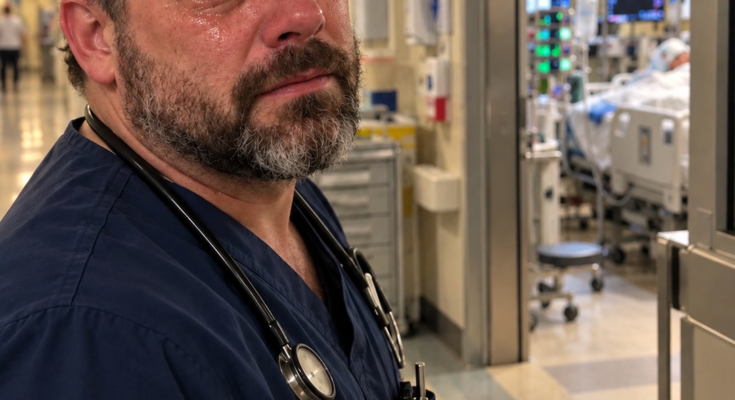
He was sitting in a recliner beside an IV pole, wearing sweatpants and an old hospital sweatshirt.
For the first time in eleven years, I wasn’t looking at Dr. Benjamin Carter.
I was looking at my husband.
Tired.
Frightened.
Sick.
He looked up.
The moment he saw me, his face fell.
“Claire?”
I walked inside carrying the lunch bag.
He looked at Arnold.
“You told her?”
Arnold shook his head.
“She brought you pie.”
Ben looked back at me.
Neither of us spoke.
I placed the bag on the table.
Then I took out the little note I’d written that morning.
I unfolded it and placed it in his lap.
You don’t have to take care of everyone. Let me have a turn.
Ben read it.
His chin began trembling.
“Claire…”
I slapped his shoulder.
Not hard.
Just enough to make him blink.
“You absolute idiot.”
Then I wrapped my arms around him.
And for the first time in seven months, my husband stopped pretending he wasn’t afraid.
He cried against my shoulder.
So did I.
After a while, I asked the question I was terrified to ask.
“Are you dying?”
Ben pulled back.
“No.”
I waited.
“The doctors think the treatment is working.”
I started crying harder.
“Then why did Arnold look like somebody had died?”
From the doorway, Arnold said, “Because your husband has spent seven months making all of us keep the worst secret of our lives.”
Ben actually laughed.
It was weak.
But it was the first real laugh I’d heard from him in months.
Then I became angry again.
“You missed Lily’s birthday because of this?”
His eyes dropped.
“I had treatment that morning. I got sick afterward.”
“She thought you chose work.”
“I know.”
“She cried.”
“I know.”
“Ben, you didn’t protect us.”
He looked at me.
“You left us alone with a version of the truth that hurt almost as much.”
That was when he finally understood.
━━━━━━━━━━━━━━━━━━━━
Part Three — Let Me Have a Turn
That evening, we told Lily.
Ben wanted to wait.
I refused.
“No more secrets.”
So we sat together on her bedroom floor.
Ben explained that there were bad cells in his body and the doctors were giving him strong medicine to get rid of them.
Lily listened very seriously.
Then she asked:
“Is that why you didn’t come to my birthday?”
Ben nodded.
“I was sick that day.”
She was quiet.
“I thought you liked the hospital more than me.”
I watched my husband’s face break.
He reached for her.
“Oh, sweetheart. Never.”
Lily climbed into his lap.
For several minutes, neither of them spoke.
Then she asked the question only an eight-year-old would think to ask.
“Are you still a doctor if you’re sick?”
Ben smiled.
“I think so.”
“Good.”
“Why?”
“Because now you know what patients feel like.”
Ben looked at me over her shoulder.
There are moments when children say something so simple that every adult in the room suddenly feels foolish.
That was one of them.
The next few months changed our family.
Not because they were easy.
They weren’t.
There were days when Ben could barely get out of bed.
There were nights when he was nauseated, frightened, angry, or simply exhausted.
There were appointments that gave us hope.
Others that scared us.
But the biggest difference was that this time, none of us went through it alone.
Ben finally took medical leave.
The first morning he stayed home, I found him standing in the kitchen at 6:30 wearing pajamas.
He looked lost.
“What do people do here all day?”
I handed him a mug of coffee.
“Apparently they don’t perform surgery before breakfast.”
He smiled.
“I might hate retirement.”
“You’re not retired.”
“Practice retirement.”
“You’re forty-six.”
“Fine. Medical sabbatical.”
I laughed.
It felt good to laugh with him again.
Lily became fiercely involved in his recovery.
She made a treatment calendar covered in stickers.
Green stickers meant good days.
Yellow meant tired days.
Blue meant hospital days.
One morning, I found a bright red sticker in the center.
“What does red mean?” I asked.
She looked at me like I was ridiculous.
“Pie day.”
Apparently pie was now medically necessary.
Ben agreed.
So did I.
Six months after I walked into the hospital carrying that lunch bag, Ben had another scan.
We sat in the doctor’s office holding hands.
The oncologist smiled.
“The response is excellent.”
I squeezed Ben’s fingers.
He didn’t say anything.
“What does excellent mean?” I asked.
“It means we’re seeing no evidence of active disease right now.”
Ben stared at the doctor.
Then at me.
“Right now?”
The doctor nodded.
“We continue monitoring. But this is very good news.”
I cried before Ben did.
Then Ben cried because I was crying.
Then the doctor politely handed both of us tissues and pretended he hadn’t seen this hundreds of times before.
On the drive home, Ben was unusually quiet.
Finally, he said:
“I thought keeping it from you was love.”
I looked at him.
“I know.”
“I kept telling myself that if I could get through treatment quietly, you and Lily would never have to carry any of it.”
I took his hand.
“That’s not how marriage works.”
“I know that now.”
“No, you know the doctor version.”
He raised an eyebrow.
“What’s the wife version?”
“If you’re scared, you tell me.”
He nodded.
“If you’re sick, you tell me.”
Another nod.
“If you cry at three in the morning, you wake me up.”
He smiled faintly.
“Yes, ma’am.”
“And if someone brings you apple pie, you eat it before Arnold finds it.”
That finally made him laugh.
Ben eventually returned to the hospital.
But not as the same doctor.
Something in him had changed.
He reduced his hours.
He stopped treating exhaustion as a badge of honor.
He began sitting beside frightened patients instead of standing over them whenever he could.
One afternoon, I met him for lunch.
As I approached his office, I heard him talking to a young man who had just received a difficult diagnosis.
The man said:
“I don’t want to tell my wife yet. I don’t want to put this on her.”
There was a long pause.
Then Ben answered.
“I once thought the same thing.”
I stopped outside the door.
He continued.
“I thought protecting someone meant carrying the fear alone.”
Another pause.
“It doesn’t.”
“What does it mean?”
Ben’s voice softened.
“It means trusting them enough to let them stand beside you.”
I quietly walked away before he saw me.
Some conversations belong to the person who needs them.
Three years have passed.
Ben’s scans have remained clear.
We don’t pretend that makes us invincible.
If anything, we understand the opposite now.
Life is fragile.
Plans change.
People get sick.
People we love leave before we’re ready.
But fear does not become lighter just because you hide it.
Sometimes it becomes heavier because now you’re carrying the secret too.
Our anniversary last year was simple.
No expensive restaurant.
No big trip.
Ben cooked dinner at home.
He burned the potatoes.
Lily complained.
I made apple pie.
Afterward, Ben handed me a small frame.
Inside was the note I had packed with his lunch that Tuesday years earlier.
The paper was wrinkled and stained at one corner.
He had kept it.
Beneath it, he had added one sentence of his own.
My original note said:
You don’t have to take care of everyone. Let me have a turn.
Underneath, Ben had written:
The day I finally did was the day I started getting my life back.
I used to believe love meant being strong for the people you care about.
Now I think that’s only half of it.
Sometimes love is being strong.
And sometimes love is admitting you aren’t.
Sometimes the bravest thing you can say to another person isn’t:
“I’ll take care of you.”
It’s:
“I need you.”
And sometimes the greatest gift you can give someone who loves you is simply the chance to answer:
“I’m here.”