Part One — The Cages Beside His Photograph
The house still smelled like candle wax and funeral lilies when my son walked in without knocking.
Ernest had been gone exactly one week.
I had buried my husband on a gray Tuesday. He wore the white linen shirt he loved, his rosary folded between his hands, and I slipped a little photograph from our Key West honeymoon into his pocket before they closed the casket.
For seven days, I cried until my eyes burned.
On the eighth day, I bought a ticket for a one-year cruise.
Nobody knew.
Especially not my son, Austin.
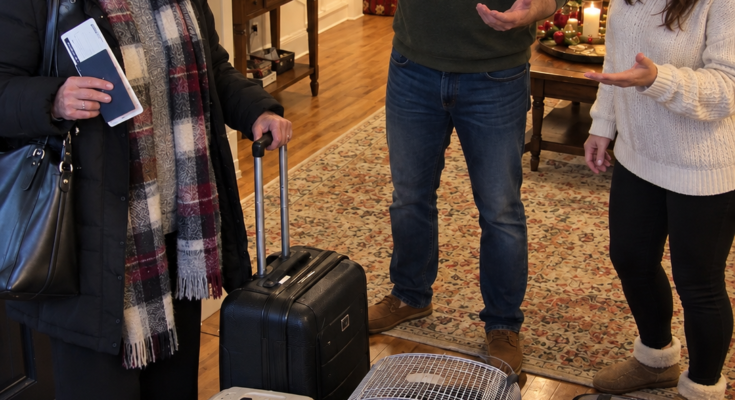
That afternoon, he walked into my living room wearing sunglasses and announced, “Mom, Chloe and I are going to the Bahamas. You’re watching the pets.”
His wife came in behind him carrying three cages.
Two parakeets.
A rabbit.
A terrified cat.
She dropped them beside Ernest’s memorial photograph.
No hug.
No flowers.
Not even, “How are you doing?”
Instead, Chloe handed me a sheet of instructions.
“Change the birds’ water twice a day. Don’t feed the rabbit lettuce. Keep the cat inside the carrier because he gets stressed.”
I stared at her.
“Chloe, I just buried my husband.”
She sighed.
“Oh, Mrs. Theresa, everyone has problems.”
Austin didn’t correct her.
He only shrugged.
“Besides, Mom, you’ll get bored alone.”
That hurt more than I expected.
For forty years, I had been everybody’s emergency fund, babysitter, cook, driver, nurse, and backup plan.
When Austin lost his job, I emptied my savings.
When Chloe had her baby, I slept on their couch for three months.
At Ernest’s funeral, Austin hadn’t asked whether I was okay.
He had asked what I planned to do with the house.
I looked at the cages.
Then at my son.
And smiled.
“Of course, sweetheart. Leave them here.”
They left fifteen minutes later.
Austin kissed my forehead.
“We can always count on you.”
After the door closed, I whispered:
“That’s exactly the problem.”
Then I pulled my blue suitcase from the closet.
By four in the morning, the animals had been safely collected by my neighbor’s nephew, who volunteered with a rescue.
I packed three dresses, sandals, my passport, and Ernest’s favorite bottle of perfume.
Then I placed my house keys on the table beside a folded note.
Austin, when you read this, don’t call me to complain. Call your lawyer.
At 5:30, I climbed into a taxi for the Port of Miami.
My phone began ringing before sunrise.
Chloe.
Austin.
Chloe again.
I ignored them.
Then a message appeared.
Mom, what did you do? There’s a woman from the court here saying the house isn’t ours anymore.
A photograph followed.
Austin stood in my living room, pale as paper.
And behind him was the second folder I had left on the table.
Clearly marked:
FOR AUSTIN.
━━━━━━━━━━━━━━━━━━━━
Part Two — The Folder Ernest Left Behind
I didn’t open Austin’s messages until the ship had left the harbor.
Miami was shrinking behind me when I finally sat on the balcony of my cabin.
There were fourteen missed calls.
Then twenty-three.
I poured coffee and opened the last message.
WHAT IS THIS TRUST?
I smiled.
The folder wasn’t mine.
It was Ernest’s.
Three months before he died, when the doctors told us treatment was no longer working, he had asked me to sit beside him at the kitchen table.
He looked tired that day.
But his mind was perfectly clear.
“Theresa,” he said, “promise me Austin isn’t going to turn our home into his retirement plan.”
I told him not to talk like that.
He squeezed my hand.
“I’m dying, not confused.”
That was Ernest.
Direct until the end.
For years, both of us had noticed the same thing.
Austin no longer asked whether we needed help.
He asked what things were worth.
How much equity was in the house.
Whether I still needed two cars.
Whether Ernest had updated his will.
One afternoon, while Ernest was undergoing chemotherapy, Chloe had stood in our kitchen and casually said, “When this house becomes ours, I’d knock down this wall.”
Ernest heard her from the hallway.
He never forgot it.
Neither did I.
So we met with our attorney, Margaret Ellis.
The house had been fully paid off for eleven years.
Ernest and I placed it into a trust.
I retained the right to live there for the rest of my life.
But when I died, Austin would not inherit it.
The house would be sold.
Half of the proceeds would go to the hospice that had cared for Ernest.
The other half would fund temporary housing for older widows who had nowhere safe to go.
Austin would receive Ernest’s watch, family photographs, several personal belongings, and a modest cash inheritance.
Nothing more.
When Ernest signed the papers, he looked at me.
“Maybe he’ll hate us.”
I shook my head.
“He can hate the decision.”
Then Ernest smiled.
“But he can’t spend it.”
I laughed so hard I cried.
After Ernest died, Margaret completed the final filings.
The woman at my house that morning wasn’t there to throw Austin out.
She was delivering formal documents because Austin had already contacted a realtor claiming that he and Chloe expected to “take over the property” once I decided where I was living.
He had apparently told people I would probably move into assisted living.
I was seventy-one.
Healthy.
Independent.
And currently standing on a cruise ship headed toward the Caribbean.
But apparently my son had already begun planning my disappearance.
Then my phone rang again.
This time, I answered.
“Mom!”
Austin sounded furious.
“What did you do?”
I looked out over the ocean.
“I took a vacation.”
“You know what I mean.”
“Yes.”
“You gave away my inheritance?”
There it was.
Not Dad’s house.
Not your home.
My inheritance.
I closed my eyes.
“Austin, your father isn’t even gone two weeks.”
Silence.
Then he said something I will remember for the rest of my life.
“But eventually the house would have been mine anyway.”
My heart didn’t break.
It had already broken enough.
Instead, something healed.
“That’s why we changed the paperwork.”
━━━━━━━━━━━━━━━━━━━━
Part Three — The Life Waiting Beyond the Harbor
Austin shouted for several minutes.
He accused me of being manipulated by the attorney.
He blamed grief.
He blamed the hospice.
He even blamed Mrs. Mary next door.
Eventually, I interrupted him.
“Austin.”
“What?”
“You left three animals in the living room of a woman who buried her husband seven days ago.”
He went silent.
“You didn’t ask how I was sleeping.”
Nothing.
“You didn’t ask whether I had eaten.”
Still nothing.
“At your father’s funeral, you asked me what I was going to do with the house.”
His voice softened.
“Mom, I didn’t mean—”
“Yes, you did.”
That was difficult to say.
But once I said it, I felt lighter.
“You’ve spent years treating me like the answer to whatever problem you don’t want to solve yourself.”
“I’m your son.”
“I know.”
“Family helps family.”
“Yes.”
I looked toward the horizon.
“But help is something given. It isn’t something you get to assign.”
Austin didn’t answer.
Then he asked:
“How long are you gone?”
“A year.”
I heard him inhale sharply.
“A YEAR?”
“Yes.”
“What are you going to do for an entire year on a ship?”
That question made me smile.
“I have no idea.”
And that was exactly why I was going.
For forty-two years, I had known what every day required of me.
Get up.
Pack lunches.
Go to work.
Care for parents.
Raise a child.
Pay bills.
Cook dinner.
Help Austin.
Care for Ernest when he became sick.
Wake up at two in the morning when the pain medication wore off.
Call doctors.
Wash sheets.
Hold his hand.
Tell him I wasn’t scared when both of us knew I was.
I loved my husband.
Caring for him was never the burden.
But somewhere during those decades, I had disappeared beneath everyone’s needs.
Ernest knew it.
The night before he died, he held my hand and whispered:
“Don’t spend whatever time you have left sitting beside my photograph.”
I cried.
“Where am I supposed to go?”
“Anywhere you want.”
He smiled.
“Just go somewhere I can’t.”
That was why I bought the ticket.
The cruise wasn’t running away from grief.
It was keeping my final promise to the man I loved.
I ended the call with Austin.
Then I turned off my phone.
For the first three days, I barely left my cabin.
I cried every morning.
Grief had followed me aboard.
Of course it had.
You don’t leave forty years of love on a dock in Miami.
But on the fourth morning, an elderly woman named June knocked on my door.
We had spoken briefly at breakfast.
“You’re the widow who keeps eating alone,” she said.
I stared at her.
“That’s quite an introduction.”
“I’m seventy-four. I don’t have time for subtlety.”
I laughed.
It surprised me.
She invited me to trivia.
I said no.
She returned ten minutes later.
“I wasn’t really asking.”
So I went.
We lost spectacularly.
That evening, I ate dinner with June and three other passengers.
One was widowed.
One was divorced.
One had never married.
Nobody needed me to fix anything.
Nobody asked me for money.
Nobody handed me a baby, a cage, or a bill.
They simply asked:
“Theresa, what do you like?”
I didn’t know how to answer.
That embarrassed me.
But over the following months, I started finding out.
I liked watercolor painting.
I hated ballroom dancing.
I loved snorkeling.
I learned enough Italian to order coffee badly.
I watched sunrise in Madeira.
I ate mango in Barbados.
I walked through a market in Barcelona wearing a ridiculous yellow hat June convinced me to buy.
And on what would have been my forty-first wedding anniversary, I went ashore alone.
I carried Ernest’s Key West photograph.
I sat beside the water and talked to him.
Not because I believed he could answer.
Because after forty years, telling him about my day still felt natural.
“I think you’d like who I’m becoming,” I whispered.
Then I cried.
But that day, the tears didn’t feel like drowning.
They felt like love.
Austin and I barely spoke for the first two months.
Then his messages changed.
At first:
You need to fix this trust.
Then:
Please call me.
Eventually:
Mom, I handled this badly.
I didn’t rush to forgive him.
I had spent my life smoothing things over too quickly.
Instead, I let him sit with discomfort.
Six months into the trip, we had our first real conversation.
He said:
“I think I was angry at Dad for dying.”
I listened.
“And I think I started thinking about the house because it was easier than thinking about him.”
That sounded painfully human.
“But that doesn’t excuse how I treated you,” he added.
“No.”
“I know.”
That was the first apology I believed.
Chloe apologized too.
Not immediately.
She needed longer.
Apparently having to arrange pet care without assuming I would do it was the least of the lessons waiting for her.
By the time I returned to Miami eleven months and three weeks later, Austin was waiting at the port.
Alone.
No cages.
No paperwork.
No questions about the house.
When he saw me, he looked uncertain.
I had lost twelve pounds, cut my hair shorter, and was wearing the ridiculous yellow hat.
He started laughing.
“Mom?”
“Yes?”
“What happened to you?”
I hugged him.
“I happened to me.”
He held me for a long time.
Then he whispered:
“I miss Dad.”
“So do I.”
For the first time since Ernest died, my son and I cried together.
Not over money.
Not over property.
Over him.
That was the conversation we should have had at the funeral.
We simply weren’t ready then.
The trust remained unchanged.
I never gave Austin the house back.
Forgiveness doesn’t require returning to the arrangement that allowed someone to take you for granted.
But our relationship improved.
He started visiting because he wanted to see me.
Not because he needed something.
When he asked for help, he actually asked.
And sometimes I said no.
The first few times felt unnatural.
Then wonderful.
Two years later, I became a volunteer with the same hospice named in our trust.
Sometimes I sit beside newly widowed women who have no idea what comes next.
I never tell them to take a cruise.
Most people would hate that.
I simply tell them something Ernest gave me permission to believe:
Your life does not end because the person you built it with is gone.
Love can continue.
Grief can continue.
And somehow, so can you.
Austin once thought my house was his inheritance.
He was wrong.
The greatest inheritance Ernest left our family wasn’t property.
It was the lesson hidden inside those papers.
People are not resources.
Mothers are not permanent emergency services.
And love doesn’t mean keeping yourself available until there’s nothing left of you.
I spent forty years taking care of everyone I loved.
Then, one week after burying my husband, three cages appeared in my living room.
At the time, they felt like one more burden.
Looking back, I think of them differently.
Those cages showed me exactly what my life had become.
And the morning I walked away from them was the morning I finally opened my own door.