Part One — The Only Thing Left for Me
The day my family divided my father’s estate, my brother got the house.
My sister got the SUV.
My mother handed over the savings books and my grandmother’s gold bracelets as if I wasn’t even sitting in the room.
When my turn finally came, the only thing left was a crooked red wardrobe with peeling paint and one broken leg propped up by a brick.
My sister-in-law laughed under her breath.
I stood up, touched the damaged wood, and said, “I’ll take it.”
It had been exactly forty days since we buried Dad.
He had spent seventy-three days in the county hospital.
For much of that time, I practically lived there.
My brother Michael always had a project at work.
My sister Sarah could never find a sitter.
Neither spent a single night beside Dad.
But after he died, suddenly everyone had time.
Michael wanted to know about the house.
Sarah wanted to know whether Dad had left the Tahoe paid off.
I paid for the funeral.
The casket.
The burial plot.
Even the trays of sandwiches after the service.
Then we gathered in Mom’s living room to divide what Dad had left behind.
“The house should go to Michael,” Mom said. “He has a mortgage.”
Then she slid the Tahoe title toward Sarah.
“You need the space for the children.”
Next came the savings books.
Then the jewelry.
My name never came up.
I had always been the one expected to understand.
To adjust.
To need less.
Eventually, Mom pointed toward the corner.
“That old wardrobe is all that’s left.”
My sister-in-law laughed.
“That thing isn’t even worth hauling.”
Mom gave me the familiar look she used whenever she wanted me to accept scraps gracefully.
“You’re the youngest,” she said. “Don’t be greedy.”
I walked toward the wardrobe.
Dad had kept his flannel shirts inside it for as long as I could remember.
Old receipts.
Tools.
Newspapers.
Things nobody else valued.
I bent down and pulled the brick from beneath its broken leg.
The wardrobe shifted.
Something inside the bottom drawer slid hard against the wood.
For the first time that afternoon, Mom looked frightened.
My uncle Robert, who had been silent in the corner, suddenly leaned forward.
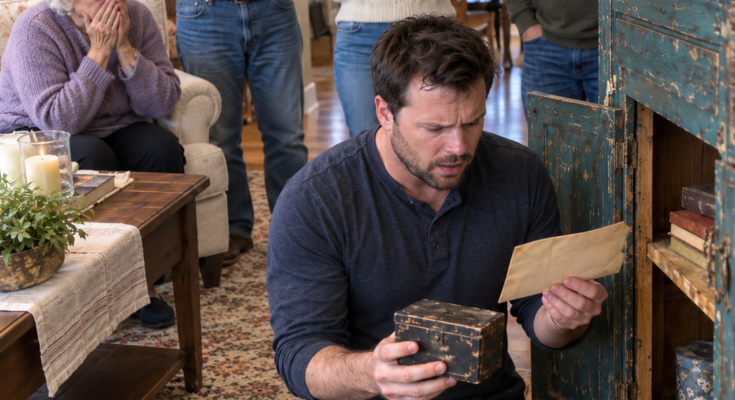
I opened the drawer.
Michael lowered his coffee.
Sarah finally looked up from her phone.
And Mom whispered my name like a warning.
That was when I realized Dad hadn’t left me the wardrobe by accident.
━━━━━━━━━━━━━━━━━━━━
Part Two — What Dad Hid Behind the Drawer
I pulled the bottom drawer all the way out.
Behind it was a thin wooden panel.
Someone had cut a small notch into one corner.
Dad’s work.
I recognized it immediately.
He had been a carpenter before arthritis made him give up the trade, and every hidden hinge, repaired cabinet, and crooked shelf in that house carried his fingerprints.
I slid my finger into the notch and pulled.
The panel came loose.
Behind it sat a metal document box.
Nobody laughed anymore.
Michael stood.
“What is that?”
“I don’t know.”
Mom did.
I could see it in her face.
“Put it back,” she said.
I looked at her.
“Why?”
“It doesn’t belong to you.”
Uncle Robert spoke from the corner.
“Actually, Helen, I think you’ll find that it does.”
Everyone turned toward him.
Mom’s face went white.
“You knew?”
Robert nodded.
“Your father asked me to witness something six months ago.”
My hands began trembling.
The metal box was locked, but an envelope had been taped to the top.
My name was written across it.
EMILY.
I opened it.
Inside was a small key and a letter.
The first line nearly broke me.
Emily, if you’re reading this, then your mother gave everyone exactly what I expected her to give them.
I looked up.
Nobody spoke.
I kept reading.
Dad wrote that he had watched our family repeat the same pattern for years.
Michael received help because he demanded it.
Sarah received things because she complained when she didn’t.
And I received responsibility because I rarely complained at all.
I know who sat beside me in the hospital.
My vision blurred.
I know who paid for things nobody thanked her for. I also know you would never ask me to repay you. That’s why I’m doing this without asking permission.
Inside the box were several documents.
A bank statement.
A deed.
An insurance policy.
And a notarized letter signed by Dad.
The first statement showed an account containing $184,000.
Michael stared at it.
Sarah stood up.
“Where did Dad get that?”
Uncle Robert answered.
“He sold the old commercial lot.”
Years earlier, Dad and Robert had jointly inherited a small piece of industrial property from their father.
I knew they had sold it.
I had no idea what Dad had done with the money.
Then I unfolded the deed.
It was for a small lake cottage two hours north.
The place where Dad had taken me fishing every summer when I was a child.
I thought he had sold it years ago.
He hadn’t.
The deed had been transferred into a trust.
My name was the sole beneficiary.
Sarah snatched the document from my hand.
“This can’t be right.”
Michael looked at Mom.
“Did you know about this?”
Mom said nothing.
That silence answered him.
Then I found the final document.
Dad’s life insurance policy.
The beneficiary had been changed eight months earlier.
To me.
$250,000.
Sarah stared at me.
“You’re getting all of that?”
Before I could answer, Mom finally spoke.
“Your father wasn’t thinking clearly.”
Uncle Robert stood.
“That’s not true.”
She turned on him.
“You stay out of this.”
“I can’t.”
Robert’s voice remained calm.
“I witnessed the trust documents. His attorney was present. So was his doctor. Your husband knew exactly what he was signing.”
Michael looked furious.
“So Dad secretly gave Emily almost half a million dollars?”
“No,” Robert said.
“He gave her what he wanted her to have.”
Mom looked at me.
“You can’t possibly keep all of it.”
There it was.
I hadn’t even finished reading Dad’s letter.
And already, they were dividing my inheritance too.
I looked down and read the final paragraph.
One more thing, Emmy. Do not let guilt make this decision for you. You’ve spent your whole life confusing love with surrender. I did too. Don’t inherit that from me.
I pressed the letter against my chest.
Then I looked at my family.
For once, I knew exactly what I was going to say.
━━━━━━━━━━━━━━━━━━━━
Part Three — What the Wardrobe Was Really Worth
“No.”
My mother blinked.
“What?”
“No, I’m not dividing it.”
Sarah laughed sharply.
“You can’t be serious.”
“I am.”
Michael stepped toward me.
“So I get a house with property taxes and repairs, and you walk away with cash and a lake house?”
I stared at him.
“You wanted Dad’s house.”
“That isn’t the point.”
“It seemed to be the point twenty minutes ago.”
He went silent.
Sarah crossed her arms.
“This is disgusting. Dad clearly favored you.”
I almost laughed.
For thirty-eight years, nobody had ever accused Dad of favoring me.
Not when Michael’s college debt was paid.
Not when Sarah’s wedding cost twice mine.
Not when I spent weekends caring for our parents while they were busy.
Favoritism had only become offensive once something landed in my lap.
Mom began crying.
“Your father would hate seeing the family fight like this.”
I looked at her.
“Then why did you arrange an estate meeting where everyone received something except me?”
Her crying stopped.
“I thought you didn’t need anything.”
That sentence was so familiar I could have said it with her.
Emily doesn’t need help.
Emily understands.
Emily will manage.
I pulled out the notebook from my handbag.
The one where I had written every hospital and funeral expense.
I placed it on the coffee table.
Michael frowned.
“What is that?”
“Everything I paid while Dad was dying.”
Nobody touched it.
“I didn’t keep this because I wanted reimbursement. I kept it because I knew eventually someone would tell me I hadn’t done as much as I remembered.”
Sarah looked away.
The total at the bottom was $31,640.
That didn’t include the seventy-three days of my life.
The unpaid leave from work.
The nights sleeping in hospital chairs.
Or the last afternoon Dad had squeezed my hand and tried to say something he no longer had the strength to pronounce.
At the time, I thought he was trying to say “home.”
Now I wondered if he had been trying to tell me about the wardrobe.
I closed the notebook.
“I’m keeping what Dad left me.”
Mom shook her head.
“Money changes people.”
“No.”
I picked up Dad’s letter.
“Sometimes money just gives people enough room to stop pretending.”
I hired movers the following morning.
Nobody offered to help.
That seemed fitting.
When they carried the red wardrobe out of Mom’s house, Sarah stood in the driveway watching.
“You’re really taking that ugly thing too?”
I ran my hand across the peeling paint.
“Yes.”
“You could buy a hundred nicer ones now.”
“I know.”
She didn’t understand.
That was all right.
The wardrobe went to the lake cottage.
I had it repaired, but I asked the carpenter not to repaint it.
He replaced the broken leg.
Fixed the hinges.
Strengthened the back.
But the red paint remained chipped and faded.
I wanted it that way.
Inside the bottom drawer, I kept Dad’s letter.
The money changed my life, but not in the ways my family expected.
I paid off the funeral expenses I’d put on credit.
I replaced my old car.
I reduced my hours at work.
I put some money into retirement.
Then I did something Dad would have loved.
I used part of the insurance money to create a small fund at the county hospital for families who couldn’t afford to miss work while sitting beside a dying parent.
The social worker called me six months later.
The fund had already helped nine families.
One was a single father whose mother was dying.
Another was a woman caring for her husband through late-stage cancer.
When she thanked me, I cried in my car for twenty minutes.
Because I knew what those hospital hallways felt like at three in the morning.
I knew the vending machine coffee.
The stiff chairs.
The fear of checking your bank balance while someone you love is running out of time.
Dad’s money could not give me those seventy-three days back.
But it could make someone else’s seventy-three days a little less frightening.
My relationship with my siblings became distant.
For a while, Michael only contacted me through angry messages.
Sarah told relatives I had manipulated Dad while he was sick.
That one hurt.
But Uncle Robert had copies of everything.
So did Dad’s attorney.
There was nothing to fight.
Eventually, the anger ran out of energy.
A year after Dad died, Mom called me.
“I’d like to see the cottage.”
I almost said no.
Then I heard something in her voice I hadn’t heard in years.
Not authority.
Not expectation.
Uncertainty.
So I invited her.
She arrived on a Sunday afternoon carrying Dad’s old fishing hat.
When she walked inside and saw the red wardrobe against the wall, she stopped.
“You kept it.”
“Of course.”
She touched the chipped paint.
Then she sat down.
For several minutes, neither of us spoke.
Finally, Mom said:
“I knew he had put something in there.”
I looked at her.
“How much did you know?”
“Not everything.”
“Why didn’t you tell me?”
She stared through the window toward the lake.
“Because I was angry with him.”
“For leaving it to me?”
She nodded.
“I thought he was punishing Michael and Sarah.”
“And me?”
Mom’s eyes filled.
“I think I assumed you’d be fine no matter what happened.”
There was that sentence again.
But this time, she sounded ashamed of it.
“You were always so capable,” she whispered.
I sat beside her.
“Being capable doesn’t mean things don’t hurt.”
“I know.”
“No, Mom. I don’t think you did.”
She began crying.
Neither of us rushed to make the moment easier.
That was new for us.
After a while, she said:
“Your father used to worry about you.”
That surprised me.
“Me?”
“He said everyone leaned on you so much that someday you’d disappear underneath them.”
I looked at the wardrobe.
Dad had seen more than I realized.
Mom reached into her handbag and removed something wrapped in tissue paper.
One of Grandma’s gold bracelets.
The bracelet she had given Sarah.
I frowned.
“Why do you have that?”
“Sarah returned it.”
“Why?”
“She said every time she wore it, she thought about that meeting.”
Mom placed it in my hand.
“I thought you should have one.”
I closed my fingers around it.
Then handed it back.
Mom looked confused.
“No.”
“But it was Grandma’s.”
“I know.”
“Don’t you want it?”
I thought for a moment.
Then smiled.
“I already got what Dad wanted me to have.”
I looked toward the crooked red wardrobe.
It was worth almost nothing.
And yet it had been the most valuable thing in that room.
Not because of what was hidden inside.
Because Dad had known exactly how our family worked.
He knew Michael would choose the house.
Sarah would choose the car and jewelry.
Mom would distribute everything according to who demanded the most.
And he knew I would be the only person willing to take something everyone else considered worthless.
That was the real inheritance.
Dad wasn’t rewarding me for sitting beside his hospital bed.
Love shouldn’t be a transaction.
He was trying, perhaps too late, to correct something our family had taught me since childhood.
That the person who complains least should receive least.
That the responsible child doesn’t need care.
That kindness means accepting whatever remains after everyone else has chosen.
Dad knew better by the end.
Now I do too.
The wardrobe still stands in the cottage.
The broken leg is gone.
The doors close properly.
But I never covered the old red paint.
Every scratch reminds me of something.
Sometimes the thing everyone else overlooks is valuable precisely because they never bothered to look closely.
And sometimes being handed what’s left over is not an insult.
Sometimes it’s the moment you discover someone quietly saved the best for last.