Part One — The Man Who Came for Pie
“I’m sorry, sir. We’re short-staffed tonight.”
The old biker looked up from his black coffee and smiled.
“Don’t worry about me, sweetheart. I’ve got nowhere else to be.”
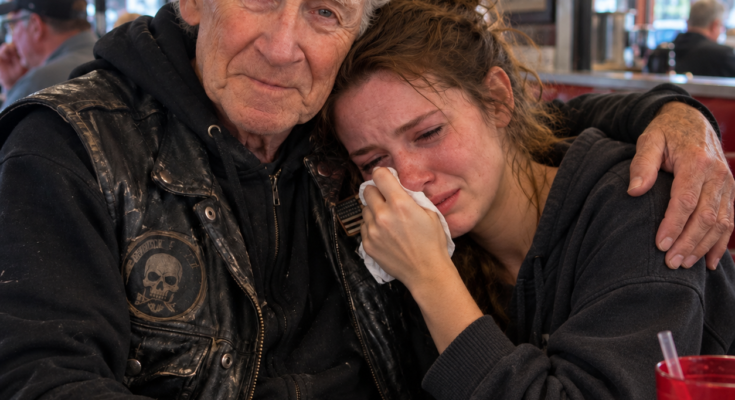
His name was Ray Mercer. He was sixty-eight, with a gray beard, a worn leather vest, and hands that looked like they had spent half a century rebuilding engines.
For almost three months, Ray had come to the same little diner outside a small Ohio town every Friday evening. He always chose the corner booth by the window.
Black coffee.
Apple pie.
Sometimes two refills.
Never anything else.
But eventually I realized he wasn’t really coming for the food.
He was watching me.
Not in a way that made me uncomfortable.
In the way older people sometimes notice things because they’ve lived long enough to recognize exhaustion when they see it.
My name is Emily.
I was twenty-nine then, and I worked enough hours that the diner felt more like home than my apartment did.
I arrived before sunrise most mornings. If somebody called in sick, I stayed through dinner. If the manager asked whether I could cover Sunday, I said yes before he finished the question.
One Friday, Ray waited until I had finished refilling his coffee.
“You working two jobs?”
I laughed.
“Just this one.”
“Then why do you look like you’re working four?”
My smile disappeared.
Normally, I would have given him the standard answer.
I’m fine.
Instead I said:
“My brother is sick.”
Ray didn’t ask for details.
That was probably why I eventually gave them to him.
My little brother Noah was nineteen. He had been born with a severe neurological condition that affected his mobility and required ongoing medical care.
Our mother died when I was twenty.
Our father had disappeared long before that.
By twenty-one, I had become Noah’s legal guardian.
At first, everyone said they’d help.
Relatives brought casseroles.
Friends sent encouraging messages.
People promised to “call anytime.”
Then life resumed for them.
Mine didn’t.
There were specialist appointments, equipment, insurance appeals, medication, transportation, and the thousand ordinary things nobody photographs when they talk about caregiving.
So I worked.
Because rent didn’t care whether I had slept.
Medical bills didn’t care whether I was tired.
That Friday, when Ray finished his pie, he left a twenty-dollar tip on a twelve-dollar check.
I ran outside after him.
“Sir!”
He was fastening his helmet.
“You left too much.”
“No, I didn’t.”
“I can’t take this.”
He smiled.
“Then don’t call it a tip.”
“What should I call it?”
“An advance on next Friday’s pie.”
He climbed onto his motorcycle before I could argue.
The next Friday, he returned.
Then the next.
Sometimes he brought groceries.
Nothing extravagant.
Coffee.
Cereal.
A bag of apples.
Once he brought Noah a stuffed bear wearing a tiny leather vest.
Another time, he sat for almost an hour while I told him how frightened I was that something would happen to Noah while I was working.
Ray never said he understood.
Not until a rainy evening in October.
I was wiping his table when he said:
“My daughter was sick too.”
I stopped.
Ray stared through the window.
“She was twenty-three when she died.”
“I’m sorry.”
“So am I.”
He stirred coffee he always drank black.
“She had a heart condition. We spent years thinking if we worked hard enough, found the right doctor, raised enough money, somehow we’d win.”
He looked at me.
“We didn’t.”
I lowered the cloth.
“What happened afterward?”
“I got angry.”
“At who?”
“Everybody.”
Then he smiled sadly.
“Mostly people who didn’t deserve it.”
Rain streaked the glass.
Ray continued.
“I thought grief was something you defeated. Like if you were strong enough, eventually you’d beat it.”
“Did you?”
“No.”
He shook his head.
“You learn how to carry it without letting it crush everything else.”
I looked toward the kitchen.
“I don’t know how to do this anymore.”
It was the first time I had said that aloud.
Ray answered quietly:
“You don’t have to know how to do it forever.”
I looked at him.
“Just figure out tomorrow.”
That was the first time I cried in front of him.
A month later, Ray didn’t come on Friday.
At first I assumed the weather had kept him home.
Then Saturday passed.
Sunday.
On Monday morning, the diner phone rang.
My manager called me over.
“Emily, it’s a hospital.”
Ray had suffered a heart attack while riding home.
He was alive.
Barely.
I drove there after my shift.
He was sitting upright when I entered, looking deeply offended by the wires attached to him.
“You came.”
“Of course I came.”
“I thought you’d be mad.”
“Why?”
“Missed pie night.”
I laughed through tears.
“You almost died.”
“Still didn’t pay for Friday’s pie.”
Then I noticed an envelope on the bedside table.
“What is that?”
Ray picked it up.
“For you.”
Inside were keys.
And a letter.
I stared at him.
“What are these?”
“Garage.”
“Ray—”
“Read first. Panic second.”
The letter was from an attorney.
Ray had arranged something months earlier, before the heart attack.
Not ownership of his entire property.
Not some surprise fortune.
A formal arrangement.
He owned a detached motorcycle workshop behind his small house. It had a bathroom, electricity, heat, and enough space to be converted into a modest accessible apartment.
He had established a restricted fund to pay for renovation work and certain documented care expenses for Noah.
An attorney and trustee would administer it.
I lowered the pages.
“Why?”
Ray looked toward the window.
“When my daughter got sick, I was broke.”
He swallowed.
“There was a mechanic named Walter. Owned the shop where I worked.”
Ray’s eyes filled.
“He paid for hotel rooms near the hospital. Never told the other guys. Never let me call it charity.”
“What did he call it?”
“Getting through Tuesday.”
I smiled despite myself.
“I tried to pay him back years later.”
“What happened?”
“He died before I could.”
Ray looked at the keys in my hand.
“So I stopped thinking repayment had to travel backward.”
━━━━━━━━━━━━━━━━━━━━
Part Two — What Help Was Supposed to Mean
My first instinct was to refuse.
“I can’t take your garage.”
“You aren’t.”
“The letter literally has your address on it.”
“You aren’t being given my house. The workshop stays legally protected under the arrangement my attorney prepared. Noah can use the apartment under the terms we set up. The fund pays approved renovation and care expenses.”
“That’s still enormous.”
“Yes.”
“Why us?”
Ray looked irritated.
“Emily, don’t make generosity into a job interview.”
I went quiet.
Then he softened.
“I’m not rescuing you.”
“That is exactly what this feels like.”
“No.”
He pointed toward me.
“You’re already doing the work. Too much of it.”
His finger shifted toward the letter.
“This just moves some weight.”
That distinction mattered.
I took the documents to my own attorney before agreeing to anything.
Ray insisted.
“Never sign something important because the person offering it seems nice.”
“Does that include you?”
“Especially me. I wear leather indoors.”
The renovation took almost three months.
There was no magical transformation overnight.
A contractor widened the doorway.
A ramp was added.
The bathroom was redesigned for accessibility.
The electrical system was updated.
A small bedroom took shape where Ray once stored tires.
We kept part of the workshop intact because Noah loved watching people work with their hands.
The first day I brought him there, he stared at the shelves of motorcycle parts.
“Is this all Ray’s?”
Ray was standing behind us.
“Most of it.”
Noah smiled.
“Why do you have six carburetors?”
“Because throwing things away is a character flaw I have chosen not to correct.”
Noah laughed.
That laugh changed Ray’s entire face.
I noticed it.
So did he.
We never tried to make Noah into a replacement for the daughter Ray had lost.
That would have been unfair to both of them.
Ray talked about his daughter by name.
Maggie.
Sometimes he told Noah stories about her.
Sometimes he didn’t.
Noah never had to fill an empty space.
He simply became another person Ray cared about.
Once the apartment was ready, I expected relief.
Instead, the first night Noah stayed there with his overnight support worker, I sat alone in my apartment and panicked.
I called three times in forty minutes.
On the third call Noah said:
“Emily.”
“What?”
“Go to bed.”
“I’m checking.”
“You’re hovering.”
“You literally need help transferring out of bed.”
“And I currently have help.”
I could hear Ray laughing in the background.
“Don’t encourage him.”
Ray shouted:
“Go to sleep!”
I hung up.
Then cried.
Not because something was wrong.
Because for the first time in eight years, I wasn’t the only person standing between Noah and disaster.
Relief can feel frightening when responsibility has become part of your identity.
I had spent so many years being necessary that having help almost felt like failing.
Ray noticed.
One Friday at the diner, he said:
“You know you’re allowed to have a life, right?”
“I have a life.”
“You work and supervise your brother.”
“That’s life.”
“No. That’s responsibility.”
I put his pie down harder than necessary.
“What exactly do you want me to do? Take up salsa dancing?”
“I’d pay money to see that.”
I glared.
He grinned.
Then became serious.
“I’m saying Noah needs a sister too. Not only a guardian.”
That hurt because it was true.
So I began changing small things.
I stopped volunteering for every extra shift.
I went to dinner with coworkers.
I slept an entire Saturday morning once and woke at eleven feeling as though I had committed fraud.
Noah became more independent too.
Not magically.
His condition didn’t disappear.
He still needed care.
But the accessible apartment let him make more decisions about his day.
Which shirt.
What time to eat.
Whether he wanted company.
Whether Ray’s terrible country music was allowed in the workshop.
“It’s not terrible,” Ray protested.
Noah replied:
“It sounds like sad farming.”
That became their favorite argument.
━━━━━━━━━━━━━━━━━━━━
Part Three — The Friday Booth
Ray recovered from the heart attack, but not perfectly.
His cardiologist restricted his riding for a while.
He hated that.
Then his knees worsened.
Eventually, his motorcycle spent more time in the garage than on the road.
He complained constantly.
Nobody believed him when he claimed this meant he was “basically imprisoned.”
Every Friday, however, he still came to the diner.
At first I drove him.
Later Noah insisted on coming too.
The old corner booth became theirs.
Ray by the window.
Noah opposite him.
Black coffee for Ray.
Apple pie.
Noah preferred chocolate milk and whatever dessert contained the most sugar.
“You’re corrupting him,” I told Ray once.
“He was corrupt when I found him.”
Noah nodded solemnly.
“True.”
Years passed that way.
Not perfectly.
There were hospitalizations.
Insurance fights.
Bad months.
Ray had another cardiac procedure.
Noah’s condition progressed in ways that required additional support.
Sometimes I became frightened all over again.
But the difference was that fear no longer automatically meant I was alone.
Ray’s restricted fund did not pay for everything.
It was never designed to.
Public benefits, insurance, my income, and other support all remained part of Noah’s care.
That mattered to Ray.
He never wanted help to become control.
One afternoon I asked him:
“Why didn’t you just give me the money directly?”
He looked horrified.
“Because then you’d spend half of it on your brother and feel guilty every time you bought yourself socks.”
“That is ridiculous.”
“Emily, you once apologized for buying name-brand toothpaste.”
I had no response.
He pointed his fork at me.
“The structure means neither you nor I get to turn the money into guilt.”
That was Ray.
Even kindness came with an argument.
When he turned seventy-four, we held his birthday at the diner.
The entire staff signed a card.
Noah gave him a framed photograph of the two of them in the workshop.
Ray stared at it for a long time.
Then muttered:
“Terrible picture.”
“You’re crying.”
“Heart medication.”
“That’s not how heart medication works.”
“Are you a cardiologist now?”
The photograph stayed on his workbench from then on.
Ray died at seventy-nine.
Not on his motorcycle.
Not dramatically.
He died in hospice after heart disease finally caught up with the body he had spent years insisting was “still under warranty.”
Noah and I were with him.
So was Ray’s niece, Carla, who had become part of our lives over the years.
The last afternoon he was awake, I sat beside him.
“I don’t know how to do this.”
Ray’s eyes opened slightly.
He knew what I meant.
Losing him.
He whispered:
“Tomorrow.”
I started crying.
Of course that was his answer.
The same thing he’d told me years earlier beside a rain-streaked diner window.
You don’t have to know how to do it forever. Just figure out tomorrow.
At his funeral, Noah wore Ray’s old motorcycle vest.
It was ridiculously large.
Carla had offered to have it altered.
Noah refused.
“He was ridiculously large too.”
Ray would have loved that.
The legal arrangements Ray had created continued according to their terms.
His house went where his estate plan directed.
The accessible workshop apartment remained available to Noah under the arrangement Ray had carefully established.
Nothing depended on a vague deathbed promise.
Ray had done the unglamorous work.
Attorneys.
Signatures.
Trustees.
Maintenance provisions.
The boring paperwork that allows generosity to survive the person who started it.
Years later, I became manager of the diner.
Eventually, owner.
The first thing people noticed after I renovated was that I never removed the corner booth.
I replaced almost every other seat.
Not that one.
One rainy Friday evening, a new waitress asked me:
“Why is that booth different?”
I looked over.
Noah was sitting there drinking coffee now, because apparently adulthood had ruined his taste.
Beside him sat a teenager from a supported-employment program who had begun helping a few hours a week in the workshop.
Noah was showing him photographs of motorcycles.
“That booth belonged to a friend.”
The waitress smiled.
“Must’ve been somebody important.”
I thought about it.
“No.”
She looked confused.
“He would’ve hated that word.”
Ray wasn’t famous.
He wasn’t extraordinarily wealthy.
He didn’t rescue strangers from burning buildings or donate millions to hospitals.
He was a mechanic who had accumulated a modest house, a workshop, some savings, and more tools than any sane person needed.
He saw a tired waitress.
He listened.
He remembered a kindness someone had shown him decades earlier.
Then instead of spending the rest of his life feeling guilty that he had never repaid it, he passed it forward carefully enough that the help actually helped.
People sometimes hear the story and say:
“Ray saved your family.”
I understand why.
But Ray always rejected that.
One Friday, not long before he died, a customer recognized Noah from a local community article about the accessible workshop.
The woman walked over to Ray.
“You’re the man who saved them.”
Ray frowned.
“No.”
“You paid for all that.”
“I helped.”
“You changed their lives.”
He glanced toward me.
Then toward Noah.
Finally he said:
“I showed up.”
The woman looked disappointed, as though she wanted something grander.
Ray continued:
“Showing up isn’t small if you keep doing it.”
That became the sentence I remembered.
Because the money mattered.
Of course it did.
Accessible housing matters.
Medical bills matter.
Financial help can change what choices a family has.
But the first thing Ray gave me wasn’t money.
It was Friday.
Then another Friday.
Then another.
A booth where I could talk without being fixed.
A person who remembered Noah’s name.
Someone who could hear me say I can’t do this forever without replying that I was strong enough.
He never demanded gratitude.
Never asked Noah to call him family.
Never made us prove we deserved help.
He simply made room.
The old stuffed bear Ray bought Noah still sits on a shelf in the workshop.
The fake leather vest has peeled around one shoulder.
One eye is slightly crooked.
I once suggested replacing it.
Noah looked horrified.
“Ray bought that.”
So it stays.
Every Friday evening, when the diner gets busy and I see one of my waitresses apologizing to someone for taking too long, I sometimes look toward that corner booth.
I can still picture him.
Gray beard.
Black coffee.
Apple pie.
Pretending he had nowhere else to be.
It took me years to realize he did have somewhere to be.
Exactly there.
Not because he was waiting for someone to save.
Because once, when his own life was falling apart, somebody had sat beside him and made the next day possible.
Ray spent the rest of his life believing kindness didn’t have to return to the person who gave it.
It only had to keep moving.
And sometimes that is what saving someone looks like.
Not fixing their whole life.
Not becoming their hero.
Just showing up often enough that, eventually, they no longer have to carry everything alone.