Part One — The Table Beside the Service Door
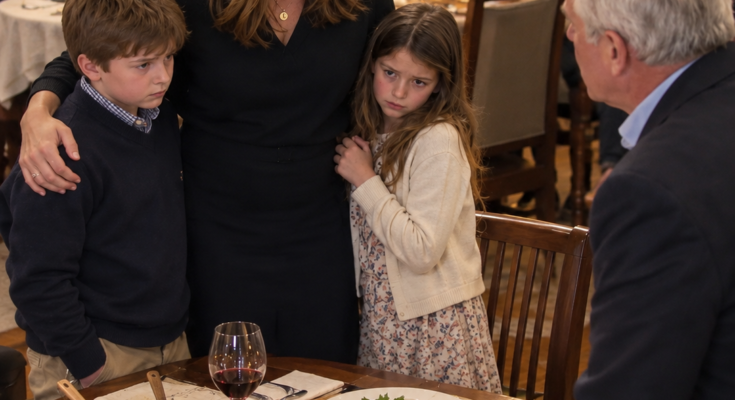
At my father’s seventieth birthday dinner, my children were placed at a separate table with empty plates while my sister’s children ate filet mignon with the rest of the family.
When I asked why, Vanessa smiled over her wineglass.
“They can eat after the guests are finished.”
My father nodded as though this were perfectly reasonable.
That was the moment something inside me finally stopped bending.
“No, Vanessa. My children are not going to learn that being family means waiting for everyone else’s leftovers.”
The private dining room went silent.
My eleven-year-old son, Ethan, quickly wiped his eyes with his sleeve. Sophie, who was eight, kept folding and unfolding her napkin.
Behind Vanessa’s children hung a gold banner reading:
FAMILY FIRST
Vanessa sighed.
“Don’t make this into another one of your performances, Claire.”
“You turned it into a performance when you put two children on display.”
Dad pushed his chair back.
“If you leave now, don’t expect to come back once you’ve calmed down.”
For years, those words would have worked.
I would have apologized just to keep the peace.
But Ethan was staring at his empty plate.
Sophie had stopped looking toward the main table entirely.
I helped them into their coats.
“I’m calmer than I’ve been in years.”
Most of the family avoided my eyes as we walked out.
Only my cousin Marisol stood.
She slipped a dinner roll into Sophie’s hand and whispered, “I’m sorry.”
I took the kids to a diner.
Ethan ordered a cheeseburger. Sophie asked for pancakes and a chocolate milkshake.
Neither ate much.
Then Ethan asked quietly:
“Does Grandpa not think we’re family?”
I didn’t know how to answer.
My phone began vibrating.
Vanessa called three times.
Dad called twice.
I ignored them.
Then an email arrived from Bennett Office Supply, the family company I had quietly kept running for years.
My access to payroll, inventory, banking reports, and vendor accounts had been terminated.
Effective immediately.
I checked the timestamp.
The email had been scheduled before dinner.
Before the empty plates.
Before Dad threatened me.
My hands went cold.
Then another message appeared.
It was from Marisol.
Claire, you need to know something. Tonight was planned. And it wasn’t just about the dinner.
━━━━━━━━━━━━━━━━━━━━
Part Two — What They Had Already Decided
Attached to Marisol’s message were three photographs.
The first showed a printed company organization chart.
Vanessa’s name appeared at the top.
PRESIDENT — VANESSA BENNETT
My position beneath hers had been crossed out in red.
The second was a draft announcement Dad apparently intended to send Monday morning.
It described me as “stepping away from daily operations to focus on family matters.”
I had never agreed to step away from anything.
The third photograph hurt the most.
It was a text exchange between Vanessa and Dad.
Vanessa had written:
If Claire causes trouble about the company, tonight should remind her she isn’t the center of this family.
Dad replied:
She’ll get over it. She always does.
Then Vanessa wrote:
Put her kids at the side table. Mine should be with us since they’ll eventually be part of the business.
I stared at the screen.
The empty plates suddenly made sense.
This wasn’t careless seating.
It was a message.
For twelve years, I had handled purchasing, payroll, supplier contracts, inventory, and most of the problems nobody wanted photographed for the company newsletter.
Vanessa handled clients, charity luncheons, networking events, and anything that came with applause.
Dad called her “the face of Bennett.”
He called me “the reliable one.”
I had once thought that was a compliment.
Now I understood what it meant.
Reliable people are often expected to absorb whatever everyone else doesn’t want to carry.
What Vanessa apparently forgot was that I wasn’t merely an employee.
Eight years earlier, when Dad had suffered his heart attack, the company nearly ran out of operating cash.
The bank refused to extend our credit line.
I put $160,000 of my own savings into the business as a documented shareholder loan.
Dad later transferred twenty-five percent of the company to me in exchange for keeping the doors open.
Vanessa owned twenty-five percent.
Dad owned the remaining fifty.
They could remove my passwords.
They could remove my title.
They could not erase my ownership or the money the company still owed me.
At 10:38 that night, Dad finally left a voicemail.
“You’ve embarrassed the family enough. Come in Monday morning, apologize to Vanessa, and we’ll discuss whether there’s still a place for you here.”
I listened twice.
Then I opened my laptop.
I wrote one email to Dad, Vanessa, our accountant, and the company attorney.
I will not be returning as Director of Operations. Please preserve all company records and direct future shareholder matters through my counsel. I also expect the outstanding balance of my shareholder loan to be formally addressed.
I read it three times.
Then pressed send.
Ethan looked up from across the diner booth.
“Are you in trouble?”
I closed the laptop.
“No.”
For the first time in my life, I realized it was true.
“I think I’m finally getting out of it.”
━━━━━━━━━━━━━━━━━━━━
Part Three — The Seat We Choose to Accept
Monday morning was chaos.
Vanessa called before seven.
“You can’t just quit.”
“I thought you wanted me gone.”
“Not like this.”
That sentence told me everything.
She wanted me powerless.
She had not expected me to leave with my dignity, my ownership, and a paper trail.
Dad called next.
“You’re destroying something your grandfather built.”
“No, Dad. I’m stepping away from something I helped keep alive.”
“You’re doing this over a dinner table?”
I was quiet for a moment.
Then I said:
“No. The dinner table just made it impossible to pretend anymore.”
There had been years of smaller moments.
Vanessa’s children receiving larger birthday gifts because “they needed more.”
My kids being told to give up bedrooms during family trips because they were “more adaptable.”
Vanessa arriving late to holidays and having everyone wait while my children were expected to eat quietly in the kitchen if they became hungry.
Every incident had been explainable by itself.
Together, they formed a pattern.
And I had taught my children to tolerate it because I wanted to keep my father happy.
That realization hurt.
The company dispute took four months to resolve.
There were meetings, accountants, attorneys, and several uncomfortable conversations that should have happened years earlier.
I did not take the company down.
I did not call vendors and tell them to leave.
I did not try to punish employees who had nothing to do with my family’s behavior.
I simply stopped providing unpaid labor and personal financial support.
Dad and Vanessa bought my shares over time.
My shareholder loan was repaid.
For the first time since I was twenty-six, Bennett Office Supply was no longer my responsibility.
Vanessa discovered quickly how much work had been happening behind the scenes.
Payroll still had to run when she was at lunch.
Suppliers still expected answers.
Inventory did not care whose name appeared on the office door.
She eventually hired two people to replace the work I had been doing alone.
I never said, “I told you so.”
I didn’t need to.
The harder problem was Dad.
For nearly three months, we barely spoke.
Then one Saturday afternoon, he appeared at my house.
He looked older than seventy.
He carried two grocery bags.
“I brought dinner.”
I almost laughed.
“Are we allowed to eat at the main table?”
He winced.
I regretted saying it immediately.
Not because it wasn’t true.
Because Ethan was standing in the hallway.
Dad saw him.
Neither spoke.
Then Dad slowly put the grocery bags down.
“Ethan?”
My son stopped.
Dad walked toward him.
“I owe you an apology.”
Ethan looked at me.
I nodded.
Dad continued.
“What happened at my birthday dinner was wrong. You and Sophie didn’t do anything to deserve it.”
Ethan asked the question he had asked me that night.
“Do you think we’re family?”
Dad’s face changed.
“Yes.”
“Then why did you let Aunt Vanessa treat us like that?”
Dad opened his mouth.
Nothing came out.
Finally he said:
“Because I was trying to keep your aunt happy, and I expected your mother to accept it because she usually did.”
Ethan stared at him.
“That’s not fair.”
“No.”
Dad nodded.
“It wasn’t.”
Sophie appeared behind her brother.
Dad knelt carefully.
“I’m sorry, Sophie.”
She looked at him suspiciously.
Then she asked:
“Did you bring dessert?”
Dad laughed through tears.
“Yes.”
“What kind?”
“Chocolate cake.”
Sophie considered this.
“Okay.”
Children sometimes make forgiveness look wonderfully uncomplicated.
Adults aren’t always capable of that.
Dad and I had much more to repair.
An apology did not undo years of favoritism.
But it was a beginning.
Vanessa took longer.
For months, she insisted I had overreacted.
Then something happened that I never expected.
Her oldest daughter, Chloe, called me.
She was sixteen.
“Can I ask you something?”
“Of course.”
“Why don’t Ethan and Sophie come to Grandma and Grandpa’s house anymore?”
I answered carefully.
“There were some problems between the adults.”
She was quiet.
Then she said:
“Mom said you were jealous of us.”
I almost laughed.
Instead, I told her:
“No, sweetheart. None of this was ever your fault.”
A few weeks later, Vanessa asked to meet me.
We sat at a coffee shop.
She spent the first ten minutes defending herself.
Then suddenly she stopped.
“Chloe asked me if I would have made her wait for leftovers while your children ate.”
I said nothing.
Vanessa looked down.
“I told her no.”
Then she began crying.
“And she said, ‘Then why was it okay the other way around?’”
Sometimes adults ignore truths until they hear them spoken in their child’s voice.
Vanessa wiped her eyes.
“I was horrible to your kids.”
“Yes.”
She looked up, surprised by my honesty.
“I don’t know how to fix it.”
“You don’t fix it with one apology.”
“What do I do?”
“You stop asking them to accept less so somebody else can feel more important.”
She nodded.
That conversation did not magically make us close.
We are still different people.
We still disagree.
But something changed.
The following year, Dad’s birthday dinner was held at his house.
No private dining room.
No gold banner.
No seating chart.
Just two folding tables pushed together in the living room because there wasn’t enough space around the regular one.
When we arrived, Ethan hesitated at the doorway.
Dad noticed.
He pulled out the chair beside him.
“Ethan, I saved this one for you.”
Then he looked at Sophie.
“And yours is right here.”
Every plate was already filled.
Nothing dramatic happened that evening.
And that was exactly what made it beautiful.
The children laughed.
Dad told the same old stories.
Vanessa burned the rolls.
Marisol brought too much dessert.
Nobody sat by the service door.
Nobody waited for leftovers.
Later that night, while I was helping Dad collect plates, he stopped me.
“I thought keeping peace meant giving the difficult person what they wanted.”
I looked at him.
“So did I.”
He sighed.
“We hurt the quiet people instead.”
That stayed with me.
Because he was right.
Families often say they want peace.
But sometimes what they really mean is that the kindest person should stay silent so the least considerate person never has to change.
I had done that for years.
I called it patience.
I called it loyalty.
I called it respecting my father.
But the moment I saw my children sitting with empty plates, I understood what I was actually teaching them.
That love required humiliation.
That family hierarchy mattered more than dignity.
That keeping everyone else comfortable was worth making themselves small.
I refused to teach them that lesson.
Leaving that birthday dinner cost me a job, a company, and several relationships I thought I understood.
But it gave me something more important.
Ethan and Sophie learned that night that their mother would never ask them to accept disrespect simply because it came from someone they loved.
And I learned it too.
Because sometimes walking away from the wrong table isn’t breaking up a family.
Sometimes it’s how you finally make room for everyone to have a seat.