Part One — “We Aren’t a Charity”
The $60,000 custom saltwater pool behind our house had been my dream project. I had saved for it, researched contractors, chosen every stone around the patio, and signed the checks myself.
But once it was finished, my mother-in-law, Brenda, and my brother-in-law, Kyle, seemed to forget one important detail.
It was ours.
Not theirs.
At first, I tried to be generous. Brenda would text my husband on a hot Saturday morning:
We’re coming over to swim.
Not asking.
Announcing.
Then Kyle started arriving with friends. Sometimes I knew them. Sometimes I didn’t. They brought coolers, speakers, beer, food, towels, and the confidence of people walking into property they owned.
By evening, I would be collecting cans and wrappers from a patio I hadn’t even used that day.
I hated it.
But my husband, Daniel, loved his family, and I loved Daniel.
So I repeated the same phrase I had been repeating for years.
Keep the peace.
What nobody seemed to remember was that I was already doing far more than sharing a swimming pool.
For nearly three years, I had quietly paid several of Brenda’s and Kyle’s bills.
Their cell phone plans came through my account.
So did their car-insurance premiums.
It started during a rough period when Brenda complained money was tight and Kyle was between jobs again. I offered to help for a few months.
A few months became three years.
Nobody ever suggested ending the arrangement.
Then came Tuesday.
Our eight-year-old son, Leo, was preparing for his first camping trip with Daniel. He had been talking about nothing else for days.
Bears.
Marshmallows.
Flashlights.
Whether raccoons could unzip tents.
While we were visiting Brenda, he remembered the ancient tent stored in her garage.
“Grandma?”
Brenda looked up from her wine.
“Yeah?”
“Can Dad and I borrow your old tent this weekend?”
The thing was almost thirty years old. The bag was torn. The fabric had faded from green to some color between gray and swamp water.
Brenda stared at him.
Then at me.
“Buy your own.”
Leo blinked.
“Oh.”
“If your mother can afford that ridiculous pool, she can afford a tent.”
The room became quiet.
Then she laughed.
“We aren’t a charity.”
My eight-year-old looked at the floor.
For one second, I thought about every insurance payment, every cell-phone charge, every month I had quietly covered because I didn’t want Daniel fighting with his family.
I could have humiliated Brenda in front of everyone.
I didn’t.
I took Leo’s hand.
“Come on, sweetheart.”
On the drive home, he barely spoke.
Finally:
“Mom?”
“Yeah?”
“Did I do something wrong?”
That question changed something in me.
“No. You asked politely. Grandma was allowed to say no, but she wasn’t allowed to make you feel ashamed for asking.”
The next morning, I bought him a tent.
A good one.
That weekend, he and Daniel camped exactly as planned. I joined them later, and for a day and a half, Brenda barely crossed my mind.
Sunday afternoon, Leo and I got home first.
I opened the front door.
A metallic screech came from behind the house.
Then silence.
Leo looked up.
“What was that?”
I hurried through the kitchen and opened the back door.
The smell hit first.
Beer.
Stale food.
Chlorine.
Something overheated.
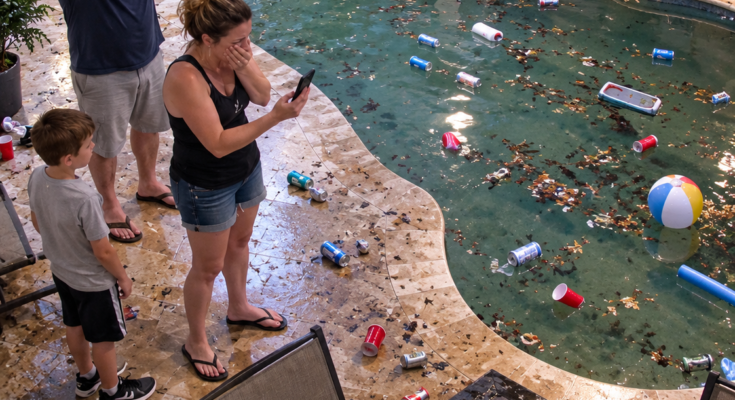
Our pool looked like someone had dumped a party into it and walked away.
Crushed cans floated in the shallow end. Plastic cups drifted near the steps. Food had sunk to the bottom. Broken glass glittered across the patio.
“Stay inside,” I told Leo.
Daniel came through the side gate minutes later and froze.
“What the hell?”
The equipment pad was worse.
The skimmers had been packed with garbage. The pump was dangerously hot. A thin wisp of smoke rose from the housing.
Then I noticed Brenda’s designer sunglasses beside an empty wine bottle.
Daniel saw them too.
“That’s it. I’m calling her.”
“Don’t.”
He turned.
“What?”
I pulled out my phone.
“I’m documenting it first.”
I photographed everything.
The cans.
The glass.
The equipment.
The sunglasses.
Then I saw the open electrical enclosure beside the pool system.
A protective cutoff that should have stopped the malfunctioning equipment had been defeated with a piece of plastic.
I stopped moving.
Daniel looked over my shoulder.
His face changed.
Neither of us was an electrician, so we didn’t touch anything.
We shut off power to the pool from a safe location and called the pool company.
The technician arrived that evening.
After inspecting the equipment, he looked genuinely angry.
“Whoever did this should have stopped when the system shut itself down.”
Daniel pointed toward the damaged control.
“You’re saying somebody intentionally did that?”
“I’m saying somebody intentionally defeated a safety function. I can’t tell you why.”
That distinction mattered.
We didn’t yet know whether someone had wanted to destroy the pump.
But we knew it hadn’t happened by accident.
The technician photographed everything before beginning any work.
His preliminary estimate was several thousand dollars, possibly more once they opened the pump and checked the filtration system.
Daniel stared at the ruined patio.
“I’m calling Kyle.”
I shook my head.
“Not yet.”
Then I remembered something else.
The driveway camera.
And unlike the pool equipment, nobody had thought to disable it.
━━━━━━━━━━━━━━━━━━━━
Part Two — The Party We Were Never Supposed to Know About
The footage started Saturday at 12:47 p.m.
Kyle’s truck pulled into our driveway.
Then another car.
Then another.
By two o’clock, there were nine vehicles.
Brenda arrived carrying two grocery bags and the same bottle of wine I’d found empty on the table.
I watched in disbelief as people I didn’t know walked through our side gate carrying coolers.
Daniel looked sick.
“I never told them they could come.”
“I know.”
For years, Kyle had known the gate code because we had trusted him.
Apparently, in his mind, access had become permission.
The backyard camera gave us the rest.
Around six that evening, the pool system shut itself down.
Kyle walked to the equipment.
The audio wasn’t perfect, but his voice was clear enough.
“Pump keeps cutting out.”
Brenda answered from the patio:
“Then turn it back on.”
Kyle tried.
It shut down again.
Someone suggested leaving it alone.
Kyle laughed.
Then Brenda said:
“She’s gone camping. She isn’t going to know.”
What happened next was partially obscured by the angle, but the technician later confirmed what the footage suggested.
Kyle opened the enclosure and interfered with the protective shutdown so the equipment would continue operating.
He wasn’t secretly plotting to burn down my pool.
The truth was almost more insulting.
He simply wanted the party to continue.
The water was already getting cloudy. People were complaining. Instead of stopping, calling us, or leaving, he decided a safety device was an inconvenience.
Then everyone went home.
Leaving the pump struggling behind them.
I saved the video in multiple places.
Daniel sat at the kitchen table with both hands over his face.
“I let this happen.”
“You didn’t damage the pool.”
“No. I spent years telling you, ‘That’s just my family.’”
I didn’t answer.
He looked at me.
“Every time you complained about them showing up, I asked you to be flexible because arguing with them was harder.”
That was true.
Then Leo walked into the kitchen.
He had apparently heard enough to understand Grandma and Uncle Kyle had used our pool.
“Why were they here?”
Daniel looked at me.
I answered simply.
“They came over without asking.”
Leo frowned.
“But Grandma said we’re not a charity.”
Neither Daniel nor I spoke.
Leo continued with the merciless logic of an eight-year-old.
“Then why does she get our stuff for free?”
That was the moment Daniel finally understood the whole picture.
Not just the pool.
The arrangement.
My generosity had become invisible because everyone had grown used to receiving it.
The next morning, we contacted our homeowner’s insurer and an attorney, largely because of the extent of the damage and the deliberate bypass of the equipment safety system. We also made a police report documenting the unauthorized entry and property damage.
Nobody promised us anyone would be arrested.
Past access to the property and the history of family visits made some issues less simple than an obvious stranger breaking in.
But we could establish something clearly from that day forward.
Their permission to enter was revoked.
We changed the gate code.
Changed exterior access codes.
Put the instruction in writing.
No Brenda.
No Kyle.
No guests invited by them.
No pool access without our express permission.
Then I made two more calls.
The first was to the cell provider.
The second was to the insurance agent.
I did not cancel anyone’s insurance without warning and leave them unknowingly driving uncovered.
I sent Brenda and Kyle written notice.
They had thirty days to transfer their phone numbers to their own accounts.
Their car-insurance premiums would become their responsibility at the next billing cycle, and they needed to arrange payment directly with the carrier.
No demand for the previous three years.
No invoice for old generosity.
No revenge surcharge.
The subsidy simply ended.
Brenda called twelve minutes after receiving the message.
“You’re cutting us off over a swimming pool?”
“No.”
“Then what is this?”
“Me ending expenses I volunteered to cover temporarily three years ago.”
She laughed bitterly.
“This is punishment.”
“No. You’re adults paying your own bills.”
“You know Kyle isn’t doing well financially.”
“I know.”
“And you’re still doing this?”
I remembered Leo’s face.
Then her exact words.
“We aren’t a charity, Brenda.”
Silence.
It would have felt satisfying to say it cruelly.
It didn’t.
Mostly, it felt sad.
Because I finally understood that I had spent years paying for peace that never actually belonged to me.
Then Brenda said:
“You have plenty of money.”
And there it was.
The belief underneath everything.
My having more meant she was entitled to take more.
The pool.
The bills.
My patience.
My silence.
“Whether I can afford something isn’t the same as you being entitled to it.”
She hung up.
━━━━━━━━━━━━━━━━━━━━
Part Three — Asking Is Different From Taking
Kyle denied responsibility at first.
He said people at the party had caused the mess.
He said he had only opened the pool because “we’ve always been allowed.”
Then our attorney sent the relevant footage, photographs, and technician’s report through the proper channels.
His story changed.
He admitted manipulating the equipment after it kept shutting down.
“I didn’t know it would damage anything.”
The technician’s response was simple.
“That is why you’re not supposed to bypass something designed to stop.”
Insurance covered part of the damage subject to our policy and deductible. The remaining losses became part of a civil claim.
Eventually, rather than continue fighting over evidence that was difficult to dispute, Kyle agreed to a repayment arrangement covering the portion attributed to his actions.
It wasn’t dramatic.
No sheriff seized his truck.
Nobody marched Brenda away in handcuffs.
Money arrived monthly.
Slowly.
That was enough.
Brenda’s part was harder.
She did not apologize for almost six months.
Instead, she told relatives we had “turned family into a legal matter.”
A few called Daniel.
His old instinct would have been to calm everyone.
This time he said:
“My brother entered our home while we were away, hosted a party, damaged equipment, and left my wife and child to discover it. What part would you like me to pretend didn’t happen?”
The calls stopped.
Our marriage changed too.
Not because Daniel suddenly hated his family.
He didn’t.
He loved them.
But he stopped using love as an excuse for unlimited access.
That distinction saved us.
The first time Brenda came to our house again was nearly a year later.
She did not have the gate code.
She rang the bell.
That small act meant more than she probably knew.
Leo was nine by then.
He saw her through the window.
“Do I have to hug her?”
“No.”
“Can I if I want?”
“Of course.”
He opened the door.
Brenda stood outside holding a wrapped box.
She looked at him.
“Hi, sweetheart.”
“Hi.”
Then she looked at me.
“May I come in?”
Not:
We’re here.
Not:
Open the gate.
May I?
“Yes.”
Inside, she handed Leo the box.
He opened it.
A camping lantern.
For one uncomfortable second, I thought she was trying to rewrite the tent incident with a gift.
Then Brenda said:
“I owe you an apology.”
Leo looked at her.
“For the pool?”
“For something before the pool.”
She swallowed.
“You asked me to borrow something. I could have said no kindly. Instead, I tried to embarrass your mother through you.”
Leo stared at her.
Children don’t make redemption scenes easy.
“So can I borrow your tent now?”
I nearly choked.
Brenda laughed despite herself.
“If it hasn’t disintegrated.”
Leo shrugged.
“I already have a better one.”
Daniel covered his mouth.
I turned away so Brenda wouldn’t see me smiling.
She apologized to me later that afternoon.
Not perfectly.
She still talked too much about stress and feeling judged and believing I looked down on her.
But eventually she said the part I needed to hear.
“I got used to you paying.”
I waited.
“And after a while, I stopped experiencing it as kindness. I experienced it as normal.”
“Yes.”
“So when you stopped, it felt like you were taking something from me.”
“That doesn’t mean it was yours.”
“I know.”
That was the first real progress.
I never put Brenda or Kyle back on my accounts.
That boundary remained.
We did not need to return to the old arrangement to prove there was no anger.
Kyle never again had unrestricted access to our property.
That remained too.
Forgiveness is not handing someone the same key they misused and hoping gratitude will make them different.
Years later, the pool is still there.
The damaged equipment was replaced.
The water became clear again.
The scorch mark near the old equipment pad eventually faded.
We host family sometimes.
Friends too.
Children run across the patio despite me telling them not to.
Someone always forgets a towel.
There are burgers.
Music.
Too many inflatable toys.
I am still generous.
That part of me did not need to die just because other people abused it.
But now there is one rule everyone understands.
Ask.
That is all I had ever wanted.
You can ask to swim.
You can ask to borrow something.
You can ask for help.
Sometimes the answer will be yes.
Sometimes it will be no.
Neither answer makes someone cruel.
The old tent stayed in Brenda’s garage until it finally fell apart.
Leo’s newer tent lasted years.
He and Daniel used it every summer.
When Leo was thirteen, he asked if two friends could come over and use the pool while Daniel and I were at home.
“Of course.”
He smiled.
Then paused.
“Do I need to ask every time?”
“Yes.”
“Even though I live here?”
“You live here. That’s different.”
He considered that.
Then grinned.
“So Grandma definitely has to ask.”
“Especially Grandma.”
He laughed.
It became a family joke eventually.
But beneath the joke was something I wish I had understood much earlier.
Generosity given freely is love.
Generosity expected indefinitely becomes obligation.
And when someone becomes angry because you stopped giving them something they never had a right to demand, the problem is not your boundary.
The problem is that somewhere along the way, they mistook your kindness for ownership.
Brenda’s thirty-year-old tent was never really the issue.
Neither was my $60,000 pool.
The tent could have been worth five dollars and she still had every right to say no.
The pool could have cost five hundred thousand dollars and she still had no right to enter without asking.
That was the lesson I wanted Leo to grow up understanding.
You can be generous without surrendering yourself.
You can love relatives without giving them unrestricted access to your home, money, or peace.
And you can say no without becoming the villain simply because somebody else had gotten very comfortable hearing yes.