Part One: The Empty Chair
“First chair’s already taken.”
Franklin Hayes said it every Saturday morning, even when the chair beside the front window was obviously empty.
The little barbershop sat between a hardware store and an old brick pharmacy in a West Virginia town where people still waved from pickup trucks and knew who had gotten married, who had gotten sick, and whose boy had come home from college.
Franklin had been cutting hair there for forty-three years.
His shop had two chairs.
One worked.
The other squeaked.
The coffee was usually burnt by 9 a.m., the magazines were months old, and the red-and-white pole outside had faded nearly pink.
But every Saturday, Franklin refused to book his first appointment.
That chair belonged to somebody who needed it more.
Usually, it was a man with a job interview.
Sometimes it was a teenager applying at the grocery store.
Once, it was a grandfather trying to get hired at a warehouse after his pension stopped stretching far enough.
Franklin never charged them.
He called it “getting a fellow ready.”
Most people in town knew about it.
What they didn’t know was how difficult those Saturday haircuts had become.
Two years earlier, Franklin had been diagnosed with Parkinson’s disease.
At first, it was just a small tremor in his left hand.
He hid it by resting his wrist against the chair.
Then the tremor grew.
Some mornings, buttoning his shirt took ten minutes.
Holding a coffee cup required both hands.
And on bad days, the scissors rattled softly between his fingers.
His daughter had begged him to retire.
“Dad, nobody would blame you.”
Franklin had smiled.
“Maybe not. But I’d blame me.”
So he adjusted.
He worked slower.
He steadied one hand with the other.
He scheduled fewer customers.
And every Saturday morning, that first chair still stayed empty.
Then one cold November morning, a man named Caleb Turner walked through the door.
He looked like he’d slept in his clothes.
His work jacket was stained at the cuffs. His boots were cracked. He had several days of beard growth and dark circles beneath his eyes.
He stood just inside the doorway, gripping a folded piece of paper.
The conversation in the shop went quiet.
Three regulars were waiting.
One lowered his newspaper.
Another gave Caleb a long look.
The third quietly pulled his jacket closer around himself.
Caleb noticed.
You could see it in his face.
That quick flash of embarrassment people get when they realize they’ve already been judged before saying a word.
Franklin looked at him.
“Morning.”
Caleb swallowed.
“Morning, sir.”
“You here for the Saturday chair?”
Caleb looked surprised.
“I… I heard maybe you help people sometimes.”
Franklin pointed toward the chair.
“Sit down.”
One of the regulars shifted impatiently.
“Frank, you sure?”
Franklin didn’t even look over.
“I’ve been sure about most things since 1957.”
That got a small laugh.
Caleb didn’t laugh.
He sat down carefully, like he was afraid he might be asked to leave.
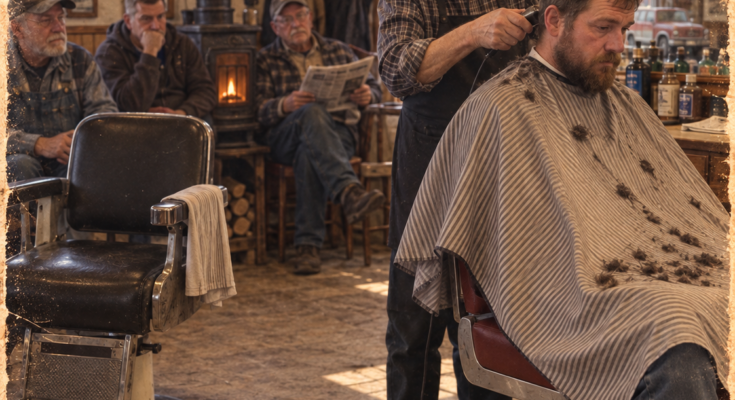
Franklin draped the cape around him.
“What kind of work?”
“Maintenance supervisor at a distribution place outside town.”
“Good job?”
“Could be.”
“Family?”
Caleb stared at the mirror.
“Two girls.”
Franklin nodded.
“That’s enough reason.”
He picked up his clippers.
His hand shook.
Caleb noticed immediately.
Franklin noticed him noticing.
“Parkinson’s,” he said.
Caleb started to rise.
“Sir, you don’t have to—”
“Sit.”
Franklin smiled.
“My hands shake. They haven’t forgotten what to do.”
So Caleb sat.
And the shop became strangely quiet.
Franklin moved slowly.
He steadied the clippers with both hands.
He trimmed around Caleb’s ears, cleaned the neckline, shaped the sides, and stopped whenever the tremor grew stronger.
Nobody complained about waiting anymore.
About halfway through, Caleb began talking.
He had worked at a small manufacturing plant for eleven years.
Then the plant closed.
His wife worked nights at a nursing facility, but her paycheck barely covered rent, utilities, groceries, and the girls’ school expenses.
Their truck had needed a transmission repair.
Then the furnace broke.
Caleb had been taking whatever work he could find—hauling scrap, clearing brush, unloading trucks.
“I’ve got one decent shirt,” he said quietly.
“Interview’s at ten.”
Franklin glanced at the clock.
8:41.
“You’ll make it.”
When the haircut was finished, Franklin brushed the loose hair from Caleb’s shoulders and turned the chair toward the mirror.
Caleb stared at himself.
For a few seconds, he said nothing.
He looked different.
Not rich.
Not transformed.
Just… ready.
Like somebody had handed him back a little dignity.
“What do I owe you?” Caleb asked.
Franklin shook his head.
“Nothing.”
Caleb reached into his pocket anyway.
Franklin placed a hand over his.
“Use it for gas.”
Caleb looked down.
That was when Franklin disappeared into the back room.
He returned carrying a clean white dress shirt still wrapped in thin plastic.
“My daughter bought it for me,” Franklin said. “Wrong size.”
Caleb looked at Franklin’s much smaller frame.
It was very clearly not Franklin’s size.
Franklin held it out.
Caleb understood the lie.
So did everybody else.
“I can’t take that.”
“Yes, you can.”
“Mr. Hayes—”
“Son, pride is good when it helps you stand.”
Franklin pushed the shirt gently against Caleb’s chest.
“But don’t let it keep you from taking a hand when you need one.”
Caleb’s eyes filled.
He looked away quickly.
“Thank you.”
Franklin nodded toward the door.
“Go get your job.”
Caleb left.
The shop stayed silent for several seconds.
Then the man who had pulled his jacket closer earlier cleared his throat.
“I misjudged him.”
Franklin began sweeping hair from the floor.
“Most of us have misjudged somebody.”
He leaned the broom against the wall.
“Difference is whether we learn anything afterward.”
—
Part Two: The Return
Three months passed.
Winter settled hard over the valley.
Franklin kept working.
The tremor became a little worse.
His daughter brought up retirement again.
Franklin kept the Saturday chair open.
Then one February morning, just after eight, the door opened.
Franklin looked up.
For a moment, he didn’t recognize the man standing there.
Clean work pants.
Polished boots.
Trimmed beard.
Company jacket.
A supervisor badge clipped near the chest.
Then the man smiled.
“Morning, Mr. Hayes.”
Franklin grinned.
“Well, look what the wind blew back.”
It was Caleb.
But he wasn’t alone.
He carried a paper bag in one hand and a stack of envelopes in the other.
He placed them on Franklin’s counter.
“What’s all this?”
Caleb swallowed.
“I got the job.”
Franklin smiled.
“I figured.”
“They hired me that morning.”
“Good.”
“Started on the floor. They promoted me last month.”
Franklin reached across the counter and shook his hand.
His hand trembled badly.
Caleb held it anyway.
Then Caleb pointed to the envelopes.
“There are twenty gift cards there.”
Franklin frowned.
“For what?”
“For this shop.”
Caleb took a breath.
“For the next twenty guys who walk in here needing that Saturday chair.”
Franklin stared at him.
Caleb continued.
“I couldn’t pay you that morning.”
“You didn’t owe me anything.”
“I know.”
Caleb smiled.
“That’s why I’m not paying you back.”
He looked toward the empty chair.
“I’m paying it forward.”
—
Part Three: The Legacy
Nobody in the shop spoke.
Even Franklin’s daughter, who had arrived with his breakfast, stopped in the doorway.
Caleb reached into the paper bag and pulled out another white dress shirt.
Same size as the one Franklin had given him.
“I bought two,” he said.
“One for the next man.”
Franklin turned away for a moment.
He pretended to straighten his combs.
Everyone politely pretended not to notice him wiping his eyes.
That morning, there wasn’t a job seeker waiting for the free chair.
So it stayed empty.
But it no longer looked empty.
It looked like possibility.
Franklin eventually reduced his hours.
Some days, his hands simply wouldn’t cooperate.
A younger barber started helping at the shop and learned Franklin’s Saturday rule.
First appointment.
No charge.
No questions designed to embarrass anybody.
Just a haircut, a little conversation, and a reminder that hard times are not the same thing as being a failure.
And Caleb?
He kept coming back.
Sometimes for a haircut.
Sometimes with another shirt.
Sometimes with the name of a company hiring.
And whenever somebody walked into that little shop looking worn down by life, nobody stared quite as quickly anymore.
Because the regulars had learned something from the man they once thought might cause trouble.
A worn jacket doesn’t tell you how hard somebody works.
Cracked boots don’t tell you how much they love their children.
Empty pockets don’t tell you what kind of person stands inside them.
And a shaking hand can still lift someone up.
Never judge a person by what hardship has put on their back. Sometimes the one who looks broken is simply waiting for someone to remind them they still belong.
—