Part One: The Forgotten Name
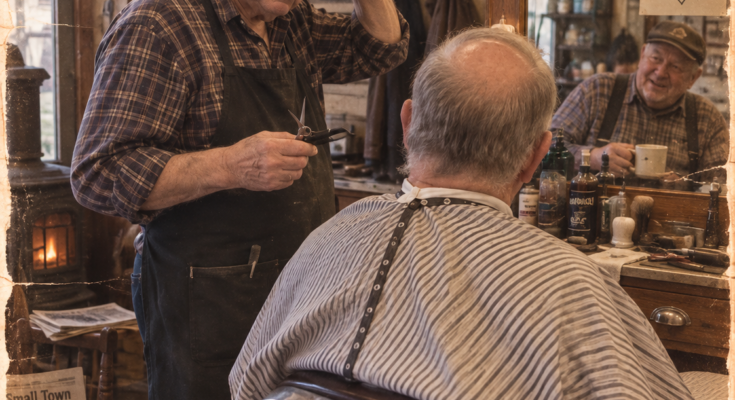
Frank Mallory stared at the man in his barber chair and felt his stomach drop.
He knew the face.
He knew the crooked left eyebrow, the scar near the chin, even the way the man always asked for his sideburns cut a little shorter than Frank thought they should be.
But the name was gone.
Frank stood frozen behind the chair, silver scissors resting in his hand.
The little barber shop on Main Street suddenly seemed painfully quiet.
Finally, Frank swallowed.
“I’m sorry,” he whispered. “I know you. Lord knows I know you.”
The customer looked at him through the mirror.
Frank’s hands began to shake.
“But I can’t remember your name.”
For nearly fifty years, people in that little Missouri town had trusted Frank Mallory with more than their hair.
They trusted him with first-job nerves, wedding-day jitters, stories about grandchildren, divorces, layoffs, harvests, funerals, and everything people confess when they’re sitting beneath a striped cape staring at themselves in a mirror.
Frank had opened Mallory’s Barber Shop when he was twenty-six.
Back then, haircuts cost a few dollars, men paid in cash, and Saturday mornings brought a line clear to the door.
The shop had changed very little.
Same worn black-and-white floor tiles.
Same old radio near the window.
Same faded photographs of local baseball teams.
Same red vinyl chairs Frank had repaired so many times nobody could remember what the original upholstery looked like.
Frank had changed, though.
At first, it was little things.
He misplaced his keys.
Forgot where he had set his coffee.
Asked a customer twice whether his grandson was still playing football.
Then he began writing appointments on index cards and taping reminders beneath the mirror.
Nobody said much about it.
Small towns can be funny that way.
Sometimes everybody knows something, and everybody quietly agrees to protect the person living through it.
Frank’s daughter had convinced him to see a doctor after he drove to the hardware store one afternoon and couldn’t remember why he was there.
The diagnosis had frightened him more than he admitted.
Early-stage Alzheimer’s.
He told only a handful of people.
But news traveled gently through town, less like gossip and more like concern.
Still, Frank kept cutting hair.
“I’ve been doing this since before half this town was born,” he told his daughter.
And he had.
His hands still knew what to do even when his mind occasionally stumbled.
That Saturday morning, though, Frank faced the moment he had feared most.
The man in his chair was Walter Hayes.
Walter and Frank had known each other since they were teenagers.
Frank had cut Walter’s hair before his high school graduation.
Before his wedding.
Before job interviews.
Before Walter’s daughter got married.
Before Walter buried his wife.
Forty-eight years of Saturday haircuts.
And Frank could not remember his name.
Frank slowly placed the scissors on the counter.
Then he untied his apron.
“I think maybe I ought to go home,” he said.
Walter turned in the chair.
“What are you doing?”
Frank stared at the floor.
“I can’t do this if I don’t know who’s sitting in front of me.”
Walter stood.
For a second, Frank probably expected him to leave.
Instead, Walter put one hand on Frank’s shoulder.
“Frank.”
Frank looked up.
“My name is Walter Hayes.”
Frank nodded quickly, ashamed.
“I know. I should’ve known.”
Walter smiled.
“That’s all right.”
Frank looked away.
“No, it isn’t.”
Walter squeezed his shoulder.
“You remembered my name for forty-eight years.”
Frank’s eyes filled.
Walter continued.
“I can remember it for both of us today.”
Nobody in the shop said a word.
Frank blinked hard and gave a small laugh that sounded dangerously close to a sob.
Walter sat back down.
“Now quit fooling around and fix this mess on my head.”
Someone near the waiting chairs chuckled.
Frank laughed too.
Then he tied his apron again.
And finished the haircut.
Walter paid, left his usual tip, and walked out without making a big deal about any of it.
But something changed in that shop afterward.
—
Part Two: The Quiet Kindness
The following Tuesday, a retired mail carrier named Dennis stepped through the door.
Instead of saying, “Morning, Frank,” the way he had for thirty years, he said:
“Morning, Frank. Dennis Cooper. Still need the usual.”
Frank looked at him.
Dennis just picked up a magazine.
No pity.
No awkward pause.
No explanation.
The next customer did the same thing.
“Hey, Frank. Bobby Turner. Number three on the sides.”
Then another.
“Frank, it’s Mike Reynolds. My wife says don’t let me leave looking like I did last time.”
Soon nearly every regular began introducing himself when he entered.
Not dramatically.
Not slowly, as if speaking to a child.
Just naturally.
“Morning, Frank. Jim.”
“Afternoon, Frank. Carl.”
“Hey, Frank. Tom Benson.”
People who had known him for decades suddenly offered their names like they were shaking hands for the first time.
Nobody announced why.
Nobody made Frank explain himself.
And nobody took away the thing he cared about most.
His dignity.
One afternoon, Frank’s daughter stopped by and noticed.
She watched three customers walk in.
Each one gave his name before hanging up his coat.
She waited until they were gone.
“Dad,” she said quietly, “did you ask people to do that?”
Frank shook his head.
“No.”
He looked toward the window.
“Walter started it, I think.”
His daughter’s eyes filled.
Frank pretended not to notice.
“I’ve spent half my life remembering these people,” he said.
“Birthdays. Kids’ names. How they like their hair.”
He paused.
“Never thought I’d be the one needing help remembering.”
His daughter reached across the counter and squeezed his hand.
Frank looked at the old shop around him.
Then he said something she would never forget.
“I thought losing my memory would make people see me differently.”
He swallowed.
“But they’re working pretty hard to make sure I still see myself the same.”
—
Part Three: The Sign
Months passed.
Frank began working fewer hours.
Some mornings were better than others.
Sometimes he remembered every person who walked through the door.
Other days, a familiar face felt like a photograph with the name rubbed off.
But people kept coming.
Not because Frank gave the fastest haircut in town.
He didn’t.
Not because the shop was modern.
It definitely wasn’t.
They came because for nearly fifty years, Frank had given that town something that could not be measured in haircuts.
He had listened.
He had remembered.
He had noticed when someone’s wife was sick.
He had slipped free haircuts to men between jobs.
He had stayed late for fathers bringing sons home from college.
He had once opened the shop early before a funeral because a widower told him, “I just want to look like myself when I say goodbye.”
Frank had spent decades making people feel known.
So when Frank began forgetting them, they decided he deserved to feel known too.
Eventually, a small handwritten sign appeared near his register.
Nobody knew who put it there.
It read:
*Please tell Frank your name when you come in. He’s remembered ours long enough.*
Frank kept that sign.
Even on the days he didn’t need it.
Especially on the days he did.
Because growing older has a way of teaching us things youth never could.
There may come a day when the strongest person in your family needs help fastening a button.
When the parent who taught you everything asks the same question twice.
When the neighbor who once remembered every birthday forgets your name.
Those moments do not erase who they were.
And they do not erase what they gave.
Sometimes love means doing for someone what they once did for you.
Quietly.
Without embarrassment.
Without keeping score.
Frank Mallory spent nearly fifty years remembering a town.
And when he needed it most, the town remembered him.
—