Part One: The Video
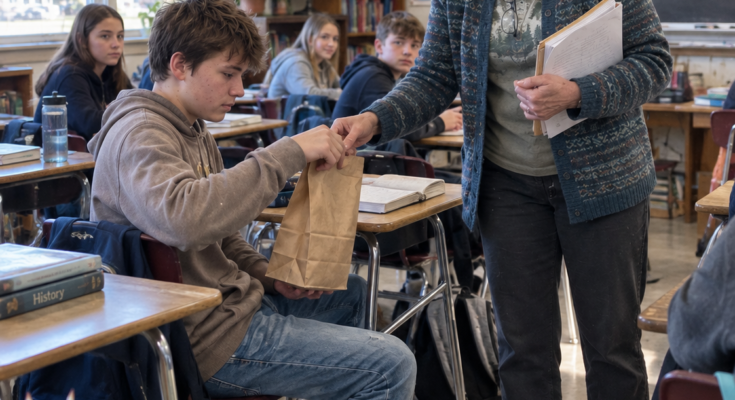
“Give me the bag, Caleb.”
Mrs. Sloan held out her hand beside his desk.
The seventh grader stared down at the brown paper sack tucked between his shoes.
Around him, twenty-five kids had suddenly gone quiet.
Caleb finally picked it up and handed it to her.
Mrs. Sloan took the bag without explanation, carried it behind her desk, and placed it inside a cabinet.
That was the part someone recorded.
Not what happened afterward.
The video was only fourteen seconds long.
By Friday evening, half the town had seen it.
“Teacher takes hungry boy’s food.”
That was the caption.
People called her heartless.
Cruel.
One parent wrote that anyone who could take lunch away from a child should never be allowed near a classroom again.
Another demanded that the school fire her.
Someone posted her picture.
Someone else mentioned that she was 52, lived in a small house outside town, and was raising two grandchildren.
None of those people knew Mrs. Meredith Sloan.
I did.
She taught next door to me.
And when I saw the video, I knew something was missing.
Meredith was the kind of teacher who kept safety pins, crackers, pencils, cough drops, and clean socks in her bottom drawer.
She remembered which kids hated being called on.
She knew who needed an extra minute after the bell.
She had buried her only daughter three years earlier and was raising her grandchildren, ages eight and eleven, without ever mentioning how exhausted she was.
Most mornings, she arrived before the custodian finished unlocking the hallway doors.
Every afternoon, she left carrying two canvas grocery bags and a stack of papers to grade.
She was not soft.
But she was kind in a way that didn’t advertise itself.
That Monday, the principal called a meeting.
Caleb’s mother came.
So did two administrators, the counselor, Meredith, and Caleb.
I was there because I had witnessed part of what had been happening on Fridays.
Caleb sat beside his mother in a chair that seemed too small for his long legs.
His mother looked worn down.
Not careless.
Not indifferent.
Just tired in the way people look when life has been asking too much of them for too long.
The principal began carefully.
“There are concerns about what happened in the video.”
Meredith folded her hands in her lap.
“I understand.”
The principal looked toward Caleb.
“Can you tell us why Mrs. Sloan was taking your lunch bag?”
Caleb’s face turned red.
His mother touched his shoulder.
For several seconds, he said nothing.
Then he whispered, “It wasn’t my lunch.”
Nobody moved.
He looked at the floor.
“It was food from the cafeteria.”
The principal leaned forward.
“What kind of food?”
“Stuff people didn’t eat.”
Caleb swallowed.
“Apples. Milk if it was unopened. Crackers. Sometimes sandwiches.”
His mother closed her eyes.
Caleb continued.
“I was taking it home.”
“To eat?” the counselor asked gently.
He shook his head.
“For my sisters.”
That room changed.
You could feel it.
Caleb had two younger sisters, ages six and nine.
Their mother worked evening shifts at a care facility outside town.
Their rent had gone up.
Then her car needed repairs.
Then Caleb’s youngest sister got sick and she missed several days of work.
Nothing dramatic had happened.
That was almost the saddest part.
Their family had simply fallen behind.
One bill at a time.
One grocery trip at a time.
One Friday at a time.
Caleb had noticed before anyone else.
He started collecting what other students left behind at lunch.
A sealed cup of applesauce.
A banana.
A bag of chips.
Anything he thought he could bring home without anyone noticing.
But school rules did not allow students to take leftover cafeteria food off campus.
Partly for safety.
Partly because nobody could know where opened food had been.
Meredith caught him one Friday stuffing leftovers into his lunch sack.
She could have reported him.
She could have embarrassed him.
She could have lectured him in front of the class.
Instead, she asked him quietly why.
He told her.
And that was when the “confiscating” started.
Every Friday, Caleb would bring his small paper bag into class.
Meredith would take it.
But she wasn’t throwing the food away.
She was replacing it.
Behind her desk, inside that cabinet, she kept a larger grocery bag.
Bread.
Peanut butter.
Cereal.
Pasta.
Soup.
Fruit.
Sometimes pancake mix.
Sometimes cookies for the girls.
She would place Caleb’s empty lunch sack inside the larger bag, fold the top down, and hand it back to him after the hallway cleared.
Nobody knew.
That was the point.
—
Part Two: The Truth
“I didn’t want people feeling sorry for me,” Caleb said.
His voice cracked.
Meredith finally spoke.
“He asked me not to tell anyone.”
His mother covered her mouth.
“I didn’t know,” she whispered.
Caleb looked at her.
“I knew you were trying, Mom.”
That sentence broke everyone in the room.
His mother began crying.
Not loudly.
Just the quiet kind of crying adults do when they are trying desperately to stay composed.
“I thought you were eating more at school,” she said.
Caleb shrugged.
“I was okay.”
Meredith reached into her purse and handed his mother a tissue.
That small gesture nearly undid me.
The principal looked at Meredith.
“Why didn’t you explain yourself when the video started spreading?”
She gave a tired little smile.
“Because explaining myself meant explaining Caleb.”
She looked at him.
“And his dignity mattered more than my reputation.”
Nobody had an answer for that.
The principal eventually released a short statement saying the video had been taken out of context and that no student had been denied food.
No family details were shared.
Meredith insisted on that.
The online anger faded after a few days.
Some people deleted their comments.
Most never apologized.
Life moved on.
—
Part Three: The Bag
But something else happened quietly.
A few teachers started keeping grocery gift cards in the counselor’s office.
A local farmer began dropping off produce once a month.
A retired couple started an anonymous pantry shelf for families who needed help over the weekend.
Nobody put Meredith’s name on it.
She did not want them to.
One Friday later that spring, I passed her classroom after dismissal.
Caleb was standing near her desk.
He was taller by then.
Less nervous.
He handed Meredith a grocery bag.
She looked confused.
“What’s this?”
“My mom got extra hours.”
He grinned.
“And she said we’re okay this week.”
Meredith smiled.
“That’s wonderful.”
Caleb pushed the bag toward her.
“It’s for somebody else.”
Inside were two boxes of cereal, peanut butter, canned soup, and a package of cookies.
“For another kid,” he said.
“In case they don’t want anybody to know.”
Meredith stared at him for a long moment.
Then she nodded.
“All right.”
He turned to leave.
At the doorway, she called his name.
“Caleb?”
He looked back.
She said, “Your mother should be proud of you.”
He smiled.
“She is.”
—