Part One: The Lunchbox
“You don’t have to keep doing that, Clayton.”
My husband stood at the kitchen counter with a butter knife in his hand. It was 4:46 in the morning, and he had already laid two slices of bread on a paper towel.
“Doing what?”
“Getting ready for work.”
He looked down at the bread. Then he spread the mustard all the way to the corners, the same way he had every weekday for twenty-eight years.
“Still have to eat, June.”
I wish I could tell you I heard what he was really saying. But after thirty-three years of marriage, I had gotten too comfortable believing I understood him.
Clayton was fifty-nine when the plant shut down. He came home on a Thursday carrying his welding helmet, a folded pair of gloves, and the small photograph of our daughter that had hung inside his locker since she wore braces.
She was thirty-one now.
He set everything on the kitchen table and said, “Well. That’s that.”
Then he went outside and fixed the gate I’d been asking him to fix since April.
For the first week, he stayed busy. He cleaned the gutters, changed the oil in my car, and tightened every loose handle in the house.
By the second week, there was nothing left to tighten.
He filled out applications on our old computer while I sat beside him because some of the websites frustrated him. He could make a straight, sound weld in a space I couldn’t fit my hand into, but a little red box saying *required field* could leave him staring at the screen like he’d forgotten how to read.
“I already put that in,” he would say.
“I know.”
“Then why’s it asking again?”
I didn’t have an answer that helped.
By the fourth week, he had started taking his lunchbox out again.
It was blue metal with a dent near the latch. Our daughter had stuck a crooked yellow flower on it in second grade, and he had spent the next twenty-four years washing carefully around that sticker.
He packed a sandwich, an apple, and coffee in his old thermos.
Then he left.
When I asked where he was going, he said, “Out for a while. See what’s happening.”
I thought he was driving past the plant. Or sitting somewhere alone, too ashamed to come home.
One Tuesday, worry got the better of me.
I waited until his truck turned off our road, then grabbed my keys.
He drove right past the shuttered plant without slowing down. Two miles later, he pulled into the public park beside the ball fields.
I parked behind the restrooms, feeling foolish and sneaky.
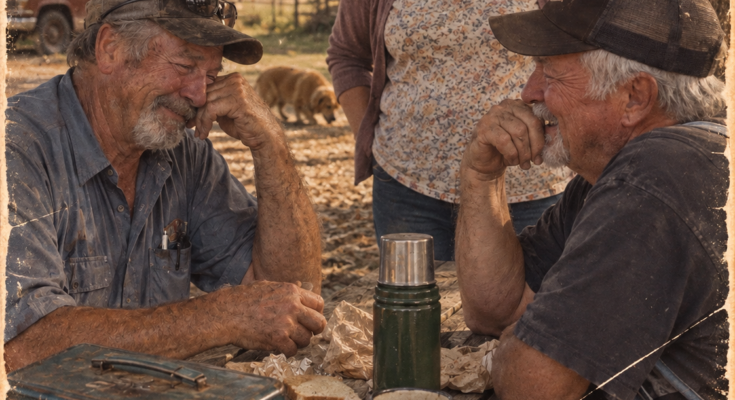
Clayton carried his lunchbox to a picnic table beneath a bare-limbed oak. Another man was already there, sitting with a thermos between his hands.
It was Vernon Pike.
I knew him from company picnics, back when there were company picnics. His wife had died three years earlier, and Clayton had helped carry their old couch out when Vernon moved into a smaller place.
I nearly left. My husband was having lunch with a friend; that wasn’t something a woman needed to investigate.
Then Vernon asked, “How’s that new place treating you?”
Clayton set his lunchbox down.
“All right.”
“Keeping you busy?”
“Some.”
Vernon nodded like that was good news. Clayton opened his sandwich, then asked, “What about yours?”
“Can’t complain.”
Neither man took a bite.
I was still standing beside the restroom building when Vernon reached into his coat pocket. A folded sheet of paper slipped out and skidded beneath the table.
Clayton caught it with his boot.
“Application?” he asked.
Vernon held out his hand. “Just looking around.”
“I thought you started somewhere.”
A groundskeeper’s mower hummed beyond the ball fields. Vernon stared at the paper.
“Didn’t want you worrying about me.”
Clayton sat back.
Then he said, “Well, you can quit being impressed with me, too.”
Vernon looked up.
“Nothing?”
“Nothing.”
For a moment they just stared at each other. Then Vernon started laughing.
Not a big, happy laugh. More like something had finally loosened that had been pulled too tight.
“Here I’ve been sitting here jealous of you.”
Clayton rubbed his face.
“I ironed this shirt to come eat a sandwich with an unemployed man.”
They laughed until Vernon took off his glasses.
I laughed, too, which gave me away.
Clayton turned toward me. His face changed, and I hated that I had put that look there.
“I followed you,” I said, coming toward the table. “I’m sorry. I was worried.”
He looked at Vernon, then at the empty place beside him.
“Well. Pull up some bench.”
I sat down.
Up close, I could see that Clayton had packed two sandwiches. He pushed one toward me without asking whether I was hungry.
Vernon twisted the lid onto his thermos.
“We ran into each other here a few weeks ago,” he explained. “Both said we were on a lunch break.”
“And then neither one of us knew how to take it back,” Clayton said.
I put my hand over his.
“Honey, why didn’t you tell me?”
He watched a brown leaf scrape across the concrete.
“You’re already sitting up at night with that notebook, figuring what we can put off.”
“We’re supposed to figure it out together.”
“I know.”
He was quiet long enough that I thought he was finished.
Then he said, “I miss being expected somewhere.”
—
Part Two: The Table
That was the part I hadn’t understood.
For twenty-eight years, somebody had looked up when Clayton walked through a door. Somebody needed his hands, his judgment, the thing he knew how to fix.
At home, I kept telling him to rest.
I hadn’t thought about how much resting could feel like disappearing when you hadn’t chosen it.
Vernon picked at the label on his thermos.
“Told my daughter I was enjoying the peace and quiet,” he said. “Truth is, some days I turn the television on before I take my coat off.”
Clayton looked across the table.
“You heard from Dwayne?”
Vernon shook his head.
“What about Curtis?”
“Not lately.”
My husband reached for his phone.
The following Tuesday, four men sat at that table.
There was no speech and nobody called it anything. Curtis brought a bag of chips. Dwayne arrived twenty minutes early and claimed he’d misjudged the traffic.
There isn’t much traffic between his house and that park.
I sent cookies, wrapped in the wax paper Clayton said made everything taste like somebody’s mother had packed it.
After that, I sent extras.
—
Part Three: The Invitation
They talked about job openings and whose truck needed what. Some weeks they talked about the plant. Other weeks they argued over the best way to grow tomatoes or sat listening to a ball game on Vernon’s little radio.
When Curtis found work, he asked if they could move lunch to Saturday.
Nobody objected.
When rain came, they moved into our garage, pulled folding chairs around Clayton’s workbench, and left crumbs in the drawer where he kept his tape measure.
Eventually Clayton found welding work at a smaller shop. Fewer hours, a longer drive, and a paycheck we had to adjust to.
He still met the men for lunch.
Last Saturday, I came downstairs and found his blue lunchbox open on the counter. Four sandwiches sat beside it.
“Where you headed?” I asked.
He glanced up, and this time there was nothing guarded in his face.
“Park. Vernon’s bringing somebody.”
I added another packet of cookies.
Clayton tucked them carefully beside that battered old thermos, closed the latch, and kissed my cheek.
“Don’t wait lunch on me,” he said. “They’re expecting me.”
I watched him walk out the door, carrying that dented blue lunchbox with the crooked yellow flower still stuck to the side.
Twenty-eight years of showing up somewhere. Twenty-eight years of being needed.
The plant took a lot when it closed. But it didn’t take that.
It just took a little longer to find.
—