Part 1: The Stubborn Man
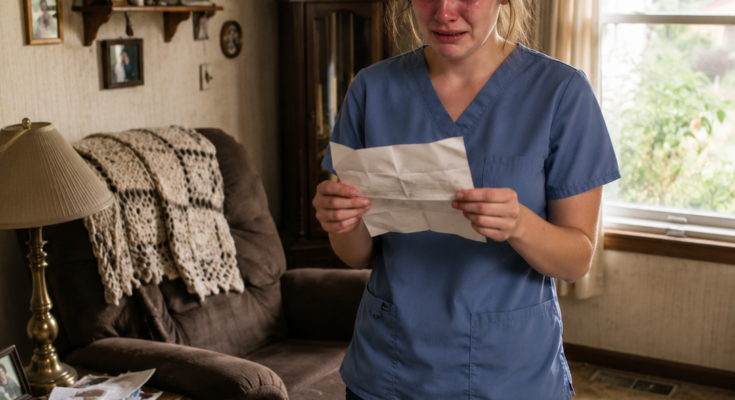
The house was entirely too quiet. I stood in the middle of Silas’s living room, holding a piece of folded notebook paper, breathing in the lingering scent of his pipe tobacco and old library books. For the first time in five years, the grandfather clock in the hallway was the only voice in the house. Silas was gone.
When I was first assigned to Silas, I was a twenty-two-year-old home health aide trying to figure out my place in the world. My agency warned me about him. They said he was difficult, set in his ways, and had already chased off three other caregivers. He was an eighty-eight-year-old retired mechanic living at the end of a long gravel driveway in rural Ohio. He had lost his wife of sixty years, and along with her, he had lost his tolerance for the outside world.
Our first day together, he didn’t even look at me. He just stared out the kitchen window and muttered, “I don’t need a babysitter. I need my wife.” I didn’t take it personally. I just made him a pot of black coffee, exactly how he liked it, set it on the table, and started washing his dishes.
For the first month, we barely spoke. I did his laundry, organized his medications, and swept the hardwood floors. He sat in his recliner, watching the news, pretending I was invisible. But I noticed something. Every afternoon, he would walk out to the backyard and stare at a massive, overgrown garden box. It was full of weeds and dead vines.
One Tuesday, I brought a pair of gardening gloves from home. Instead of sitting in the kitchen while he took his afternoon nap, I went out back and started pulling weeds. I was knee-deep in dirt when I heard the screen door squeak. Silas was standing on the porch, leaning heavily on his wooden cane. I froze, thinking he was going to yell at me for touching his things.
Instead, he walked slowly down the steps, came over to the garden, and pointed a shaky finger at a patch of green. “Don’t pull those,” he said, his voice thick with emotion. “Those were her favorite heirloom tomatoes. They’re trying to come back.”
That afternoon, everything changed. Silas didn’t just need someone to check his blood pressure or cook his oatmeal. He needed someone to help him keep his wife’s memory alive. He needed to know that the things he cared about still mattered to someone.
Part 2: The Garden
Over the next five years, that garden became our sanctuary. He sat on an old metal lawn chair and directed me on how to prune, water, and harvest. He taught me the secret to growing perfect green beans and how to keep the bugs off the squash. But more importantly, he taught me about life.
While my friends were out on the weekends worrying about social media and dating drama, I found myself looking forward to Monday mornings on Silas’s porch. He told me stories about being a young man with no money, trying to build a life from scratch. He told me about the dignity of hard work, the importance of keeping your word, and what it really means to love someone when it isn’t easy.
“People your age think love is a feeling,” he told me once, shaking his head. “Love is a choice. You wake up every single day and you choose that person, even when they’re driving you crazy. Especially then.”
As the years passed, the generational gap between us vanished. I wasn’t just his health aide anymore, and he wasn’t just my client. We had become a strange, wonderful little family.
When his health started to fail, the tough, stubborn man I met on day one was replaced by someone vulnerable and afraid. There were late-night ambulance rides and terrifying hours in bright, sterile hospital waiting rooms. Through all of it, I sat right by his bed. When the doctors delivered bad news, I was the one holding his weathered, calloused hand. I brushed his thinning hair. I read his favorite western novels out loud when his eyes grew too weak. I promised him he would never be alone.
But I had no idea that after Silas was gone, something hidden beside his bed would reveal what those five years had truly meant to him—and change my life in a way I never saw coming.
Part 3: The Letter
After Silas passed, I stood in his bedroom, trying to decide what to keep and what to let go. I opened the drawer of his nightstand, expecting to find old reading glasses, a worn Bible, maybe some loose change. Instead, I found a sealed envelope with my name on it.
My hands were shaking as I opened it. Inside was a letter, written in his familiar, shaky handwriting.
*”My dearest girl,*
*If you’re reading this, I’m gone. And I want you to know something I should have said out loud a thousand times.*
*When you first walked into my house, I was a bitter old man waiting to die. I had lost my wife, my purpose, and my will to keep going. I thought my life was over. And then you showed up, with your gardening gloves and your stubborn insistence on making me coffee.*
*You brought me back to life. You gave me a reason to get out of bed. You made me laugh again. You made me care again. And somewhere along the way, you stopped being just my aide. You became my daughter.*
*I know I’m not your real father. I know you have your own family, your own life. But I want you to know that you are the child I never had. You are the legacy I leave behind.*
*Everything I have—the house, the land, the old truck in the garage—I leave to you. Not because I feel obligated. Because I want you to have it. Because I want you to know that you were the greatest gift of my final years.*
*Thank you for staying. Thank you for seeing me. Thank you for loving me when I was unlovable.*
*With all my love,*
*Dad.”*
I read the letter three times, tears streaming down my face. He had called himself Dad. He had called me his daughter. After five years of being his aide, his friend, his companion—he had secretly been thinking of me as family all along.
I sat down on the edge of his bed, clutching the letter to my chest, and sobbed. Not from grief. From gratitude. From the overwhelming realization that I had been loved—truly, deeply loved—by a man who had no obligation to love me at all.
The house was silent, but it wasn’t empty. Silas was everywhere. In the garden. In the books. In the coffee cup he always left on the kitchen table. And now, in the letter that would forever change how I saw myself.
I never knew my biological father. He left before I was born. I grew up without a dad, never quite sure what I was missing. But Silas filled that gap. He taught me what a father’s love looks like. He taught me that family isn’t always about blood. It’s about who shows up. Who stays. Who chooses you, even when it’s hard.
I moved into the house. I kept the garden alive. I planted her heirloom tomatoes every year, just the way he taught me. I sat on the porch and drank coffee, listening to the grandfather clock tick away the hours. And I thought about Silas every single day.
Years later, I showed the letter to my own children. They asked me who Silas was. I told them he was my father. Not my biological father, but my real father. The one who chose me.
I still visit his grave every year on the anniversary of his death. I bring a handful of tomatoes from the garden. I sit beside the headstone and tell him about my life. I tell him about my children, my work, my garden. I tell him I miss him.
And every time I walk past that grandfather clock in the hallway, I hear his voice in my head. “Love is a choice,” he said. “You wake up every single day and you choose that person.”
Silas chose me. And I chose him. And that choice made all the difference.
Some people come into our lives for a reason. Some come to teach us, to challenge us, to show us who we really are. Silas came into my life as a client. He left as my father.
And I will carry him with me forever. ❤️