Part 1: The Coffee Can
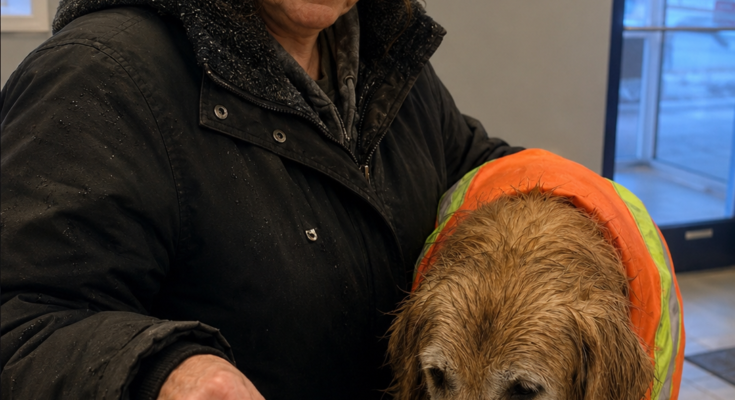
Lenora Voss counted the quarters twice before she pushed the old coffee can across the veterinary counter. Her hands were red from the cold. Her coat was damp around the sleeves. And sitting beside her boots, wrapped in the orange safety vest she wore every school morning, was a golden retriever who could barely lift his head.
“I know it’s not much,” Lenora said quietly. “But it’s all I have right now.”
The young woman behind the counter looked down into the can. Quarters. Dimes. A few folded dollar bills. Two five-dollar bills clipped together with a clothespin. On top was a small envelope with the words “furnace repair” written in shaky blue ink. The dog gave one soft whimper. Lenora reached down and placed her hand gently on his head. “I know, sweetheart,” she whispered. “I know.”
It had started that afternoon behind the elementary school in Duluth, Minnesota, where the wind comes off the lake like it has something to prove. Lenora had been a crossing guard there for fourteen years. Every weekday morning, she stood on the corner in her bright vest, holding her stop sign in one hand and waving children across the street with the other.
She knew which kids dragged their backpacks. Which ones forgot their mittens. Which ones needed an extra smile because their mornings at home had been hard. She knew the little boy who always waved with two hands. The girl who brought her drawings of cardinals. The twins who argued every morning and hugged every afternoon.
Parents honked and waved, but most of them didn’t know much about Lenora. They didn’t know her husband had passed nine winters earlier. They didn’t know she lived alone in a small blue house with a sagging porch and a kitchen window that looked out over an alley. They didn’t know her furnace had been coughing and rattling for weeks. They didn’t know she slept in thick socks, two sweaters, and the afghan her mother had crocheted in 1978.
Lenora never complained. People like her usually don’t. She just showed up. Rain, snow, sleet, bitter wind. She stood there with her stop sign and made sure other people’s children got across safely.
That Thursday afternoon, after the last school bus pulled away and the sidewalks emptied, Lenora heard a sound behind the building. At first, she thought it was the wind scraping loose metal against the fence. Then she heard it again. A low, broken whine.
Part 2: The Dog
She followed the sound behind the dumpsters, past a line of snow-covered bushes, and found him tied to a rusted pipe with a piece of rope. A golden retriever. Thin. Shaking. One paw lifted off the frozen ground. His fur was dirty and matted, and his eyes had that awful look animals get when they no longer understand what they did wrong.
Beside him was a torn piece of notebook paper tucked under a brick. Lenora picked it up. Three words were written on it. “Can’t afford him.”
She stood there for a long moment, the paper trembling in her hand. The dog looked up at her. Not angry. Not wild. Just waiting. As if he still believed somebody good might come back.
“Oh, honey,” Lenora said, and her voice cracked. “You poor sweet thing.”
She took off her orange vest and wrapped it around him. Then she knelt in the snow, worked the frozen knot loose with aching fingers, and somehow managed to get him into the back seat of her old car.
She did not go home. She drove straight to the nearest animal clinic. The whole way there, the dog rested his chin on her folded scarf and watched her in the rearview mirror. Lenora kept one hand on the wheel and one hand reaching back, fingers brushing his paw whenever traffic slowed.
“You’re not alone anymore,” she kept saying.
But inside, her heart was pounding. Because she knew what was in her purse. The coffee can. The furnace money. For three months, she had been saving every spare coin. She had skipped haircuts. Skipped coffee with her neighbor. Put back oranges at the grocery store because apples were cheaper. She had told herself she could make it a little longer. Just until the repairman came. Just until the heat worked right again.
But when the vet came out and said the dog had an injured paw, dehydration, and needed treatment immediately, Lenora didn’t ask what it would cost. She just opened her purse.
But when Lenora reached for the envelope marked “furnace repair,” what happened next left the entire clinic silent—and soon, the whole town would know why.
Part 3: The Town
She pushed the coffee can forward. “It’s all I have,” she said again.
The vet looked at the can. Then at Lenora. Then at the dog. She didn’t count the money. She just said, “We’ll take care of him.”
Lenora blinked. “But I can’t pay—”
“The clinic will cover it,” the vet said quietly. “I think we can handle this one.”
Lenora’s eyes filled with tears. She reached down and stroked the dog’s head. “Thank you,” she whispered. “Thank you so much.”
The vet smiled. “What’s his name?”
Lenora looked at the golden retriever. He had lifted his head slightly, his tail thumping weakly against the exam table. “I don’t know,” she said. “He doesn’t have one. But I think I’ll call him Lucky.”
The dog’s tail thumped harder. Lenora laughed through her tears.
The vet treated the dog’s paw, gave him fluids, and sent him home with Lenora that night with medications and a bag of food. Lenora carried him into her cold house and wrapped him in every blanket she owned. She slept on the floor beside him, her hand resting on his side, whispering that everything would be okay.
The next morning, she showed up to her crossing guard post without her coffee can. But she had something else. A smile. Because for the first time in nine years, she wasn’t coming home to an empty house.
But the town had noticed. Someone at the clinic had posted about the crossing guard who spent her furnace money on a stray dog. The story spread like wildfire. Parents started talking. Kids started drawing pictures of Lucky. The local newspaper ran a small article.
Then something incredible happened.
A local hardware store owner showed up at Lenora’s door with a crew and a new furnace. He said the community had chipped in. By the end of the day, her house was warm again. A neighbor brought groceries. Another brought a basket of dog treats. Kids from the school drew cards and left them on her porch.
And the clinic? They covered the rest of Lucky’s bills. No one asked Lenora for a dime.
A few days later, a woman showed up at Lenora’s door with a check. She said she had seen the story and wanted to help. “I lost my husband two years ago,” she said. “I know what it’s like to feel alone. I’m glad you found a friend.”
Lenora couldn’t hold back her tears. “I don’t know what to say.”
The woman smiled. “You already said everything. You showed us what it means to care.”
Lucky recovered fully. He followed Lenora everywhere—to the bus stop, to the grocery store, to her crossing guard post. He sat beside her every morning, watching the children cross the street. The kids loved him. They brought him treats and patted his head. He was the happiest dog in Duluth.
And Lenora? She was no longer invisible. The town had seen her. The town had recognized her. The town had held her up the way she had held up everyone else.
Years later, when Lenora finally retired from crossing guard duty, the town held a ceremony in her honor. Lucky sat beside her, wearing a tiny bow tie. The mayor gave her a plaque. The children sang a song they had written for her. And the crossing guard, who had spent fourteen years keeping others warm, finally felt the warmth of her community.
She didn’t need a furnace to be warm. She had Lucky. She had her town. She had a heart that wouldn’t quit.
And the old coffee can? Lenora kept it. It sat on her mantel, empty but full of meaning. A reminder that sometimes, the smallest offerings lead to the biggest miracles.
She never regretted spending that furnace money. Because in saving Lucky, she had saved herself. And in being seen, she had reminded everyone that the invisible people among us are often the ones holding the world together.
Lenora Voss died peacefully ten years later, with Lucky by her side. The town built a small bench in her honor near the elementary school. On it, they engraved her name and her motto: “One crossing guard. One dog. One community.”
Every morning, children still wave as they cross the street. And somewhere, Lenora is still keeping them safe. ❤️