
Modern Italy looks so natural on a map that it is easy to forget something remarkable:
Italy as a unified country is relatively young.
For most of European history, the Italian Peninsula was not governed by one national government.
Instead, it was divided among kingdoms, duchies, republics, papal territories and foreign empires.
There was a Kingdom of Sardinia in the northwest.
Austria controlled important territory in the north.
The pope ruled a large central region.
The Kingdom of the Two Sicilies controlled almost the entire south.
And numerous smaller states occupied the territory between them.
Then, during the 19th century, wars, revolutions, diplomacy and popular nationalism transformed this political patchwork into the Kingdom of Italy.
The process is known as the Risorgimento, meaning roughly “resurgence” or “rebirth.”
But Italian unification did not happen in a single year.
The kingdom was proclaimed in 1861.
Venetia joined in 1866.
Rome was captured in 1870 and became the capital in 1871.
Italy’s borders changed again after World War I.
Then fascism, World War II and civil conflict nearly tore the country apart.
Finally, in 1946, Italians voted to abolish the monarchy and create the Italian Republic.
The map above compresses almost a century of political transformation into six panels.
The real story is even more fascinating.
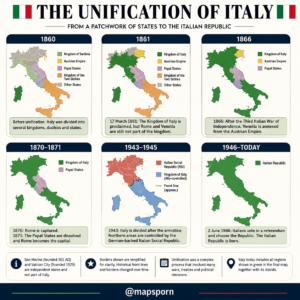
Before Italy, There Were Many Italies
The concept of Italy is ancient.
The peninsula had geographical and cultural identities stretching back thousands of years.
Rome had once ruled an empire from the peninsula.
Italian literary culture developed through figures such as Dante, Petrarch and Boccaccio.
People used varieties of Italian alongside numerous regional languages and dialects.
But political unity was another matter entirely.
After the fall of the Western Roman Empire, the peninsula repeatedly fragmented.
By the early 19th century, the territory of modern Italy was divided between several major powers.
Among them were:
- Kingdom of Sardinia-Piedmont
- Kingdom of the Two Sicilies
- Papal States
- Austrian-controlled Lombardy and Venetia
- Grand Duchy of Tuscany
- Duchy of Parma
- Duchy of Modena
- smaller territories
San Marino also remained independent.
There was no government in Rome ruling an Italian nation from Sicily to the Alps.
Napoleon Accidentally Helped Create Italian Nationalism
One important step toward unification came from an unlikely source:
Napoleon Bonaparte.
During the French Revolutionary and Napoleonic wars, French armies invaded much of the peninsula.
Old political structures were reorganized.
Some territories were combined into larger administrative units.
French-style legal reforms were introduced.
When Napoleon was defeated, the Congress of Vienna attempted to restore Europe’s traditional rulers.
Yet the political ideas unleashed by the revolutionary era could not simply be erased.
People had experienced governments that crossed old regional boundaries.
Ideas about:
- National identity
- Constitutional government
- Citizenship
- Liberalism
continued spreading.
Among a growing number of intellectuals and activists, a question became increasingly important:
Why should Italy remain divided?
The Risorgimento Begins
The movement for Italian political unity became known as the Risorgimento.
There was no single organization directing it.
Different supporters wanted very different versions of Italy.
Some wanted a republic.
Some wanted a constitutional monarchy.
Some hoped the pope might lead an Italian federation.
Others believed the Kingdom of Sardinia-Piedmont offered the most realistic foundation for unity.
Three individuals became especially important:
Giuseppe Mazzini
Count Camillo di Cavour
Giuseppe Garibaldi
A fourth figure, King Victor Emmanuel II, eventually became the first king of unified Italy.
Each represented a different path toward nationhood.
Giuseppe Mazzini: The Revolutionary Idealist
Giuseppe Mazzini believed Italy should become a unified democratic republic.
In 1831 he founded Young Italy, a revolutionary movement dedicated to creating a single independent Italian nation.
Mazzini’s uprisings repeatedly failed.
He spent long periods in exile.
Yet his ideas were enormously influential.
He helped convince younger generations that Italians should think of themselves not merely as Tuscans, Piedmontese, Sicilians or Venetians but as members of a common nation.
Mazzini therefore helped create the intellectual and emotional foundation of unification even though the Italy that eventually emerged was a monarchy rather than the republic he wanted.
The Revolutions of 1848
Europe exploded in revolution in 1848.
The Italian Peninsula was no exception.
Revolts challenged Austrian authority and conservative rulers.
King Charles Albert of Sardinia-Piedmont went to war against Austria.
For a moment, it appeared that nationalist revolution might drive Austria out of northern Italy.
It failed.
Austria defeated Piedmontese forces.
Revolutionary governments collapsed.
Rome briefly became a republic, but French troops restored papal authority.
The failure of 1848 demonstrated something important:
Italian nationalism alone was not yet strong enough to defeat Austria and unify the peninsula.
A more powerful state and more sophisticated diplomacy would be required.
That brought Sardinia-Piedmont to the center of the story.
Sardinia-Piedmont Becomes the Engine of Unification
The Kingdom of Sardinia was an unusual state.
Despite its name, its political and economic center was not Sardinia itself.
It was Piedmont, in northwestern Italy.
Its capital was Turin.
After the failures of 1848, Sardinia-Piedmont increasingly emerged as the strongest Italian-led state capable of challenging Austrian influence.
King Victor Emmanuel II came to the throne in 1849.
But the political mastermind behind much of Piedmont’s strategy was his prime minister:
Camillo Benso, Count of Cavour.
Cavour’s Strategy Was Diplomacy, Not Revolution
Cavour differed dramatically from Mazzini.
He was not primarily a revolutionary.
He was a pragmatic statesman.
He wanted to strengthen Piedmont economically and militarily and believed Italian expansion would require support from powerful European allies.
Cavour modernized infrastructure, encouraged trade and strengthened Piedmont’s international position.
Then he made an apparently strange decision.
He sent Piedmontese troops to participate in the Crimean War alongside Britain and France.
Piedmont had little direct stake in Crimea.
But the war gave Cavour something more valuable:
a seat at the diplomatic table with Europe’s great powers.
He used that position to draw attention to Austrian dominance in Italy.
France Becomes Piedmont’s Crucial Ally
Cavour then sought help from French Emperor Napoleon III.
France agreed to support Piedmont in a war against Austria under certain conditions.
In 1859, conflict began.
French and Piedmontese armies defeated Austrian forces in major battles including Magenta and Solferino.
Austria lost Lombardy, which was transferred to Sardinia-Piedmont.
This was the first dramatic expansion of the state that would soon become Italy.
Central Italy Begins Joining Piedmont
Events then moved rapidly.
Several central Italian states experienced political upheaval.
Through plebiscites and political agreements, territories including Tuscany, Parma and Modena joined Sardinia-Piedmont in 1860.
France received Nice and Savoy in return for accepting Piedmontese expansion.
That decision would have consequences for another great figure of Italian nationalism.
Giuseppe Garibaldi had been born in Nice.
He was furious that his birthplace was transferred to France.
Yet he soon launched the campaign that transformed Italian unification.
Garibaldi and the Expedition of the Thousand
In 1860, southern Italy was ruled by the Kingdom of the Two Sicilies.
The kingdom included:
- Sicily
- Naples
- almost the entire southern mainland
It was one of the largest states on the peninsula.
Then Giuseppe Garibaldi arrived.
Garibaldi was already internationally famous as a revolutionary soldier.
In May 1860, he sailed from northern Italy toward Sicily with a volunteer force known as the Thousand, or the Redshirts.
The expedition looked almost impossibly ambitious.
A small volunteer army intended to overthrow an entire kingdom.
Yet that is largely what happened.
Sicily Falls
Garibaldi landed at Marsala in western Sicily.
Local revolts and growing support strengthened his force.
His volunteers defeated Bourbon troops.
Palermo fell.
Garibaldi crossed the Strait of Messina onto the mainland.
He advanced rapidly northward.
In September 1860, he entered Naples.
The Bourbon monarchy collapsed.
Garibaldi Could Have Become a Rival to the King
At this point, the future of Italy remained uncertain.
Garibaldi was a republican.
Victor Emmanuel II was a monarch.
Their political ideals were not the same.
But Garibaldi placed national unity ahead of his personal ideology.
In the famous meeting near Teano, he acknowledged Victor Emmanuel II as king.
The southern territories were annexed into the expanding state.
This is why the infographic’s 1861 panel needs correction:
By the time the Kingdom of Italy was officially proclaimed, the former Kingdom of the Two Sicilies had already become part of it.
March 17, 1861: The Kingdom of Italy Is Born
On March 17, 1861, the Kingdom of Italy was officially proclaimed.
Victor Emmanuel II became:
King of Italy.
This is the date normally treated as the formal birth of the unified Italian state.
But Italy was still incomplete.
Two extremely important territories remained outside the kingdom:
Venetia
and
Rome with the remaining Papal States.
The first capital of the new kingdom was Turin.
It would later move to Florence before finally moving to Rome.
Why Was Venetia Still Outside Italy?
Venetia, including Venice, remained controlled by the Austrian Empire.
Austria was one of Europe’s great military powers.
Italy was not yet strong enough simply to take the territory on its own.
Once again, international conflict created an opportunity.
1866: Venetia Joins Italy
In 1866, Prussia went to war against Austria.
Italy allied with Prussia and opened another front against the Austrians.
This conflict became known in Italian history as the Third Italian War of Independence.
Italian forces did not perform especially well militarily.
They suffered notable defeats on land and sea.
But Prussia decisively defeated Austria in the wider Austro-Prussian War.
Because Italy was on the victorious side diplomatically, Austria surrendered Venetia.
Following a plebiscite, the territory joined the Kingdom of Italy.
Venice was now Italian.
But Rome remained outside.
Why Was Rome So Difficult to Capture?
Rome was the seat of the pope.
The pope controlled what remained of the Papal States in central Italy.
Many Italian nationalists believed Rome had to become the capital of the new country.
But there was a major obstacle:
France protected the pope.
French troops were stationed in Rome.
Italy could not simply attack without risking war with Napoleon III.
So for nearly a decade after the Kingdom of Italy was proclaimed, Rome remained outside it.
Garibaldi Tried Anyway
Garibaldi repeatedly attempted to advance toward Rome.
His efforts were blocked.
The Italian government itself could not openly support a confrontation with France.
The situation only changed because of another European war.
1870: The Franco-Prussian War Opens Rome
In 1870, France went to war against Prussia.
Napoleon III suddenly needed his troops elsewhere.
French soldiers protecting Rome were withdrawn.
Then France suffered catastrophic defeat.
The Second French Empire collapsed.
Italy seized the opportunity.
Italian troops advanced into the remaining Papal States.
On September 20, 1870, they entered Rome after breaching the ancient city wall near Porta Pia.
The pope’s territorial rule over most of central Italy effectively ended.
A plebiscite followed.
Rome and Lazio were annexed to Italy.
1871: Rome Becomes the Capital
In 1871, the Italian government moved its capital to Rome.
This is generally regarded as the completion of the central phase of Italian unification.
The sequence had taken little more than a decade:
1859 — Lombardy acquired
1860 — Central Italian states and southern Italy incorporated
1861 — Kingdom of Italy proclaimed
1866 — Venetia acquired
1870 — Rome captured
1871 — Rome becomes capital
But even this was not the final territorial shape of modern Italy.
Italy Still Did Not Have Today’s Borders
This is another major simplification in the infographic.
After 1870, some Italian nationalists argued that Italian-speaking or historically connected territories remained outside the kingdom.
These included areas under Austro-Hungarian rule such as:
- Trentino
- South Tyrol
- Trieste
- Istria
The movement to bring such territories into Italy became associated with Italian irredentism.
Those ambitions helped shape Italy’s involvement in World War I.
World War I Changes Italy Again
Italy had initially been allied with Germany and Austria-Hungary in the Triple Alliance.
But when World War I began in 1914, Italy remained neutral.
Then the Entente powers secretly offered Italy territorial gains if it entered the war against Austria-Hungary.
Italy joined the war in 1915.
Fighting along the Alpine and northeastern front was extraordinarily brutal.
Italian and Austro-Hungarian armies fought across mountains, glaciers and rivers.
Hundreds of thousands died.
Austria-Hungary finally collapsed in 1918.
After the war, Italy gained territories including:
- Trentino
- South Tyrol
- Trieste
- parts of the former Austrian Littoral
These acquisitions moved Italy much closer to the northern border seen today.
So a map that jumps directly from 1870 to World War II misses an important stage in the country’s territorial development.
The Unification of Italy Did Not Mean Italians Immediately Felt Unified
Creating a country on a map is one thing.
Creating a shared national society is another.
In 1861, regional differences were enormous.
Many people primarily identified with their:
- Village
- City
- Region
- Local language
- Former state
rather than with an abstract Italian nation.
Standard Italian was not the everyday spoken language of most of the population.
People spoke Sicilian, Neapolitan, Venetian, Piedmontese, Sardinian and many other regional languages and dialects.
Economic differences were substantial.
The industrializing north and heavily agricultural south followed different developmental paths.
The new government therefore faced an enormous task:
creating Italians after creating Italy.
A famous phrase often associated with the period captures the problem:
“We have made Italy. Now we must make Italians.”
Whether phrased exactly that way or not, the idea summarizes one of the new state’s greatest challenges.
Southern Resistance and the “Southern Question”
Unification was not universally welcomed.
Former Bourbon territory in the south experienced violent resistance.
Banditry, political rebellion, local grievances and resistance to the new Piedmontese-led government combined into years of conflict.
The Italian state deployed large military forces to suppress the unrest.
This difficult period contributed to what became known as the Southern Question:
Why was southern Italy economically and socially different from the north?
The debate would persist for generations.
Even today, regional economic disparities remain one of Italy’s most important domestic issues.
Italian unification therefore should not be imagined simply as every region happily deciding to join one country.
It involved consent, nationalism, diplomacy, military conquest and coercion in different proportions.
The Monarchy Became the House of Savoy’s Italy
The new Kingdom of Italy was ruled by the House of Savoy, the dynasty that had previously ruled Sardinia-Piedmont.
Victor Emmanuel II retained his regnal number.
Interestingly, he did not become “Victor Emmanuel I of Italy.”
He remained Victor Emmanuel II.
That symbolized an important reality:
The new kingdom was legally and institutionally built largely through the expansion of Sardinia-Piedmont.
The Piedmontese constitution became the constitution of the new state.
Turin was initially the capital.
The political elite of Piedmont occupied powerful positions.
Italy was unified—but through the enlargement of one existing monarchy.
The Pope Did Not Accept the Loss of Rome
The capture of Rome created another problem.
Pope Pius IX refused to recognize the legitimacy of Italian control over the former Papal States.
For decades, popes considered themselves effectively confined within the Vatican.
This became known as the Roman Question.
The dispute lasted until 1929.
That year, Benito Mussolini’s Italian government and the Holy See signed the Lateran Treaty.
The agreement created Vatican City as an independent sovereign state.
That is why there is still a tiny independent country inside Rome today.
Italy unified almost the entire peninsula.
But the pope retained sovereignty over one extremely small territory.
San Marino Remained Independent Too
Another state survived Italian unification:
San Marino.
The tiny republic in the Apennines traces its traditional foundation to the early fourth century.
It maintained its independence throughout the Risorgimento.
Garibaldi himself had received refuge there during the revolutionary struggles of 1849.
San Marino’s political survival meant that the Italian Peninsula never became completely identical with the Italian state.
Today the peninsula contains:
- Italy
- Vatican City
- San Marino
All three are sovereign countries.
From Liberal Italy to Fascism
The Kingdom of Italy survived into the 20th century.
But the trauma of World War I, economic instability, political violence and social conflict destabilized the country.
In 1922, Benito Mussolini and his Fascist movement came to power.
King Victor Emmanuel III appointed Mussolini prime minister following the March on Rome.
Over the following years, Mussolini dismantled democratic institutions and established a dictatorship.
Italy pursued imperial expansion and eventually aligned itself with Nazi Germany.
In 1940, Mussolini brought Italy into World War II.
The consequences were disastrous.
1943: Italy Splits in Two
By 1943, Italy’s military position was collapsing.
Allied forces invaded Sicily.
Mussolini was removed from power.
King Victor Emmanuel III appointed Marshal Pietro Badoglio as prime minister.
Italy secretly negotiated an armistice with the Allies.
The armistice was announced on September 8, 1943.
Germany responded immediately.
German troops occupied much of northern and central Italy.
Mussolini was rescued by German forces and installed as the head of a German-supported puppet state:
The Italian Social Republic, often called the Republic of Salò.
Meanwhile, the monarchy and government continued in southern territory under Allied protection.
Italy was effectively divided.
Italy Became a Battlefield and a Civil War
From 1943 to 1945, Italy experienced several overlapping conflicts.
Allied forces fought German troops northward through the peninsula.
The Royal Italian government joined the Allied side against Germany.
Italian resistance groups fought German occupation forces and Fascist troops.
The Italian Social Republic fought alongside Germany.
Civilian populations endured:
- Bombing
- Reprisals
- Massacres
- Food shortages
- Displacement
The front line gradually moved north.
So the 1943–45 panel in the map should be understood as highly simplified.
The front did not remain fixed.
Territory repeatedly changed hands.
1945: Mussolini Falls and the War Ends
By April 1945, German control in northern Italy was collapsing.
Partisan uprisings occurred in several cities.
Mussolini attempted to escape toward Switzerland.
He was captured and executed by Italian partisans.
German forces in Italy surrendered shortly afterward.
The Fascist state disappeared.
But the monarchy itself was now deeply discredited.
Many Italians blamed King Victor Emmanuel III for having enabled Mussolini’s rise and for failing to prevent dictatorship and war.
The country faced a fundamental question:
Should Italy remain a kingdom at all?
June 2, 1946: Italians Choose a Republic
On June 2, 1946, Italians voted in a referendum between:
Monarchy
and
Republic
For the first time in a national political vote, Italian women participated alongside men.
Almost 25 million people voted.
The official result gave:
Republic — 12,718,641 votes (54.27%)
Monarchy — 10,718,502 votes (45.73%).
The result was geographically divided.
Northern Italy voted strongly for the republic.
Much of southern Italy favored the monarchy.
But nationally, the republican side won.
The House of Savoy’s rule ended.
King Umberto II left Italy for exile.
The Italian Republic was born.
The Republic Was Not Fully Built in a Single Day
June 2 is celebrated as Italy’s Republic Day, but the institutional transition continued afterward.
The referendum also elected a Constituent Assembly charged with drafting a new constitution.
Enrico De Nicola became provisional head of state.
The new Italian Constitution was promulgated in December 1947.
It entered into force on:
January 1, 1948.
At that point De Nicola assumed the title President of the Republic under the new constitutional system.
The constitution also contains an extraordinary safeguard:
The republican form of the state cannot be abolished by constitutional amendment.
After centuries of monarchies, duchies and foreign rulers, republican government was constitutionally protected.
The Borders Changed Again After World War II
The infographic’s “1946–Today” panel also deserves a qualification.
Italy’s northeastern border was still being settled in the aftermath of World War II.
Italy lost several territories along the eastern Adriatic that had been acquired after World War I.
The Trieste area became particularly complicated.
For several years it existed under a special international arrangement known as the Free Territory of Trieste, divided into different administrative zones.
Most of the city of Trieste eventually returned to Italian administration in 1954.
The Italian-Yugoslav border was later formally settled through additional agreements.
So modern Italy did not emerge from one clean border decision in 1946.
Like unification itself, the final territorial story was gradual.
Three Men, Three Different Paths to Italy
Italian unification is often symbolized through three remarkable figures.
Giuseppe Mazzini — The Idea
Mazzini supplied the revolutionary nationalist vision.
He imagined Italy as one nation when political reality still showed numerous states.
Camillo Cavour — The Diplomacy
Cavour used Piedmont’s government, international alliances and strategic warfare to make unification politically possible.
Giuseppe Garibaldi — The Sword
Garibaldi’s military campaign destroyed the Kingdom of the Two Sicilies and delivered southern Italy to Victor Emmanuel II.
And above them stood:
Victor Emmanuel II — The King
The House of Savoy provided the monarchy around which the new state was ultimately built.
Italian unification succeeded partly because these very different forces—revolutionary nationalism, monarchical government, diplomacy and military action—temporarily pushed in the same general direction.
Why Italy Unified So Late
Another interesting question is why Italy remained divided long after countries such as France, Spain and Britain had developed powerful centralized monarchies.
Several factors mattered.
The peninsula contained wealthy and fiercely independent cities.
Foreign powers repeatedly intervened.
Austria, France and Spain all controlled or influenced Italian territory during different eras.
The pope’s temporal authority divided the peninsula geographically.
Regional identities were extremely strong.
The mountainous geography also encouraged political fragmentation.
And for centuries, there was no single Italian state powerful enough to conquer or peacefully absorb all its neighbors.
Only when nationalism combined with Piedmontese military power and favorable international circumstances during the 19th century did unification become possible.
Italy Is Younger Than the United States
This comparison often surprises people.
The United States declared independence in:
1776
The Kingdom of Italy was proclaimed in:
1861
That is an 85-year difference.
Rome did not join Italy until 1870.
So while Italian civilization is ancient, the unified Italian nation-state is younger than the United States.
Germany provides a similar case.
The modern German Empire was not unified until 1871.
Many countries that appear timeless on modern maps are actually products of relatively recent political transformations.
The Flag Also Tells the Story
Italy’s green, white and red tricolor predates the unified kingdom.
Variations of the flag appeared during the revolutionary and Napoleonic era.
The colors later became associated with Italian nationalism.
During the monarchy, the national flag commonly carried the shield of the House of Savoy.
When Italians chose a republic in 1946, the royal arms disappeared.
The simple vertical:
green — white — red
became the flag of the republic.
The political system changed.
The tricolor remained.
From a Patchwork to One of Europe’s Largest Countries
Look again at the first map.
The peninsula is divided into colored pieces.
Kingdoms.
Papal territory.
Austrian possessions.
Duchies.
Independent states.
Then watch what happens.
1861: most of the peninsula becomes the Kingdom of Italy.
1866: Venetia joins.
1870: Rome is annexed.
1871: Rome becomes capital.
After World War I: the northern and northeastern frontier expands.
1943–45: war divides the country.
1946: Italians abolish the monarchy.
1948: the republican constitution takes effect.
What now looks like one obvious country was assembled over generations.
The Bigger Lesson
The story of Italian unification demonstrates something that modern political maps often hide.
Countries are not permanent geographical facts.
Borders change.
States disappear.
Kingdoms merge.
Empires collapse.
National identities develop.
And political systems can change completely while the population remains on the same land.
In 1860, someone traveling from Turin to Palermo would have crossed through a political landscape divided among different governments.
A decade later, almost the entire journey lay inside one kingdom.
Less than a century later, that kingdom itself disappeared.
The monarchy became a republic.
And the map we recognize as modern Italy emerged.
That is why the unification of Italy is not merely a story about borders.
It is the story of how an idea of Italy became a state—and how that state continued changing long after politicians declared unification complete.
Source and Accuracy Note
The map is a simplified overview of Italian political development. The Kingdom of Italy was proclaimed on 17 March 1861, by which point the former Kingdom of the Two Sicilies had already been incorporated and should not be shown as a separate state in an 1861 snapshot. Venetia joined Italy in 1866, Rome was annexed in 1870 and became capital in 1871. Italy’s territory changed again after both World Wars, so modern borders should not be treated as fully settled by 1870 or immediately in 1946. On June 2, 1946, 54.27% of valid referendum votes favored the republic; the republican Constitution entered into force January 1, 1948.