
Part 3: The Resolution
Twenty-four hours came and went. No apology. No payment. No acknowledgment. Instead, I got a text from Karen’s husband telling me I was “overreacting” and that it was “just a pool party.”
I smiled when I read that message. Because I had already made my decision.
I took the footage to the police. The officer who reviewed it laughed out loud when he saw the video of Karen cannonballing into my pool while wearing a red, white, and blue bikini. “This is fantastic,” he said. “Do you want to press charges?”
“Yes,” I said. “I do.”
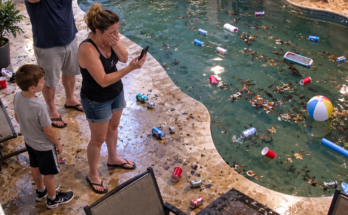
The police visited my neighbors that afternoon. I watched from my window as they opened the door, their faces shifting from confusion to horror. The officer handed them a citation for trespassing and another for property damage. He also informed them that I would be filing a civil suit for the cost of cleaning my pool, the water usage, and the emotional distress they had caused.
But I wasn’t done. The next day, I posted the footage on the neighborhood Facebook group. I wrote a caption that read: “If you’re going to break into someone’s pool and throw a party, maybe don’t do it on camera. Just a thought.”
The response was immediate. People were outraged. Other neighbors commented about how Karen and her husband had always been entitled, how they had complained about everyone else’s properties while ignoring their own. The comments section exploded.
Karen tried to defend herself. She posted a long rant about how I was “unneighborly” and “overreacting.” But the footage didn’t lie. You could see her walking through my yard, setting up decorations, and even taking a selfie by the pool. There was no way to spin it.
Within a week, Karen and her husband had to hire a lawyer. They tried to get me to drop the charges, offering to pay for everything and apologize publicly. I refused. They had their chance to make it right, and they chose to ignore me. Now they would have to face the consequences.
The civil suit awarded me $3,500 for the cleanup, water usage, and damages. The trespassing charges resulted in a fine and community service for both of them. And the neighborhood Facebook group became a source of endless entertainment as people shared their own stories about Karen’s entitled behavior.
A few weeks later, I was sitting by my pool, enjoying the evening sun, when I noticed a “For Sale” sign go up across the fence. Karen and her husband were moving. I didn’t feel sorry for them. I felt relieved.
My husband and I celebrated by throwing our own 4th of July party the next year. We invited all the neighbors—except Karen and her family. People came, swam, laughed, and thanked us for being “the best neighbors in the neighborhood.”
I had taught them something important: you can’t take what isn’t yours. And when you do, you’d better be ready for the consequences.
Sometimes, standing up for yourself means setting a boundary that others will try to cross. And sometimes, it means showing them exactly what happens when they do. I didn’t start the conflict. I didn’t ask for the disrespect. But I ended it—on my terms, in my way, with a smile on my face.
Now, every time I swim in my pool, I think about that 4th of July. I think about the camera footage. I think about Karen’s face when the police arrived. And I think about how good it felt to finally say: enough.
Because my pool is my pool. My property is my property. And no one—not even the most entitled neighbors—gets to take that away from me.
So if you’re out there, wondering if you should stand up for yourself when someone disrespects you, let me tell you something: you should. You absolutely should. Because the peace you get after you stand up for yourself is worth more than any pool party. ❤️