Lucas Miller was the quiet type of kid teachers usually forgot about once class was over. I sat in the third row by the windows at Northwood High, wore secondhand sneakers, kept my head low, and only spoke when I had to. Most students barely noticed me unless they needed someone to copy homework from.
That week was Heroes’ Week at school. Every classroom was decorated with patriotic posters, paper flags, and essays about bravery. Students gave presentations about relatives they looked up to. One girl brought in a firefighter helmet. Another student made a slideshow about his uncle in the military.
Then it was my turn. I walked to the front of the room carrying only a small notebook and one photograph folded carefully inside it. The picture showed my mother standing next to a gray fighter jet on a bright runway somewhere overseas. She had on a flight suit and dark sunglasses, with one hand resting near the cockpit ladder. She was not smiling much, but that was normal for her. My mom never liked posing for photos.
“Go ahead, Lucas,” Mr. Reynolds said lazily from his desk. “Tell us about your hero.”
I took a breath. “My hero is my mother,” I started quietly. A few students groaned like they were already bored. “Her name is Rachel Miller. She served in the United States Air Force. She’s an F-22 pilot.”
The laughter began instantly. At first, it was only one person near the windows. Then another. Then half the classroom joined in. Mr. Reynolds lifted his eyebrows dramatically. “An F-22 pilot?” he repeated slowly. “Your mother?”
“Yes, sir,” I said, my voice shaking.
He leaned against his desk, crossed his arms, and smiled the way adults do when they think they are being clever. “Lucas,” he said, “let’s try to stay with believable stories today.”
The room exploded. Kids covered their mouths while laughing. Someone in the back made fake airplane noises. Another boy muttered, “Sure, and my dad’s Batman.”
My face burned so much I could feel the heat climbing into my ears. But I did not argue. My mother had taught me something years earlier after another kid made fun of me for not wearing designer clothes. “People who need to embarrass others usually feel small inside,” she told me calmly. “You don’t make yourself smaller to match them.”
So I stood there silently while Mr. Reynolds kept talking. “There’s nothing wrong with ordinary jobs,” he told the class. “Not everyone has to make up dramatic stories just to sound impressive.”
Make up. That hurt worse than liar. Because I was not making up anything. I looked down at my paper, the one I had written while Mom washed dishes beside me the night before, correcting my grammar every now and then without even looking over my shoulder. Every word in it was true.
I know you’re curious to see what happens next, so please be patient and continue reading in the comments below. Thank you for understanding the inconvenience. Please leave a “YES” below and give us a Like to get the full story. 👇to part 2.
—
Part 2: The Picture
I sat back down at my desk, still clutching the photograph. My hands were trembling, but I refused to cry. I had cried too many times in front of people who didn’t deserve to see it. Not this time.
Mr. Reynolds moved on to the next student, but I could still hear the whispers. “F-22 pilot. Yeah, right.” “He’s such a liar.” “Why would he make up something so stupid?”
I slipped the photograph back into my notebook and stared out the window. I thought about my mother. I thought about the night before, when she had helped me write my speech. She had been standing at the kitchen sink, scrubbing a pan, when I told her about the assignment.
“I don’t know what to say,” I admitted. “Everyone’s going to think I’m making it up.”
She turned off the water and dried her hands. “Lucas, you tell them the truth. That’s all you ever have to do. What they choose to believe is their problem, not yours.”
“But what if they laugh?”
She smiled, and for a moment, she looked like the woman in the photograph. “Then they laugh. And you keep standing. That’s what bravery really is.”
That night, I had written my speech with her sitting beside me. She corrected my grammar, helped me find better words, and made sure I spelled her rank correctly. “Captain Rachel Miller,” she said. “Don’t forget the Captain part. I earned that.”
I didn’t forget. But when I stood in front of the class, I was too humiliated to say anything else. The laughter had stolen my voice.
After class, I walked through the hallways with my head down. Other students passed me, some still laughing, others just glancing at me with pity. I heard one boy say to his friend, “Did you hear about Lucas? He said his mom flies a fighter jet. Can you believe that?”
I kept walking. I didn’t stop until I reached the bathroom, where I locked myself in a stall and finally let the tears fall.
I know you’re curious to see what happens next, so please be patient and continue reading in the comments below. Thank you for understanding the inconvenience. Please leave a “YES” below and give us a Like to get the full story. 👇to part 3.
—
Part 3: The Assembly
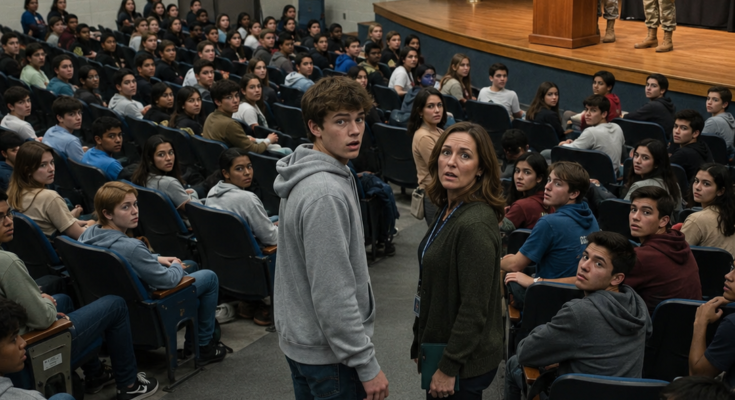
The auditorium was packed. Every student, every teacher, every administrator had gathered for the Heroes’ Week assembly. The stage was decorated with flags and banners. The principal stood at the podium, welcoming the guests who had come to speak to us.
I sat in the back row, hoping to disappear into the crowd. I had told my mother about the assembly, but I didn’t mention what had happened in class. I didn’t want her to be upset. I didn’t want her to think she had raised a kid who couldn’t handle a little mockery.
But she knew. She always knew.
The first speaker was a police officer. Then a firefighter. Then a veteran from the Army. Each one told stories about bravery, sacrifice, and service. The crowd clapped politely. I watched, feeling hollow.
Then the principal stepped forward again. “And now,” she said, “we have a special guest. Captain Rachel Miller of the United States Air Force.”
My heart stopped.
The doors at the back of the auditorium opened, and a woman in full dress uniform walked in. She moved with the kind of confidence that made people stop talking and just watch. Her boots clicked against the floor. Her medals caught the light. Her face was calm and serious, just like in the photograph.
It was my mother.
The entire auditorium went silent. I could see Mr. Reynolds in the front row, his mouth hanging open. I could see the students who had laughed at me, their faces frozen in shock.
My mother walked to the stage, shook the principal’s hand, and approached the podium. She adjusted the microphone and looked out at the crowd.
“Good morning,” she said. “I’m Captain Rachel Miller. I’m an F-22 Raptor pilot. And I’m here today because my son, Lucas, told me his school was having a Heroes’ Week assembly.”
She paused. I could feel everyone’s eyes shifting toward me. I wanted to sink into my chair.
“I understand that yesterday, Lucas gave a presentation about me. And I understand that some of you found it hard to believe.” Her voice was calm, steady, and clear. “I don’t blame you. It’s not every day you meet a fighter pilot. And it’s definitely not every day you meet a fighter pilot who’s also a mom.”
She smiled, and for the first time, I saw the warmth behind her uniform.
“So I came here today to tell you something. Lucas wasn’t lying. Every word he said was true. I’ve flown missions in the F-22 for over a decade. I’ve been deployed overseas. I’ve earned the medals you see on my chest. And I’ve also been the mother who packed his lunches, helped him with his homework, and taught him how to be brave.”
She looked directly at Mr. Reynolds.
“Bravery isn’t about telling stories that sound impressive. It’s about standing up when people laugh at you. It’s about telling the truth even when no one believes you. My son did that yesterday. And I’ve never been prouder of him.”
The auditorium was dead silent. Then, slowly, someone started clapping. Another person joined. Then another. Soon the entire room was on its feet, applauding.
I sat in my chair, tears streaming down my face, unable to move. My mother walked off the stage and came straight to me. She knelt down in front of my row and looked me in the eye.
“See?” she said softly. “I told you. You keep standing.”
Mr. Reynolds found me after the assembly. His face was red, his hands shaking. “Lucas,” he said, “I’m so sorry. I shouldn’t have—”
I held up my hand. “It’s okay,” I said. “My mom told me not to make myself smaller to match anyone.”
He nodded, looking like he wanted to say more. But I didn’t need to hear it. I had already heard everything that mattered.
The next day, I walked into class with my head held high. No one laughed. No one whispered. Instead, people came up to me and asked about my mother. They wanted to know what it was like. They wanted to see the photograph.
And for the first time in my life, I felt proud. Not because of her rank or her medals. But because she had taught me something that no one could ever take away: the courage to stand tall when everyone else is trying to push you down.
That evening, I hugged my mother tighter than I ever had before.
“Thanks for coming,” I said.
“Always,” she said. “That’s what moms do.”
And I knew, without a doubt, that she meant every word. ❤️