The gravel crunched under my funeral shoes like it had been waiting for me. I watched my son’s SUV roll forward, hesitate for half a second—just long enough to pretend this wasn’t real—then pick up speed and disappear past the bend where the cornfields start and the town stops pretending it’s still the center of the world.
I didn’t scream his name. I didn’t throw my hands up. My throat was too dry for drama, and my heart was too tired for begging.
Three days ago, I stood at the cemetery with a paper program folded in my hands. People brought comfort the only way they knew how—Costco trays, foil pans, paper plates stacked on my counter like a quiet army. Neighbors hugged me and whispered, “He was a good man,” the way Americans say goodbye when they don’t have better language for loss.
My children flew in like they were arriving for an appointment. My son carried himself the way men do when their lives are scheduled in fifteen-minute blocks—eyes already elsewhere, phone always face-down. My daughter arrived with expensive sunglasses and a brittle smile, hugging me like she was performing tenderness for an audience.
That first night after the funeral, the house felt too quiet for two grown kids who used to fill it with noise. I made coffee out of habit and stood at the sink staring at the yard, at the bare branches that would bud soon, at the life my husband and I had built with our hands.
Then my son opened his laptop on the dining table—our dining table—and said, “We should talk about next steps.”
Next steps. Not grief. Not memories. Not even, “Mom, are you sleeping?” Just next steps, like I was a file that needed closing.
They spoke softly, politely, the way you speak when you’re trying to move an older woman out of the way without calling it what it is. They used words like “practical” and “manageable.” In the morning, they handed me a suitcase I didn’t recognize and told me we were going to “look at a place” that would be “good for me.”
I said, “I’m not going anywhere.” My son smiled like he’d heard that sentence before, like resistance was just a phase. So I walked through my own house like a guest, then followed them to the car because something in me wanted to see how far they’d go.
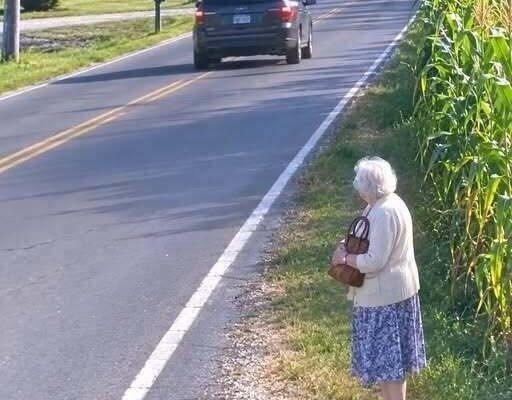
They didn’t head toward town. My son turned onto a road with no witnesses—two lanes, no shoulders, fields on both sides. Then he pulled over and said it again, calm as a weather report: “This is where you get out.”
I stepped out. The car door shut behind me with a soft, final click. No phone. No cash. Or so they believed.
I held my bag close and watched the SUV shrink. And for the first time since the funeral, my chest loosened—not because it didn’t hurt, but because I finally understood what this was. A clean cut. A release.
Then I slid my hand into the deepest pocket of my purse and felt the sharp corner of something they never knew existed—something that still carried my name from long before I became “Mom.”
I know you’re curious to see what happens next, so please be patient and continue reading in the comments below. Thank you for understanding the inconvenience. Please leave a “YES” below and give us a Like to get the full story. 👇to part 2.
—
Part 2: The Secret They Never Knew
I started walking. The road stretched ahead, endless and empty, the kind of road that makes you feel like the last person on earth. But I wasn’t lost. I knew exactly where I was going.
You see, my children never really knew me. They knew “Mom”—the woman who packed their lunches, drove them to soccer practice, and kept a clean house. They never knew the woman I was before I married their father. They never asked about the life I left behind, the name I carried before I became “Mrs. Bennett.”
But my husband knew. He knew everything.
Forty-seven years ago, I was Eleanor Vance—a name that meant something in this town long before my husband’s family ever arrived. I was the only child of the Vance family, the founders of the very land my children now thought they’d inherited. When I married my husband, I kept that part of myself hidden, tucked away like a secret I wasn’t ready to share. But I never forgot who I was.
And neither did my husband.
Before he passed, we had long conversations about our children. We both saw it coming—the entitlement, the impatience, the way they looked at us like we were just obstacles between them and what they thought they deserved. My husband worried about what would happen to me. He knew I was strong, but he also knew my children had no idea what I was capable of.
So we put a plan in place. Quietly. Carefully.
The deed to the property, the business, everything—it didn’t just have my husband’s name on it. It had mine too. My maiden name. The name my children had never heard, attached to documents they’d never thought to look for. And in those documents was something else: a trust, set up years ago, that ensured the house and the land would pass to me, and only to me, no matter what anyone else claimed.
My children thought they were taking everything from me. They didn’t realize I had already put everything in my own name, right under their noses.
I reached into my purse and pulled out the folded papers—worn at the edges, but still perfectly legal. My name, Eleanor Vance, printed clearly on every page. The house was mine. The land was mine. The business was mine.
And my children had just abandoned me on a dirt road, thinking they’d won.
I smiled, tucked the papers back into my purse, and kept walking toward the town that still remembered the Vance name.
I know you’re curious to see what happens next, so please be patient and continue reading in the comments below. Thank you for understanding the inconvenience. Please leave a “YES” below and give us a Like to get the full story. 👇to part 3.
—
Part 3: The Reckoning
I walked for nearly an hour before I reached the edge of town. My feet ached, and dust clung to my black funeral dress, but I didn’t stop. I had a phone call to make.
The first person I called was Margaret Ellis, my husband’s oldest friend and the town’s most trusted attorney. She answered on the second ring. “Eleanor? Are you alright? I’ve been trying to reach you for days.”
“I’m fine, Margaret,” I said, my voice steady. “Better than fine, actually. I need you to do something for me.”
“Anything.”
“Call my son. Tell him there’s been a mistake. Tell him to meet me at the house. And Margaret—don’t tell him about the trust. Let him find out on his own.”
There was a pause on the other end. Then Margaret laughed—a low, knowing laugh. “I’ve been waiting for this day for years, Eleanor. I’ll make the call.”
By the time I reached the house, my son’s SUV was already in the driveway. He stood on the front porch, arms crossed, his face a mask of irritation. My daughter was beside him, her expensive sunglasses pushed up into her hair, looking like she’d rather be anywhere else.
“Mom, what is this?” my son demanded. “Margaret called and said something about a mistake with the paperwork. What mistake? The house is mine. We already filed the transfer.”
“Is that what you think?” I walked past him, unlocked the front door, and stepped inside. My house. My home. The place where I’d raised them, loved them, given them everything I had. And they’d tried to throw me away like garbage.
“Follow me,” I said.
I led them to the study—my husband’s study, the room they’d never bothered to explore. I pulled open the bottom drawer of the old oak desk and retrieved a thick folder bound with a rubber band. Inside were copies of everything: the original deed, the trust documents, the notarized affidavits. Every piece of paper that proved the house, the land, and the business belonged to me—Eleanor Vance Bennett—free and clear.
My son stared at the documents, his face slowly draining of color. “This can’t be right. This has to be a forgery. Dad would have told me.”
“Would he?” I asked quietly. “Would he really have told you, after you spent the last five years treating us like we were inconveniences? After you barely came home for Christmas? After you called three times in the last year, and only to ask about money?”
He opened his mouth, but no words came out.
My daughter stepped forward, her hands trembling. “Mom, we didn’t mean—”
“Didn’t mean what?” I interrupted, my voice rising for the first time. “Didn’t mean to abandon me on a dirt road with no phone and no cash? Didn’t mean to steal my home from under me? Didn’t mean to treat me like I was already dead?”
Neither of them could look me in the eye.
“Here’s what’s going to happen,” I said, my voice quiet but firm. “You’re going to leave. Both of you. And you’re going to think about what you did today. The house stays with me. The business stays with me. And if either of you ever tries to come for any of it again, I will make sure every person in this town knows exactly what you did to your mother.”
My son’s eyes filled with tears—real tears, for once. “Mom, please. I’m sorry. I didn’t know—”
“No,” I said. “You didn’t know. That’s the problem. You didn’t bother to know. You assumed I was weak. You assumed I was helpless. You never asked me who I really was, and you never wanted to find out.”
I walked to the front door and held it open.
“Goodbye,” I said.
They left without another word.
I closed the door and leaned against it, my heart pounding but my soul finally at peace. I walked into the living room, poured myself a glass of water, and sat in my husband’s favorite armchair. The house was quiet again, but this time it was a peaceful quiet—the quiet of a woman who had taken back what was hers.
The next day, I changed the locks. I called Margaret and asked her to draft a new will. I called the bank and transferred everything into my name only. And then I called my neighbor, Ruth, the one who had brought me a casserole and held my hand at the funeral.
“Ruth,” I said, “I need a favor. I want to learn how to manage the business. Can you teach me?”
Ruth laughed. “Eleanor, I’ve been waiting for you to ask for thirty years.”
Over the next few months, I did what everyone thought I couldn’t do. I learned the business inside and out. I made changes. I hired good people. I turned a profit. And I did it all without my children’s help, their pity, or their permission.
My son called once, late at night. He was crying. He told me he was sorry, that he’d made a terrible mistake, that he wanted to come home.
“Home,” I said, “is where people love and respect each other. You’ll have to earn your way back, if you ever want to come at all.”
He didn’t call again for a long time.
But I didn’t need him to. I had my home. I had my freedom. I had the life my husband and I had built, and I was finally living it on my own terms.
Now, every morning, I sit on the front porch with my coffee and watch the sunrise. The bare branches have budded into green. The fields are growing tall. And I am exactly where I belong—right where I fought to stay.
Sometimes, the best revenge isn’t anger. It’s living well, knowing your worth, and never letting anyone make you feel small again.
I may have been abandoned on a dirt road, but I walked away from that road stronger than I’d ever been. And that, I think, is the kind of story worth telling. ❤️