Part 1 of 5
After my daughter passed away, I sold my home and moved in with her husband to help raise their three little children. When he married someone else, he told me the money I’d contributed toward his house was simply rent. So I moved into a tiny apartment near a bus stop. Now, every afternoon at 3:40, three familiar faces appear on my porch. But one October afternoon, my oldest granddaughter brought something from her new stepmother that left me speechless.
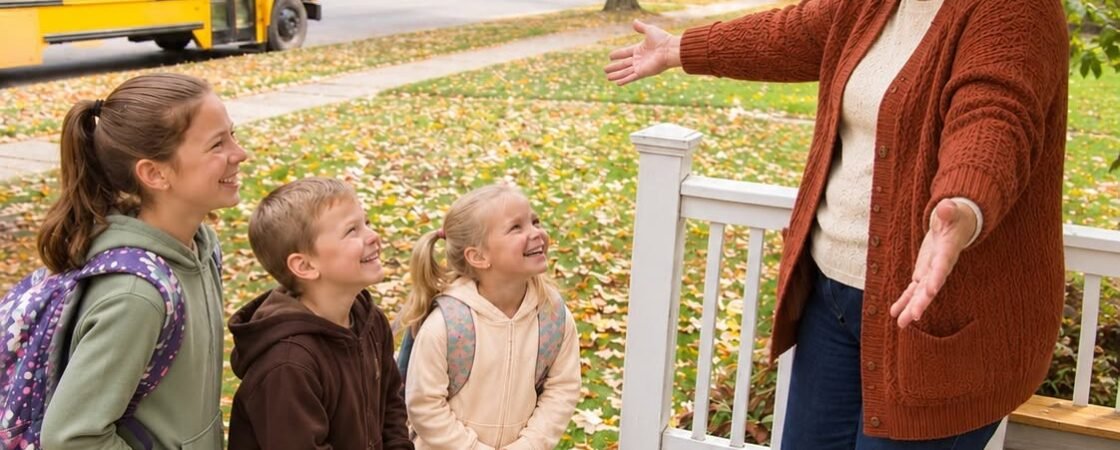
The school bus comes to a noisy stop at the corner of Third Street.
Lily steps off first.
Owen follows, wearing his favorite baseball cap.
Then comes little Gracie, her blonde pigtails bouncing above a bright pink backpack.
I’m always waiting on the porch in my red cardigan, ready to welcome them with open arms.
Three years ago, I lost my daughter, Kelsey, to a brain aneurysm.
She was only thirty-one.
She left behind three young children and a husband who barely knew how to continue without her.
I was fifty-seven then, working as a rural mail carrier.
I’d delivered mail along the same route for twenty-six years.
But when Kelsey died, everything changed.
I retired earlier than planned.
Sold my modest house for $90,000.
And moved into the spare bedroom of my son-in-law Nick’s home.
I immediately used $52,000 from the sale to reduce his mortgage.
I wanted my grandchildren to remain in the house where they’d grown up with their mother.
The remaining money gradually disappeared into everyday necessities.
Groceries.
Winter coats.
School photographs.
Dental appointments.
There were no written agreements.
No contracts.
I never imagined I’d need them.
We were family.
And taking my daughter’s widower to court would have risked losing the three children who were my last living connection to Kelsey.
So I focused on caring for them.
I prepared their school lunches.
Stayed awake with Owen when he suffered from croup.
Memorized every song little Gracie wanted me to sing.
Nick worked extra shifts.
Sometimes, late at night, I heard him crying alone in the garage.
I understood his grief.
I never blamed him for struggling.
Then, last winter, he met Ashley.
She was thirty, worked as a dental receptionist, and had a gentle manner.
The children seemed comfortable around her.
I liked her, too.
They married in June.
Two weeks after the wedding, Nick asked me to sit with him at the kitchen table.
“Roxanne, I think you should start looking for somewhere else to live.”
I listened quietly.
Then I asked what would happen to the money I’d put into his mortgage.
He stared at the table.
“That money covered your rent. You lived here for almost three years.”
Rent.
That’s what he called it.
Three years of helping raise his children.
Three years of sacrificing my retirement and spending the proceeds from my house.
I didn’t argue with him.
And I waited until I was alone before allowing myself to cry.
I don’t believe Nick was naturally unkind.
He’d lost his wife and wanted to begin another chapter.
He wanted the children to accept Ashley as their new mother.
And perhaps having me around reminded everyone too much of Kelsey.
So I found a small rental on Third Street.
It cost $650 a month.
I chose that particular place for one simple reason.
The school bus stopped just down the street.
Nick and Ashley both worked until after five.
Someone needed to look after the children when school ended.
I offered to have them come to my place.
Nick completed the bus paperwork the following week.
Since then, every school afternoon at 3:40, my grandchildren have climbed my porch steps.
We sit together at the kitchen table while they finish their homework.
I prepare apple slices with peanut butter.
We talk about school and whatever happened that day.
At 5:45, Nick arrives to collect them.
He never comes inside.
Ashley has never picked them up herself.
I assumed Nick had told her his own version of why I’d moved out.
Then came an October afternoon when the maple trees along Third Street had turned brilliant orange.
The bus stopped at the corner.
The children climbed down.
But Lily didn’t rush into my arms as usual.
Instead, she paused on the top porch step and removed her backpack.
“Grandma, Ashley gave me something for you.”
Behind her, Owen and Gracie became unusually quiet.
Lily opened the small front pocket of her bag.
“She told me to give it to you before we started anything else.”
I watched as she reached inside.
Then she looked up at me.
“Ashley said you’d understand what it means.”
She handed me a cream-colored envelope.
My name was written on the front.
Not Grandma.
Not Mrs. Brennan.
Just:
Roxanne.
The handwriting belonged to Ashley.
“Did she tell you what was inside?” I asked.
Lily shook her head.
“She said it was grown-up stuff.”
That answer immediately bothered me.
“Did she ask you to keep this secret from your dad?”
“No.”
“Good.”
I touched Lily’s cheek.
“You didn’t do anything wrong, sweetheart. Go wash your hands. There are cinnamon crackers in the cupboard.”
Owen perked up.
“With frosting?”
“Not on a school day.”
“That seems unfair.”
“File a complaint.”
He hurried inside with Gracie following.
Lily stayed.
“Are you okay?”
That was Kelsey’s expression.
The exact tilt of her head.
The same little crease between the eyebrows.
Sometimes grief is not a memory.
Sometimes it is a nine-year-old girl standing on your porch.
“I’m fine.”
She studied me with the skepticism of a child who had learned too early that adults sometimes said fine when they meant absolutely nothing of the sort.
Then she went inside.
I sat in the kitchen and opened Ashley’s envelope.
The first thing inside was a photocopied page from a spiral notebook.
I recognized Nick’s handwriting immediately.
There was a date at the top.
March 18.
Two years earlier.
Almost exactly one year after Kelsey died.
I began reading.
Kelsey,
Your mom saved us again today.
I almost stopped.
But I couldn’t.
The writing continued.
The mortgage principal is finally low enough that I can breathe. Roxanne used $52,000 from selling her place. She keeps saying she doesn’t need anything in return except for the kids to stay in their home.
I don’t know how I can ever repay that.
I told her this would always be her home too.
She shouldn’t have had to give up everything because I couldn’t figure out how to stand up after losing you.
I put one hand over my mouth.
For four months, I had been trying not to remember the conversation when Nick called my money rent.
Now, in his own handwriting, from two years earlier, was the truth.
He had known exactly what the money was.
Help.
A sacrifice.
Something he didn’t know how to repay.
And he’d promised—if only privately—that the house would remain my home too.
There was another page.
This one wasn’t Nick’s handwriting.
It was Ashley’s.
Roxanne,
I found the notebook in a storage box while looking for the children’s winter clothes.
Nick told me you chose to move because you wanted your own place again.
He told me the money you gave toward the house had basically covered living expenses while you stayed there.
I believed him.
Then Lily asked me last week why her father had made Grandma leave after Grandma helped save the house.
I didn’t know what she meant.
So I started asking questions.
Nick avoided them.
Today I found this.
I am sorry I sent it through Lily. I didn’t know how else to reach you without Nick noticing before I had a chance to understand what happened.
Please don’t discuss this with the children.
I won’t either.
But I would like to speak with you.
Alone.
If you are willing, meet me tomorrow at four at Bell’s Diner.
Ashley
I read it twice.
Then a third time.
I wasn’t angry with Ashley.
Not yet.
Mostly I felt embarrassed.
There is a particular humiliation in discovering that someone else has uncovered the thing you have been trying to endure quietly.
I folded the papers.
Then something slid from the envelope.
A photograph.
Nick and Kelsey.
They were sitting on the back steps of the house.
Owen was a baby in Nick’s arms.
Lily, barely three, stood between her parents holding a bubble wand.
Kelsey was laughing.
I remembered taking the picture.
On the back, Nick had written:
Everything worth protecting is in this picture.
I closed my eyes.
“Grandma?”
I quickly wiped my face.
Gracie stood in the doorway.
She held a cinnamon cracker.
She had somehow acquired frosting despite my ruling.
“Yes, sweetheart?”
“Lily says you’re crying.”
“Lily notices too much.”
“She says that means she’s observant.”
“That sounds like Lily.”
Gracie climbed into my lap.
At six years old, she still fit there, though not as easily as she once had.
“Are you sad?”
“A little.”
“Because of Mommy?”
Children rarely circle grief politely.
They walk straight through the center.
“Partly.”
She leaned against me.
“I miss her sometimes even when I don’t remember things.”
My throat tightened.
Gracie had been only three when Kelsey died.
“What do you mean?”
“I remember how she smelled.”
I kissed the top of her head.
“What did she smell like?”
“Yellow.”
I smiled through tears.
“That doesn’t make any sense.”
“It does to me.”
And that was enough.
At 5:45 exactly, headlights crossed the front window.
Nick’s truck.
As always, he stopped by the curb rather than the driveway.
The children gathered their bags.
Lily hugged me longest.
When she pulled away, she whispered, “Did you understand?”
I glanced toward the envelope.
“Yes.”
“Is Ashley in trouble?”
“No.”
“Dad?”
I crouched until we were eye to eye.
“This is grown-up business. You don’t need to carry it.”
Her expression became serious.
“But everybody keeps having grown-up business, and then we have to move around because of it.”
The sentence cut straight through me.
“You’re right.”
I touched her shoulder.
“And that’s exactly why you don’t have to fix any of this.”
She nodded uncertainly.
Then ran outside.
Nick remained behind the steering wheel.
He raised one hand.
I did the same.
That was our relationship now.
A wave through glass.
Once, we had sat together at two in the morning while Gracie burned with fever.
Once, he had fallen asleep at my kitchen table after Kelsey’s funeral while I covered him with a blanket.
Once, he’d called me Mom by accident and then cried because he’d realized I was the only mother left in his life.
Now he wouldn’t walk up my three porch steps.
I watched his truck disappear.
Then I called Bell’s Diner.
“Do you have a quiet booth around four tomorrow?”
The waitress laughed.
“Honey, at four, they’re all quiet.”
“Perfect.”
The next afternoon, Ashley was already there when I arrived.
She stood quickly.
“Roxanne.”
“Hello.”
She looked nervous.
That softened me despite myself.
Ashley wasn’t dressed for drama.
She still wore her pale-blue dental office scrubs beneath a cardigan.
Her hair was pulled back.
A paper cup of coffee sat untouched before her.
“Thank you for coming.”
I sat across from her.
“You shouldn’t have used Lily.”
“I know.”
She looked genuinely ashamed.
“I realized that five minutes after she got on the bus. I was afraid if I called you from my phone, Nick would see. Then I thought about leaving it in your mailbox, but—”
“Ashley.”
She stopped.
“Don’t use them again.”
“I won’t.”
I nodded.
“Now tell me what you found.”
She opened a folder.
Inside were copies.
Mortgage statements.
Bank records.
Pages from Nick’s notebook.
Nothing stolen, she explained.
All had been in an old filing box in the garage she was organizing with Nick’s permission.
“You knew about the fifty-two thousand?” I asked.
“Not really.”
“What did he tell you?”
“That you contributed to the household after Kelsey died.”
“That’s an interesting way to put it.”
“I know that now.”
She looked down.
“He said you sold your house because you wanted to retire and live with family. He said most of the money went toward your expenses and some went to the mortgage.”
“Fifty-two thousand went directly to the mortgage.”
“I know.”
“On the first week I lived there.”
Her face tightened.
“I know that too.”
I waited.
“Why does this matter to you?”
Ashley looked up.
“Because I think Nick made you leave because of something I said.”
I hadn’t expected that.
“What did you say?”
“After the wedding, I told him I was struggling.”
“With me?”
“With the house.”
She twisted her napkin.
“Everywhere I looked, I felt like I was living in Kelsey’s life.”
I said nothing.
There was no cruelty in her voice.
Only discomfort.
“Her pictures were everywhere. Her mug was still by the coffee maker. Her coat was in the hall closet. The kids talked about her constantly, which they should. You talked about her too.”
“I did.”
“I know.”
Ashley looked embarrassed.
“I wasn’t jealous of a dead woman, Roxanne. At least I don’t think I was.”
“That sounds like something a person says when they’re afraid they were.”
She gave a small, sad smile.
“Maybe.”
She continued.
“I told Nick I needed to figure out how to be part of the family without feeling like I was replacing Kelsey or borrowing her life.”
“And he decided I was the problem.”
“Yes.”
“Did you ask him to make me move?”
“No.”
The answer came immediately.
“Never.”
I believed her.
“He told me afterward that you’d been talking about getting your own place anyway.”
“I hadn’t.”
“I know.”
“He told me you wanted more independence.”
“I wanted a shelf in the refrigerator nobody put juice boxes on.”
Ashley almost laughed.
Then her eyes filled.
“I’m sorry.”
“You didn’t put me out.”
“No.”
“But you benefited from it.”
She nodded.
“Yes.”
That honesty mattered.
I sat back.
“Why are you telling me this now?”
“Because there’s more.”
Of course there was.
Ashley opened the folder again.
She removed a bank statement.
“What is that?”
“Nick refinanced the house last November.”
“I didn’t know.”
“He took out some equity.”
My stomach tightened.
“How much?”
“Thirty-eight thousand.”
I stared at her.
The money I had put into that mortgage had created breathing room.
Equity.
Security.
“What did he use it for?”
“Some went to credit card debt.”
“And the rest?”
“Our wedding.”
The diner seemed suddenly too warm.
Ashley quickly added, “I didn’t know where the money came from. He told me he’d been saving.”
I looked toward the window.
Cars passed.
A waitress poured coffee two booths away.
Normal life again.
Always normal life around the worst sentences.
“How much was the wedding?”
“About eleven thousand.”
I closed my eyes.
Not extravagant by modern standards.
Still.
Eleven thousand dollars drawn from a house I’d helped preserve for Kelsey’s children.
Ashley reached across the table but stopped before touching my hand.
“There is one more page.”
I almost didn’t want it.
She slid a photocopy toward me.
Another entry from Nick’s notebook.
This one was dated shortly before his wedding.
I read:
I know Roxanne’s money was never rent.
If I call it what it really was, then I owe her something I can’t afford.
Not just money.
A place.
A voice.
Maybe forever.
Ashley wants us to make the house ours.
I want that too.
I don’t know how to start a new life without admitting that most of what makes it possible came from people who belonged to the old one.
My eyes remained on the final line.
There it was.
Not hatred.
Not greed exactly.
Fear.
Shame.
Convenience.
A man who wanted a clean beginning and had discovered the past couldn’t be scrubbed out without taking people with it.
Ashley whispered, “There’s another sentence on the next page.”
I looked up.
“What?”
She slid the final copy toward me.
Nick had written:
If Roxanne ever sees this, she’ll know the worst part.
I frowned.
“What worst part?”
Ashley didn’t answer.
She pointed.
I read the next sentence.
I told her the money was rent because I knew if I told her the real reason I needed her gone, she’d never forgive me.
I stared at the page.
Then at Ashley.
“What real reason?”
She shook her head.
“I don’t know.”
And for the first time since leaving my daughter’s house, I wondered whether Nick had pushed me out for reasons that had very little to do with Ashley at all.
-END OF Chapter 1–