Kristy read the first line of the second paper, and the gate remote slipped from her fingers and hit the dirt with a crack. “Kristy,” the paper said, “if you are reading this, you have changed the code on the gate.” It was a letter from her father, addressed to her, in his square handwriting. She put both hands over her face. Brett bent to pick up the remote, and Amos put one boot on it, quite politely, and Brett straightened up without it. The sun was warm on the back of my neck.
Amos handed the letter to me, and I read it aloud at the open end of that gate in the late sun. “Kristy, my girl. I know the best of you, which is more than your husband knows. I think you love your mother and are afraid of being poor. I should have told you plainly what we have.
The ranch is clear of debt. There is no bank note and no lien. A trust holds it, and your mother is the trustee for life. If Brett has told her otherwise, he is lying, and you should ask him why.”
The face of Brett went the color of old tallow. “Kristy, he was sick when he wrote that,” he said. Amos produced a folder from his truck and laid it on the hood: the bank statements, with the note paid in full in 2019, the last page showing a balance of zero. “Ask your husband where he got the idea of debts,” Amos said mildly. Brett opened his mouth and closed it again. The man who had told me the ranch was drowning had never once checked, because he never wanted to learn that it was not.
Russ had kept one dollar and one promise, and between the two he had saved a ranch.
The letter went on. “Kristy, I have left you something that Brett cannot touch. The house in Sheridan, in your name alone, and thirty thousand dollars at First Interstate. Your mother has the ranch for her life. After her, it goes to a land trust to be kept as ranch land forever. You may live on it, work it, and lease the south pasture, if you earn the right. I mean work, not paper. I believe you are strong enough. Your father.” Kristy was crying so hard she could not stand, and she sat down on the dirt in her good jeans.
Amos took out the last page. “The trust has one more clause,” he said. “If any beneficiary or spouse tries to force a power of attorney on Dolores, or lock her away from her own land, that beneficiary forfeits all claim until the trustee restores it.
Brett, you tried to force the power of attorney. I have the letter from your lawyer, and so does the lawyer of Russ.” Brett stared at the paper. “Which means,” said Amos, quietly, “that your wife loses her share, because you took it from her. I am sorry, Kristy.”
Kristy turned on her husband from the dirt. “You told me the debts would take the place by spring,” she said. “You told me Mom was confused. I watched you walk the fence with a tape measure.” Brett said, “Kris, I only wanted to protect us.” “Take the Tahoe and go,” she said. “And leave the saddle.” He stood there a moment, and I saw him look from her face to mine and understand that he had lost.
He took the saddle out of the back and set it on the fence, and he drove away that evening with one bag.
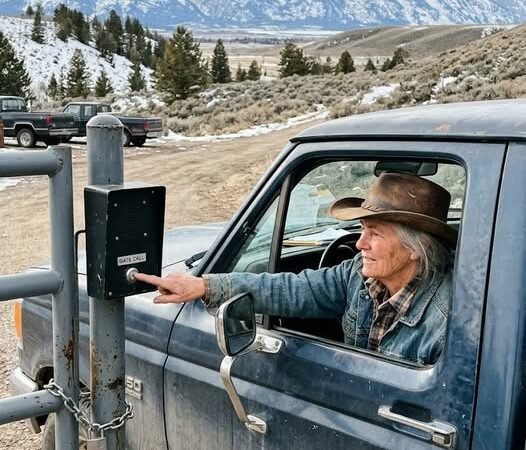
Kristy knelt before me in the dirt. “Mama, I am so sorry.” I lifted her up by her elbows. “Your father was right, honey. You are not a bad girl. You were afraid.” I reached through the bars, past the speaker box, and punched the old code into the keypad by hand. Our wedding date. The light turned green, and the gate swung wide. “Amos, you will stay for supper,” I said. He said he had never turned down a meal after a fence. We ate fried eggs, from the dozen that had warmed on the seat of my truck all day, and they tasted fine.
At four thirty the next morning I rapped on her old bedroom door. “Calving,” I said. “Mama, it is April,” she groaned.
“Yes. And we have a hundred and twelve heifers due.” She worked twenty hours in the mud that day. A late snow came in after supper, and she and Amos pulled a breech calf in the barn by lantern light, and when that calf finally stood up on its wobbling legs and took its first breath of cold air, my daughter laughed and cried at the same time and said, “Mama, I did not know.” I told her nobody does until they see it.
Brett never came back. The lawyer of Russ filed a report about the attempted power of attorney, and the state looked into it, and I heard he lost his job in Billings. Kristy filed for divorce in June. She stayed at the ranch, in her old room, and she carried the saddle back to the barn herself.
She said it was heavier than she remembered, and I told her that was how you knew it was worth carrying.
In the fall, after five months of work, I restored her to the trust. The lawyer came out in his truck with a pen. We branded a hundred and forty calves that October, her first, with Amos on the fire and a whole neighborhood of people at the fence. The gate remote hangs on a nail in the barn now. The code is still our wedding date. And over the entrance, Kristy painted a new sign, white on green: KINCAID RANCH. ALL WELCOME. She learned in one spring what her father spent a lifetime teaching. Land is not a number. It is a promise you keep every morning at four thirty. I like to stand at that fence at sunset and listen to the cattle settle.