Part 4 of 5
June didn’t seem surprised to see me again.
She opened the door and said, “Kevin told you.”
“Not enough.”
She stepped aside.
This time there was only one coffee cup on the kitchen table.
I noticed that too.
“What happened the night Marianne left?”
June sat.
“It depends who you ask.”
“I’ve spent twenty years hearing only the things Earl was willing to tell me.”
“And now?”
“Now I’d like the things nobody wanted to.”
June looked toward the cedar trees.
“It wasn’t one event.”
That disappointed me at first.
Secrets train you to expect a single dramatic moment.
A slammed door.
A betrayal.
A discovery.
Real families are rarely that tidy.
June explained.
In 1987, Earl was thirty-eight.
The farm was struggling after two poor seasons.
Interest rates had hurt them.
Equipment needed repair.
Clyde’s health was declining.
Earl worked from before sunrise until dark.
Marianne worked evenings at a nursing home.
Kevin moved between two exhausted parents.
“They weren’t cruel to each other,” June said. “That would’ve almost been easier to recognize.”
“What were they?”
“Absent.”
The marriage thinned gradually.
Meals eaten separately.
Conversations limited to bills.
Promises postponed.
Then Marianne was offered a full-time nursing position in Missouri near relatives.
She wanted to take it.
Earl refused to leave the farm.
“Did he forbid Kevin from going?”
“No.”
June paused.
“But Kevin heard something he wasn’t supposed to hear.”
One night, Marianne told Earl she would leave with or without him.
Earl, exhausted and frightened, said something careless.
“What?”
June looked at me.
“He said, ‘If Kevin wants to go, let him.’”
I closed my eyes.
I could hear Earl saying it.
Not because he didn’t care.
Because he was angry.
Because he believed there would be another conversation tomorrow.
But fourteen-year-olds do not hear temporary anger as temporary.
Kevin heard rejection.
“He was standing in the hallway,” June said.
“Did Earl know?”
“Not until years later.”
“What happened?”
“Marianne packed that night.”
“And took Kevin.”
“Yes.”
“Did Earl try to stop them?”
“He woke the next morning and they were gone.”
I thought of Earl’s letter.
A fourteen-year-old boy had reasons for wanting to leave me.
“Where does the tractor fit?”
“Clyde tried to fix it.”
Of course he did.
The old man visited Missouri twice.
He reminded Kevin that the Farmall would someday be his.
To Clyde, it meant belonging.
A promise that Kevin still had a place on the farm.
To Kevin, it became something else.
Proof that at least one person expected him to return.
“That tractor wasn’t just a tractor to either of them,” June said. “That’s the problem.”
I understood.
For Earl, it represented a son he hoped would come home.
For Kevin, a grandfather who had promised he still belonged.
Neither one could surrender it without believing they were surrendering something larger.
“They wasted thirty-nine years arguing over the symbol,” I said.
June smiled sadly.
“Families are very talented at that.”
I stayed almost two hours.
There were no affairs.
No secret crimes.
No hidden fortunes.
Just ordinary human failures preserved by silence until they hardened into mythology.
Before leaving, I asked June why she had stayed away from Earl.
“Because Marianne asked me to.”
“Even after Marianne died?”
“By then Earl and I had both become comfortable blaming each other.”
“You never thought Kevin needed somebody to stop that?”
June’s eyes filled.
“Every year.”
“Then why didn’t you?”
She gave me an answer I understood too well.
“Because every year it became harder to explain why I hadn’t done it the year before.”
On the drive home, I thought about all the damage people could do without intending to.
Not through hatred.
Through delay.
Through pride.
Through assuming tomorrow would be more convenient for honesty.
Kevin’s truck was parked at our house.
He was sitting on the front steps.
“I talked to Doyle,” he said.
“And?”
“I withdrew the consignment.”
“He allowed it?”
“Caleb agreed to cancel the sale.”
Relief moved through me.
“What about the five thousand dollars?”
“Never changed hands.”
“Fees?”
“I owe Doyle four hundred and eighty dollars.”
“Can you afford that?”
“No.”
He almost smiled.
“But I’m going to.”
I sat beside him.
For a while we watched swallows move beneath the barn roof.
“I talked to June.”
Kevin nodded.
“I figured.”
“I know what you heard.”
His jaw tightened.
“Dad saying I could leave.”
“Yes.”
“He meant it.”
“You were fourteen.”
“I had ears.”
“I didn’t say you imagined it.”
Kevin looked at me.
“Then what are you saying?”
“That one sentence can be true and still not mean everything you thought it meant.”
He turned away.
“That sounds like something June would say.”
“It’s something I learned from being married to your father.”
That earned a reluctant laugh.
I continued.
“He shouldn’t have said it.”
“No.”
“And he should’ve come after you.”
“Yes.”
“He knows that.”
Kevin rubbed his palms together.
“Knowing it thirty-nine years later doesn’t change being fourteen.”
“No.”
He looked surprised that I agreed.
I wasn’t there to repair his childhood.
I couldn’t.
Neither could Earl.
But perhaps the point wasn’t repairing the past.
Perhaps it was stopping the past from collecting new years.
“When are you going back to the hospital?” I asked.
“Tomorrow.”
“Good.”
Kevin nodded.
Then he looked toward the equipment shed.
“Caleb’s bringing the tractor home tonight.”
“Tonight?”
“Doyle released it.”
Around six, we heard the diesel engine of Caleb’s truck.
A trailer followed behind.
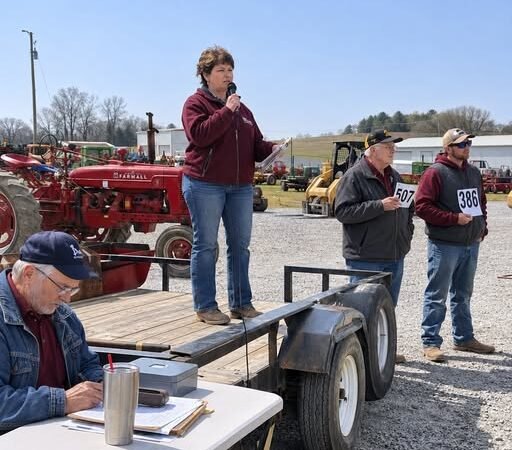
And on it, glowing red beneath the evening sun, sat Earl’s Farmall.
Kevin and I stood together as Caleb backed the trailer toward the shed.
Nobody said much.
Caleb lowered the ramps.
Kevin climbed onto the tractor.
For a second, his hands rested on the steering wheel.
I wondered if he was remembering being fourteen.
Then he put the transmission in neutral and let Caleb guide it slowly backward.
When the tires touched our gravel, Kevin stopped.
“Darlene.”
“What?”
“You want to put it in the shed?”
“I don’t drive tractors.”
“You’ve lived on a farm nineteen years.”
“I didn’t say I couldn’t.”
Caleb laughed.
“Get up there.”
So I did.
The seat was hard.
The steering wheel larger than I expected.
Kevin showed me the controls.
Then the Farmall started.
That familiar uneven rumble filled the yard.
I had heard Earl start it a hundred times.
But from the seat, the sound moved through my whole body.
Kevin stepped onto the drawbar.
“Easy on the clutch.”
“I know what a clutch does.”
“Dad said you hated this tractor.”
“I hated waiting behind it in parades.”
“Different thing.”
I eased the Farmall toward the shed.
Caleb walked beside us.
Kevin held the fender.
For perhaps twenty yards, everything felt strangely peaceful.
Then Kevin shouted.
“Stop.”
I pushed in the clutch.
“What?”
He jumped down.
“What is that?”
He pointed beneath the left side of the seat.
Something metallic was wedged against the frame.
Caleb crouched.
“Looks like a box.”
It was small.
Flat.
Painted black.
Earl must have installed it during the restoration because the bolts were newer than the surrounding metal.
Kevin fetched tools.
We removed it.
Inside was a key.
Just a key.
No note.
No label.
“What’s it for?” I asked.
Kevin shook his head.
Caleb turned it over in his palm.
“Safety-deposit key.”
I stared at him.
“How do you know?”
“Had one just like it for thirty years.”
Stamped into the metal was a number.
Kevin looked at me.
“Did Dad have a bank box?”
“Not that I knew of.”
Caleb handed me the key.
“Looks like Earl had one more thing he planned to tell you.”
The next morning, I showed the key to Earl.
His reaction answered the question.
He knew exactly what it was.
“Bank?” I asked.
He nodded.
“Which one?”
With his left hand, he wrote:
FIRST COUNTY.
Kevin stood beside the window.
“What’s in box 317?”
Earl looked at him.
Then at me.
He began writing.
The words were shaky.
YOUR MOTHER’S THINGS.
Kevin went completely still.
“My mother’s?”
Earl nodded.
“I thought everything she had was gone.”
Earl shook his head.
Kevin’s voice dropped.
“What things?”
Earl wrote again.
LETTERS.
“To who?”
Earl looked at Kevin for a long time.
Then wrote:
YOU.
Kevin stared at the page.
“She wrote letters to me?”
Earl nodded.
“And you kept them?”
Another nod.
Kevin backed away.
“How many?”
Earl wrote a number.
Kevin’s face drained of color.
“My mother died twenty-one years ago.”
Earl closed his eyes.
Kevin’s voice trembled.
“You’ve had twenty-seven letters from her all this time?”
Earl opened his eyes.
Tears filled them.
He wrote one final sentence.
SHE ASKED ME TO WAIT.
Kevin stared at him.
“Wait for what?”
But Earl had exhausted himself.
His hand dropped.
And neither Kevin nor I yet understood that whatever Marianne had placed inside box 317 had been waiting longer than any of us knew.
-END OF Chapter 4–