Part 3 of 5
The seed cabinet had not held seed in fifteen years.
It stood in the back corner of the barn beneath shelves of oil filters, rusted chains and coffee cans filled with bolts.
Earl never threw away a useful container.
Or an almost useful container.
Or, in several cases, objects whose usefulness remained purely theoretical.
Under different circumstances, I would have smiled.
Instead I stood beneath the buzzing fluorescent light, staring at the cabinet door.
Before Kevin does.
Earl had known exactly what he was saying.
I opened it.
Work gloves.
A grease gun.
Two rolls of electrical tape.
A mouse-chewed tractor manual.
No blue folder.
I removed everything.
Nothing.
Then I noticed four screws holding a thin plywood panel against the back.
The upper-right screw was loose.
Behind the panel was a manila envelope and a blue plastic folder.
I took both into the house.
The folder contained bank statements.
Loan documents.
Receipts.
And a photocopy of Kevin’s signature.
My first thought was that Kevin had borrowed money from Earl.
Then I saw Earl’s signature.
GUARANTOR.
I sat at the kitchen table.
Three years earlier, Kevin had borrowed forty-eight thousand dollars to purchase equipment for a small excavation business.
Earl had guaranteed part of the loan.
I hadn’t known.
The balance had fallen to a little over eighteen thousand.
Then Kevin lost two major contracts.
Payments became irregular.
The most recent letter warned that the account was delinquent.
I felt betrayed.
Not because Earl had helped his son.
I would have understood that.
What hurt was that he had hidden it.
We had always said financial decisions belonged to both of us.
Not because we needed permission from each other, but because secrets had a way of collecting interest.
Earl had apparently been paying plenty of that.
The manila envelope contained something stranger.
An unsigned bill of sale.
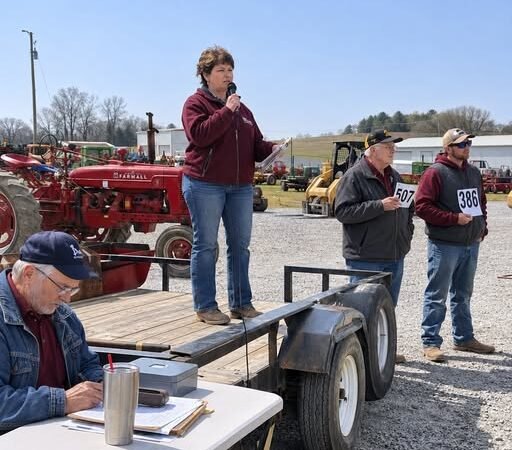
1948 FARMALL M.
Sale price: $1.
Seller: Earl Whitaker.
Buyer: Kevin Whitaker.
I stared at it.
Then I understood.
Earl had intended to give Kevin the tractor.
But the document had never been signed.
On the back, Earl had written:
After Labor Day. If we can finally have the conversation.
I heard a vehicle outside.
A truck door slammed.
Kevin.
I put the folder on the table.
For one moment, I considered hiding it again.
Then I stopped myself.
Too many people in this family had hidden too many things.
Kevin knocked once and entered.
He looked exhausted.
His baseball cap was pulled low.
“Hospital called me.”
“Your father’s awake.”
“I know.”
He glanced at the folder.
His face changed.
“You found it.”
“You knew about this?”
He closed the door.
“Some of it.”
“How much?”
“The loan.”
“You knew Earl guaranteed it?”
Kevin laughed once without humor.
“Considering I signed the loan, yes.”
“I didn’t.”
His expression softened.
“I thought he told you.”
“No, you didn’t.”
He looked away.
“No.”
“Why did you take the tractor?”
“I told you.”
“You told me you were behind on a payment. That isn’t the whole answer.”
Kevin leaned against the counter.
For once, he didn’t argue.
“I owe twenty-three thousand total. Eighteen on that loan. Another five to suppliers.”
“So you decided to sell somebody else’s property.”
“I thought it was mine.”
“You knew the bill of sale wasn’t signed.”
His head snapped toward me.
“What bill of sale?”
I pushed the paper across the table.
Kevin read it.
His face went pale.
He sat down.
For nearly a minute, he said nothing.
“You never saw this?”
“No.”
“You said half the tractor belonged to you.”
“Because Grandpa promised it.”
“That doesn’t make it yours.”
“I know that.”
“Do you?”
He looked up.
“I know it now.”
The answer was so quiet that some of my anger lost momentum.
“Why now?”
Kevin rubbed both hands over his face.
“Because Dad called me Monday.”
The same Monday Earl visited Caleb.
“What did he say?”
“He wanted me to come over.”
“Did you?”
“No.”
“Why?”
“Because we argued.”
Of course.
“What about?”
“He asked about the loan. I told him I could handle it. He said he’d heard that before.”
Kevin stared at the floor.
“I told him he had never trusted me.”
“What did Earl say?”
“He said trust wasn’t the same as cleaning up after somebody.”
That sounded exactly like Earl.
Kevin continued.
“I told him maybe if he’d kept one promise in his life, I’d know what trust looked like.”
“The tractor.”
“He knew what I meant.”
“And?”
“He got quiet.”
Kevin’s voice changed.
“He said, ‘Come over Sunday. We’ll settle the M once and for all.’”
Sunday.
The auction had been Saturday.
“You thought he meant he was giving it to you.”
“Yes.”
“But then he had the stroke.”
Kevin nodded.
“I went to the hospital. Saw him with all those tubes.”
His eyes reddened.
“The doctor said nobody could promise what would happen.”
“So you took the tractor.”
“My payment was due Friday.”
“You couldn’t wait forty-eight hours?”
“I wasn’t thinking right.”
“That is a convenient excuse.”
“I know.”
There was no defiance in the answer.
That made it harder.
Anger is simple when the other person refuses to see what they have done.
Kevin saw it.
He just couldn’t undo it.
“I told myself Dad would’ve wanted me to save the business,” he said. “I told myself the M was supposed to be mine anyway. I told myself Grandpa had promised it.”
“And every time the truth got inconvenient, you found another version.”
He nodded.
“Yes.”
I had expected resistance.
Instead I found something worse.
Shame.
“Why did you tell me your father would never operate it again?”
Kevin winced.
“Because I was scared.”
“You sounded certain.”
“I was trying to make myself certain.”
He looked toward the window.
“I sat beside him Tuesday night and watched that machine breathe for him. All I could think was that Dad might die before we ever fixed anything.”
His voice broke.
“I’ve been mad at him since I was fourteen, Darlene. Do you know how stupid that feels when you’re fifty-three?”
I didn’t answer.
He wiped his eyes angrily.
“I spent almost forty years waiting for him to admit he chose the farm over me.”
“Did he?”
Kevin looked at me.
“I don’t know anymore.”
The answer surprised us both.
I poured coffee.
Not because coffee would fix anything.
Because in our house, serious conversations had always required something to do with our hands.
Kevin stared at the unsigned bill of sale.
“He was really going to give it to me.”
“Looks that way.”
“After Labor Day.”
“Yes.”
His thumb moved over Earl’s handwriting.
“If we can finally have the conversation.”
Kevin laughed quietly.
“That sounds like him. Even giving away a tractor had to become a homework assignment.”
Despite myself, I smiled.
“He does enjoy conditions.”
Kevin looked at the folder again.
“What else is in there?”
“Loan papers.”
“Anything else?”
“Not that I’ve read.”
We went through it together.
Most of it was ordinary.
Receipts.
Payment records.
Notes Earl had made.
Then Kevin found a sealed envelope tucked behind a bank statement.
His name was written on it.
Kevin stared.
“Open it.”
He hesitated.
“What if Dad meant to give it to me himself?”
“He also told me to find the folder before you did.”
Kevin frowned.
“That sounds less encouraging.”
“Open it.”
Inside were four handwritten pages.
Kevin read the first paragraph silently.
Then stopped.
“What?”
He handed me the letter.
Kevin,
If you’re reading this before I manage to say it aloud, then once again I’ve waited too long.
Your grandfather promised you the M. I spent years telling myself he shouldn’t have made that promise because it tied my hands. Truth is, I was grateful for the excuse to keep the tractor.
I read on.
Earl admitted that the Farmall had become a substitute for things he couldn’t say.
Keeping it allowed him to pretend Kevin would always have a reason to come back.
Restoring it allowed him to revisit the years when Kevin was still a boy following Clyde through the fields.
Then came the part that made Kevin sit down.
I was angry when you left in 1987. I blamed your mother because blaming her was easier than admitting a fourteen-year-old boy had reasons for wanting to leave me.
Kevin pressed his knuckles against his mouth.
I continued reading.
I thought providing for you was the same as knowing you. It wasn’t.
I thought you would understand I loved you because I worked.
You didn’t.
How could you?
Nobody ever taught you how to read silence.
Neither of us spoke.
Then we reached the final paragraph.
The Farmall is yours if you still want it.
But not because Clyde promised it.
And not because you inherited something.
I want to give it to you because I’m tired of using an old tractor as a locked door between us.
Drive it.
Sell it.
Restore it again.
Paint it blue just to irritate me.
But first sit with me one afternoon and tell me what happened in 1987 from your side.
I finally want to hear it.
Kevin put the letter down.
His shoulders shook once.
Then again.
I didn’t touch him.
Some grief asks to be held.
Some asks for room.
After a while, Kevin whispered, “I sold it before he could give it to me.”
“Caleb has it.”
“That doesn’t change what I did.”
“No.”
He nodded.
“I need to make it right.”
“For your father?”
“For everybody.”
He stood.
“I’ll call Doyle.”
“What will you tell him?”
“The truth.”
I studied him.
“That could cost you.”
“I know.”
His phone rang before he reached the door.
He looked at the screen.
“Hospital.”
I stood.
Kevin answered.
“This is Kevin.”
His expression changed almost immediately.
“What happened?”
I came closer.
He listened.
Then he looked at me.
“They want us there.”
My stomach dropped.
“Why?”
Kevin ended the call.
“Dad’s condition changed.”
The drive to the hospital took fifty-two minutes.
It felt like five hours.
When we entered Earl’s room, he was awake.
A doctor stood beside the bed.
The panic inside me eased slightly.
“What happened?”
The doctor explained that Earl had experienced a temporary neurological setback.
His right side was weaker.
His speech had become more difficult.
They were running tests.
“But he’s stable,” the doctor said.
Stable.
I’d discovered hospital language could be both comforting and terrifying.
Kevin approached the bed.
Earl looked at him.
Father and son remained silent.
Kevin pulled the letter from his pocket.
“I read it.”
Earl’s eyes widened slightly.
Kevin sat beside him.
“I’m sorry.”
Earl tried to speak.
Nothing came.
Kevin leaned closer.
“I took the M.”
Earl closed his eyes.
“I thought it was already mine.”
Earl opened them again.
“I was wrong.”
Kevin looked down at his hands.
“I can fix the auction. Caleb hasn’t taken possession. Doyle hasn’t paid me.”
Earl’s left hand moved across the blanket.
Kevin took it.
For perhaps ten seconds, they simply held on.
Then Earl pointed weakly toward the bedside drawer.
I opened it.
Inside was a yellow legal pad.
I gave it to him.
His handwriting was almost unreadable.
Three words appeared.
NOT JUST TRACTOR.
I read them aloud.
Kevin frowned.
“What do you mean?”
Earl wrote again.
It took nearly a minute.
Kevin’s face tightened.
Earl added two more words.
ASK JUNE.
Kevin stood abruptly.
“No.”
Earl looked at him.
“No,” Kevin repeated. “Leave it alone.”
I had never seen fear on Kevin’s face before.
Not anger.
Not embarrassment.
Fear.
“What happened that summer?” I asked.
Kevin backed away from the bed.
“Nothing you need to know.”
Earl struck the legal pad with his hand.
Kevin looked at him.
“You promised.”
Earl wrote one final sentence.
DARLENE DESERVES TRUTH.
Kevin stared at the words.
Then he looked at me.
“The tractor wasn’t the reason I left in 1987.”
“What was?”
He took a breath.
“Ask June why my mother packed our car in the middle of the night.”
-END OF Chapter 3–