Part One — The Secret I Kept for Fifteen Years
“You’re a waste of everything we’ve invested in you.”
My mother said it across a spotless kitchen table two weeks before my sixteenth birthday.
The following morning, two duffel bags were waiting beside the front door.
My father, Richard, sat at the counter drinking coffee and reading the newspaper as though nothing unusual were happening. He pulled $250 from his wallet, placed it between us, and finally looked up.
“You want to work with your hands? Go figure out life without our money, without our support, without us.”
I stared at him.
“You’re kicking me out. I’m fifteen.”
“You’ll be sixteen in two weeks.”
Behind me, my mother Elaine checked her reflection in the hallway mirror.
“Maybe the real world will teach you what we couldn’t.”
My younger sister Megan stood halfway down the stairs crying.
Nobody stopped me.
So I picked up the bags and walked five miles across Indianapolis to my grandfather Harold’s small ranch house.
By the time I reached his porch, my shoulders were burning and my feet were blistered.
Harold opened the door.
He looked at my face.
Then at the bags.
“They finally did it, didn’t they?”
I nodded.
He pulled me inside.
“You listen to me, Noah. You are not a waste. You are not an embarrassment. You’re a good kid with parents who don’t understand what matters.”
That night changed everything.
School had always been difficult for me.
Not because I was stupid.
I simply learned better when I could see something, touch it, take it apart, and understand how it worked.
I loved following electricians around Harold’s construction projects.
I liked tracing circuits.
Finding faults.
Solving problems no exam had ever measured properly.
My parents saw failure.
Harold saw ability.
He helped me finish my education and supported me through an electrical apprenticeship.
By twenty-one, I was working full time.
By thirty, I owned a small commercial electrical company.
Eventually, I employed more than forty people.
My parents barely knew.
Dad never came to the shop.
Mom called once to ask if I’d “finally thought about getting a real degree.”
When I said I loved what I did, she ended the conversation.
Harold never asked me to prove anything.
He simply showed up.
Then, when I was twenty-three, he asked me to sit with him at the kitchen table.
His hands were clasped tighter than usual.
“I need you to keep something between us.”
I waited.
“I have advanced heart disease.”
I stared at him.
“What?”
“The doctors think I have time. Maybe a lot of time if treatment works.”
“Does Dad know?”
“No.”
“Aunt Elaine?”
He laughed softly.
“Your mother isn’t my daughter.”
Right.
I was so shaken I wasn’t thinking straight.
“Does anyone know?”
“My doctors. My attorney. You.”
“Why keep it from everyone?”
His answer came immediately.
“Because if Richard knows I’m dying, he’ll begin visiting my bank account before he visits me.”
I wanted to tell him that was cruel.
Then I remembered being sixteen.
Harold continued.
“I don’t want people changing how they treat me because they think there is an expiration date attached to my money.”
I promised.
For fifteen years, I kept that secret.
I drove him to cardiology appointments.
Rearranged jobs when he had procedures.
Cooked dinners.
Stayed overnight when his balance became poor.
Watched baseball with him when he was too tired to talk.
Meanwhile, my parents visited perhaps once a year.
They never noticed the pill organizer.
Never asked why he had lost weight.
Never wondered why I was always there.
Megan visited more than they did.
But she lived in Oregon by then and had a family of her own.
She didn’t know the diagnosis either.
Harold had been clear.
“You don’t lie if someone asks directly,” he’d told me. “You just don’t volunteer my private medical information.”
So I didn’t.
Three months before he died, he called me into his study.
“They’re going to blame you when I’m gone.”
“For what?”
“For being here.”
I frowned.
He gave me that sad, knowing smile.
“You kept the secret. You showed up when there was nothing to gain.”
Then he changed the subject.
I never understood exactly what he meant.
Until the funeral.
Harold died peacefully at home on a Tuesday morning.
I was there.
His hospice nurse was there.
I held his hand.
When I called my father, he listened to the details, paused, and asked:
“Did he leave instructions about the estate?”
Harold had been dead three hours.
Four days later, Richard and Elaine arrived at the chapel in matching silver BMW SUVs.
Dad wore a charcoal suit.
Mom wore designer sunglasses.
Harold’s former construction workers came in pickups and ordinary sedans.
Men with scarred hands hugged me.
One old foreman cried so hard he had to step outside.
My parents sat in the front row.
At the reception, Dad pulled me aside.
“When is the will meeting?”
“Tomorrow. Nine-thirty.”
“We’ll be there.”
Mom appeared beside him.
“Family should be together for these things.”
Family.
I almost laughed.
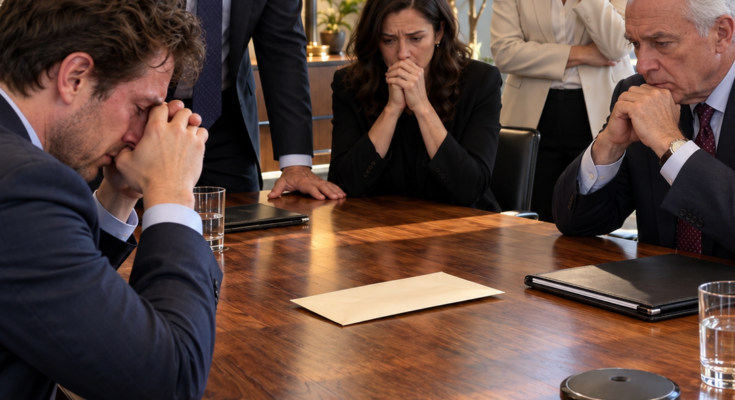
The next morning, we sat around attorney Arthur Reynolds’s conference table.
I sat on one side.
Richard, Elaine, and Megan sat across from me.
Megan looked uncomfortable.
She had barely spoken since arriving.
Arthur opened a thick estate binder.
“Harold Parker’s estate and trust holdings are valued at approximately sixty million dollars.”
Mom’s posture changed instantly.
Dad leaned forward.
Arthur continued.
“Mr. Parker revised his estate plan several times during the last fifteen years. The central distribution instructions remained substantially unchanged.”
Dad frowned.
“What does that mean?”
“It means Harold anticipated that someone might challenge his decisions.”
The room went still.
Arthur read from a letter Harold had instructed him to include with the estate documents.
I have seen who showed up when there was nothing to gain. I have seen who cared for an old man rather than his balance sheet.
Dad interrupted.
“This is ridiculous. I was his son.”
Arthur raised one hand.
“Please allow me to finish.”
Then he looked at me.
He removed a sealed envelope.
My name was written across the front.
Arthur slid it toward me.
“The letter refers to a secret kept for fifteen years.”
Dad looked sharply at me.
Mom stopped breathing.
Arthur continued:
“Harold wrote one sentence beneath your name.”
He read it aloud.
The true heir is the one who kept the secret safe.
Then he looked directly at me.
“Noah, only you understand what that means.”
My hands began shaking.
I opened the envelope.
Inside was a single page.
The first line said:
If you’re reading this, kid, then you finally know why I asked you not to tell them I was dying.
━━━━━━━━━━━━━━━━━━━━
Part Two — What Sixty Million Dollars Actually Meant
I kept reading.
I didn’t ask you to keep my illness private to test your loyalty. I asked because I wanted the final years of my life to belong to me, not to people suddenly performing affection because they could smell an inheritance.
My throat tightened.
Then:
You gave me fifteen ordinary years. Baseball. Burned dinners. Doctor appointments. Arguments about whether I should still climb ladders. You never treated me like a dying man or a bank account. That is the inheritance I received from you.
I stopped.
Arthur waited.
Dad did not.
“So what exactly is he getting?”
Megan whispered:
“Dad.”
“What?”
“He’s reading Grandpa’s letter.”
Richard leaned back, irritated.
Arthur opened the trust summary.
Harold had not simply written “everything to Noah.”
He had planned more carefully than that.
About twenty million dollars remained in a family investment trust.
Ten million was allocated to a charitable foundation supporting trade education, apprenticeships, and housing repairs for elderly homeowners.
Several million went to long-serving employees and key people from Harold’s businesses.
Megan received a substantial trust of her own.
I looked at her.
She immediately shook her head.
“I didn’t know.”
“I know.”
Then Arthur reached the largest provision.
Harold’s controlling business interests, real-estate holdings, and the remainder of his personal trust were left for my benefit through a structured trust, with professional management and safeguards against an immediate liquidation.
The estimated value was tens of millions.
I couldn’t process it.
Dad could.
“What did he leave me?”
Arthur looked at him.
“A specific cash bequest of $100,000.”
Dad stared.
“Out of sixty million?”
“Yes.”
His face turned red.
“I’m his only son.”
Arthur nodded.
“And Harold documented substantial lifetime transfers to you totaling considerably more than that.”
Dad went silent.
I had never known.
Arthur slid a schedule across the table.
Loans.
Business rescues.
A house down payment.
Debt repayments.
Investments.
More than two million dollars over decades.
Most marked by Harold as gifts.
Richard stared at the page.
Mom snapped:
“That has nothing to do with inheritance.”
Arthur answered calmly.
“It has everything to do with understanding Harold’s decisions.”
Dad pointed toward me.
“He manipulated him.”
I almost laughed.
Arthur did not.
“Mr. Parker anticipated that allegation.”
Of course he did.
Harold had arranged independent medical evaluations around major estate revisions.
His attorney had documented private meetings without me present.
His physicians had found him capable of understanding his decisions.
Trust officers had been involved.
There was no deathbed document I’d slipped beneath his hand.
No secret signature obtained while he was confused.
The core plan had been established years earlier.
Dad looked at me.
“You knew.”
“No.”
“You expect me to believe you spent fifteen years with him and never discussed money?”
“We discussed money constantly.”
His eyes narrowed.
“Then you admit it.”
“I helped him pay utility bills online. I argued with him about replacing a twenty-year-old furnace. I told him he tipped waitresses too much.”
Megan almost smiled.
“I never asked what I was getting.”
Dad slammed his palm against the table.
“You stole my inheritance.”
And for the first time in my life, I didn’t feel like the sixteen-year-old boy standing beside two duffel bags.
I just felt tired.
“Dad, Grandpa’s money was never yours.”
Silence.
“He didn’t take sixty million dollars away from you. You never owned it.”
Mom stood.
“This isn’t over.”
Arthur remained perfectly calm.
“You are entitled to consult independent counsel.”
“We’ll contest.”
“That is your right.”
Dad seemed surprised by that.
Maybe he expected a threat.
Arthur continued.
“But before doing so, your attorney should review the estate-planning history, medical-capacity documentation, lifetime gift records, and the no-contest provisions carefully.”
Not magic.
Not revenge.
Just paperwork Harold had spent years putting in order.
Megan reached for her coat.
Mom stared at her.
“Where are you going?”
“Home.”
“You’re just accepting this?”
Megan looked at Dad.
“Grandpa left me more money than I ever expected.”
Then she looked at me.
“And Noah was the one who took care of him.”
Dad said:
“So you’re choosing him?”
Megan’s face crumpled.
“No, Dad. That’s what you’ve never understood. Everything doesn’t have to be choosing one child over another.”
That sentence stayed with me.
Because my parents had made our childhood exactly that.
One child was successful.
One child was disappointing.
One deserved investment.
One deserved consequences.
Harold had refused to play that game.
He hadn’t made Megan poor to make me rich.
He hadn’t left Dad nothing.
He had simply stopped pretending biology created an automatic right to everything he’d built.
━━━━━━━━━━━━━━━━━━━━
Part Three — The Thing Grandpa Actually Left Me
My parents did challenge parts of the estate plan.
The dispute did not end in one dramatic courtroom scene.
Their lawyers requested records.
Arthur produced them.
Experts reviewed Harold’s capacity.
Depositions happened.
Old financial transfers were examined.
Eventually, after months of legal expense and unpleasant family history being reduced to exhibits, my parents withdrew most of their claims and accepted a settlement consistent with the estate plan.
I never celebrated.
Winning a case involving your dead grandfather and your living father does not feel like winning.
For a long time, I couldn’t even touch the money.
My trustee kept asking what I wanted to do.
I kept saying:
“Nothing yet.”
So I went back to work.
That confused everyone.
One employee asked:
“Boss, you’re worth what now?”
“I don’t know.”
“You could quit.”
“I could.”
“Are you?”
“No.”
He shook his head.
“That’s weird.”
Maybe.
But electricity still made sense to me.
A circuit either worked or it didn’t.
People were harder.
Megan and I became closer.
One afternoon, she came to my shop carrying an old cardboard box.
“What is that?”
“Something I’ve had since you left home.”
Inside was one of the duffel bags I’d carried out at fifteen.
I stared at it.
“You kept this?”
“You left one at Grandpa’s later. He gave it to me.”
She sat down.
“I wanted to follow you that morning.”
I looked at her.
“You were thirteen.”
“I know.”
“You couldn’t have fixed it.”
“I still feel like I should have done something.”
I shook my head.
“No.”
She cried anyway.
Then she told me something I had never known.
For years after I left, Mom used me as a warning.
Study or you’ll end up like Noah.
Don’t throw your future away like your brother.
Meanwhile, Megan had been terrified of disappointing them.
She went to the college they chose.
Entered the career they preferred.
Married someone they approved of.
Then, at thirty-five, had a breakdown and changed almost everything.
“Grandpa used to call me too,” she said.
That surprised me.
“He never told me he was sick.”
“He made me promise.”
“I know.”
She smiled sadly.
“But he asked whether I was happy.”
I laughed softly.
“That sounds like him.”
Megan looked around my workshop.
“You know the funny part?”
“What?”
“You were the one they called a failure.”
I waited.
“And you’re the only one who built the life you actually wanted.”
That was worth more than I wanted to admit.
Dad took longer.
Almost three years after Harold died, he appeared at my office without calling.
He looked smaller.
Age had finally caught him.
I met him in the conference room.
He didn’t sit at first.
“I found something.”
He placed an envelope on the table.
Harold’s handwriting.
My stomach tightened.
“Where?”
“In a box of papers from my childhood.”
The envelope was addressed to Richard.
Dad had never opened it.
Or maybe he had been afraid to.
He handed it to me.
“You read it.”
“No.”
“Please.”
So I did.
The letter had been written nearly ten years before Harold died.
Richard,
You have spent most of your life believing money is proof of worth. I taught you some of that, and I am sorry.
Dad looked away.
I continued.
When Noah struggled in school, you saw embarrassment instead of a child asking to be understood. When he chose a trade, you treated your disappointment as permission to withdraw love.
My voice shook.
Dad whispered:
“Keep going.”
I helped him because someone needed to. But do not confuse my helping him with why I respect him now. He earned that himself.
Then came the line that broke my father.
You threw your son out to teach him independence. He learned it. What you never learned was how to remain his father after he no longer needed you.
Dad sat down.
For several minutes he said nothing.
Then:
“I thought I was making you stronger.”
I looked at him.
“No. You thought hurting me would make me become the person you wanted.”
He nodded.
“Yes.”
No defense.
That was new.
“I was wrong.”
I waited.
“I don’t expect you to forgive me because Dad left you money.”
“This isn’t about the money.”
“I know.”
His eyes filled.
“I think that’s what took me three years to understand.”
We did not repair twenty-four years that afternoon.
He did not suddenly become Dad again.
But he started calling.
Not asking about the trust.
Not asking about the businesses.
Asking about me.
At first, the calls lasted five minutes.
Then ten.
Sometimes I answered.
Sometimes I didn’t.
He learned not to punish me for either.
Mom never came as far.
Her apologies always seemed to contain an invisible invoice.
She wanted forgiveness to restore access.
I could not give her that.
We remained distant.
That was sad.
It was also honest.
As for Harold’s sixty million dollars, most people assume the dramatic part was inheriting it.
It wasn’t.
The money changed my life, of course.
I expanded apprenticeship programs.
The trade foundation Harold created eventually helped hundreds of young people who were brilliant with their hands but had spent years being told that college was the only respectable proof of intelligence.
I kept my company.
I also bought Harold’s old ranch house from the trust at an independently appraised value rather than treating every family asset as automatically mine.
The front porch still creaks.
I never fixed that.
Some things deserve to sound like memory.
In my study, I keep three objects.
The $250 Dad gave me when he threw me out.
One of the drafting diagrams from my first electrical apprenticeship.
And Harold’s final letter.
At the bottom, after everything about the estate, he had written one more paragraph.
Noah, the secret was never my heart disease.
For years, I had misunderstood that.
Then I read the next line.
The real secret was that I had money. You were the only one close enough to discover both things, and you protected my privacy instead of converting either into an opportunity.
Then:
That’s why I trust you with what comes next. Not because you kept quiet. Because you understood that loving someone does not give you ownership of what they have.
That was the inheritance.
Not sixty million dollars.
Not buildings.
Not investments.
Trust.
When I was fifteen, my parents threw me out because I wasn’t becoming the son they wanted.
Harold opened his door because I was already someone worth letting in.
Twenty-four years later, my father walked into an attorney’s office expecting blood to determine inheritance.
Harold had spent the last fifteen years learning something different.
Family wasn’t the person who arrived when there was money to divide.
It was the person who stayed when there was nothing visible to receive.
And the secret I had protected all those years wasn’t valuable because nobody else knew it.
It was valuable because Harold had trusted me with something that belonged to him—
and I had never once mistaken that trust for ownership.