Part One — The Bottle in Her Purse
I had warned Linda about my shellfish allergy so many times that I could hear myself saying the words in my sleep.
My throat closes.
I carry an EpiPen.
Cross-contamination can send me to the emergency room.
James knew all of it before we ever got serious, and he took it seriously from the beginning.
His mother did not.
Linda rolled her eyes the first time James mentioned it.
“People your age collect allergies for attention.”
Another time she said doctors would diagnose anything if they could bill for it.
When I showed her my medical bracelet and prescription paperwork, she waved them away like I had brought her a coupon instead of proof of a condition that could kill me.
Then the little tests started.
At first, it was a sauce she swore was safe.
After I had eaten two bites, she smiled.
“Maybe there was a little shrimp paste in there.”
I remember the first time because I thought I’d misheard her.
“What?”
She watched my face carefully.
“I’m saying maybe there was. Are you dying?”
My throat began itching.
My lips tingled.
James saw me reach for my medication.
“Mom, what did you put in her food?”
Linda laughed.
“Nothing serious. See? She’s fine.”
James was furious.
I was frightened.
Linda called it helping.
I called it what it felt like.
Being watched while someone waited to see whether my body would prove me worthy of belief.
After that, James stopped letting me eat anything she cooked unless we knew every ingredient.
Then one afternoon he caught her standing near my plate with a spoonful of something she called “seasoning.”
That was the last meal we ate at her house.
Linda told everyone I had forced her son away from his family.
I let people believe what they wanted.
I was tired of making every dinner a courtroom where my medical history was somehow up for debate.
Then came James’s birthday dinner.
It was at a restaurant we’d used before.
The manager knew about my allergy.
The waiter repeated the kitchen notes back to me.
Separate preparation.
No shellfish.
Clean utensils.
I relaxed.
That was my mistake.
Not because I should have been more suspicious.
Because after years of fear, I was exhausted from having to be suspicious at all.
Linda insisted on ordering several appetizers for the table.
I declined everything I wasn’t certain about.
She rolled her eyes but said nothing.
When my pasta arrived, the waiter leaned down.
“Kitchen confirmed again. No shellfish, and they used clean equipment.”
“Thank you.”
I ate.
The first warning was heat under my tongue.
Then tingling.
Then my throat tightened so fast I couldn’t pull in a full breath.
I tried to say James’s name.
Nothing came out properly.
He looked at me.
His chair slammed backward.
He grabbed my purse, pulled out the EpiPen, and used it exactly as we’d practiced while someone at the table called 911.
Linda stood with both hands over her mouth.
“Oh my God.”
James didn’t look at her.
He stayed beside me.
“Stay with me. Ambulance is coming.”
My eyes watered.
My chest tightened.
I could hear chairs moving and people asking questions, but everything sounded far away.
The paramedics arrived quickly.
They treated me and transported me to the hospital.
James rode with me.
At the emergency department, the doctors treated the reaction as anaphylaxis based on the symptoms and known allergy.
No one stood there dramatically declaring exactly how much shellfish I had ingested.
That would require evidence and testing.
What they did say was simple enough.
This had not looked like anxiety.
It had not looked like me “working myself up.”
My body had reacted.
Severely.
While I was being monitored, Linda arrived.
Crying.
“The restaurant must have made a mistake.”
James stared at her.
“You were sitting at our table.”
“So?”
“You’ve done this before.”
Her face changed.
“I have never tried to hurt her.”
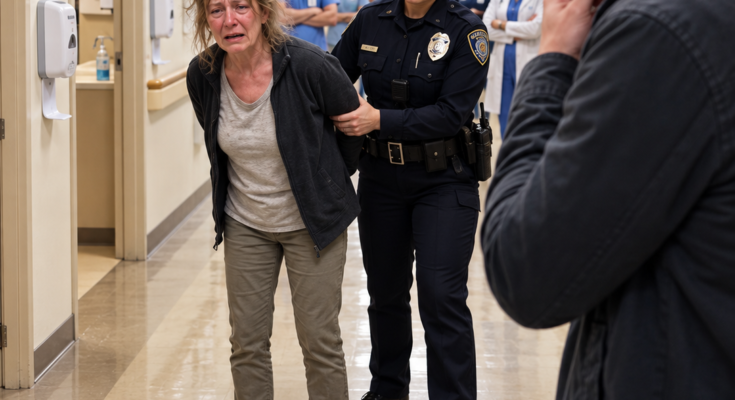
Then the restaurant manager arrived.
He was carrying a sealed evidence bag containing my plate and utensils.
Beside him was a police officer.
The manager looked pale.
He spoke to James first.
“Our kitchen logs show her dish was prepared under the allergy protocol.”
Linda immediately said:
“Then somebody in the kitchen contaminated it.”
The manager looked at her.
“We checked the dining-room cameras.”
Silence.
My stomach dropped.
He continued.
“When Mr. and Mrs. Parker stepped away from the table before the entrées arrived, you remained seated.”
James looked at his mother.
The manager went on.
“The footage appears to show you removing a small bottle from your handbag, adding liquid to her plate, stirring it, and putting the bottle back.”
Linda’s face went white.
The officer asked quietly:
“Mrs. Crawford, do you still have that bag with you?”
Linda grabbed it against her body.
“Why?”
The officer did not reach for it.
He simply said:
“We’d like to speak with you about what happened. You don’t have to answer questions right now, and we’ll handle any search according to proper procedure.”
For the first time that night, Linda looked frightened.
Not offended.
Not angry.
Frightened.
James looked at her.
“Did you put something in her food?”
She began crying harder.
“I just wanted to prove she was exaggerating.”
I closed my eyes.
There it was.
Not an accident.
Not cross-contamination.
Not a kitchen mistake.
A test.
Performed on my body without my consent.
James sat down beside my bed.
He did not scream at his mother.
That somehow made it worse.
“Mom,” he said, “what did you put in her food?”
Linda whispered:
“Shellfish flavoring.”
James stared at her.
“For what?”
“To see if she’d actually react.”
Nobody spoke.
Then he asked one question.
“Did you bring it here for that reason?”
Linda covered her face.
And started sobbing.
━━━━━━━━━━━━━━━━━━━━
Part Two — What “I Didn’t Mean to Kill Her” Actually Meant
The police investigation did not end in the hospital hallway.
The plate was preserved.
The restaurant retained its security footage.
Investigators obtained the bottle through the appropriate legal process.
The contents were analyzed.
The concentration, the video, Linda’s statements, the prior incidents, and the medical records all became part of a case that took months to develop.
What happened legally was not decided by one dramatic accusation.
That mattered to me.
Because I did not want exaggeration.
I had spent too many years being told I exaggerated.
I wanted facts.
The facts were bad enough.
The bottle contained a concentrated shellfish-based flavoring.
The footage showed Linda taking it from her purse and adding it to my food while James and I were away from the table.
It also showed her watching me after I began eating.
That detail disturbed me more than almost anything else.
She wasn’t distracted.
She wasn’t unaware.
She was watching for the result.
Her attorney later argued that she had not intended to kill me.
That may even have been true.
But intent to kill and willingness to risk someone’s life are not the same question.
Linda kept saying:
“I thought she’d take one bite and nothing would happen.”
James eventually answered:
“And what if something did happen?”
She cried.
“I didn’t understand it was that serious.”
He stared at her.
“She told you it was that serious.”
“I thought she was being dramatic.”
“That is not the same as not being told.”
That sentence became the center of everything.
Linda had information.
She rejected it because she preferred her own belief.
Then she turned my body into the experiment.
James struggled badly after that.
Not with whether to believe me.
He did.
With the fact that his mother had done it.
For weeks, he’d wake in the middle of the night and ask:
“What if I hadn’t been looking at you?”
I would say:
“You were.”
“What if the injector had been expired?”
“It wasn’t.”
“What if—”
Finally, one night, I stopped him.
“James.”
He looked at me.
“You saved time by acting quickly. I’m grateful. But you cannot spend the rest of your life trying to relive that dinner until you find a version where your mother made a different choice.”
He started crying.
“I should have cut her off sooner.”
I knew what he meant.
The little tests.
The jokes.
The “maybe there was shrimp paste.”
We had both tolerated things we shouldn’t have because we kept hoping contempt would stop short of real danger.
But I refused to let him take ownership of her decision.
“You set boundaries.”
“Not enough.”
“She crossed them.”
He shook his head.
“I kept thinking she’d eventually understand.”
“So did I.”
That was painful to admit.
Linda had trained both of us to accept escalating behavior because each individual incident could be minimized.
A joke.
A tiny ingredient.
A mistake.
A test.
Until eventually the pattern became impossible to rename.
We stopped all contact.
Not as punishment.
Because I could not safely eat, drink, or relax around her.
James’s relatives reacted exactly as families often do when a private pattern becomes public.
Some believed us immediately.
Some said Linda had always been “difficult” but would never intentionally hurt anyone.
Some asked whether pressing charges was really necessary.
One aunt called James and said:
“She’s your mother.”
James answered:
“And that’s supposed to make what she did safer?”
The aunt never called again.
The restaurant manager checked on me twice.
The waiter sent a card.
Inside he wrote:
You trusted us to keep you safe. I’m sorry someone at your table violated that trust.
I kept that card.
Because for years, Linda had tried to make me feel ashamed of needing accommodation.
The restaurant staff did the opposite.
They did not make me apologize for having a body with limits.
They simply treated those limits as real.
That should not have felt revolutionary.
It did.
━━━━━━━━━━━━━━━━━━━━
Part Three — The First Dinner I Didn’t Have to Defend Myself
The criminal case ended more than a year later.
I won’t turn the courtroom into a revenge fantasy.
There were hearings.
Experts.
Arguments over intent.
The security footage mattered.
The bottle mattered.
My medical records mattered.
Her prior statements and behavior mattered.
Linda eventually entered a plea to serious charges rather than take the case through a full trial.
The sentence included incarceration, probation conditions afterward, and a no-contact order protecting me.
I did not feel triumphant.
Mostly, I felt tired.
The day the case ended, James and I sat in our car outside the courthouse for almost twenty minutes.
Neither of us spoke.
Then he said:
“I thought I’d feel better.”
I looked at him.
“Me too.”
He laughed once.
“What do we do now?”
I answered:
“Go home.”
So we did.
Healing was embarrassingly ordinary.
Therapy.
Refilling my EpiPens.
Replacing the one James had used.
Reviewing restaurant safety without letting fear take over every meal.
Learning to trust kitchens again.
Learning not to scan every table for somebody else’s hands near my plate.
For months, I struggled with food I hadn’t prepared myself.
Even when I knew a restaurant was safe, I’d take the first bite and wait.
Five seconds.
Ten.
Thirty.
Listening to my throat.
James noticed.
He never said:
“Relax.”
He never said:
“Nothing’s going to happen.”
Instead he’d ask:
“Want me to try anything?”
Sometimes yes.
Sometimes no.
Slowly, meals became meals again.
Not tests.
Linda sent letters through her attorney at first.
We declined them.
Months later, after consulting with my therapist, I agreed to read one.
Most of it was what I expected.
Grief.
Shame.
Explanations.
Her belief that she had “lost her son.”
Then near the end, one paragraph stopped me.
I kept calling your allergy anxiety because that allowed me to make myself the reasonable person in every room. If I admitted your allergy was real, then every joke, every test, and every time I dismissed you became cruelty. I did not want to see myself that way. So I made you the liar instead.
I read that paragraph twice.
Then handed the letter to James.
He cried.
I didn’t.
Not then.
The next sentence was harder.
I understand now that saying I did not intend your death does not make what I did safe. I knew you said it could kill you. I decided I knew your body better than you did.
That was the first apology I believed.
Believing it did not mean reopening contact.
Forgiveness, if it came at all, did not require access.
James struggled with that more than I did.
His mother was still his mother.
He had childhood memories that existed alongside what she had done.
Sunday pancakes.
School concerts.
Her sitting beside him through a broken arm.
People expected him either to hate her completely or excuse her because she once loved him.
He did neither.
One night he said:
“I miss the mother I thought I had.”
I understood exactly what he meant.
Missing someone is not evidence they are safe to return to.
Several years later, James and I had his birthday dinner at the same restaurant.
That was his idea.
I almost said no.
Then I realized I wanted to know whether the place could become ordinary again.
The manager still worked there.
He recognized us immediately.
“You sure?”
I smiled.
“Yeah.”
The same waiter no longer worked there, but the allergy protocol remained.
The new server wrote everything down.
Repeated it back.
When my pasta arrived, I stared at it.
James didn’t touch his fork.
“You don’t have to eat it.”
“I know.”
I took one bite.
Nothing happened.
Then another.
Still nothing.
By the fifth bite, I realized I was hungry.
Actually hungry.
Not frightened.
James smiled.
“What?”
“Nothing.”
“James.”
He laughed.
“You’re eating.”
That was when I cried.
Quietly.
Right there over a bowl of pasta.
The manager saw and came over looking alarmed.
“Is something wrong?”
I laughed through tears.
“No.”
For once, no.
Nothing was wrong.
At the end of dinner, the server asked whether we wanted dessert.
James looked at me.
I said:
“Yes.”
No hesitation.
That mattered more than any courtroom outcome.
Linda had spent years telling me my body was unreliable.
That my fear was attention-seeking.
That my allergy was something she had a right to investigate personally.
What she never understood was that the deepest injury wasn’t simply the reaction.
It was the constant demand that I prove danger before anyone respected the boundary.
I don’t do that anymore.
I tell restaurants once.
I carry my medication.
I leave situations that aren’t safe.
And if someone says:
“Are you sure it’s really that serious?”
I don’t pull out medical paperwork.
I don’t explain the emergency-room visits.
I don’t tell the story of Linda.
I simply say:
“Yes.”
The people who respect me accept the answer.
The ones who don’t are giving me useful information.
James and I still celebrate his birthday at that restaurant every few years.
We never sit at the same table.
Not because we’re afraid of it.
Because we don’t need to.
The old table belongs to an old version of our lives.
The woman who sat there waiting for her body to prove itself is gone.
What remains is simpler.
A marriage where no means no.
A medical condition that does not require family approval.
And a husband who understands that protecting me never meant speaking for me.
It meant believing me the first time I spoke.