Part One — The Gold-Star Candle
That morning, Emma came downstairs in purple pajamas and asked:
“Mom, am I officially ten yet?”
I laughed.
“You’ve been officially ten since 6:42 this morning.”
She grinned like turning ten had granted her access to some secret level of adulthood.
For a week, she had been talking about her cake.
Pink frosting.
White sugar flowers.
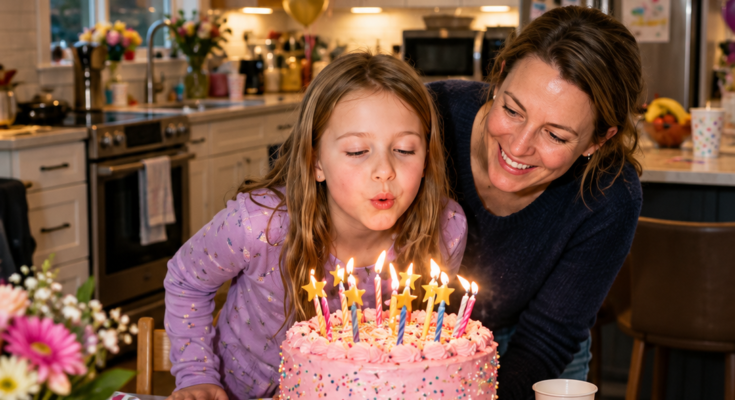
And ten little gold-star candles she had picked herself.
I spent almost four hours making it.
Not because it needed to be perfect.
Because our house had not felt happy in a long time.
My husband, Mark, had become distant.
Money was disappearing into “investments” he refused to explain.
Accounts I used to access freely suddenly required new passwords.
Whenever I asked questions, he said:
“Let me handle the financial stuff.”
His mother had become bolder too.
She had never hidden her disappointment that both of our children were girls.
Emma was ten.
Her younger sister, Lucy, was seven.
My mother-in-law had spent years making comments she insisted were jokes.
“Maybe the next one will carry the family name.”
“Mark needs a son.”
“Girls leave eventually.”
Mark rarely corrected her.
That morning, I wanted none of that.
Just pancakes.
Balloons.
Presents.
A pink cake.
For once, I wanted my daughters to feel that our home existed for them too.
Then my mother-in-law arrived.
Emma ran toward the table the moment everyone finished lunch.
“Can I light them now?”
I reached for the matches.
Before I could touch them, Grandma stepped forward.
“Don’t.”
Emma froze.
“What?”
“Don’t touch that cake.”
The room went strangely quiet.
Emma looked at me.
“Mom?”
I stood.
“What are you doing?”
My mother-in-law stared at the cake as though it offended her.
“All this for a girl’s tenth birthday.”
I thought I had misheard.
“Excuse me?”
She laughed.
“No son. No celebration.”
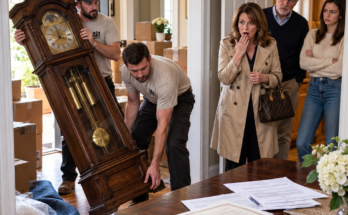
Then she grabbed the cake board.
I saw what she was doing a second too late.
The entire cake hit the hardwood floor.
Pink frosting exploded across the boards.
Sugar flowers disappeared beneath the table.
One gold-star candle rolled across the floor and stopped beside Mark’s shoe.
Emma made a tiny sound.
Not a scream.
Worse.
The sound a child makes when she is trying not to cry in front of adults.
My mother-in-law folded her arms.
“This family needs a grandson to carry the name. Making this kind of fuss over girls is ridiculous.”
Every person in the room looked toward Mark.
I whispered:
“Mark?”
I expected him to be furious.
Expected him to kneel beside his daughter.
Expected something.
Instead, he crossed his arms.
“She’s right.”
Emma looked at me.
I will remember her face until the day I die.
She didn’t ask anything.
She didn’t have to.
Her eyes said:
Mom, are you going to let them do this to me?
Three days earlier, I had already met with a divorce attorney.
Mark did not know.
For months, money had been moving between accounts.
He had refused to explain several new companies that appeared on our tax documents.
I had also found messages between him and his mother.
One read:
Move what you can before Sarah starts asking questions.
Another:
Protect the family assets before she gets ideas.
I had saved screenshots.
But I had not filed.
Part of me kept waiting for proof that the man I married was still somewhere inside the man sitting across from me.
That morning, I got my answer.
I bent down.
Picked up the gold-star candle beside Mark’s shoe.
Wiped pink frosting from it.
Placed it carefully on the counter.
Then I said:
“Okay.”
Mark visibly relaxed.
His mother smiled.
She thought I had surrendered.
Instead, I went upstairs, packed clothes for both girls, took our documents and medication, and left.
Mark followed me into the hall.
“Where are you going?”
“Somewhere Emma can have a birthday without being told she’s worth less because she’s a girl.”
“Sarah, don’t be dramatic.”
Emma heard him.
That was what finally removed any doubt I had left.
I turned.
“You watched your mother deliberately humiliate your daughter.”
“It was cake.”
“No.”
I looked at Emma.
“It wasn’t.”
That evening, the girls and I checked into a hotel downtown.
Lucy fell asleep watching cartoons.
Emma didn’t.
She lay beside me in her purple pajamas, staring at the ceiling.
Finally she whispered:
“Does Dad wish I was a boy?”
My chest tightened.
I turned toward her.
“Your dad is responsible for whatever he believes. You are not responsible for changing yourself to deserve love.”
“Grandma doesn’t like girls.”
“Grandma believes some very wrong things.”
Emma was quiet.
Then:
“Did I do something wrong?”
“No.”
I said it immediately.
“No, sweetheart. Your birthday was not wrong. Your cake was not wrong. Being excited was not wrong. And being a girl is definitely not wrong.”
She nodded.
A few minutes later, she fell asleep.
I opened my laptop.
The divorce petition was still in the folder my attorney had emailed me.
Before I could finish reading it, another message appeared.
From my accountant.
URGENT — Please call me before speaking with Mark. We found a transfer document involving the commercial property interests.
There was an attachment.
I opened it.
The document purported to transfer my ownership interest in two properties into an LLC connected to Mark.
At the bottom was my name.
And a signature.
I stared at it.
Then I called my attorney.
When Sarah answered, I said:
“I’m ready.”
She became very quiet.
“Ready to file?”
“Yes.”
Then I looked at the document again.
“And Sarah?”
“Yes?”
“That isn’t my signature.”
━━━━━━━━━━━━━━━━━━━━
Part Two — The Signature
Sarah did not tell me Mark was going to prison.
She did not promise an arrest.
She said something much more useful.
“Do not confront him about this yet.”
The next morning, she brought in a forensic accountant.
We preserved the original electronic records, bank statements, emails, transfer documents, and metadata available to us.
My accountant explained what could be established and what still required investigation.
There were transfers I had known nothing about.
Companies controlled by Mark and, in one case, his mother.
Money that appeared to have moved out of accounts I believed were still jointly held.
And a property-transfer document bearing a signature I denied making.
That did not magically prove who created it.
So we treated it like evidence instead of a verdict.
Sarah filed the divorce petition.
She also sought temporary court orders designed to preserve disputed marital assets while their ownership and movement could be sorted out.
Mark received the papers two days later.
His first call lasted nineteen seconds.
“You filed?”
“Yes.”
“Over a birthday cake?”
“No.”
That silenced him.
I continued.
“The cake showed me what I had been refusing to admit. The marriage ended because of everything around it.”
Then he said:
“My mother was upset.”
“So was your daughter.”
“She didn’t mean—”
“She threw Emma’s birthday cake onto the floor and told her girls weren’t worth celebrating.”
Silence.
“And you agreed.”
Mark lowered his voice.
“Come home. We’ll talk.”
“No.”
“What do you mean, no?”
“I mean I am not bringing our daughters back into that house tonight.”
For years, Mark had treated my no as the opening position of a negotiation.
This time it wasn’t.
The financial issues took months to untangle.
The questionable signature was referred through the appropriate legal channels for examination.
The divorce court did not simply hand me every asset because I accused Mark of wrongdoing.
Records were produced.
Experts reviewed them.
Lawyers argued about ownership, authorization, valuation, and timing.
Some transactions turned out to be ordinary investments badly communicated.
Others did not.
That distinction mattered to me.
I wanted the truth, not a story in which everything Mark had ever touched automatically became criminal because I was angry with him.
My mother-in-law’s role also became clearer.
She had encouraged Mark to move assets where she believed I would have less access to them.
Her messages were ugly.
But ugly messages and criminal liability were not the same thing.
My attorney handled the legal questions.
I handled my daughters.
Emma stopped talking about her birthday.
That worried me more than if she’d cried every day.
One evening, I found her drawing at the hotel desk.
She had drawn the ruined cake.
Pink scribbles everywhere.
One little gold star off to the side.
“Can I keep this?” I asked.
She shrugged.
Then whispered:
“I shouldn’t have wanted such a big cake.”
I sat beside her.
“Why?”
“Because maybe Grandma wouldn’t have gotten mad.”
There it was.
The thing I had been afraid of.
A ten-year-old had taken an adult’s cruelty and converted it into a rule for herself:
Want less. Be smaller. Cause less trouble.
I pulled her chair toward me.
“Listen carefully.”
She looked up.
“Grandma’s behavior was Grandma’s choice. Your dad’s behavior was his choice. You don’t prevent people from behaving badly by becoming less visible.”
She cried then.
So did I.
And for the first time since the party, I understood what I was actually fighting to protect.
Not property.
Not money.
Not revenge.
My daughters’ belief that they were allowed to take up space.
━━━━━━━━━━━━━━━━━━━━
Part Three — Ten Candles Again
We did not celebrate Emma’s birthday again immediately.
I asked.
She said no.
So I respected that.
Two weeks later, she came into the temporary rental where the girls and I were staying and placed the rescued gold-star candle on the kitchen counter.
I had kept it in my purse.
She had apparently found it.
“Can we make cupcakes?”
“Tonight?”
She nodded.
“No party.”
“Okay.”
“No Grandma.”
“Definitely.”
“Can Lucy help?”
“Obviously.”
That night, the three of us made twelve terrible cupcakes.
Lucy added too much food coloring.
Emma dropped half a container of sprinkles.
One cupcake collapsed completely in the middle.
They were nowhere near as beautiful as the cake I had spent four hours decorating.
Emma loved them.
We placed ten gold-star candles across the cupcakes because she said birthday candles still counted if the birthday was late.
Before lighting them, I asked:
“Ready?”
She nodded.
Then she hesitated.
“Mom?”
“Yes?”
“Will Dad come?”
My heart hurt.
“No. Not tonight.”
She looked disappointed.
That mattered too.
Children do not stop loving a parent simply because the parent failed them.
I didn’t want her to feel ashamed of missing him.
“You’re allowed to wish he were here,” I said.
She nodded.
Then we lit the candles.
Her face glowed gold in the tiny flames.
“What are you wishing for?” Lucy asked.
“You can’t tell.”
Emma closed her eyes.
Blew.
All ten went out.
Months passed.
The divorce remained difficult but eventually settled.
The disputed financial transfers were addressed through the legal process, and assets were divided based on actual ownership and evidence rather than whoever moved money fastest.
Mark had consequences.
But they weren’t the fantasy version where everything he owned disappeared overnight.
He still had a career.
Still had obligations.
Still had to parent.
The custody arrangement required something I initially struggled with.
I could leave Mark.
Emma and Lucy could not simply erase their father.
So we followed professional advice.
The girls had counseling.
Mark’s parenting time was structured around what was safe and appropriate.
His mother had no unsupervised access to them.
For a long time, Emma refused to see her grandmother at all.
Nobody forced her.
Mark’s first attempts to apologize were terrible.
“I should’ve handled Mom differently.”
That wasn’t enough.
Then:
“I was under a lot of stress.”
Still not enough.
Almost a year after the birthday, he finally said something different while talking with Emma in a therapist’s office.
“I agreed with Grandma because I had spent years letting her opinions become easier to obey than challenge.”
Emma stared at him.
Mark continued.
“And when she hurt you, I protected myself from an argument with her instead of protecting you.”
Emma asked:
“So you did think she was right?”
Mark swallowed.
“Yes.”
My whole body tensed.
Then he continued.
“And I was wrong.”
Emma looked down.
Mark’s voice broke.
“There is nothing a son could have given me that my daughters didn’t.”
That did not repair everything.
But it was the first honest apology.
My mother-in-law took much longer.
She sent gifts.
We returned them.
She sent cards.
We kept the ones for the children only when appropriate.
She repeatedly said:
“It was just a cake.”
Until finally Mark, of all people, told her:
“If you still think it was about cake, you’re not ready to see them.”
Two years passed before Emma agreed to a brief supervised meeting.
By then she was twelve.
Her grandmother began:
“I’m sorry you were upset—”
Emma stopped her.
“No.”
My mother-in-law blinked.
Emma’s hands trembled, but she continued.
“Don’t apologize for me being upset. Apologize for what you did.”
I had never been prouder.
Her grandmother stared at her for several seconds.
Then looked down.
“I smashed your birthday cake because I was angry that my son didn’t have a boy.”
Emma said nothing.
“That was cruel.”
Still nothing.
“And when I said girls weren’t worth celebrating, I was wrong.”
Emma’s eyes filled.
Her grandmother whispered:
“You never had to become a boy for me to be proud of you.”
Emma answered:
“I don’t need you to be proud of me.”
My mother-in-law began crying.
Emma wasn’t trying to hurt her.
She was simply telling the truth.
“I need you not to be mean to me.”
That sentence stayed with me.
Adults complicate love.
Children often don’t.
Emma didn’t ask for a grandmother who worshipped her.
She wanted one who didn’t humiliate her.
The relationship never became what it might have been.
But it became safer.
That was enough.
Years later, Emma turned eighteen.
She requested the same thing she had wanted at ten.
Pink cake.
White sugar flowers.
Gold-star candles.
This time she asked for eighteen.
I laughed.
“You know you’re technically too old for the princess cake phase.”
She looked offended.
“Who decided that?”
“Excellent point.”
We made it together.
Not because the old cake needed replacing.
Some things cannot be replaced.
But they can lose their power.
As we worked, Emma found the single old candle in my kitchen drawer.
The gold had faded.
A little pink frosting was still hardened inside one tiny groove.
She held it up.
“You kept this?”
“Apparently I’m sentimental.”
She turned it between her fingers.
Then asked:
“Do you know what I wished for when we did the cupcakes?”
“No.”
“I wished we’d never have another birthday where somebody made Lucy or me feel unwanted.”
I stopped stirring.
“That’s a pretty serious wish for ten.”
“I was a serious kid.”
“You still are.”
She smiled.
Then placed the old candle in the middle of the new cake.
We surrounded it with seventeen new ones.
When the candles were lit, the old gold star looked smaller than I remembered.
Maybe that was fitting.
For years, I thought the shattered cake was the moment my marriage ended.
It wasn’t.
The marriage had been breaking long before that.
The cake simply made the fracture visible.
What I remember most now is not my mother-in-law’s face.
Not Mark crossing his arms.
Not the financial records.
I remember Emma looking at me.
Waiting to learn what I would do when someone told her she was worth less.
I could not undo what she heard.
But I could make sure my response did not confirm it.
And that became the lesson our family carried forward.
A daughter does not need to become a son to carry anything important.
She can carry a name.
A business.
A family.
A memory.
A room full of people.
Or nothing at all.
Her worth is not measured by what she carries for someone else.
On Emma’s eighteenth birthday, she closed her eyes in front of eighteen little flames.
Then she opened them again.
“Ready?” I asked.
She smiled.
“Yeah.”
And this time, when she blew out the gold-star candles, nobody told her the celebration belonged to someone else.