Part One — The Child They Couldn’t Be Bothered to Help
The rain hammered against the black umbrellas gathered around the open grave.
My husband, Samuel, had just died at thirty-four.
I stood at the edge of the artificial turf with one hand pressed against the brass handle of his coffin and the other supporting my enormous belly.
I was nine months pregnant.
Samuel was supposed to be standing beside me when our son arrived.
Instead, I was standing beside the place where we were about to bury him.
Across the grave stood my mother-in-law, Vivian.
She wore an expensive black coat and a lace veil that covered half her face.
Beside her was Samuel’s brother, Derek.
Even at his brother’s funeral, Derek kept checking his watch.
Then pain tore through my abdomen.
Not grief.
Something physical.
Sharp.
Deep.
My knees buckled.
A warm rush soaked through my tights.
For one stunned second, I couldn’t understand what had happened.
Then I did.
My water had broken.
“Vivian.”
She turned slowly.
“Please.”
My voice shook.
“My water broke. I think the baby is coming.”
She stared at me.
Not frightened.
Not concerned.
Annoyed.
“We are grieving, Claire.”
I thought I had misheard her.
“What?”
“This is Samuel’s funeral. Please don’t turn everything into a scene.”
Another contraction tightened around my spine.
I grabbed the edge of a folding chair.
“Call 911.”
Vivian actually stepped away from me.
“Call a taxi yourself.”
I looked at Derek.
“Please.”
He sighed.
“I’ve got a meeting with the estate attorneys in an hour.”
“Derek, I’m in labor.”
“You’re nine months pregnant. This was going to happen eventually.”
I will remember those words longer than I remember the rain.
Then Vivian took my elbow and steered me away from the graveside.
“Go home, Claire.”
I pulled free.
“I can’t drive.”
Derek opened the side gate and motioned toward the parking lot as though escorting an inconvenient guest from a restaurant.
“You’ll figure it out.”
And that was the moment something inside me changed.
Not dramatically.
Not revengefully.
I simply stopped seeing them as family.
A cemetery attendant saw me doubled over beside a stone wall and came running.
He called emergency services.
A woman I had never met took off her coat and wrapped it around my shoulders while we waited.
She held my hand through two contractions.
Strangers did what my husband’s family had refused to do.
My son was born later that evening.
Not literally alone.
There were nurses.
A doctor.
A respiratory therapist.
People whose names I barely remember but whose kindness I never will.
But Samuel wasn’t there.
My mother wasn’t alive anymore.
And no one from the Hale family came.
I named the baby Arthur Samuel.
Arthur after my father.
Samuel after his.
For twelve days, Vivian never called.
Neither did Derek.
No flowers.
No message asking whether I had survived labor.
No question about the baby.
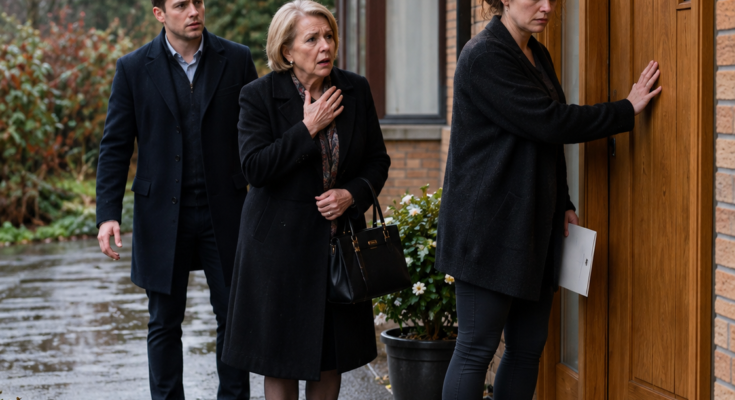
Then on the twelfth morning, my doorbell rang.
I checked the camera.
Vivian stood on the porch wearing pearls and carrying a gift bag.
Derek was behind her with a stuffed bear that still had the price tag attached.
I opened the door but did not move aside.
Vivian immediately smiled.
“Claire, darling. We’ve come to see my grandchild.”
I looked at her.
“Which grandchild?”
Her smile disappeared.
“What?”
“The one whose mother begged you to call an ambulance?”
She stiffened.
“Claire—”
“The one you watched leave Samuel’s funeral in labor?”
Derek sighed.
“Can we not do this at the door?”
“No.”
Vivian’s voice softened.
“We were grieving.”
“So was I.”
She opened her mouth.
I continued.
“And I was giving birth.”
For a moment, nobody spoke.
Then Derek finally said what they had really come for.
“There are some issues with the company accounts.”
I almost laughed.
There it was.
Not the baby.
Money.
Samuel had spent the final six months of his life trying to untangle problems inside Hale Logistics, the company his father had founded and Samuel later expanded.
He had discovered irregular transfers involving a subsidiary Derek oversaw.
He hadn’t accused his brother publicly.
He had hired accountants.
Asked questions.
Preserved records.
And quietly changed several estate documents so I would have independent legal representation if he died before the review was finished.
Three days after Arthur’s birth, Samuel’s attorney had delivered a lockbox to the hospital.
Inside were financial records.
A trust document.
A letter.
And one handwritten note on top:
Claire, if they come asking for access before they ask how you and the baby are, you’ll know why I changed everything.
I had cried for an hour.
Now Derek stood on my porch asking about bank accounts.
I said:
“The company’s attorneys are handling it.”
Vivian stepped closer.
“Samuel wouldn’t want his family locked out.”
I looked at her.
“Samuel was trying to find out whether his family was taking money that didn’t belong to them.”
Derek’s face changed.
“That’s ridiculous.”
“Then the audit will clear you.”
He had no answer.
Vivian lifted the gift bag.
“We still have a right to see the baby.”
I looked down at it.
Then back at her.
“No.”
Her mouth fell open.
“You cannot keep my grandson from me.”
“I can decide who enters my home and who has contact with my newborn while I’m recovering.”
“Claire, I’m his grandmother.”
“Twelve days ago, you were standing ten feet from him and wouldn’t call 911.”
That was when she stopped pretending this was a social visit.
“You’re punishing us.”
“No.”
I shook my head.
“I’m protecting the only person in this family who cannot protect himself.”
Then I closed the door.
━━━━━━━━━━━━━━━━━━━━
Part Two — Samuel’s Last Decision
The financial investigation took months.
Not twelve dramatic hours.
Not one courtroom speech.
Months.
Hale Logistics had legitimate accounts, complicated ownership, outside investors, lenders, and a board.
Samuel’s death did not magically make me the owner of everything.
What he had done was more careful.
He had placed his personal shares into a trust for Arthur and me, with an independent corporate trustee and me serving alongside a professional co-trustee.
He had also instructed the board to complete the forensic review he had already started.
Derek’s access to certain company funds was restricted while records were examined.
Some transfers were legitimate.
Others weren’t.
There were payments for personal debts recorded as business consulting costs.
A vehicle.
Travel.
Several transfers routed through a company Derek controlled.
The board removed him from financial authority while the matter was reviewed.
The rest went where it belonged.
Accountants.
Attorneys.
Eventually, investigators.
I didn’t need to threaten anyone.
Facts were enough.
Vivian called repeatedly.
At first, every voicemail sounded the same.
You are destroying Samuel’s legacy.
Then:
Arthur needs his grandmother.
Then:
You are keeping us away because you’re angry.
I was angry.
But anger wasn’t the reason.
The reason was simpler.
I didn’t trust her.
There is a difference between grief and cruelty.
Vivian was grieving at the funeral.
So was I.
Grief explained why she might have been distracted.
It did not explain looking at a woman in labor and saying:
Call a taxi yourself.
Derek eventually came to my attorney’s office.
He looked terrible.
Not ruined.
Not homeless.
Just stripped of the confidence he wore when someone else was carrying the consequences.
He said:
“Samuel always thought he was better than me.”
I answered:
“I don’t think this is about how Samuel felt about you.”
“He was going to expose me.”
“If the records are accurate, you exposed yourself.”
He looked down.
Then he said:
“I loved him.”
“I believe you.”
That surprised him.
“You do?”
“Yes.”
I had learned something important after Samuel died.
People could love someone and still exploit them.
Love did not automatically make behavior safe.
Derek cried then.
For real.
He admitted he had borrowed money from company accounts intending to replace it after an investment paid off.
The investment failed.
Then he moved more money to cover the first hole.
Then more.
By the time Samuel found out, Derek had built a system of lies larger than the original debt.
“I kept thinking I’d fix it before he knew.”
I thought of the funeral.
Of Derek checking his watch while I begged for help.
“You seem to think fixing something before people notice means nobody was harmed.”
He didn’t argue.
For once.
━━━━━━━━━━━━━━━━━━━━
Part Three — The Letter Samuel Left for His Son
Arthur was almost six months old when I finally read Samuel’s personal letter all the way through.
I had tried several times.
I never made it past the first page.
One night, Arthur fell asleep against my chest, his tiny fist curled around my sweater.
So I opened the letter again.
Samuel had written:
Claire, if you’re reading this, then something happened before I got to tell Arthur these things myself.
I stopped.
Cried.
Started again.
Please don’t turn him into the Hale heir before he gets the chance to become Arthur.
That sentence broke me.
Because Samuel understood his family better than I had.
The Hales spoke constantly about legacy.
Names.
Businesses.
Inheritance.
Samuel worried that Arthur would grow up carrying all of it before he learned what he actually wanted.
His letter continued:
My mother will probably talk about blood. Derek will talk about the company. Other people will talk about responsibility. Tell him none of those things are the price of being loved.
Then:
If he wants the business one day, teach him it belongs to people too—the drivers, warehouse workers, dispatchers, families whose mortgages depend on decisions made in offices. If he wants to become a teacher, musician, mechanic, nurse, or professional fisherman who catches absolutely nothing, let him.
I laughed through tears.
That sounded like Samuel.
At the bottom was one final paragraph.
And Claire, please don’t spend your life fighting my family because of me. Protect yourself. Protect Arthur. But if any of them change, leave room for change. Boundaries should keep danger out, not keep you imprisoned inside the worst day of your life.
I sat staring at those words.
Samuel had managed to give me advice from a future he would never see.
Vivian did change.
Not quickly.
Her first apology was useless.
I’m sorry things got out of control at the funeral.
I rejected it.
The second was worse.
I had just buried my son. You cannot understand what that does to a mother.
I answered:
I had just buried my husband. I was also in labor. Grief was not yours alone.
Then she stopped contacting me for months.
When Arthur was almost one, I received a handwritten letter.
No expensive stationery.
No lawyer.
Just Vivian’s handwriting.
Claire, I keep telling myself I was out of my mind with grief because that makes what I did easier to live with. But there was a moment when you looked directly at me and said you needed help. I understood you. I chose not to help.
I read that twice.
I was angry that Samuel was gone and you were carrying the last part of him that I could not control. I treated you as though your labor was competing with my grief. That was cruel. Derek followed my lead. I cannot undo it.
Then:
I would like to know Arthur someday. I understand that wanting that does not entitle me to it.
That was the first apology I believed.
Still, I didn’t invite her over the next day.
Trust is not restored because someone finally finds the correct words.
We began with photographs.
Then a video call.
Then a meeting at a park.
Arthur was fourteen months old.
Vivian sat on a bench and cried the moment she saw him.
She did not reach for him.
That mattered.
She waited.
Arthur stared at her pearls.
Then, after several minutes, toddled over and grabbed them.
I nearly laughed.
Vivian whispered:
“Hello, Arthur.”
He tried to put one pearl in his mouth.
I said:
“Apparently that’s his review.”
She laughed and cried at the same time.
For years afterward, Vivian’s relationship with us remained limited but real.
She never had automatic access.
She asked.
She respected no.
She stopped saying my grandson as though the words were ownership papers.
She started saying Arthur.
Derek’s road was different.
There were financial consequences from the company investigation.
He lost his position.
Repayment and other legal issues followed according to what could actually be proved.
For almost two years, I had very little contact with him.
Then one Christmas, he sent Arthur a wooden truck.
No giant gift.
No request to visit.
Inside was a card:
Your dad taught me more about responsibility after he died than I let him teach me while he was alive. I’m trying to become someone he’d recognize again.
I kept the card.
Not because it erased anything.
Because Samuel had asked me to leave room for change when change was real.
Arthur is eight now.
He knows his father died before he was born.
He knows Samuel loved terrible jokes, black coffee, old motorcycles, and him.
He does not know every ugly detail yet.
He doesn’t need to.
One rainy afternoon he asked:
“Grandma Vivian was at Dad’s funeral, right?”
“Yes.”
“Was I there?”
I smiled.
“Technically.”
He thought that was hilarious.
Then he asked:
“Did Dad get to see me?”
My throat tightened.
“No.”
Arthur looked disappointed.
So I went upstairs and brought down Samuel’s letter.
Not all of it.
Just one paragraph I knew Arthur could understand.
I read:
Tell him that before I ever held him, I already loved the person he might become.
Arthur was quiet.
Then he said:
“So Dad loved me before he knew me?”
“Yes.”
He considered that.
“That’s kind of weird.”
I laughed so hard I cried.
“Yeah. Love is weird.”
That night, after Arthur went to bed, I thought again about Vivian standing on my doorstep twelve days after his birth.
We came to see my grandchild.
And my answer.
Which grandchild?
At the time, I meant it as a boundary sharpened by pain.
The child she suddenly claimed after refusing to help bring him safely into the world.
Years later, the question means something different to me.
Which grandchild?
The Hale heir?
Samuel’s replacement?
The baby who carried a family name?
Or Arthur?
A boy who hated peas.
Loved dinosaurs.
Wanted to build airplanes.
Had his father’s crooked smile.
The greatest gift Samuel left wasn’t a company or a trust.
It was the warning not to let anyone turn our son into an inheritance before he became a person.
Vivian eventually learned that.
So did Derek.
So did I.
And when Arthur asks about the night he was born, I don’t tell him his grandmother abandoned him.
Not yet.
I tell him the truest part first.
“Your dad couldn’t be there. But there were people who helped me. A cemetery worker called for help. A stranger gave me her coat. Nurses stayed with me. And when you arrived, you were surrounded by people making sure you were safe.”
Because that’s the story I want him to carry before he’s old enough for the harder one.
Not that his first hours began with rejection.
That even on the worst day of my life, when the people who should have helped walked away, someone else stepped forward.
Samuel was gone.
I was terrified.
And still, Arthur entered the world into waiting hands.