Part One — The Man Waiting Outside the Barn
I was standing in my workshop, pruning shears frozen in my hand, surrounded by fourteen copper vases filled with lavender, rosemary, and white dahlias I had spent months growing myself.
Dad delivered the sentence as casually as if he were canceling lunch.
“Why?” I asked.
He sighed, already exhausted by my reaction.
“Vanessa is going through a difficult time with the divorce. Watching me walk you down the aisle would be painful for her.”
Vanessa was my older sister—the person my parents had protected from consequences for as long as I could remember.
“She isn’t getting married,” I said. “I am.”
Dad lowered his voice.
“She said she won’t bring Lily and Owen to Christmas if I walk you.”
There it was.
Vanessa had used her children as leverage, and my father had folded immediately.
“So you chose her.”
“Please don’t make this sound cruel, Darcy.”
That was Dad’s special talent.
He could hurt me and still become offended when I accurately described what he was doing.
I looked toward the oak shelves in my workshop.
Marcus’s father, Frank, had built them for me two years earlier. Deep in the left panel, he had carved my initials where they would survive every future coat of paint.
My own father had forgotten my birthday that same year.
“Okay,” I said.
“Darcy, I’m sorry.”
“No. You’re uncomfortable. That isn’t the same thing.”
I hung up.
Mom called ten minutes later.
“Your father told you, so let’s not drag this out. Plenty of modern brides walk alone now. It’s empowering.”
“He promised me.”
“Things change. Vanessa is hurting. You already have Marcus.”
“And that means I’m not allowed to be hurt?”
Her silence wasn’t guilt.
It was irritation.
“Just walk by yourself, smile, hold your head up, and do not embarrass anyone.”
I ended the call.
Twenty minutes later, Marcus found me sitting on the back steps staring at the garden.
He didn’t tell me to forgive them.
Didn’t tell me to keep the peace.
He simply put an arm around me and listened.
Then he said:
“You don’t have to walk alone.”
I already knew who he meant.
“Frank?”
Marcus nodded.
“My dad has treated you like his daughter since the first day I brought you home. He would understand exactly what you’re asking.”
The next morning, I drove to Frank’s workshop.
He was feeding cherry wood through his table saw when I arrived.
The moment he saw me, he killed the machine and took off his safety glasses.
I told him everything.
Vanessa’s threat.
Dad backing out.
Mom telling me to smile so nobody would be embarrassed.
Frank listened without interrupting.
Then I looked at my boots.
“Mom says walking alone would prove I’m strong.”
My voice cracked.
“But I don’t want to spend my wedding proving I can survive being abandoned. I want to walk with someone who’s actually proud to be there.”
Frank slowly removed his work gloves.
“Are you asking me?”
I nodded.
His eyes filled immediately.
Frank was the kind of man who showed love by sharpening your mower blades without mentioning it or replacing a broken porch board before you noticed.
He hugged me.
“Darcy, it would be one of the greatest privileges of my life.”
On Saturday, the converted stone barn glowed beneath a crisp autumn sun.
Nearly two hundred guests filled the wooden pews.
My parents arrived late.
Dad sat in the third row beside Mom.
Vanessa sat next to them with Lily and Owen, looking far too satisfied with herself.
They expected me to enter alone.
Outside, behind the closed barn doors, Frank stood beside me in a charcoal suit.
His hands were shaking.
I noticed and smiled.
“You’re nervous?”
“Terrified.”
“Why?”
He looked at me as though the answer were obvious.
“Because this matters.”
Those three words almost made me cry.
The music changed.
Inside, everyone stood.
Frank offered me his arm.
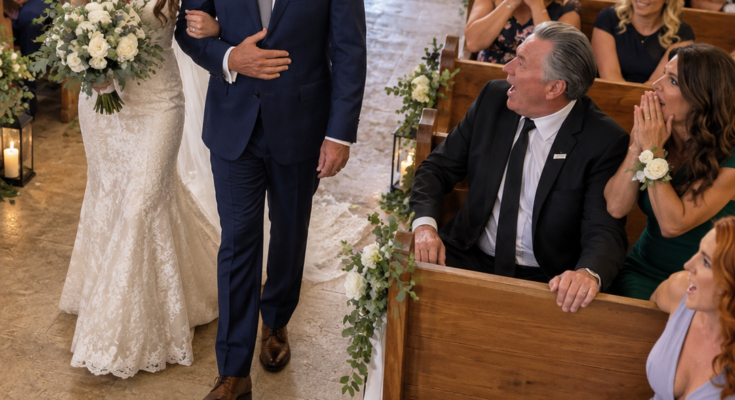
Then the barn doors opened.
I will never forget my father’s face.
His smile disappeared first.
Then Mom’s.
Vanessa leaned forward.
Frank and I stepped into the aisle.
He did not look at them.
Neither did I.
Halfway down, he whispered:
“Slow down. You grew these flowers for six months. At least look at them.”
I laughed.
That saved me from crying.
Near the third row, Dad stood completely still.
For one second, Frank’s eyes met his.
There was no triumph in Frank’s expression.
No challenge.
He simply kept walking.
At the altar, Marcus hugged his father.
Then Frank kissed my cheek.
He whispered:
“Thank you for letting me do that.”
Not:
I saved you.
Not:
I replaced him.
Thank you.
During the ceremony, I forgot about my parents.
Mostly.
Then came the reception.
Dad found me less than twenty minutes after dinner began.
His face was tight.
“You could’ve told me.”
I stared at him.
“Told you what?”
“That Frank was walking you.”
I almost laughed.
“You told me three days ago you weren’t.”
“That doesn’t mean you had to humiliate me.”
There it was again.
His embarrassment had become my responsibility.
“I didn’t humiliate you, Dad.”
“Everybody was looking at me.”
“Because they knew you were supposed to walk me.”
He glanced toward Frank.
“You replaced me.”
I shook my head.
“No.”
Dad looked at me.
“You gave away your place because Vanessa threatened Christmas.”
His face changed.
“That was your decision. Frank just showed up when I asked.”
Then Vanessa appeared.
Of course she did.
“You did that on purpose.”
I turned toward her.
“Did what?”
“Made Dad look terrible.”
“You threatened to keep his grandchildren away if he walked me down the aisle.”
Her face went white.
Apparently she had not expected me to say that out loud.
Mom stepped closer.
“Darcy. Not here.”
I looked at her.
“You’re right.”
For once, I agreed.
“It isn’t worth spending another minute of my wedding on.”
Then I walked away.
━━━━━━━━━━━━━━━━━━━━
Part Two — What My Father Finally Admitted
My parents left before the cake was cut.
Vanessa left with them.
I did not chase anyone into the parking lot.
I danced with Marcus.
I danced with Frank.
I danced badly with Lily and Owen before Vanessa took them home.
And I had a wonderful wedding.
That mattered.
The day did not become beautiful because my family was punished.
It was beautiful because their choice stopped controlling it.
Three weeks later, Dad asked to meet.
We sat in a diner.
For the first ten minutes, he talked about everything except the wedding.
Finally, he said:
“I’ve been thinking about what you said.”
I waited.
“About choosing Vanessa.”
“Yes.”
He rubbed his coffee cup.
“I kept telling myself I was preventing a bigger family fight.”
“That usually means I was the one expected to lose.”
He looked up.
That landed.
Then he said something I had never heard him admit.
“Vanessa has always been harder to say no to.”
“I know.”
“You were easier.”
That hurt even though I already knew it.
He continued.
“When you were disappointed, you got quiet. Vanessa punished everyone.”
I swallowed.
“So you rewarded the person who made the biggest threat.”
“Yes.”
He looked ashamed.
“And then I told myself it was because you were stronger.”
That sentence explained half my childhood.
Darcy understands.
Darcy is independent.
Darcy doesn’t need as much attention.
Darcy will get over it.
Strength had become the excuse everyone used for giving me less.
Dad looked at me.
“I thought asking you to walk alone was asking the stronger daughter to make one sacrifice.”
“No.”
I shook my head.
“You asked the daughter who usually gives in to give in again.”
He nodded slowly.
“You’re right.”
That apology mattered more than if he had begged forgiveness at the wedding.
Because finally he understood what the injury actually was.
━━━━━━━━━━━━━━━━━━━━
Part Three — The Father Who Kept Showing Up
Dad and I did not immediately return to normal.
I didn’t want normal.
Normal was the problem.
For a while, we saw each other less.
Mom was angrier.
She believed I should have let everything go once Dad apologized.
“Families survive by moving on,” she told me.
I answered:
“Families also survive by changing.”
She didn’t like that.
Vanessa did not apologize at all.
For months, she insisted she had never truly threatened Dad.
Then Lily, who was twelve, innocently mentioned:
“Mom said Grandpa wasn’t allowed to walk you because it would prove he loved your wedding more than her divorce.”
That ended the revision of history.
I never confronted Vanessa with it.
There was nothing left to prove.
Over time, Dad changed in small ways.
The next Christmas, Vanessa threatened not to attend because I had been invited.
Dad told her:
“We’ll miss you if you don’t come.”
She came.
That was the first time I ever watched one of her threats fail because nobody rewarded it.
A year later, Mom criticized me during dinner for not visiting often enough.
Dad interrupted her.
“Darcy gets to decide how often she comes.”
Mom stared at him.
So did I.
He didn’t look at me for approval.
He simply continued eating.
That mattered more than speeches.
Frank never tried to capitalize on any of it.
He never called himself my “real dad.”
Never mocked my father.
Never made the wedding into a competition.
When I thanked him again months later, he said:
“You already had a father. You just needed somebody to walk beside you that day.”
That was Frank.
He never needed ownership of the role to perform the love inside it.
Years later, Marcus and I had a daughter.
We named her Mae.
Dad became Grandpa Robert.
Frank became Grandpa Frank.
Nobody had to lose a title for someone else to be loved.
But when Mae turned five, she found our wedding album.
She sat on the floor flipping pages until she reached the photograph of Frank and me entering the barn.
“That’s Grandpa Frank!”
“Yes.”
“Why did he walk you?”
I looked at the photograph.
Frank’s shoulders were straight.
My hand was tucked around his arm.
In the third row behind us, Dad was visible slightly out of focus.
I could have told Mae the entire story.
Instead, I said:
“Because I asked him.”
She nodded.
“Was he happy?”
I smiled.
“Very.”
Years after the wedding, Dad and Frank ended up alone together on our back porch during Mae’s birthday party.
I saw them talking through the kitchen window.
Later, Dad found me.
“I thanked him.”
“For what?”
“For walking you.”
I stared at him.
Dad looked toward Frank.
“He told me I didn’t owe him thanks.”
“That sounds like Frank.”
Dad smiled faintly.
“Then he told me something else.”
“What?”
“He said, ‘I wasn’t taking your place, Robert. I was standing in a place you left empty.’”
I inhaled slowly.
Dad nodded.
“He was right.”
That was the closest the two men ever came to discussing the wedding.
And maybe that was enough.
When Frank died many years later, I helped Marcus clean out his workshop.
The table saw was still there.
So were stacks of wood, coffee cans filled with screws, and dozens of pencils sharpened down almost to nothing.
Then I saw a photograph pinned above his workbench.
My wedding.
Frank and me at the barn doors.
On the back, in his handwriting, were six words:
She asked me. I was honored.
I sat on the workshop floor and cried.
Not because Frank had replaced my father.
He hadn’t.
That was never the point.
Dad eventually learned to love me without asking me to be the easier daughter.
Our relationship became better because he finally stopped mistaking my ability to endure disappointment for permission to keep disappointing me.
But Frank taught me something different.
Family roles can be assigned by birth.
Love cannot.
Love is built in ordinary moments.
A shelf made for your workshop.
A tire checked before winter.
Someone remembering your birthday.
A man putting down his work gloves because he can see you are trying not to cry.
And sometimes, three days before your wedding, love is simply someone saying:
You don’t have to walk alone.
My parents thought my humiliation would be entering that barn without my father.
They were wrong.
The humiliating thing would have been pretending his absence didn’t hurt just to protect the people who caused it.
So I didn’t walk alone to prove I was strong.
I walked beside the man who had already spent years proving he would show up.
And when the doors opened, I finally understood something I should have learned much earlier:
The person who deserves the honor is not always the person who was originally promised it.
Sometimes it’s the person who, when you ask, simply says:
It would be my privilege.