Part One — “Under Control”
There was exactly one bruised banana sitting on the kitchen counter.
That detail still bothers me more than almost anything else.
Not the dark house.
Not the thermostat showing fifty-three degrees.
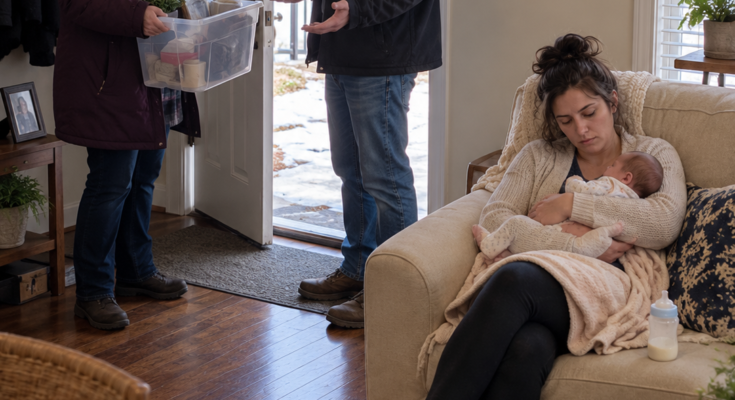
Not even the sight of my wife, Lauren, curled on our sofa eleven days after emergency surgery, holding our newborn daughter inside her winter coat because it was the warmest place she could think to put her.
The banana.
One piece of food in a house where I had left enough groceries and money for weeks.
I dropped my suitcase.
“Lauren?”
She looked toward me slowly.
Her lips were pale.
For half a second she seemed confused, as though she thought I wasn’t really there.
Then she started crying.
I crossed the room and touched her hand.
Ice cold.
“Where’s the heat?”
“She turned it down.”
“Who?”
Lauren looked at me as though the answer should have been obvious.
“Your mother.”
My stomach dropped.
I had been gone four days.
It was a work trip I had tried to cancel after our daughter, Lily, arrived three weeks early by emergency C-section. Lauren had hemorrhaged badly enough that she needed a transfusion.
I told my employer I wasn’t going.
Lauren argued with me.
We needed my job.
My mother, Diane, lived fifteen minutes away and promised she would come every morning, bring meals, help with laundry, and stay as long as Lauren wanted.
I had stocked the refrigerator myself before leaving.
I had arranged grocery delivery.
I had left money.
And I called Lauren several times every day.
She kept telling me she was tired.
I mistook tired for safe.
Now her oversized sweatshirt was stained with formula, the room felt like a refrigerator, and our eleven-day-old daughter was pressed against her chest underneath a winter coat.
I turned the heat up immediately.
Then I stopped.
A newborn and a woman recovering from major surgery weren’t something I was going to diagnose with a thermostat and blankets.
I called the nurse line from Lauren’s discharge paperwork.
After hearing what I described, they told me to bring both of them in for evaluation.
Lauren resisted.
“I’m okay.”
“No.”
Then I caught myself.
I crouched beside her.
“Sorry. You decide. But I’m scared, and the nurse thinks you and Lily need to be checked.”
She looked at our daughter.
Then nodded.
“Okay.”
Before we left, I asked the question that had been tearing through my head.
“Why didn’t you call me?”
Lauren looked away.
“Your mother said you were furious.”
“About what?”
“The hospital bill.”
I stared at her.
“She said you couldn’t believe how expensive the delivery was. She said you were already worried about missing work and that if I kept needing things, you’d start wondering whether I could handle being a mother.”
I felt sick.
“I never said that.”
Lauren started crying harder.
“I know that now.”
Then:
“But I didn’t know it yesterday.”
That sentence nearly broke me.
I had told Lauren repeatedly that the only thing I cared about was getting her and Lily home safely.
I had never complained about the hospital bill.
Not once.
Then I remembered the security cameras.
We had two exterior cameras and one small indoor camera pointed toward the entryway after a series of package thefts in our neighborhood.
Diane knew about the exterior cameras.
I wasn’t sure she remembered the indoor one.
I opened the app.
Day one.
My mother entered using the emergency key I had given her.
Day two.
She came carrying two bags of groceries.
Twenty minutes later, she left carrying the same bags.
Lauren whispered:
“She checked the receipt.”
“What?”
“She said berries were too expensive. And the soup. She said if I was hungry enough, there was food in the pantry.”
I opened the pantry.
Rice.
Flour.
Canned tomatoes.
Ingredients that meant nothing to someone struggling to stand upright after abdominal surgery while feeding a newborn every few hours.
Day four had audio.
Lauren stood near the hallway wrapped in a thin blanket.
“Diane, can we turn the heat up? Lily feels cold.”
My mother’s answer came clearly through my phone.
“Babies survived winter before people started wasting money on seventy-degree houses.”
Lauren said something too soft for the microphone.
Then Diane:
“And don’t call him. He needs to see whether you can manage without constantly being rescued.”
I stopped the video.
For several seconds, I couldn’t speak.
Then I kept watching.
She removed clean baby clothes from the laundry room because Lauren was “running the washer too much.”
She unplugged a small space heater.
She criticized the amount of formula being used even though Lily’s pediatrician had specifically told us to supplement while Lauren recovered.
She repeatedly told Lauren I was worried about money.
And every time Lauren defended herself, my mother answered with some version of:
“I know my son better than you do.”
I called Diane.
Speakerphone.
She answered cheerfully.
I was supposed to be hundreds of miles away until the following afternoon.
“How are things at my house?” I asked.
“Under control.”
She laughed lightly.
“Lauren’s emotional, obviously. But that’s normal. I’ve been keeping her from making bad financial decisions.”
I looked at my wife.
“Like eating?”
Silence.
“What?”
“Like turning the heat on?”
Another silence.
Then:
“You’re home.”
“Yes.”
Diane’s tone changed immediately.
“You weren’t supposed to be home until tomorrow.”
“No.”
She started explaining.
I interrupted.
“Mom, I’m looking at the camera footage.”
Nothing.
“I’m looking at Lauren asking you for heat.”
“That’s being taken out of context.”
“I watched you carry her groceries back out.”
“She was wasting money.”
“They were groceries I paid for.”
“You don’t understand. She was becoming dependent—”
“She had major abdominal surgery eleven days ago.”
“I raised three children without everyone treating me like I was made of glass.”
There it was.
Not budgeting.
Not concern.
Something older.
Something she had carried for decades and decided Lauren needed to inherit.
I asked one question.
“Did Dad do this to you?”
My mother stopped speaking.
“Did somebody tell you that needing help after childbirth made you weak?”
Her voice became sharp.
“This is not about me.”
I knew then that it partly was.
But that could wait.
“Your key no longer works.”
“What?”
“I’m changing the locks.”
“You cannot keep me from my granddaughter.”
“Yes, I can.”
“I am your mother.”
“And Lauren is my wife. Lily is our child.”
My voice shook.
“You don’t get authority over either of them because you raised me.”
Then I said the part that finally made her silent.
“We’re going to the hospital. After that, you will communicate with us only when Lauren says she’s ready.”
I ended the call.
But the thing that shocked my mother most came the following morning.
Because I didn’t simply change a lock.
I told everyone what had actually happened.
━━━━━━━━━━━━━━━━━━━━
Part Two — The Story My Mother Had Already Told
Lauren and Lily were both medically stable.
That was the good news.
Lauren was dehydrated, underfed, exhausted, and in more pain than she had admitted.
Lily’s temperature improved quickly once she was properly warmed, and doctors found no lasting harm.
A social worker spoke with us before discharge.
That conversation was uncomfortable.
Not because anyone accused Lauren of failing.
Because the social worker asked me questions I needed to hear.
“Who was supposed to be supporting her while you were gone?”
“My mother.”
“Who else knew she was alone?”
I swallowed.
“Her sister. Some friends.”
“Did they believe they were allowed to come?”
I looked at Lauren.
She shook her head.
“Diane told them I wanted privacy.”
That was new.
My mother had not merely controlled the house.
She had controlled information around it.
Lauren’s sister later showed me messages.
Lauren needs rest. Please don’t overwhelm her with visitors. I’ll let everyone know when she’s ready.
Another friend had offered to drop off food.
Diane replied:
We’ve got everything covered.
Under control.
That phrase again.
My mother had positioned herself between Lauren and everyone who might have noticed what was happening.
I called my mother from the hospital.
Not to argue.
To tell her one thing.
“You have been telling people Lauren didn’t want visitors.”
“She needed rest.”
“That wasn’t your decision.”
“I was protecting her.”
“No.”
I looked at Lauren beside me.
“You were controlling access to her.”
My mother hung up.
Then the family messages started.
My aunt called me ungrateful.
My older brother said I was “humiliating Mom over a thermostat.”
A cousin asked why Lauren had not simply ordered food herself.
That one made me furious.
Then I realized all of them had heard my mother’s version first.
So with Lauren’s permission, I sent one message to the family group.
Not the video.
Not medical details.
Just facts.
Lauren had emergency surgery eleven days ago. While I was away, Mom repeatedly entered our home, restricted heat and food, discouraged Lauren from contacting me, and told relatives not to visit. Lauren and the baby required medical evaluation when I returned. We are taking space from Mom. Please do not contact Lauren for explanations right now.
Then I muted the group.
Lauren read the message.
“You didn’t call her evil.”
“No.”
“She’ll hate that more.”
I laughed for the first time in twenty-four hours.
Lauren smiled faintly.
Then she said:
“Thank you for asking before sending it.”
That mattered.
Because after days of my mother deciding what Lauren needed, the last thing I wanted was to become another person speaking over her.
━━━━━━━━━━━━━━━━━━━━
Part Three — The Thermostat Stayed at Seventy
My mother did not apologize quickly.
Her first response was anger.
Then denial.
Then self-pity.
“I was only trying to help.”
“You’ve made me sound like a monster.”
“People waste money when they’re emotional.”
And finally:
“You have no idea what I went through when you were born.”
That was the first honest thing she said.
I asked her to tell me.
My father had controlled nearly every dollar during their marriage.
When my mother gave birth to my older brother, she came home to a house kept at fifty-eight degrees because Dad believed heating costs were too high.
He gave her a weekly grocery allowance in cash.
If she spent too much, he made her explain every receipt.
When she cried, he told her motherhood was making her irrational.
When she asked her own mother for help, Dad accused her of embarrassing him.
I sat there stunned.
“Mom.”
She wiped her eyes.
“We survived.”
That sentence told me everything.
She had converted I survived this into therefore this is acceptable.
Maybe because admitting otherwise would mean acknowledging what had been done to her.
I said:
“What Dad did to you was wrong.”
Her face hardened.
“Don’t speak about your father like that.”
“He made you afraid to buy food.”
“We were poor.”
“He made you justify heat after childbirth.”
“Everybody struggled.”
“And now you did the same thing to Lauren.”
She stood up.
“I was teaching her not to be helpless.”
“No.”
I kept my voice calm.
“You were repeating something that hurt you.”
She stared at me.
For once, she had nothing to say.
Understanding where her behavior came from did not mean we immediately let her back into the house.
For months, she did not have a key.
She did not visit Lily without one of us present.
She did not manage errands, groceries, childcare, or anything financial for us.
That wasn’t revenge.
It was a boundary based on what she had done.
Lauren started counseling.
Not because something was wrong with her.
Because after days of being told she was weak, wasteful, and incapable while recovering from surgery, she had begun questioning her own judgment.
For weeks she asked permission for absurd things.
“Is it okay if I turn the heat up?”
“Can I order soup?”
“Do you think Lily needs another outfit or am I overdoing it?”
Each time, I wanted to say:
You don’t have to ask me.
But eventually I learned a better answer.
“What do you think?”
At first, that frustrated her.
Then she understood what I was trying to give back.
Her own authority.
We also made a practical emergency plan.
Not a heroic husband plan.
Not “call me and I’ll fix everything.”
A real one.
Lauren’s sister had a key.
So did one trusted neighbor.
Emergency numbers were written beside the refrigerator.
Meal delivery was arranged for the next few weeks.
Our pediatrician’s after-hours number was easy to find.
And if either parent became overwhelmed, there were multiple adults who could step in.
One person should never be the entire safety net.
Especially not someone recovering from surgery while caring for a newborn.
My mother met Lily again when Lily was almost four months old.
It happened at our house.
She rang the bell.
No spare key.
Lauren decided when to open the door.
That distinction mattered.
Mom carried a casserole.
Before walking inside, she handed it to me.
“I brought the receipt too.”
I looked at her.
She almost smiled.
“I’m working on it.”
The visit lasted forty-five minutes.
Mom asked before picking Lily up.
Asked before feeding her.
And when Lauren said Lily needed a nap, my mother handed her back immediately.
No argument.
As she was leaving, Mom stopped beside the thermostat.
It read seventy.
She stared at it.
Then said quietly:
“Your father would’ve had a heart attack.”
I waited.
She touched the wall beneath it.
“I used to put towels under the doors so the bedrooms wouldn’t get so cold.”
Lauren stood behind me.
My mother turned toward her.
“I thought suffering had made me capable.”
Her voice cracked.
“I didn’t understand that it had also made some terrible things feel normal.”
Lauren said nothing.
Mom continued.
“I’m sorry.”
Then, importantly, she did not ask:
“Do you forgive me?”
She simply left.
That apology mattered because it did not demand immediate comfort from the person she had hurt.
Trust returned slowly.
Not all the way.
Maybe it never returns exactly the same after something like that.
But it became possible for them to be in a room together without fear.
Years later, Lily asked why Grandma always complained that our house was too warm.
“She grew up differently,” Lauren told her.
Lily shrugged.
“Grandma is always cold.”
We laughed.
Children reduce family mythology to practical observations.
On Lily’s fifth birthday, my mother gave her a tiny play kitchen.
Inside the toy refrigerator, she had put miniature plastic groceries.
Too many of them.
Lily complained there was no room for the pretend cake.
My mother laughed until she cried.
I knew what she was remembering.
One banana.
She never mentioned it.
Neither did I.
Some memories do not need to be reopened every time people become better.
But I have never forgotten New Year’s Eve.
Not because I came home and “rescued” my wife.
That version gives me too much credit.
I should have had a better support system in place before I left.
I should have noticed the hesitation in Lauren’s voice during our calls.
I should have questioned why every update came through my mother.
Lauren survived those days using whatever she had.
Blankets.
A coat.
Formula.
Her own body heat.
The lesson wasn’t that she needed a stronger husband.
It was that nobody recovering from major surgery should have to prove strength by going without basic care.
And nobody gets to redefine food, warmth, rest, or asking for help as weakness.
For a long time afterward, whenever winter came, I would wake in the night and check the thermostat.
Seventy degrees.
Sometimes seventy-one.
Then I would look toward the bassinet, and later toward Lily’s room.
Eventually I stopped checking.
But Lauren never again asked permission to turn up the heat.
And in our house, that became more important than it sounds.
Because the thermostat was never really the thing my mother had controlled.
She had tried to teach my wife that comfort had to be earned.
That needing people was a failure.
That asking for something basic could make someone stop loving you.
We spent years teaching our daughter the opposite.
Hungry?
Tell us.
Cold?
Tell us.
Scared?
Tell us.
Need help?
Tell us.
You never have to freeze first.