Part One — Five Minutes
My name is Sarah.
For more than two decades, I carried some of the highest security clearances in the U.S. Armed Forces, and by that Fourth of July, I was serving as a major general in Army intelligence.
My family knew I had worked for the government and had served in the Army.
What they did not know was how far that career had gone.
I had stopped correcting their assumptions years earlier.
At reunions, Brad called me “the paperwork queen.”
My uncle once asked whether I still “filed stuff for the Pentagon.”
I smiled.
“Something like that.”
It was easier.
Much of my work could not be discussed anyway, and I had never believed a rank should be necessary to earn basic respect from relatives.
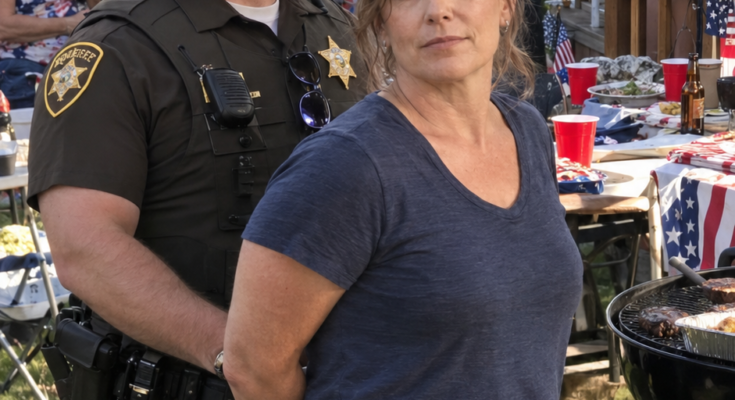
That Fourth of July, my sister’s backyard smelled like charcoal smoke, barbecue sauce, and sun-scorched grass.
Then my cousin Brad decided my car had given him an excuse to remind everyone that he wore a badge.
I had parked legally at the edge of the driveway.
He knew that.
I knew that.
But Brad had always loved authority most when there was an audience.
One sarcastic remark became another.
Then he ordered me to move the car immediately.
I told him I would when I finished helping my sister carry food outside.
That was enough.
A minute later, my cheek was against the picnic table and my wrists were being forced behind my back.
“Stop resisting, Sarah!”
“I’m not resisting.”
He tightened the cuffs anyway.
My right shoulder screamed.
Around us, nearly fifty relatives went silent.
Brad hauled me upright.
“You government pencil-pushers think rules don’t apply to you.”
My hands were beginning to go numb.
“You are crossing a line, Brad.”
He laughed.
“I’m the law here.”
That was when I saw my niece Chloe near the screen door.
Years earlier, because of the work I was doing at the time, I had given her a sealed emergency card.
Not because she knew my missions.
She didn’t.
The card contained one number connected to a duty-security contact who could verify my status and respond if I was ever unexpectedly detained, injured, or unable to communicate during a genuine emergency.
I had never expected her to use it.
At 4:17 p.m., I looked at her and gave one sharp nod.
She understood.
Brad jerked my arms higher.
“Who’s the boss now, Sarah?”
I kept my voice level.
“I’m not going to beg you.”
He smiled.
“But I strongly recommend you enjoy that feeling of power.”
His smile widened.
“It expires in about five minutes.”
He laughed.
Then the street changed.
Engines.
Several of them.
Three dark SUVs came fast down the road and stopped near the house.
Doors opened.
Men and women stepped out in plain clothes and military uniforms.
Nobody came running with weapons drawn.
Nobody tackled Brad.
Real professionals don’t create chaos simply because somebody important is embarrassed.
A lieutenant colonel I knew named Elena Ruiz walked through the side gate with two security personnel behind her.
She took in the scene in seconds.
My hands cuffed behind me.
Blood around one wrist.
Brad gripping my arm.
Phones raised around the yard.
Then she looked directly at him.
“Deputy, I need your name and agency.”
Brad puffed up.
“This is a county matter.”
“Yes,” Elena said calmly. “And we have already contacted your watch commander.”
Something flickered across his face.
“Who are you?”
She produced identification.
Brad read it.
Then looked at me.
Then back at her.
His hand loosened slightly.
Elena said:
“Major General Mercer, are you injured?”
The entire backyard seemed to inhale at once.
Brad’s face emptied.
My aunt actually whispered:
“Major General?”
I closed my eyes for half a second.
So much for keeping the afternoon uncomplicated.
Brad stared at me.
“You’re what?”
I said nothing.
Elena looked at the cuffs.
“Why is she detained?”
Brad recovered enough to point toward the driveway.
“Failure to comply. Disorderly conduct. She became aggressive.”
One of my nephews spoke from behind him.
“No, she didn’t.”
Then another voice.
“I recorded it.”
A teenager near the fence raised his phone.
Then my sister did the same.
So did Chloe.
Brad looked around.
For the first time, his audience was no longer helping him.
Elena did not order him arrested.
She did something much worse for a man like Brad.
She made everything procedural.
“Your supervisor is two minutes away,” she said. “Until then, nobody is touching those recordings. Nobody is deleting anything. And General Mercer remains exactly where she is unless there is a legitimate safety concern.”
Brad looked at me again.
“You should’ve told me.”
That sentence finally made me angry.
Not enough to shout.
Enough to answer.
“Told you what?”
He swallowed.
“Who you were.”
I stared at him.
“So you would have treated me differently?”
He didn’t answer.
“That is exactly the problem.”
The sheriff’s watch commander arrived moments later.
Captain Lewis had known Brad for years.
He looked at the scene.
Asked what happened.
Asked Brad why I had been detained.
Asked whether I had been told I was under arrest.
Asked what offense he believed had occurred.
Brad’s explanation became less confident with every question.
Then Lewis looked at my wrists.
“Remove the cuffs.”
Brad hesitated.
Lewis repeated it.
“Now.”
The metal opened.
Pain shot through my shoulder as I brought my arms forward.
Chloe started crying.
I rubbed my wrists.
Brad whispered:
“Sarah, I didn’t know.”
I looked at him.
“You knew I was your cousin.”
That was enough.
━━━━━━━━━━━━━━━━━━━━
Part Two — The Rank Was Never the Point
The family wanted answers.
Not about Brad.
About me.
My uncle stared as if I had become another person in front of him.
“You’re really a general?”
“Yes.”
“For how long?”
“Long enough.”
My sister looked hurt.
“Why didn’t you tell us?”
“I told you I was in the Army.”
“You said you worked in intelligence.”
“I do.”
Brad was standing off to one side while Captain Lewis spoke quietly with him.
My mother, who had spent years telling people I had “some office job with the government,” sat down hard in a patio chair.
“So all those trips…”
“Work.”
“The years overseas?”
“Work.”
“The time you missed Christmas?”
“Work.”
She started crying.
I went to her.
But Brad interrupted.
“You let all of us think you were nobody.”
That stopped me.
I turned.
“Nobody?”
He immediately realized what he had said.
I looked around at the people who had laughed when he called me a pencil-pusher.
“You think a woman filing paperwork deserves to be thrown against a table?”
Silence.
“If I had actually spent twenty years answering phones in a basement office, would these cuffs have been acceptable?”
Nobody spoke.
I pointed toward Elena.
“My rank did not make what Brad did wrong.”
Then I pointed toward the picnic table.
“It was wrong before she ever drove onto this street.”
That was the part I needed my family to understand.
The black SUVs were not the lesson.
The stars on my uniform were not the lesson.
Brad did not become abusive because he failed to recognize someone powerful.
He became abusive because he believed the person in front of him was powerless.
And that difference mattered.
━━━━━━━━━━━━━━━━━━━━
Part Three — What Happened After the Cars Left
Brad was not arrested in my sister’s backyard.
I didn’t want a theatrical ending.
I wanted the truth preserved.
Captain Lewis collected names of witnesses and secured the relevant video. Brad’s own department handled the internal process, while the physical handling and detention were reviewed through the appropriate local channels.
I gave a statement.
So did Chloe.
So did my sister.
So did the teenagers Brad had assumed were too intimidated to record him.
My shoulder had a strain.
My wrists were bruised.
Nothing permanently damaged.
Brad was placed on administrative leave while the incident was investigated.
He called me the next morning.
I did not answer.
Then he texted:
I’m sorry. I lost my temper. I never would’ve treated you that way if I knew who you really were.
I stared at that sentence for a long time.
Then I replied:
Read what you just wrote until you understand why I am not accepting that apology.
Three days later, another message arrived.
This one was different.
You’re right. I keep thinking the problem was that I didn’t know your rank. The problem was that I thought I could humiliate someone because I believed there would be no consequences.
I did not forgive him immediately.
But at least he had finally found the right wound.
The investigation eventually concluded that his use of force and detention were not justified by the circumstances captured in the recordings and documented by witnesses.
The consequences were handled through his department.
He lost his position as a deputy.
I did not celebrate.
There were relatives who wanted me to make calls.
Use my influence.
“Make sure he never works in law enforcement again.”
I refused.
My rank was not a private weapon.
I had spent my entire career believing institutions matter most when procedures still apply to the people we dislike.
Brad would live with the consequences of his own actions.
He did not need me secretly enlarging them.
That surprised my family more than the stars on my uniform.
Months passed.
Brad went to counseling.
Took work outside law enforcement.
For nearly a year, we did not speak beyond basic family necessities.
Then my mother became ill.
We ended up in the same hospital waiting room at two in the morning.
No uniforms.
No badges.
No black SUVs.
Just two cousins drinking terrible coffee.
Brad finally said:
“I’ve been thinking about that barbecue.”
“I assumed.”
“I liked being the guy people were careful around.”
I looked at him.
He continued.
“I called it respect.”
“Was it?”
“No.”
That answer mattered.
He rubbed his hands together.
“I used to think restraint meant somebody was scared.”
I almost smiled.
“Common mistake.”
“You could’ve hurt me that day, couldn’t you?”
I looked at him.
“Probably.”
He nodded slowly.
“But you didn’t.”
“No.”
“Why?”
“Because being capable of force and being entitled to use it are two different things.”
Brad stared into his coffee.
“I wish I understood that before somebody had to teach me publicly.”
“So do I.”
That was as close as we came to forgiveness that night.
It was enough.
The next Fourth of July, I almost skipped the cookout.
Chloe called me.
“You have to come.”
“Why?”
“Because if you don’t, everyone will act weird forever.”
She knew our family well.
So I went.
No uniform.
Faded jeans.
Old boots.
Same as always.
The difference was everybody suddenly wanted to ask about my career.
I disappointed them.
“What secret missions did you do?”
“Can’t tell you.”
“Did you meet presidents?”
“Next question.”
“Have you killed anyone?”
“Pass the potato salad.”
Eventually, the curiosity faded.
Which was exactly what I wanted.
At one point my uncle sat beside me.
“I feel bad.”
“For what?”
“For all those years we joked about your job.”
I shrugged.
“You didn’t know.”
“That’s not really an excuse.”
I looked at him.
No.
It wasn’t.
Then he said:
“We shouldn’t have needed to know.”
There it was.
The entire lesson in one sentence.
Years later, Chloe still has the black emergency card.
Expired now.
I told her she could throw it away.
She refused.
She keeps it in a small frame on her desk.
Not because it summoned SUVs.
Not because her aunt turned out to outrank everybody at a family barbecue.
Because of what I wrote on the back afterward.
Just six words:
Power is what you choose not to use.
Brad had believed his badge gave him power because it could make people obey.
My family believed my stars gave me greater power because they made Brad suddenly afraid.
Both ideas missed the point.
The strongest thing I did that afternoon was not calling in people with more authority.
It was standing still while an angry man tried to make me prove myself through force.
I spent twenty years letting my family think I was ordinary.
After that Fourth of July, they finally learned what I had done for a living.
But the truth I wanted them to remember had nothing to do with military intelligence, classified assignments, or the rank on my uniform.
If someone deserves dignity only after you learn they are important, then you never understood dignity in the first place.