
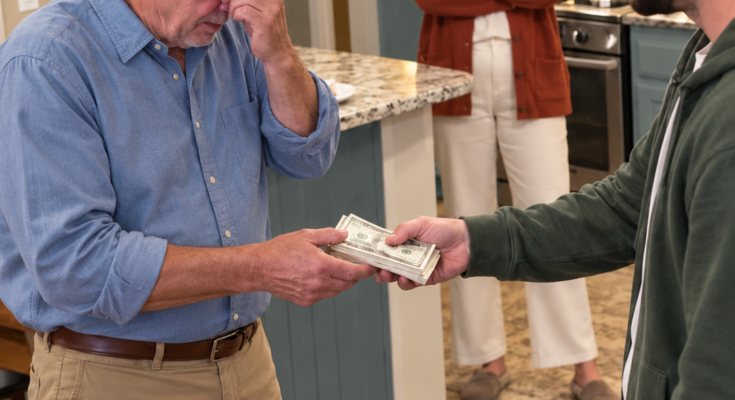
My father stood in the middle of my kitchen asking to borrow $1,000. His hands were trembling with embarrassment. Three days later, the hospital gave me a sealed envelope with one instruction: “Do not let your wife see this.”
Part One — The Envelope
My father, Raymond Mercer, almost never asked anyone for help.
He had spent more than thirty years in construction. He carried lumber, poured concrete on freezing mornings, and repaired roofs beneath brutal summer heat.
He sold his motorcycle to help with my college tuition. When I was nine, he even sold the only decent suit he owned so I could have proper shoes for school.
Dad never told me those things.
Other people did.
So when he stood beside my kitchen table with his weathered hands clasped together and asked to borrow a thousand dollars, I knew something was wrong.
“The money isn’t exactly for me, Grant,” he said. “I need certified copies of some documents. Legal help. And there’s a test I have to take.”
My wife, Natalie, folded her arms.
“There’s always some strange emergency with people who can’t manage their finances.”
“That’s enough.”
I took Dad outside.
He rubbed his palms together even though the afternoon was warm.
“I didn’t come here to cause trouble between you two. If you can’t help, I’ll understand.”
“What documents?”
He hesitated.
“Old adoption records.”
I stared at him.
“Whose adoption?”
His eyes moved toward the house.
“I need proof before I tell you everything.”
“Proof of what?”
“Because otherwise someone might say I’m getting confused.”
He swallowed.
“Or accuse me of trying to interfere with your marriage.”
I asked who he meant.
Dad wouldn’t answer.
Instead, he put one rough hand on my shoulder.
“I’m trying to give you something I should have given you a long time ago.”
I gave him the money.
Natalie was furious.
“We agreed to discuss major expenses.”
“He has never asked me for money before.”
“That doesn’t mean it won’t become a habit.”
“He’s my father.”
“And this is our house.”
That stopped me.
Because years earlier, Dad had sold the last parcel of land he inherited from his mother and given us most of our down payment.
Natalie knew that.
Three days later, the hospital called.
Dad had collapsed that morning.
An aortic aneurysm.
Emergency surgery.
By the time I reached the hospital, an attorney named Priya Desai was waiting near the intensive-care unit.
She held a large envelope.
“Your father prepared this before today,” she said. “He asked me to give it directly to you if something happened before he could speak with you.”
Across the front, in Dad’s handwriting, were six words:
GRANT ONLY. DO NOT SHOW NATALIE.
My stomach turned.
“Why?”
Priya shook her head.
“He wanted you to decide what happens after you read it.”
I opened the envelope.
The first page was a letter from Dad.
Son,
When you were seventeen, Elise Palmer became pregnant.
I stopped breathing.
Elise.
My high-school girlfriend.
We dated almost two years.
Then, halfway through senior year, her parents abruptly moved her to live with relatives in another state.
She never answered my letters.
I had spent years believing she simply wanted a clean break.
Dad’s letter continued.
Elise’s mother came to me before they left. She told me Elise was pregnant and that the family had arranged for the baby to be placed for adoption.
My hands began shaking.
They said you were too young, that telling you would destroy your future, and that Elise wanted the adoption kept closed. I told myself they were right.
I was wrong.
I lowered the paper.
Priya said nothing.
I forced myself to continue.
A daughter was born seven months later. Her name now is Leah Morgan.
Daughter.
I read the word again.
Then again.
I was forty-six years old.
And according to the paper in my hand, I had a twenty-eight-year-old daughter.
Beneath Dad’s letter were copies of records Priya had helped Leah obtain through the procedures available to her.
Her date of birth matched.
Her birth mother was Elise Palmer.
The father was not listed.
Then came the DNA report.
Dad had taken a grandparent relationship test with Leah.
The result strongly supported that Raymond Mercer was her biological grandfather.
I sat down.
“I have a daughter.”
Priya nodded gently.
“It appears so.”
Then she handed me one more page.
“This is why your father was especially worried about your wife seeing the envelope.”
It was a photocopy of a handwritten letter.
The first line said:
Leah, I received your letter. I want no relationship with you. Please do not contact me or my family again.
At the bottom was my name.
Grant Mercer.
Except I had never seen it.
And I had not written it.
The handwriting belonged to Natalie.
I knew it immediately.
The same rounded G.
The same strange way she crossed her T’s.
I felt physically sick.
“When was this sent?”
“Eighteen months ago.”
I stared at Priya.
“She contacted me eighteen months ago?”
“She mailed a letter to your home. According to Leah, this response arrived about two weeks later.”
I thought back.
Eighteen months earlier, Natalie had suddenly become obsessed with collecting the mail because she was “waiting for tax documents.”
I had thought nothing of it.
“Why did Leah contact Dad?”
“She didn’t at first. Your reply told her not to.”
Priya paused.
“But several months later, she began researching her biological family again. She found Raymond through public records and contacted him because she wanted medical history.”
My father had recognized Elise’s name.
Then he saw the letter Leah believed I had written.
He recognized Natalie’s handwriting too.
But Dad knew that if he came to me with nothing except a thirty-year-old confession and an accusation against my wife, I might think he was mistaken.
So he decided to prove everything first.
Certified documents.
Attorney.
DNA test.
The thousand dollars.
I covered my face.
All that shame in my kitchen.
He had stood there apologizing for borrowing money while trying to give me back twenty-eight years of my own life.
Then I read the final paragraph of his letter.
I made the first wrong decision, Grant. Natalie made another one years later. We both decided there was a truth you were better off not knowing.
Do not let either of us make the next decision for you.
Leah does not owe you a relationship. You do not owe her an instant father. Natalie’s actions are for you to deal with in your marriage.
I only owed you the truth.
I should have paid that debt thirty years ago.
I sat in that hospital hallway and cried.
Not because I had suddenly become somebody’s father.
Because apparently I had been one almost my entire adult life.
I just hadn’t been allowed to know.
━━━━━━━━━━━━━━━━━━━━
Part Two — The Letter I Never Wrote
Dad survived the surgery.
Barely.
The doctors warned us recovery would be slow.
I did not confront Natalie while he was still in intensive care.
I wanted facts before anger.
So I met Leah first.
Priya arranged it after asking both of us separately if we were ready.
We chose a quiet coffee shop.
When Leah walked in, I knew.
Not because she looked exactly like me.
She didn’t.
But she had my father’s eyes.
And she did the same thing I do when nervous—rubbed the side of her thumb against her index finger.
She sat across from me.
Neither of us knew what to say.
Finally she whispered:
“I don’t need money.”
That broke my heart.
“I didn’t think you did.”
“I have parents.”
“I know.”
“They’re good people.”
“I’m glad.”
She looked at me carefully.
“I’m not looking for somebody to replace my dad.”
“I wouldn’t ask you to.”
Then she reached into her bag and placed the original letter Natalie had sent on the table.
“I thought you hated me.”
I looked at my forged signature.
“I never knew you existed.”
Leah began crying.
So did I.
She asked only one thing that first day.
“If you had known?”
I couldn’t give her a fantasy.
I was seventeen.
Terrified of everything.
I might have panicked.
I might have made mistakes.
But I told her the one thing I knew.
“I would have wanted the choice to know you.”
She nodded.
“That’s what I wanted to hear.”
Not that I would have been perfect.
Just that somebody should have let us decide.
━━━━━━━━━━━━━━━━━━━━
Part Three — The Truth Nobody Gets to Own
When I finally confronted Natalie, I placed the photocopied letter on our kitchen table.
The same table where my father had stood asking for a thousand dollars.
She looked at it.
Then sat down.
She did not deny it.
That somehow hurt more.
“Why?”
Natalie started crying.
“I was scared.”
“Of my daughter?”
“Of what she would do to us.”
“What did you think she was going to do?”
“I didn’t know. Ask for money. Become part of our lives. Change everything.”
“So you answered for me?”
“I thought I was protecting our marriage.”
I stared at her.
“No. You were protecting the version of our marriage you could control.”
She flinched.
Then she said something that showed me how completely fear had justified itself in her mind.
“You were happy before she contacted you.”
I shook my head.
“I was uninformed.”
There is a difference.
A painful truth does not become kindness because somebody hides it well.
Natalie and I separated.
Not because my father told me to.
He never did.
Not because Leah demanded it.
She didn’t.
I separated because discovering my wife had impersonated me and rejected my daughter on my behalf changed something fundamental about trust.
We tried counseling.
Natalie eventually gave an honest apology without defending what she had done.
But an apology and a marriage are not the same thing.
We divorced the following year.
Quietly.
No revenge.
No attempt to punish her financially.
Just the recognition that some breaches change what a relationship can safely hold.
Dad came home from rehabilitation three months after surgery.
The first afternoon I visited, he tried to apologize.
I stopped him.
“Don’t use nearly dying to make this easier.”
He stared at me.
Then nodded.
“Fair.”
I told him I was angry.
Not because he failed to magically fix the past.
Because he had known.
He had let adults make a permanent decision for two teenagers and a baby, then kept carrying the secret after I became an adult.
Dad cried.
“I thought eventually it was too late.”
“That’s what Natalie thought too.”
His face changed.
I hated saying it.
But it was true.
Different reasons.
Same mistake.
Both had confused love with deciding what truth I was allowed to handle.
Dad whispered:
“I’m sorry.”
This time I believed him.
I did not instantly forgive him.
But we had something Natalie and I no longer had.
Time.
And he used it well.
He never pressured Leah to call him Grandpa.
Never demanded pictures.
Never told her she had to forgive him because he was old or sick.
He simply made himself available.
Leah decided when she was ready to meet him.
The first time, they sat on Dad’s porch for nearly two hours.
At the end she hugged him.
Dad cried afterward.
Then told me not to tell anybody.
I am telling everybody.
Leah and I built something slowly.
For almost a year, she called me Grant.
That was fine.
I learned about her childhood.
Her adoptive parents.
Her terrible taste in coffee.
The dog she had when she was twelve.
The fact that she had hated math but loved history.
All the ordinary facts a father normally learns as they happen.
I received them twenty-eight years late.
Sometimes that hurt.
But I learned not to make Leah comfort me for missing them.
One afternoon she said:
“You keep apologizing for years you didn’t know about.”
I looked at her.
“What should I do instead?”
“Be here for the next one.”
So I did.
Dad lived another six years.
Long enough to see Leah get married.
Long enough to meet her daughter.
Long enough for a little girl to call him Great-Grandpa Ray without knowing how complicated that name had once been.
After Dad died, Priya gave me one final envelope he had left with his papers.
Inside was a thousand dollars.
The same amount he had borrowed from me years earlier.
There was a note.
Grant,
You told me I didn’t have to pay you back. You were right.
This isn’t repayment.
Use it for something that happens because the truth finally got told.
I sat with that note for a long time.
Eventually, I called Leah.
We used the money for a weekend trip.
Nothing dramatic.
Dad would probably have laughed.
We went with her family to the small town where I grew up.
I showed her my old high school.
The construction site where Dad worked when I was little.
The diner where Elise and I used to split French fries because neither of us had money.
I did not try to recreate a childhood Leah never had with me.
You cannot backfill a life.
You can only stop missing the part that hasn’t happened yet.
Years have passed since that hospital envelope.
I think often about the three people at the center of it.
My father.
Natalie.
Me.
Dad hid a truth because he thought I was too young to handle it.
Natalie hid the same truth because she thought our marriage couldn’t survive it.
Both believed they were protecting something.
Maybe that is why secrecy is so dangerous.
It rarely introduces itself as cruelty.
Sometimes it arrives wearing the language of protection.
He’s too young.
It will hurt him.
It will destroy the family.
He’s happier not knowing.
But love does not give us ownership over someone else’s truth.
My father eventually understood that.
His last gift to me was not the thousand dollars.
Not the DNA test.
Not even the name of the daughter I had never known.
It was the sentence he wrote inside that first hospital envelope:
Do not let either of us make the next decision for you.
I didn’t.
And when Leah entered my life, I made sure I didn’t repeat the mistake with her either.
I never told her what she should call me.
How quickly she should forgive.
How often she should visit.
Whether I deserved a place in her life.
Those choices belonged to her.
Because after thirty years of people deciding what truths and relationships other people could handle, somebody finally had to stop.
So I did.