I Raised My Twin Daughters in Wheelchairs Alone After Their Mother Left When They Were 6 — On Father’s Day, 12 Years Later, They Said, “Dad, Don’t Be Mad, But We’ve Been Hiding Something from You.”
Part One — The Secret at the Kitchen Table
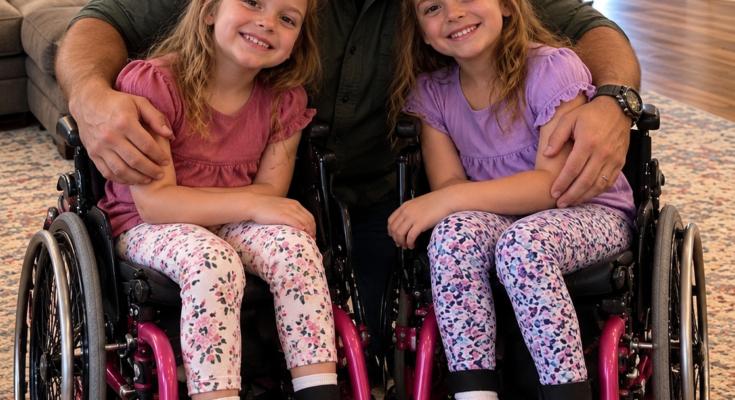
My name is Emmett, and I’ve raised my twin daughters, Brielle and Taryn, by myself since they were six years old.
Both girls were born with a spinal condition that left them unable to walk. Doctors told us when they were still very young that the damage was permanent, so wheelchairs, physical therapy, accessibility issues, and endless medical appointments simply became part of our everyday life.
Three months after the girls turned six, their mother, Colette, left.
She told me she couldn’t handle the thought of spending the rest of her life raising two children whose condition would never improve.
I was angry, hurt, and completely stunned, but I didn’t have much time to fall apart.
Brielle and Taryn still needed me.
So I stayed.
I never remarried. Between physical therapy appointments, wheelchair fittings, school meetings, insurance battles, and keeping our household running on one income, there wasn’t much room left for dating anyway.
And honestly, the three of us built a good life together.
Now Brielle and Taryn were eighteen.
They were fiercely independent, stubborn in completely different ways, and both preparing to leave for college in the fall.
I thought the hardest thing I’d face that year would be watching them move away.
Then Father’s Day came.
Usually, the girls made breakfast, gave me ridiculous handmade cards, and argued over which one had chosen the better present.
But that morning was different.
When I walked into the kitchen, both of them were already sitting at the table.
No breakfast.
No cards.
No joking.
They looked unusually serious.
“Dad,” Brielle said, “sit down.”
My stomach tightened immediately.
I sat across from them while my mind raced through every disaster a father can imagine after eighteen years of worrying about his children.
“Okay,” I said. “You’re making me nervous.”
Taryn reached across the table and took her sister’s hand.
That somehow made it worse.
Brielle looked directly at me.
“Please don’t get angry.”
“What happened?”
She hesitated.
“We’ve been keeping something from you.”
I leaned back.
“For how long?”
“A few months.”
My chest tightened.
“Why?”
Neither answered right away.
Then Taryn said quietly, “Because we didn’t want to tell you until we understood it ourselves.”
I looked from one daughter to the other.
They exchanged the kind of glance twins have when they’ve already had an entire conversation without saying a word.
Finally, Brielle took a breath.
“Mom contacted us.”
For a second, I genuinely didn’t understand what she meant.
“Mom?”
Taryn nodded.
“Colette.”
Nobody had called her Mom in our house for years.
The name hit me like a door slamming.
“When?”
“February.”
Four months.
“You’ve been talking to her for four months?”
Brielle shook her head quickly.
“Not exactly.”
“She found me on social media,” Taryn said. “She sent one message. I didn’t answer for almost two weeks.”
“What did she want?”
Taryn looked down.
“To apologize.”
I laughed once.
It wasn’t a pleasant sound.
“Twelve years later.”
“Dad—”
“No. I’m sorry.”
I stood and walked toward the sink because suddenly I couldn’t sit still.
Twelve years.
Twelve years of wheelchairs loaded into trunks.
Twelve years of fighting insurance companies.
Twelve years of fevers at two in the morning, inaccessible bathrooms, broken ramps, school meetings, surgeries, teenage heartbreak, college applications.
Twelve years of birthdays she never called for.
And now she wanted to apologize.
“Have you met her?”
Silence.
I turned around.
That was my answer.
“When?”
Brielle swallowed.
“Twice.”
I felt something inside me drop.
“You met her?”
“We didn’t go alone,” Taryn said quickly. “Aunt Lydia knew.”
“My sister knew?”
“She came with us the first time.”
That hurt too.
Suddenly, I was the only person in my own family who didn’t know.
I looked at both of them.
“Why would you hide this from me?”
Brielle’s eyes filled.
“Because we knew this is what would happen.”
“What would happen?”
“You’d think we were choosing her.”
I stopped.
Taryn wiped her face.
“We weren’t.”
Then Brielle said something I wasn’t prepared for.
“We needed to know why she left from her, Dad. Not from you.”
I stared at her.
“I told you why she left.”
“I know.”
“And I never lied.”
“We know that too.”
Taryn’s voice softened.
“But your version was the version of a husband who got abandoned too.”
That hurt because it was true.
I had always tried to speak carefully about Colette.
I never called her names in front of the girls.
Never told them they weren’t enough.
But every version of the story still passed through my pain before it reached them.
Brielle reached into her backpack and pulled out an envelope.
“She wrote us letters.”
I didn’t touch them.
“What did she say?”
“That she was afraid.”
I almost laughed again.
“We were all afraid.”
“I know.”
Brielle’s voice became firmer.
“She said that doesn’t excuse it.”
That stopped me.
Taryn continued.
“She said she spent years telling herself she left because she wasn’t strong enough, like that made it less awful. Then she finally admitted the truth.”
“What truth?”
Taryn looked directly at me.
“She thought our lives were going to be nothing but suffering.”
My hands curled against the counter.
“She was wrong.”
“We told her.”
Brielle smiled faintly.
“Pretty aggressively.”
Despite everything, I nearly smiled.
Then Taryn said:
“She said seeing us now forced her to understand what she had decided about us before we were even old enough to decide anything for ourselves.”
I looked at their wheelchairs.
At Brielle’s scratched frame covered with stickers.
At Taryn’s bright blue spokes.
Things I stopped seeing as symbols years ago.
They were simply how my daughters moved through the world.
Colette had once looked at those chairs and seen a life sentence.
I had looked at them and seen two kids who needed to get to school.
Maybe that difference had shaped everything.
“Do you want her back in your lives?” I asked.
Neither answered immediately.
Then Brielle said:
“We don’t know.”
Not yes.
Not no.
Just the truth.
Taryn reached for my hand.
“Dad, that’s what we’ve been hiding.”
I sat down again.
She held on.
“We’re not asking you to forgive her.”
Brielle nodded.
“And we’re not pretending what she did was okay.”
“Then what are you asking?”
Taryn’s eyes filled.
“For you to let this be ours.”
I frowned.
She continued.
“You spent twelve years protecting us from everything you could.”
Then she smiled sadly.
“But you can’t protect us from having a mother who left.”
That sentence broke something open in me.
Not anger.
Something underneath it.
Fear.
I had spent years believing that if I loved them enough, stayed enough, sacrificed enough, maybe the empty chair their mother left behind would stop mattering.
It never had.
Not entirely.
Brielle leaned forward.
“You taught us that being disabled doesn’t mean other people get to make decisions for us.”
I nodded slowly.
“Yeah.”
“So this has to count too.”
I closed my eyes.
Of course it did.
I hated that it did.
But it did.
━━━━━━━━━━━━━━━━━━━━
Part Two — What Colette Said
I didn’t meet Colette that day.
I wasn’t ready.
Instead, the girls told me what their two meetings had actually looked like.
No dramatic reunion.
No running into each other’s arms.
The first time, they met in a quiet restaurant with my sister sitting two tables away.
Colette cried before either girl did.
Brielle hated that.
“I told her she didn’t get to make us comfort her.”
I almost laughed.
“That sounds like you.”
“She agreed.”
Colette had remarried but never had other children.
She said she had spent years checking school websites, social media, anything public enough that she could see whether the girls were okay without intruding.
Taryn asked the obvious question.
“If you knew where we were, why didn’t you come back?”
Colette said:
“Because after a while, I wasn’t staying away for you. I was staying away because I was ashamed.”
There was no noble explanation.
No hidden illness.
No secret sacrifice that magically transformed abandonment into love.
She left because she was overwhelmed, frightened, and selfish.
Then shame became another excuse.
Brielle asked whether Colette wanted forgiveness.
She said:
“I want the chance to become someone you can know. Forgiveness is yours to decide.”
That answer mattered to them.
It mattered to me too, although I wasn’t ready to admit it.
Then Taryn told me the reason they chose Father’s Day to finally tell me.
“We didn’t want this secret following us to college.”
Brielle added:
“And because we need you to understand something before we leave.”
“What?”
She smiled.
“Knowing her doesn’t change who raised us.”
Taryn squeezed my hand.
“You’re Dad.”
Three letters.
One syllable.
Eighteen years.
That was all.
━━━━━━━━━━━━━━━━━━━━
Part Three — The Chair We Stopped Keeping Empty
I met Colette three months later.
Not because the girls demanded it.
They didn’t.
I chose to.
We met at the same kitchen table where the girls had told me the truth.
Colette looked older.
Of course she did.
So did I.
For twelve years, I had sometimes imagined seeing her again.
In those fantasies, I always had the perfect speech.
Something sharp.
Something that would make her understand every night she missed.
When she actually sat across from me, I had nothing rehearsed left.
She looked around the kitchen.
“You changed the cabinets.”
“Wheelchair clearance.”
She nodded.
Then she began crying.
I immediately felt irritated.
“Please don’t do that.”
She wiped her face.
“Sorry.”
“No, I mean… don’t make me take care of you.”
She went still.
“I won’t.”
That helped.
For almost an hour, we talked.
Not as husband and wife.
That relationship had ended long ago.
As two people connected permanently by the same daughters.
At one point she said:
“I know you hate me.”
I thought about it.
“I did.”
She looked down.
“But hate is exhausting.”
Her eyes filled again.
“I don’t know what I feel now.”
“That’s fair.”
Then I asked the question that still bothered me most.
“Why now?”
Colette folded her hands.
“Because I found Brielle’s college interview online.”
Apparently Brielle had spoken about accessible campus design for a student program.
Colette watched this confident eighteen-year-old explain ramps, transportation, independence, and disability rights.
“She was funny,” Colette whispered.
“She thinks she is.”
I smiled despite myself.
“And I realized something.”
“What?”
“I had spent twelve years thinking I left because I couldn’t bear watching my daughters have limited lives.”
She looked toward the hallway.
“But the limitation was mine.”
That was the first thing she said that truly reached me.
Not because it erased anything.
It didn’t.
But because she finally understood that our daughters had never been the tragedy.
Her inability to imagine their lives had been.
The girls left for college that fall.
Different universities.
Different states.
That nearly killed me.
For eighteen years, I had built my schedule around them.
Suddenly, my refrigerator contained food nobody ate.
The hallway was too wide.
The bathroom modifications remained, but no music blasted through the door.
For the first month, I called too often.
Brielle finally said:
“Dad, if I’m dead, campus security will tell you.”
“Very comforting.”
Taryn was worse.
She would ignore three texts and then call at midnight because she couldn’t open a jar.
“I raised you better than this.”
“I’m disabled, Dad. Not magically good at pickles.”
I mailed her a jar opener.
She sent me a photograph of it captioned:
Helicopter parenting, but useful.
Colette’s relationship with them developed slowly.
She visited each campus once.
Only after being invited.
She never introduced herself as though twelve missing years had vanished.
Sometimes the girls answered her calls.
Sometimes they didn’t.
There were setbacks.
One Christmas, Colette started talking about “making up for lost time.”
Brielle stopped her.
“You can’t.”
The room went quiet.
Brielle continued.
“We can make new time. That’s different.”
Colette nodded.
Then said:
“You’re right.”
I noticed things like that.
Not apologies.
Behavior.
That was what eventually made me believe she had changed.
Not enough to rewrite the past.
Enough to stop repeating it.
Two years later, Taryn invited Colette to a college award ceremony.
Then called me immediately afterward.
“You’re coming too.”
“I assumed.”
“No drama.”
“From me?”
“Yes.”
“Your confidence in your father is touching.”
At the ceremony, Colette sat three seats away from me.
When Taryn’s name was called, we both stood.
For one awkward second, we looked at each other.
Then we laughed.
Because of course we were both standing.
She was her mother.
I was her father.
One truth didn’t cancel the other.
Years later, people sometimes asked whether I forgave Colette.
I never found a clean answer.
Forgiveness makes good endings in stories because it fits into one sentence.
Real life rarely does.
I stopped wanting revenge.
I stopped needing her to suffer enough to equal what she had caused.
I became capable of sitting across from her at graduations, birthdays, and eventually weddings without replaying 2008 in my head.
Maybe that was forgiveness.
Maybe it was simply peace.
The girls made their own decisions.
Brielle eventually became close to her mother.
Taryn remained more guarded.
Neither choice was wrong.
That was another lesson I had to learn.
Twins share birthdays.
They do not owe anyone identical feelings.
When I turned sixty, the girls came home for Father’s Day.
By then they were twenty-eight.
Brielle worked in accessibility consulting.
Taryn was finishing graduate school.
They arrived carrying grocery bags, arguing before they even reached the kitchen.
“Dad, she bought the wrong pancake mix.”
“It’s pancake mix.”
“Exactly. How do you get that wrong?”
Ten years had passed, and apparently nothing important had changed.
After breakfast, they handed me a box.
Inside were Father’s Day cards.
Not store-bought.
Handmade.
Like when they were little.
Brielle’s had crooked marker lettering.
Taryn had drawn our old kitchen table.
I opened hers first.
Inside she had written:
Dad, thank you for staying.
I had heard versions of that before.
But underneath was another sentence.
And thank you for eventually understanding that staying didn’t mean holding on too tightly.
I sat there for a long time.
Brielle nudged me.
“You’re doing the dad face.”
“What dad face?”
“The one where you pretend you’re not crying.”
“I have allergies.”
“In June?”
“Very aggressive pollen.”
They laughed.
Then I looked at both of them.
There was something I had finally understood over the years.
For a long time, I had built my identity around one fact:
I stayed.
Colette left.
I stayed.
That was true.
And staying mattered.
Showing up mattered.
Packing wheelchairs into cars, learning insurance codes, sitting through surgeries, making lunches, fixing ramps, and being there when your children wake from nightmares—those things matter enormously.
But fatherhood was never supposed to become a debt my daughters owed me.
They did not have to reject their mother to prove they appreciated me.
They did not have to remain close to home because I had sacrificed for them.
They did not have to carry my anger because I once carried their wheelchairs.
That was the truth hidden inside that Father’s Day conversation years earlier.
I had raised two girls to believe their bodies belonged to them.
Their futures belonged to them.
Their choices belonged to them.
Eventually, they asked me to believe their hearts belonged to them too.
That morning, I looked at Taryn’s drawing of our kitchen table.
So much of our life had happened around it.
Homework.
Medication.
College applications.
Arguments.
Father’s Day pancakes.
And one conversation I had once believed might take my daughters away from me.
It didn’t.
Nothing was taken.
The table simply became big enough to hold a truth I had not been ready for.
Colette had left.
I had stayed.
The girls had been hurt.
They had also grown into women capable of deciding what happened next.
And the greatest thing I ever did as their father was not that I raised them alone.
It was that, when the time came, I finally understood they were never mine to keep.