
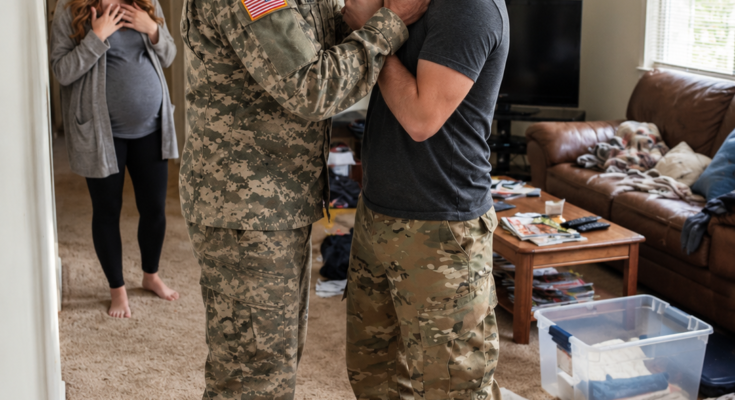
Part One — The Day I Saw What My Daughter Was Hiding
For most of my adult life, I trained Marines to stay steady when fear, exhaustion, and chaos stripped everything else away. Technically, the Marine Corps called men like me drill instructors, but civilians always called us drill sergeants, and after retirement I stopped correcting anybody. To my daughter Emily, I wanted to be Dad. To the baby she was carrying, I wanted to be Grandpa—not retired Master Sergeant Thomas Hale, the man whose voice could once make an entire squad bay go silent.
That Tuesday afternoon, I arrived at Emily’s suburban home carrying a yellow gift bag with a teddy bear for my future grandson. She was eight months pregnant, and I had promised to help assemble the crib. The second she opened the door, I knew something was wrong. Her face was pale. Her eyes kept drifting toward the living room. She spoke softly, almost automatically, as though every sentence had to pass through an invisible checkpoint before she said it.
“Did you ask Brandon about the crib?” I asked. “I can put it together today.”
“He’s busy, Dad. It’s a tournament. Online rankings.”
Brandon, my thirty-year-old son-in-law, was sprawled across the sectional surrounded by energy-drink cans, takeout boxes, and enough snack wrappers to provision a small platoon. Without looking away from the television, he shouted, “Emily! Mountain Dew. Red one. Now.”
Emily moved immediately.
That bothered me.
Not because spouses never grab drinks for each other. Because she moved before he had even finished speaking.
I followed her into the kitchen. When she reached for a glass, her sleeve slipped upward. Makeup had been rubbed across part of her upper arm, and beneath it were fading marks that looked disturbingly like fingers.
“Emily.”
She pulled the sleeve down.
“What happened?”
“Nothing.”
“That doesn’t look like nothing.”
“I hit the pantry door.”
“You have five separate pantry doors shaped like fingers?”
Her eyes filled, but before she could answer, Brandon shouted again.
“Emily!”
She flinched.
That frightened me more than the bruising.
She carried the drink back into the living room. Brandon finally paused his game and pointed toward a dark mark near the baseboard.
“I told you to clean that.”
“I was going to after lunch.”
“You were going to? Look at this place.”
He picked up a scrub brush and dropped it at her feet.
“Clean it properly. You want dinner? Earn it. Miss a spot and you don’t eat.”
Emily looked at me.
Then, to my horror, she began lowering herself toward the floor.
Eight months pregnant.
Swollen ankles.
One hand supporting her back.
Something inside me became very calm.
I walked to the entertainment center and pulled the power cord.
The screen went black.
Brandon jumped from the couch.
“You crazy old fool! That was a ranked match!”
He came toward me fast.
I put one hand up. “Stop.”
He didn’t.
He shoved my shoulder.
Thirty years earlier, that would have been a very poor decision for several reasons. At sixty-two, I was slower, but I still knew how to keep someone from putting hands on me without turning a living room into a battlefield. I redirected his arm, moved him away from Emily, and put him against the wall long enough for him to understand that charging me again was not going to improve his afternoon.
Then I let him go.
He stumbled backward, shocked more than injured.
I stepped between him and my daughter.
“Listen carefully, boy.”
He stared at me.
“Training starts now.”
His mouth opened.
I pointed toward the couch.
“Sit.”
Something in my voice reached a part of his brain that had not existed five seconds earlier.
He sat.
Emily whispered, “Dad…”
I turned toward her.
“Get your purse.”
Brandon stood again. “She’s not going anywhere.”
I looked at him.
“Sit down.”
This time he did.
Emily didn’t move.
That told me everything.
So I softened my voice.
“Sweetheart, look at me.”
She did.
“Do you want to leave?”
Her mouth trembled.
“I don’t know.”
“That’s okay.”
I pointed toward the kitchen.
“Then we’re going to stand over there for a minute, and nobody is making the decision except you.”
Brandon laughed nervously. “This is ridiculous. She’s emotional because she’s pregnant.”
I looked back at him.
“You’ve spoken enough.”
“I’m her husband.”
“And that does not make you her commanding officer.”
That shut him up.
In the kitchen, Emily began crying before I said anything.
“I’m sorry.”
Those were her first words.
Not help me.
Not he hurt me.
I’m sorry.
For what?
For making me see it?
For embarrassing him?
For not hiding the bruises well enough?
I put my hands on the counter because I didn’t trust myself to touch anything else.
“You have nothing to apologize for.”
“He’s been under pressure.”
“That is not an explanation for those marks.”
“He doesn’t always—”
“Emily.”
She stopped.
“Has he hurt you?”
Her eyes dropped.
I waited.
For years, I trained young Marines to answer quickly. That afternoon, I understood that pushing someone frightened into a fast answer can be another kind of pressure.
So I waited.
Finally, she nodded.
Once.
Barely.
But enough.
I took out my phone.
Brandon heard the keypad.
“What are you doing?”
I looked at my daughter.
“I’m asking what she wants me to do next.”
Emily wiped her face.
Then she said, “Call someone.”
So I did.
Not my old Marine buddies.
Not some group of men ready to frighten Brandon.
I called the police.
That was when Brandon finally understood that “training” did not mean I was going to teach him push-ups.
It meant he was about to learn something he should have learned years earlier.
Actions have consequences.
━━━━━━━━━━━━━━━━━━━━
Part Two — The Things I Had Mistaken for Marriage Problems
The police arrived, took statements, and separated everyone. Because Emily described physical incidents and showed visible injuries, officers documented what they could and explained the next steps. I stayed beside her, but I did not answer for her. That was important. Brandon had apparently spent months deciding what she could say, spend, wear, eat, and do. I wasn’t going to replace his control with mine, even if I thought I knew what was best.
Emily came home with me that night. On the drive, she stared out the window and said, “You probably think I’m weak.”
I nearly pulled over.
“No.”
“I stayed.”
“People stay for complicated reasons.”
“You would never have stayed.”
I thought about that.
“Maybe not. But I spent twenty-four years in an institution that taught me how to function under pressure, how to identify threats, and how to act decisively. You spent the last two years being told your judgment was wrong every time you used it. Those are not the same starting conditions.”
She looked at me.
Then she started crying.
Over the next few days, the rest came out. Brandon had not become cruel overnight. He began with jokes about her weight after the pregnancy. Then criticism about money. Then passwords. He insisted on seeing her bank account because married couples “shouldn’t have secrets,” while refusing to show her his. He discouraged her from seeing friends because they were “bad influences.” When she objected, he told her pregnancy hormones made her irrational.
The first time he grabbed her arm hard enough to bruise, he cried afterward.
The second time, he blamed her.
By the tenth time, neither of them discussed it.
That progression haunted me.
Not because I believed I should have magically known everything.
Because there had been signs.
Emily stopped visiting without Brandon.
She stopped laughing easily.
She began asking permission to buy things with money she earned.
Once, when I invited her to lunch, she said, “Let me see if Brandon needs me that day.”
I thought she was being considerate.
Now I understood she had been checking whether she was allowed.
With help from an attorney and a domestic-violence advocate, Emily began making decisions about housing, finances, medical care, and the baby. Brandon called constantly at first. Then he apologized. Then accused her of destroying the family. Then apologized again.
I asked whether she wanted me to block him.
She shook her head.
“No. I need to learn to do things myself again.”
So she blocked him.
That was the first decision I watched her make without looking at anyone else’s face for approval.
It was small.
It was enormous.
━━━━━━━━━━━━━━━━━━━━
Part Three — What “Training” Really Meant
My grandson was born six weeks later.
His name is Marcus.
Emily chose the name after my late wife’s father, not after anyone from my military life. I was grateful for that because I had already spent enough decades around men named after other men.
Marcus was seven pounds, nine ounces, furious about being born, and possessed lungs I would have admired in any recruit.
I held him for the first time while Emily slept.
I looked at his tiny hand around my finger and thought about the moment I had found his mother kneeling toward a dirty floor because her husband had told her food was conditional.
I made myself a promise.
I would never teach that boy masculinity meant domination.
I had seen too many men confuse discipline with cruelty.
They are not the same thing.
Discipline begins with controlling yourself.
Brandon’s legal situation developed over time. I won’t pretend the system transformed everything overnight. There were hearings, statements, legal restrictions, parenting issues to resolve after Marcus was born, and a great deal of documentation. Emily followed professional advice and kept her focus on safety rather than revenge.
Brandon continued insisting I had “turned her against him.”
That was almost funny.
For months, Emily had barely disagreed with anyone because disagreement frightened her.
The woman who eventually stood in court and spoke clearly about what had happened did not look turned against anyone.
She looked returned to herself.
She rented a small apartment near me.
The first week, I came over with a toolbox.
She opened the door and narrowed her eyes.
“What are you doing?”
“Fixing things.”
“What things?”
I looked around.
Nothing was broken.
“That shelf looks questionable.”
“Dad.”
“The hinge on that cabinet—”
“Dad.”
I stopped.
She smiled.
“You’re doing it too.”
That hurt.
“Doing what?”
“Deciding what I need before I tell you.”
I looked at the toolbox in my hand.
She was right.
Different motive.
Same habit.
I put it down.
“Would you like help with anything?”
She looked around theatrically.
“The crib squeaks.”
“Permission to engage?”
She laughed.
“Granted.”
That became another lesson.
I had spent my career issuing instructions.
Emily needed a father who could ask.
Over the following year, she rebuilt her life in ways that looked unimpressive from the outside.
She opened a checking account only she controlled.
She returned to work part-time.
She started meeting her friend Nicole for coffee again.
She bought a red coat because Brandon used to say red made her look “attention-seeking.”
The first time she wore it, she stood in front of my kitchen mirror for several seconds.
“What?”
“Nothing.”
“You’re staring.”
“I like the coat.”
She smiled.
“So do I.”
That was enough.
Then, about eighteen months after the day I unplugged Brandon’s game, Emily asked whether I would attend one of her therapy sessions.
I assumed she wanted to discuss Brandon.
She didn’t.
She wanted to discuss me.
That was humbling.
Her therapist asked what growing up with a retired Marine father had been like.
Emily laughed.
“Organized.”
I frowned.
She continued. “Dad wasn’t mean. But everything had a right way. Shoes went here. Homework happened then. If I had a problem, he immediately tried to solve it.”
I started to defend myself.
Then stopped.
Emily noticed.
“That right there is progress.”
I looked at her.
She smiled.
“I always knew you loved me. But sometimes I needed you to listen instead of make a plan.”
I thought about the afternoon at her house.
I had arrived ready to assemble a crib.
Within an hour, I was coordinating a crisis.
Solving problems is comfortable for me.
Sitting beside pain I cannot fix is harder.
So I learned.
Slowly.
When Marcus had colic, sometimes I held him while Emily slept.
When she cried after difficult legal meetings, sometimes I did not say anything useful.
I simply made coffee.
The Marines had taught me that people need leadership under pressure.
My daughter taught me that sometimes leadership means not taking command.
Two years after she left Brandon, Emily bought a small townhouse.
Nothing fancy.
Two bedrooms.
A patch of grass out back.
A kitchen warm enough that she once joked she could finally scrub the floor without freezing.
I did not laugh at first.
She did.
“Dad, it’s okay.”
“Still not funny to me.”
“It’s getting funny to me.”
That mattered.
Healing sometimes looks like reclaiming what used to hurt.
For Christmas that year, she invited me over.
I arrived early because apparently retirement has not cured me of that.
Marcus, now a toddler, was pushing a plastic truck across the floor.
Emily was cooking.
Music was playing.
The house was messy.
Beautifully messy.
Toys beneath the couch.
A cereal bowl in the sink.
A tiny sock on the stairs.
Nobody was inspecting baseboards.
I sat at the kitchen table.
Emily handed me potatoes.
“Peel.”
I looked at her.
“Was that an order?”
“Absolutely.”
“Careful.”
She smiled.
“You’re in my house now.”
Fair enough.
Later, after dinner, Marcus spilled milk.
He froze.
Just for a second.
Maybe because every toddler freezes when adults suddenly look toward them.
Emily immediately said, “It’s okay. Accidents happen.”
She grabbed a towel.
Marcus tried helping.
The mess got worse.
Emily laughed.
Watching her, I realized something had changed deeper than addresses or legal papers.
She was building a home where mistakes did not threaten belonging.
That night, after Marcus went to sleep, she brought something from the closet.
The yellow gift bag I had carried to her house two years earlier.
Inside was the teddy bear.
“You kept it.”
“Of course.”
“I thought it disappeared during everything.”
“No.”
She handed it to me.
“Marcus sleeps with it sometimes.”
I touched one of its ears.
Then Emily said, “Do you remember what you told Brandon?”
I knew exactly what she meant.
“Training starts now.”
She laughed.
“That was very dramatic.”
“I was under stress.”
“You loved it.”
“A little.”
Then her expression softened.
“You know what I thought you meant?”
“What?”
“I thought you were going to beat him up.”
I shook my head.
“That would have solved almost nothing.”
“I know that now.”
I looked toward the hallway where my grandson was sleeping.
“What I should have said was, ‘Consequences start now.’”
Emily nodded.
“That’s less catchy.”
“Much.”
We sat quietly.
Then she said, “You know what training actually started that day?”
I looked at her.
“Mine.”
That surprised me.
She continued. “I had to relearn everything. Saying no. Spending my own money. Making decisions without checking somebody’s face. Trusting myself.”
Then she smiled.
“And yours.”
I laughed.
“Yes.”
“Learning not to command everybody.”
“Still working on it.”
“Very much.”
I’m sixty-four now.
People who know my military background sometimes expect me to tell this story as though the important part was an old Marine putting a younger bully in his place.
That isn’t the part I am proudest of.
Yes, I stopped him from getting closer to my daughter.
Yes, I stood my ground.
But strength wasn’t what happened against that wall.
Strength was Emily saying yes when I asked whether she wanted help.
Strength was giving a statement even though she was terrified.
Strength was blocking his number.
Opening her own account.
Wearing the red coat.
Buying the townhouse.
Letting herself laugh again.
And strength was me understanding that my daughter did not need another man ordering her life, even if that man loved her.
The afternoon I shut off Brandon’s video game, I told him:
“Training starts now.”
I meant him.
Years later, I understand I was wrong.
The person with the most to learn was not only Brandon.
It was all of us.
Emily had to learn that love does not require obedience.
I had to learn that protection does not require control.
And someday, when Marcus is old enough to understand any of this, I hope we teach him the simplest lesson of all:
A strong man is not the one who can make everyone else afraid of him.
A strong man is the one nobody in his home has to be afraid of.