Part One — The Girl in the Third Row
Every December, Gwen Ellis sat at the same scratched oak table, opened the same red tin of Christmas cards, and wrote to someone who never answered. Her handwriting had become shakier with age, but the message was always nearly the same: I hope you are safe. I hope you are happy. I hope you know someone still remembers you.
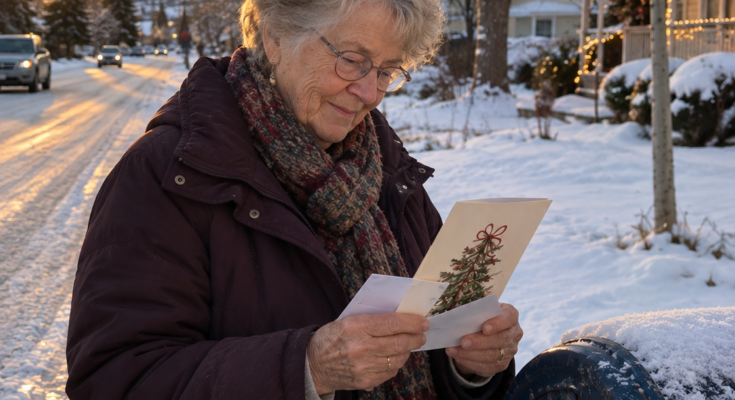
Then Gwen would slip the card into a cream-colored envelope, write an address three states away, and walk it to the blue mailbox at the end of her snowy Montana street. She had done it for twenty-two Christmases. In twenty-two years, not one card had ever come back. Not one reply. Not even a note saying she had the wrong person.
Her neighbor, Carol, had watched the ritual for years. Carol knew Gwen was seventy-four, retired, widowed, and living alone in the little house where she and her husband had raised their only daughter. She also knew Gwen and that daughter, Laura, hadn’t spoken in nearly six years. The reason was complicated. A family argument had turned cruel, old resentments had surfaced, and words were said that neither woman knew how to take back.
So Carol assumed the Christmas card was Gwen’s way of reaching across that silence. One December afternoon, while they were drinking coffee and watching snow collect against the window, Carol finally asked. “Is it for Laura?” Gwen looked up. “What?” Carol nodded toward the envelope. “The card you mail every Christmas.”
For a moment, Gwen said nothing. Then she smiled faintly. “No.”
She stood, crossed the kitchen, and opened the bottom drawer of an old desk. Inside was a faded school photograph. A girl of maybe thirteen stared into the camera with thin shoulders, dark hair cut unevenly at the jaw, and a smile that looked like someone had ordered her to make one.
“Her name was Rebecca,” Gwen said.
Gwen had taught seventh-grade English for thirty-eight years. Thousands of students passed through her classroom, but she remembered Rebecca’s desk. Third row. Near the radiator. She remembered how the girl wore long sleeves even after spring warmed the valley. She remembered the lunches Rebecca never brought, the way she jumped when someone dropped a textbook, and the essay.
The assignment had been simple: Describe the safest place you know. Most students wrote about bedrooms, grandparents’ kitchens, fishing boats, barns, treehouses. Rebecca wrote three sentences.
The safest place I know is school.
People can hear you here.
At home, nobody can.
Gwen read those words three times. Then she walked straight to the school counselor. Some adults warned her not to jump to conclusions. One person suggested Rebecca was probably being dramatic. Another said families had private matters and teachers needed to be careful.
Gwen didn’t know exactly what was happening in that house. But she knew fear when she saw it. So she reported what she had seen and what Rebecca had written.
Within days, everything changed.
Rebecca stopped coming to school. Gwen later learned the girl had been removed from the home and placed in foster care. Then she was transferred out of the county. Privacy rules meant nobody could tell Gwen much after that.
Years passed. Students grew up. Gwen retired. Her husband, Frank, became ill and eventually died. Her own family grew smaller. But Rebecca remained in the back of her mind.
“How did you get the address?” Carol asked.
“Years later, a former counselor heard she was living with a foster family in another state. She couldn’t tell me details. Just the town.”
Gwen sent the first Christmas card to that town using the only last name she knew. Months later, it returned with a forwarding sticker. She tried again.
The next one did not come back.
She had no idea whether Rebecca received it.
Still, Gwen kept sending them.
Every Christmas.
Through address changes.
Through retirement.
Through Frank’s illness.
Through the year she had cataract surgery and could barely see the lines on the card.
Through the first Christmas after Laura stopped calling.
Carol stared at her. “You never got an answer?”
Gwen shook her head.
“Then why keep doing it?”
The retired teacher looked toward the snowy backyard.
“Because children remember when adults disappear.”
She paused.
“I wanted her to know at least one hadn’t.”
That Christmas was the twenty-third card. Gwen chose one with a simple painting of a pine tree covered in snow. She wrote the familiar words: I hope you are safe. I hope you are happy. I hope you know someone still remembers you. Then, after a long hesitation, she added one more sentence.
You never owed me an answer.
She mailed it three days before Christmas.
On December 27, Gwen shuffled outside in slippers and an old wool coat to check the mailbox. Bills. A grocery advertisement. A catalog.
And one white envelope with handwriting she did not recognize.
The return address was from another state.
Gwen stood beside the mailbox staring at it. She didn’t open it outside. She walked slowly back to the kitchen, sat down, placed the envelope on the oak table, and cried before breaking the seal.
Inside was a Christmas card.
No long letter.
No explanation.
Just a photograph.
A woman in her forties stood on a front porch with three children gathered around her. Two teenage boys. One little girl missing a front tooth. A dog lay at their feet. A wreath hung crookedly on the door behind them.
They looked ordinary.
Happy.
Safe.
On the back of the photograph were seven words.
You were the first adult who believed me.
Gwen pressed the picture against her chest.
Carol happened to stop by that afternoon and found her sitting in the kitchen with tears running down her face. Gwen couldn’t speak at first. She simply handed over the photograph.
Carol read the sentence.
Then she understood.
Twenty-two years of cards.
Twenty-two years of silence.
Twenty-two years of not knowing whether the frightened girl from the third row had grown up, survived, built a life, or ever remembered the teacher who had spoken up.
And all along, Gwen thought she had been sending Christmas cards into darkness.
Someone had been receiving the light.
A week later, Gwen bought a small wooden frame and placed Rebecca’s family photograph on the shelf beside pictures of Frank and Laura.
Then she did something else.
She wrote one more letter.
This one was not to Rebecca.
It was to her own daughter.
━━━━━━━━━━━━━━━━━━━━
Part Two — The Letter Gwen Had Been Too Proud to Write
Gwen had written hundreds of letters in her life. Recommendation letters. Condolence letters. Notes to parents. Thank-you cards. Birthday cards. Christmas cards to a former student who never answered.
The one to Laura took four days.
She kept starting with explanations.
Then defenses.
Then memories.
Each time, she tore the page in half.
Finally, she wrote only what she knew was true.
Laura, I have spent twenty-two years telling someone else that she never owed me an answer. Somehow I never offered you the same grace.
Gwen stopped there for almost an hour.
The argument with Laura had happened six years earlier, after Frank died. Laura had driven from Idaho to help sort through the house. She wanted Gwen to sell it and move closer to her family. Gwen refused. Laura pushed harder. Gwen accused her of trying to erase Frank.
That opened older wounds.
Laura said Gwen had always cared more about students than about her own daughter.
Gwen called that cruel.
Laura said it was true.
She reminded Gwen of school plays missed because a student was in crisis. Dinners delayed because parents needed meetings. Weekends interrupted by phone calls. Summers spent tutoring children whose families couldn’t afford it.
Gwen defended every one of those choices.
Most of them had been good choices.
That was not the same thing as saying they had cost nothing.
Laura finally said, “You always had patience for everybody else’s children. With me, you expected me to understand.”
Gwen replied with the sentence that ended everything.
“Maybe if you had needed me the way they did, I would have known how to help you.”
Laura went completely still.
Then she picked up her suitcase.
Gwen knew the moment the words left her mouth that they were unforgivable.
But pride is a strange thing. Sometimes shame makes people apologize. Sometimes it makes them double down because admitting what they did feels unbearable.
Gwen did the second.
Laura left.
Phone calls became shorter.
Then stopped.
Birthdays passed.
Gwen sent cards, but they were stiff and ordinary.
Thinking of you. Hope everyone is well.
Never:
I was wrong.
Never:
You needed me too.
Never:
I hurt you because I was trying to defend the version of myself I could live with.
Rebecca’s photograph changed that.
Gwen went back to the letter.
You were right about something I was too defensive to hear. I knew how to notice pain when children showed it in ways I understood. I did not always notice yours because you were capable, bright, and good at making your own way. I confused needing less help with needing less of me.
She wiped her eyes.
Then wrote:
I am not asking you to forgive me because I am old, because I am alone, or because your father is gone. I am asking you to know that I finally understand the difference between explaining myself and apologizing.
She told Laura about Rebecca.
Not to make herself look noble.
That mattered.
Gwen resisted the temptation to write, Look how much good I did.
Instead she wrote:
This week I received a photograph from a student I tried to help many years ago. On the back she wrote that I was the first adult who believed her. I should have felt proud. Instead, all I could think was that I spent twenty-two years telling Rebecca she never owed me a response, while quietly believing you owed me one because I was your mother.
At the bottom she added:
You owe me nothing, Laura. Not a call. Not forgiveness. Not Christmas. I love you. I am sorry.
She mailed it.
Then waited.
January passed.
No answer.
February too.
By March, Carol began finding excuses to visit more often. Gwen pretended not to notice.
“You know,” Carol said one afternoon, “you told Rebecca she never owed you an answer.”
“I know.”
“You may have to mean it.”
Gwen gave her a look.
“I liked you better before you became wise.”
“I was always wise. You were distracted.”
Gwen laughed.
Spring arrived slowly in Montana. Snow withdrew from the yard in dirty patches. Crocuses appeared beside the front steps. Gwen began walking farther each morning.
Then, one Saturday in April, a dark SUV stopped in front of the house.
Gwen was kneeling beside a flower bed when she heard a car door close.
She looked up.
Laura stood at the end of the walkway.
Six years changed people in small ways. More gray in her hair. Glasses Gwen had never seen. A tiredness around her eyes.
Neither woman moved.
Then Laura said, “You still plant those ugly yellow tulips.”
Gwen sat back on her heels.
“Your father liked them.”
“Dad had terrible taste.”
“He married me.”
Laura’s mouth twitched.
It wasn’t forgiveness.
But it was something.
Gwen stood slowly.
“You came.”
Laura looked toward the porch.
“I almost didn’t.”
“I understand.”
“No, Mom. I don’t think you do.”
Gwen nodded.
“Then tell me.”
So Laura did.
For the next two hours, they sat at the scratched oak table while Laura told her mother what the argument had really been about.
Not the house.
Not Frank.
Not even the missed school plays.
It was about being the child everybody assumed was fine.
Students cried in Gwen’s classroom and received attention.
Laura got good grades and received independence.
Students needed rides, meals, advocates.
Laura learned not to ask.
“When Dad got sick,” Laura said, “I was scared too.”
“I know that now.”
“You kept asking how he was coping.”
Gwen lowered her eyes.
“I should have asked you.”
“Yes.”
“I’m sorry.”
Laura nodded.
Then came the harder part.
“Your letter helped,” she said. “But I don’t know how to go back.”
Gwen looked at her.
“We don’t.”
Laura frowned.
“We can’t go back. We can only decide what we do from here.”
That was something Gwen had told students countless times after mistakes.
She had never understood how hard it was to live.
Laura stayed for dinner.
She did not stay overnight.
Before leaving, she stood beside the shelf in the living room and noticed Rebecca’s photograph.
“So that’s her?”
“Yes.”
Laura picked up the frame.
“She looks happy.”
“I think she is.”
“Did she write anything else?”
“Seven words.”
Laura turned the photograph over.
Her expression softened.
Then she said, “Mom?”
“Yes?”
“I don’t think you were wrong to help her.”
Gwen’s throat tightened.
“I know.”
“I was angry for a long time, and sometimes I made it sound like every child you helped was something you took away from me.”
Gwen shook her head.
“You were allowed to be angry.”
“I know.”
Laura put the photograph back.
“But I also don’t want you rewriting your whole life as a failure because you hurt me.”
That was more generosity than Gwen believed she deserved.
She started crying.
Laura sighed.
“You’re going to make me cry too.”
“I’m seventy-four. I can do what I want.”
“Apparently that has always been your philosophy.”
They laughed.
Then Laura hugged her.
Not dramatically.
Not like six years vanished.
It was brief.
A little awkward.
But real.
After she left, Gwen sat alone at the kitchen table.
For once, silence did not feel like punishment.
It felt like room.
━━━━━━━━━━━━━━━━━━━━
Part Three — The Card That Finally Came Home
Rebecca wrote again the following Christmas.
This time there was a letter.
It was four pages long.
Gwen read it slowly because her eyes blurred almost immediately.
Rebecca explained that every card had arrived.
Every single one.
The first went to a foster home where she stayed only eight months. The second followed her through forwarded mail. Later she kept updating her address with the postal service partly because somewhere in the back of her mind she knew a Christmas card might come.
She never answered.
At thirteen, she was angry.
At fourteen, suspicious.
At sixteen, embarrassed.
At eighteen, she convinced herself too much time had passed.
Then came college.
Marriage.
Children.
Life.
Every year I thought, “This year I will answer Mrs. Ellis.” Then I didn’t know what to say. How do you thank someone for noticing the thing you were most ashamed of?
Gwen stopped and wiped her face.
Rebecca wrote that the cards lived in a shoebox in her closet.
Twenty-three of them.
Her husband knew about them.
Her children did too.
When the oldest boy was ten, he once asked why the same woman wrote every Christmas.
Rebecca told him, “Because she was my teacher.”
Her son asked, “Were you her favorite?”
Rebecca wrote:
I told him no. I don’t think I was. That mattered to me. You didn’t help me because I was special. You helped me because I was a child and something was wrong.
Then came the part Gwen had wondered about for two decades.
Rebecca’s foster placement had been difficult at first. She moved twice. Eventually she was placed with a couple named Harold and Denise Parker.
They kept her.
Not adopted immediately.
Stayed.
That was the word Rebecca used.
When she tested them, they stayed.
When she lied about stupid things because she expected punishment, they stayed.
When she failed classes during her first year with them, they stayed.
When she turned eighteen, they told her her room was still her room.
Years later, Rebecca took their last name.
She became a school counselor.
Gwen put the letter down.
Of course she did.
Carol was sitting across from her.
“What?”
“She became a counselor.”
Carol smiled.
“That sounds dangerous. Imagine how many children she might believe.”
Gwen laughed through her tears.
Rebecca had three children. Two boys and a girl.
The little girl missing the front tooth in the photograph was named Gwen.
That was when the retired teacher stopped reading aloud.
She cried so hard Carol moved around the table and put an arm around her.
When Gwen finally continued, the last paragraph said:
I used to think you saved me. As an adult, I understand it was more complicated. Social workers helped me. Foster parents helped me. Teachers after you helped me. I helped myself too. But you were the first adult who treated what I said as something worth acting on. That was the first crack in a locked door. Thank you for believing me before I knew how to believe myself.
At the bottom:
If you’re willing, I would like to call you.
Gwen sat with the phone in front of her for ten minutes before dialing.
Rebecca answered on the first ring.
Neither of them spoke.
Then Rebecca laughed nervously.
“Mrs. Ellis?”
Gwen covered her mouth.
“You still call me that?”
“I can’t call you Gwen. That’s illegal.”
Gwen laughed.
And suddenly twenty-three years of silence became conversation.
Not all at once.
They didn’t spend hours reconstructing trauma.
Rebecca didn’t owe Gwen those details.
They talked about ordinary things.
Children.
Montana winters.
Rebecca’s work.
Frank.
Gwen’s terrible habit of assigning too much homework.
“You really did,” Rebecca said.
“I was building character.”
“You were building resentment.”
They talked for forty minutes.
Before hanging up, Gwen asked one question.
“Rebecca?”
“Yes?”
“Why this year?”
There was a pause.
Then Rebecca said, “Because you finally wrote that I didn’t owe you an answer.”
Gwen closed her eyes.
“That made you answer?”
“Yes.”
“Why?”
“Because suddenly it felt like I was allowed to.”
Gwen thought about Laura.
About children.
About families.
About all the ways love becomes heavy when it carries an invoice.
“I understand,” she said.
And she did.
Over the next few years, Gwen’s life became fuller in ways she had stopped expecting.
Laura started calling every Sunday.
Not always for long.
Sometimes only ten minutes.
She visited twice a year.
Gwen went to Idaho for Thanksgiving once and complained about Laura’s guest mattress so relentlessly that her grandchildren bought her an inflatable camping pad as a joke.
Rebecca called several times a year too.
Eventually she brought her family to Montana.
When Gwen opened the front door and saw a forty-something woman standing there with three children and a crooked smile, she knew her immediately.
Not because Rebecca still looked like the frightened girl in the school picture.
She didn’t.
That was the beautiful part.
She looked like herself.
Rebecca hugged Gwen.
Then stepped back and said, “You got shorter.”
“I got older.”
“You were always short.”
“Go home.”
The little girl beside Rebecca whispered, “Mom, is that the teacher?”
Rebecca smiled.
“Yes.”
The child looked at Gwen with enormous curiosity.
“My name is Gwen too.”
“I heard.”
“Mom says I’m named after you.”
Rebecca immediately said, “Middle name. Let’s not inflate her ego.”
They all laughed.
That afternoon, Gwen showed Rebecca the old school photograph.
Rebecca stared at it for a long time.
“I hated picture day.”
“I can tell.”
“I thought everyone could see what was happening just by looking at me.”
Gwen sat beside her.
“I couldn’t.”
“I know.”
Rebecca touched the photograph.
“But you saw enough.”
That distinction stayed with Gwen.
Teachers are not detectives.
Neighbors are not investigators.
Friends do not always know the whole story.
Sometimes helping begins simply by taking seriously the piece you can see and passing it to someone equipped to do the rest.
Gwen lived to eighty-two.
By then, arthritis made writing Christmas cards difficult.
So the final few years, she dictated them.
Laura wrote.
Sometimes a granddaughter did.
Rebecca received one every year.
After Gwen died, Laura and Carol cleaned the house together.
In the bottom drawer of the old desk, they found the faded school photograph.
Next to it was the framed picture of Rebecca and her children.
And inside the red Christmas tin were twenty-three index cards.
One for each year Gwen had written.
On each card, Gwen had written the date the Christmas card was mailed.
No dramatic notes.
No record of disappointment.
Just dates.
Laura ran her fingers over them.
Carol said, “She really never stopped.”
“No.”
Then Laura found something beneath the stack.
One final envelope.
On the front, Gwen had written:
FOR LAURA — WHEN YOU FIND THIS
Laura sat down at the oak table.
Inside was a single sheet.
My darling girl,
If you are reading this, then I have probably left you another mess to clean. I am sorry for that and several thousand other things.
Laura laughed and cried at the same time.
Then she continued.
I spent much of my life believing love meant staying available to people who needed me. Near the end, I learned another part: love also means allowing people to walk away from you without deciding that distance cancels what came before.
Rebecca was silent for twenty-two years. You were silent for six. In both cases, I spent too much time wondering what the silence said about me. It did not always say anything about me. Sometimes silence is where hurt lives until it has words.
Then the final lines:
Thank you for coming back when you were ready.
And if there is anyone in your life you are waiting to hear from, remember this: leave the door unlocked, but do not stand in the doorway blocking their return.
Laura folded the letter against her chest.
That December, she took Gwen’s old red tin home.
Inside were several unused Christmas cards.
She sat at her own kitchen table, opened one, and thought for a long time.
Then she wrote to Rebecca.
Not because they were family.
Not because either woman owed the other anything.
Simply because two people had loved the same stubborn old teacher.
The card said:
My mother remembered you for twenty-two years.
You helped her remember me too.
Merry Christmas.
Rebecca answered three days later.
And somewhere, if Gwen Ellis had been able to know it, she probably would have complained that everyone had finally learned to write back only after she was no longer there to enjoy it.
But that was never really why she mailed the cards.
She mailed them because a frightened thirteen-year-old once wrote:
The safest place I know is school. People can hear you here.
Gwen could not repair Rebecca’s entire life.
She could only listen.
Believe her.
Act.
And then, year after year, remind her of one simple thing:
Someone still remembers you.
Twenty-two years later, a photograph finally told Gwen what all those unanswered cards had meant.
They had reached the right person.
They had simply needed time to come home.