Part One — The Secret Liam Was Carrying
My name is Ellen. For six years, my husband, Liam, and I had what I believed was a happy marriage. We weren’t perfect, but we talked about everything—or at least I thought we did. Liam had always talked in his sleep, usually nonsense about work, grocery lists, or things he had forgotten to put on his calendar. I used to tease him that sleeping beside him was like listening to a very boring podcast.
Over the previous few weeks, though, something changed. Liam started tossing around at night. He checked his phone constantly. Twice I woke up and found his side of the bed empty because he was downstairs in the kitchen at two in the morning. Whenever I asked what was wrong, he blamed work. “Quarter-end mess,” he would say. “It’ll settle down.”
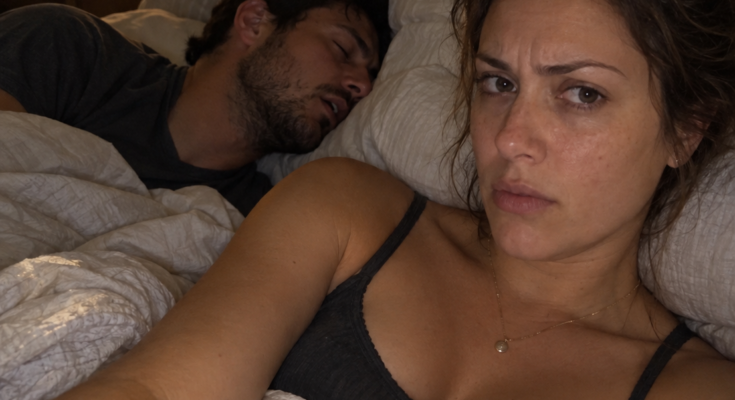
Then last night I woke to his voice. At first, I assumed he was mumbling about work again. I leaned closer, intending to nudge him onto his side, and heard him clearly whisper, “Don’t tell Ellen. She can’t know.” He paused, frowned in his sleep, then repeated it. “Don’t tell Ellen. She can’t know.”
I did not wake him. I lay there until sunrise staring at the ceiling while my imagination built every possible explanation. An affair. Debt. A problem at work. Something illegal. Someone sick. By six in the morning, I had mentally divorced him, forgiven him, buried him, and reported him to the IRS.
When I came downstairs, Liam was standing at the kitchen counter drinking coffee like it was any other Tuesday. I sat across from him and asked, “Are you hiding something from me?” He gave a short laugh that sounded too casual. “No. Why?” I watched him carefully. “I was hoping you’d just be honest. But apparently you already told me your secret in your sleep.”
The color drained from his face.
His coffee mug slipped from his hand and shattered on the tile.
Neither of us moved.
Finally I whispered, “Who is she?”
Liam looked up sharply. “What?”
“Don’t insult me. Who is she?”
“There isn’t—”
“You’ve barely slept in weeks. You hide your phone. You’re disappearing downstairs in the middle of the night, and apparently you’re telling somebody not to tell your wife something. So who is she?”
Liam stared at the broken mug. Then he sat down very slowly.
“There is a girl.”
I felt physically sick.
I stood up.
“Ellen, wait.”
“Don’t.”
“She’s sixteen.”
That stopped me.
I turned around.
“What did you just say?”
Liam covered his face with both hands.
Then he said, “I think she’s my daughter.”
For several seconds, I could hear nothing except the refrigerator humming behind me.
“You think you have a daughter?”
He nodded.
“Since when?”
“Five weeks.”
“You’ve known for five weeks?”
“I’ve known she might exist for five weeks.”
My hands started shaking. “Sit there and explain every single word.”
So he did.
When Liam was twenty-one, long before we met, he dated a woman named Rachel for about eight months. The relationship ended badly. Several weeks afterward, Rachel called and told him she was pregnant. Liam panicked, but he said he wanted to be involved. A month later, Rachel told him she had lost the pregnancy.
He believed her.
They never spoke again.
Until five weeks earlier.
Liam had received an email from a sixteen-year-old girl named Ava Morgan.
The subject line was:
I think you might be my father.
I sat down because my legs stopped feeling reliable.
Ava’s mother was Rachel.
Rachel had died from cancer eight months earlier.
While going through her mother’s belongings, Ava found an envelope containing Liam’s full name, an old photograph, and a letter Rachel had written but never mailed.
The letter said Liam was Ava’s biological father.
“Why would Rachel tell you she lost the baby?” I asked.
Liam shook his head. “I don’t know. Ava says her mother never told her much.”
“Have you done a DNA test?”
“Yes.”
The word hurt almost more than everything before it.
“When?”
“Three weeks ago.”
“And?”
He looked at me.
“Ninety-nine point nine percent.”
I stopped breathing for a moment.
My husband had a daughter.
A real one.
A sixteen-year-old girl somewhere in the world had spent almost her entire life without him.
And he had known for three weeks without telling me.
“You met her?”
Liam nodded.
“How many times?”
“Twice.”
I stood up again.
He reached toward me but stopped himself.
“I wanted to make sure before I changed your life.”
“You already changed my life.”
“I know.”
“No, Liam. You don’t get to decide which truths I’m strong enough to hear.”
“I was scared.”
“So you lied.”
“Yes.”
At least he didn’t argue.
Then something occurred to me.
“Who were you telling not to tell me?”
“My sister.”
“Rebecca knows?”
“She drove with me the first time I met Ava. I couldn’t do it alone.”
That hurt too.
Someone else had been invited into a truth about my husband before I had.
I walked upstairs, locked the bedroom door, and cried until there was nothing graceful left about it.
By noon, I had decided I was going to stay with my friend for a few nights.
Then Liam knocked on the door.
“Ellen?”
I didn’t answer.
“There’s one more thing.”
I closed my eyes.
Of course there was.
“What?”
“Ava doesn’t have anyone.”
I opened the door.
“What does that mean?”
“Her mother died. Her grandparents are both gone. She’s staying with Rachel’s friend temporarily, but that arrangement ends after the school year.”
I stared at him.
Liam’s eyes were red.
“She didn’t contact me because she wanted money.”
“Then why?”
His voice cracked.
“Because she wanted to know if there was anybody left who belonged to her.”
━━━━━━━━━━━━━━━━━━━━
Part Two — The Girl in the Red Sweater
I spent two nights at my friend Hannah’s apartment. I barely slept. My anger kept colliding with another feeling I wasn’t ready to name. Somewhere nearby was a sixteen-year-old girl who had buried her mother and discovered afterward that the man she had been told almost nothing about was alive.
That did not erase Liam’s secrecy.
Both things could be true.
Ava deserved compassion.
And my husband had betrayed my trust by deciding I should be the last person to know.
When I went home, Liam was sitting at the dining table. He looked terrible.
“I’m not leaving you,” I said.
His shoulders dropped.
“Yet.”
They went back up.
“But this does not disappear because the DNA test says you had a good reason to panic.”
“I know.”
“You go to therapy with me.”
“Yes.”
“You stop hiding messages.”
“Yes.”
“And if Ava becomes part of your life, I will not be made into an obstacle you work around.”
“I understand.”
“No. Listen. I am not promising to become her mother. I’m not promising she will live here. I’m not promising I will feel comfortable tomorrow. I’m promising that whatever happens next, we deal with reality together.”
Liam began crying.
That was the first time I had ever seen him cry.
“I thought you’d hate me.”
“I’m pretty angry with you.”
“I know.”
“But having a daughter you didn’t know about isn’t something you did to me.”
I paused.
“Hiding her was.”
He nodded.
Three days later, Liam asked whether I wanted to meet Ava.
I almost said no.
Then I thought about a sixteen-year-old girl sitting somewhere wondering whether her biological father’s wife already hated her.
“Yes.”
We met at a little diner halfway between our house and the apartment where Ava was staying.
I knew immediately which girl she was.
Not because she looked exactly like Liam.
She didn’t.
But she had his nervous habit of rubbing one thumb across the side of his index finger.
She was wearing a red sweater and sitting in a booth with an untouched glass of water.
When she saw us, she stood too quickly and bumped the table.
“Hi.”
Liam looked terrified.
“Hi.”
I nearly laughed because they were somehow both terrible at this.
Liam introduced us.
“Ava, this is Ellen.”
“I know.”
Then Ava immediately looked at me.
“I’m sorry.”
That surprised me.
“For what?”
“For messing up your marriage.”
I sat across from her.
“You didn’t.”
She looked down.
“My mom did something wrong.”
“We don’t know everything your mother was dealing with sixteen years ago.”
“But she lied to him.”
“Yes.”
“And then I showed up.”
“You did.”
Her eyes filled.
I leaned forward.
“Ava, you need to understand something now before anybody accidentally teaches you otherwise. You existing is not a wrongdoing.”
She looked at me.
“You are not an affair. You are not a secret that committed itself. You are a sixteen-year-old girl who learned something enormous after losing her mother.”
Liam looked away.
Ava wiped her eyes.
Then she said, “He should have told you.”
I glanced at Liam.
“Yes.”
“I told him that.”
For the first time in days, I almost smiled.
“I like you.”
Liam sighed.
“Wonderful. You’ve known each other thirty seconds and you’ve formed a coalition.”
Ava laughed.
That sound changed something.
Not everything.
But something.
Over lunch, she told us about herself. She liked photography. Hated chemistry. Played goalkeeper on her school soccer team. Wanted to study environmental science and had recently become obsessed with identifying birds because her mother had bought her a field guide during one of her final hospital stays.
Then she pulled an old photograph from her bag.
Liam at twenty-one.
Hair too long.
Ridiculous leather jacket.
I stared at it.
“Oh, wow.”
Liam groaned.
Ava smiled.
“Mom kept it.”
That sobered everyone.
Ava told us Rachel’s illness progressed quickly. During her final months, Rachel tried several times to tell Ava about her father but could never get through the conversation. After Rachel died, Ava found the letter in a box labeled IMPORTANT PAPERS.
There was something else inside.
A second letter.
Addressed to Liam.
Ava had not given it to him yet.
“Why?”
She looked directly at him.
“Because I wanted to know you before deciding whether you deserved it.”
Liam nodded.
“That’s fair.”
I watched him say it without defensiveness.
Maybe this girl had inherited more than his hands.
For the next two months, Liam saw Ava once or twice a week. Sometimes I went. Sometimes I didn’t.
That was important.
I did not force instant intimacy.
Neither did she.
Meanwhile, we talked with a family-law attorney and a counselor experienced with adolescents dealing with grief and family reunification. Ava’s temporary caregiver, Rachel’s longtime friend Monica, remained involved. Nobody simply packed Ava’s suitcase and declared us a family because biology had appeared on a laboratory report.
Ava needed stability.
Liam needed to learn how to be her father without pretending sixteen missing years could be repaired in sixteen days.
And I needed to figure out where I belonged in all of it.
One evening, three months after we met, Ava came over for dinner.
Afterward, she and Liam sat on the back porch talking.
I was washing dishes when Ava came inside alone.
“Can I ask you something?”
“Sure.”
“Are you mad that he has me?”
The question hurt.
“No.”
“Are you sure?”
I dried my hands.
“I’m mad that he hid you.”
She nodded.
“That’s different.”
“Yes.”
She looked relieved.
Then she asked, “If I end up living here someday, do I have to call you anything?”
I smiled.
“Ellen seems to be working.”
She smiled back.
“Okay.”
Then she went upstairs to use the bathroom.
Liam came into the kitchen a minute later.
“What did she ask you?”
I looked at him.
“You don’t get every conversation.”
He smiled.
That was the first moment the three of us felt almost normal.
Not a normal family.
Our family.
Whatever it was becoming.
━━━━━━━━━━━━━━━━━━━━
Part Three — The Secret We Stopped Protecting
Ava moved into our house eight months after she first contacted Liam.
Not because there was a dramatic custody battle.
Because Monica was relocating for work, Ava wanted to stay at her school, and after months of visits, counseling, legal planning, and increasingly boring conversations about chores and curfews, living with us became the most stable option.
The first night, Ava placed two boxes outside the guest room.
I corrected myself.
Her room.
She stood in the doorway.
“Where should I put Mom?”
She was holding a framed photograph of Rachel.
For half a second, I wondered whether Liam would feel strange seeing his former girlfriend in our house.
Then I thought about what I had told Ava in the diner.
She was not something that needed to be hidden.
“Wherever you want.”
She put the photograph on her desk.
It is still there.
Liam eventually read Rachel’s second letter.
Ava gave it to him on her seventeenth birthday.
Rachel wrote that when she discovered she was pregnant, she became frightened. Her own parents had threatened to cut her off financially if she remained connected to Liam. She was twenty, scared, and dependent on them. She told Liam she had miscarried and moved away.
She regretted it almost immediately.
Then shame grew with time.
The longer she waited, the harder the truth became to tell.
In the letter, she wrote:
I kept telling myself I was protecting Ava from disruption. Eventually I had to admit I was protecting myself from explaining what I had done.
When Liam finished reading it, he sat on the porch for almost an hour.
I joined him.
He handed me the letter.
I read it.
Then I said, “Sound familiar?”
He looked at me.
“Yes.”
Rachel had hidden the truth because each day of silence made the next confession harder.
Five weeks after learning about Ava, Liam had begun doing exactly the same thing.
Different circumstances.
Same trap.
He covered his face.
“I was becoming the person I was angry at.”
“A little.”
“I hate when you’re right.”
“You married poorly.”
He laughed.
That was probably the moment I knew we would be okay.
Not because I had forgotten.
Because he understood.
Trust after secrecy is strange.
It doesn’t return during one grand conversation.
It returns when a phone buzzes and nobody flips it over.
When plans change and someone explains why.
When fear appears and the first instinct becomes speaking instead of hiding.
Liam and I spent almost a year in counseling.
One night our therapist asked him why he hadn’t told me immediately when Ava contacted him.
He gave several explanations.
He wanted DNA confirmation.
He wanted to protect me.
He needed to understand it himself.
Then the therapist asked again.
“Why didn’t you tell Ellen?”
Liam sat quietly.
Finally he said, “Because I was afraid she would look at me differently.”
That was the real answer.
Not protection.
Fear.
I told him, “I do look at you differently.”
His face fell.
“Not worse.”
He looked up.
“Just more accurately.”
Marriage does that eventually, if you’re lucky.
You stop being married to the polished version someone presented at the beginning and start learning whether you can love the complete person underneath.
Sometimes the complete person disappoints you.
Sometimes you disappoint them.
Then you decide what happens next.
Ava graduated from high school the following spring.
She received two scholarships and chose a university three hours away to study environmental science.
At graduation, they allowed each student a limited number of tickets.
Ava gave one to Monica.
One to Liam.
And one to me.
I assumed the third would go to a friend.
“Are you sure?”
She shrugged.
“You made me do calculus flash cards.”
“That is not a reason to honor someone.”
“You also learned how to make Mom’s chicken soup.”
That recipe had taken us four attempts.
The first version tasted like salted wallpaper paste.
Rachel’s recipe card now lives in my kitchen drawer.
Not hidden.
At the graduation ceremony, Ava walked across the stage while Liam cried so openly that the stranger beside him handed him tissues.
I whispered, “Very dignified.”
“Leave me alone.”
Afterward, Ava took photographs with everyone.
With Monica.
With friends.
With Liam.
Then she said, “Ellen, come here.”
I stepped beside her.
She handed her phone to Liam.
He took the picture.
In it, Ava is wearing her graduation gown. I have one arm around her shoulders.
I am not her mother.
That photograph doesn’t pretend I am.
She already has a mother.
Rachel made a terrible choice when she was young. She also raised a funny, thoughtful girl for sixteen years and loved her enough to leave behind the truth she had been too frightened to speak aloud.
Human beings can be more than the worst thing they ever did.
So can marriages.
Ava is twenty now.
She comes home during breaks with bags of laundry she swears are “only temporary,” which is apparently the natural revenge of having a college student.
She calls Liam Dad.
That took more than a year.
She still calls me Ellen.
I like it that way.
Last Christmas, she gave us a framed photograph.
The three of us.
Underneath, she had written:
THE FAMILY NOBODY PLANNED.
Liam laughed.
I cried.
Ava pretended to be disgusted by both of us.
Later that night, Liam and I went to bed.
Sometime around two in the morning, he started talking in his sleep.
I woke immediately.
Old instincts.
I leaned closer.
He mumbled something I couldn’t understand.
Then clearly:
“Don’t forget Ava at the airport.”
I started laughing.
He woke up confused.
“What?”
“Nothing.”
“Why are you laughing?”
“You’re still terrible at keeping secrets.”
He stared at me for several seconds.
Then he understood.
He reached for my hand.
“I’m sorry.”
“I know.”
Three years earlier, hearing my own name in my husband’s sleep made me believe our marriage might be ending.
Instead, it opened a door to a truth none of us expected.
But the lesson wasn’t that secrets always hide something beautiful.
Sometimes they don’t.
The lesson was that fear grows in silence.
Liam believed he needed certainty before he told me.
Rachel believed she needed the perfect moment to tell Liam.
Both learned the same thing:
There is almost never a perfect moment for a difficult truth.
There is only the moment you choose to stop hiding it.
And these days, when Liam talks in his sleep, I usually roll over and let him mumble.
But if I ever hear “Don’t tell Ellen” again?
I’m turning on every light in the house.